10-Year Community Capital
Investment Plan
Building Community Capital for Resilient Landscapes,
Inclusive Livelihoods and Living Heritage


Table of Contents
Living Heritage & Conservation Initiative -EcoHeritage Economy Framework
(LHCI-EEC)
10-Year Strategic Community Capital Development and Investment Framework
(2026–2036)
A Comprehensive Investment Framework for Building Resilient Pastoral Landscapes Through the Integrated Development of Natural, Human, Enterprise, Physical, Social and Heritage Capital
The Parsilet Conservancy–LHCI–EEC Pastoral Landscape Investment Framework
Originating From & Inspired By the Living Experience and Community Transformation Journey of Parsilet Conservancy
Conceptualised, Systematised and Developed Through the Intellectual Architecture of: Innovative Academic Placement Solutions Limited (INAPS) Through the Living Heritage & Conservation Initiative (LHCI) Ecosystem
Developed in Partnership With: Parsilet Conservancy and its Community Members as the pioneering landscape for application, validation and continuous refinement
With Support From LHCI Ecosystem Partners and Strategic Investment Partners
Executive Summary
1.1 Executive Summary
The Living Heritage and Conservation Initiative – EcoHeritage Economy (LHCI-EEC) presents an innovative Community Capital Development and Investment Framework designed to strengthen the long-term resilience, productivity and prosperity of pastoral landscapes through integrated, regenerative and self-sustaining community economies. Rather than treating development as a collection of independent projects, the framework introduces an integrated investment architecture through which communities, governments, development partners, financial institutions, philanthropic organisations, research institutions, responsible private sector actors and other ecosystem partners may align their respective investments around a shared long-term landscape vision while advancing their own institutional priorities.
At the centre of the framework is the conviction that lasting landscape transformation is strengthened when project and programme investments are complemented by long-term Community Capital development. Sustainable prosperity emerges when investments intentionally strengthen the assets, systems and institutions that communities rely upon across generations. The LHCI-EEC framework therefore builds upon the achievements of traditional project and programme approaches by extending the focus from immediate outputs to the continuous development of Community Capital as the primary driver of resilient livelihoods, regenerative enterprise, healthy ecosystems and intergenerational prosperity.
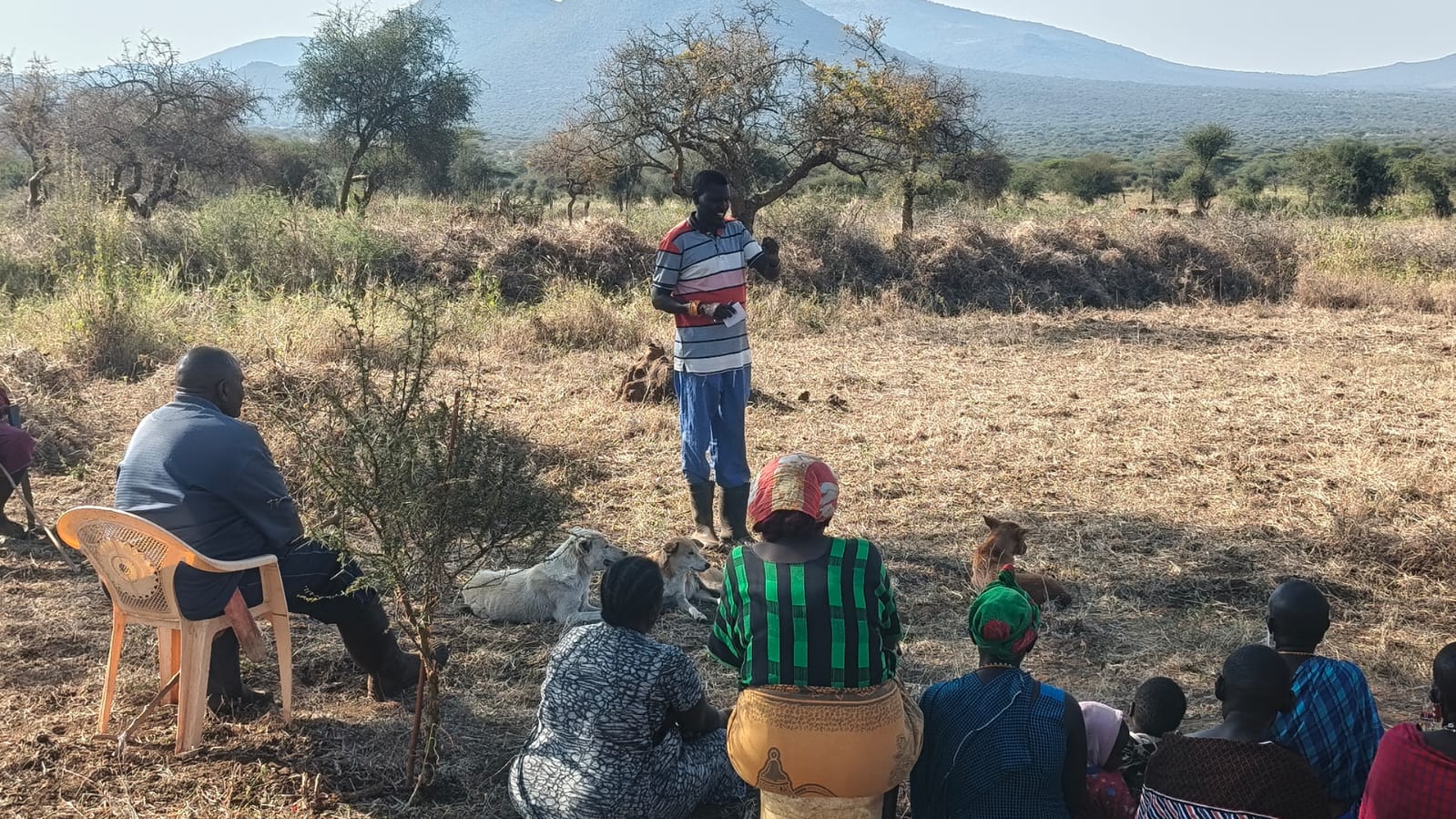
The founding implementation landscape for this approach is Parsilet Conservancy, a community-owned conservancy situated within the globally significant Amboseli–Magadi ecosystem of Kajiado County, Kenya. Covering approximately 15,000 acres and comprising approximately 300 registered community member households, the conservancy is founded upon 67 individually title-deeded land parcels whose owners have voluntarily consolidated their land under a shared conservancy governance framework. This unique arrangement safeguards private land ownership while demonstrating collective stewardship, providing both long-term tenure security for community members and a stable, investment-ready environment for strategic partners. Parsilet Conservancy is governed through established community leadership structures and possesses exceptional ecological, cultural, institutional and economic assets. Extensive rangelands, rich biodiversity, seasonal river systems, Maasai living heritage, indigenous knowledge, strong pastoral traditions and emerging enterprise opportunities collectively position the conservancy as an ideal landscape for demonstrating a new generation of integrated Community Capital investment.
While Parsilet Conservancy possesses enormous potential, it also faces interconnected challenges arising from climate variability, ecosystem degradation, changing markets, demographic transition, evolving governance demands and increasing pressure on natural resources. The LHCI-EEC framework recognises that these realities are increasingly interconnected and therefore benefit from integrated investment approaches that complement existing sector-specific interventions. By strengthening the relationships between ecological, economic, institutional, social and cultural investments, the framework enhances the collective value and long-term sustainability of ongoing and future development efforts.
Accordingly, the framework organises all strategic investments through four interconnected Strategic Investment Platforms (SIPs) that collectively strengthen the six forms of Community Capital—Natural Capital, Human Capital, Enterprise Capital, Physical Capital, Social Capital and Heritage Capital.
The four Strategic Investment Platforms are:
Climate-Smart Livestock, Rangeland Restoration & Pastoral Resilience
Restoring pastoral landscapes, upgrading livestock genetics, and establishing drought warning and response networks.
Wealth Investment Components (WICs)
- WIC 1.1: Climate-Smart Livestock Production & Rangeland Restoration
- WIC 1.2: Water Security, Rangeland Infrastructure & Ecological Restoration
- WIC 1.3: Drought Preparedness, Early Warning & Anticipatory Action
Women, Youth, Community Leadership & Transformational Governance
Cultivating leadership capacity, mentoring youth, empowering women, and strengthening indigenous conservancy governance.
Wealth Investment Components (WICs)
- WIC 2.1: Women's Leadership & Economic Empowerment
- WIC 2.2: Youth Leadership & Enterprise Innovation
- WIC 2.3: Community Governance & Transformational Leadership
Nature-Based Enterprises, Green Value Chains & Regenerative Enterprise Economy
Building honey/pollinator economies, clean energy systems, and community ecotourism networks that recycle capital back to conservation.
Wealth Investment Components (WICs)
- WIC 3.1: Beekeeping & Pollinator Economy
- WIC 3.2: Ecotourism & Cultural Heritage Commerce
- WIC 3.3: Green Value Chains & Renewable Energy Enterprises
EcoHeritage Infrastructure, Smart Community Systems & Living Spaces
Developing climate-resilient water infrastructure, solar energy microgrids, and digital community learning centers.
Wealth Investment Components (WICs)
- WIC 4.1: Solar Energy & EcoHeritage Infrastructure
- WIC 4.2: Digital Hubs & Smart Community Learning Spaces
- WIC 4.3: Water Infrastructure & Green Living Environments
Each Strategic Investment Platform is further organised into Wealth Investment Components (WICs) and Strategic Investment Areas (SIAs), providing a practical investment structure through which diverse ecosystem partners may contribute according to their comparative strengths while ensuring that every investment strengthens Community Capital and contributes towards shared landscape outcomes. This architecture enables partners to retain their individual mandates and priorities while increasing the collective impact of their investments through a shared Community Capital Development and Investment Framework.
Building upon the strengths of existing development investments, the LHCI-EEC framework is intentionally designed to create productive Community Capital that continues generating ecological, social, cultural and economic value long after the initial investment period. Every investment seeks to establish productive assets, strengthen community systems, expand regenerative enterprises, improve institutional capability and stimulate local reinvestment, thereby creating a self-reinforcing cycle of landscape resilience and community wealth.
The framework introduces a structured Community Capital Development Pathway through which existing community assets are progressively strengthened into Community Capital, transformed into productive assets, connected through resilient community systems, converted into an inclusive Enterprise Economy and ultimately translated into resilient livelihoods and long-term landscape transformation. This investment pathway provides a practical roadmap for converting diverse investments into measurable, compounding Community Capital over time.
To support this transformation, the framework also introduces the Community Capital Accounting System (CCAS™)—a proprietary accounting and performance management methodology developed by Innovative Academic Placement Solutions Limited (INAPS) to measure, monitor and report the growth of Community Capital. Complemented by the Parsilet Index (PI) and the Return on Community Capital (ROCC) methodology, CCAS complements existing Monitoring, Evaluation, Accountability and Learning (MEAL) and financial reporting systems by providing additional insight into how investments contribute to the long-term growth of Community Capital and overall landscape resilience.
ROCC Engine v1.0
Calculates and monitors the socio-ecological return velocity of investments.
Capital Radar PI
Baseline socio-ecological scores mapped across six capitals.
MEAL & Finance Ledgers
Interconnected view of qualitative learning targets and capital efficiency ledgers.
Parsilet Conservancy therefore serves as Africa's Living Laboratory for Community Capital Development and Investment, where innovative investment models are collaboratively designed, demonstrated, refined and documented. Lessons generated through the conservancy provide practical evidence capable of informing adaptation, replication and scaling across pastoral, conservation and indigenous landscapes throughout Kenya, Africa and beyond.
The framework is implemented through a collaborative partnership between Parsilet Conservancy, Innovative Academic Placement Solutions (INAPS) as the Framework Architect and Community Capital Systems Developer, LHCI-trained community members and an expanding ecosystem of governments, development partners, financial institutions, universities, research institutions, philanthropic organisations and responsible private sector actors committed to advancing resilient landscape development.
Ultimately, the Living Heritage and Conservation Initiative – EcoHeritage Economy represents an evolution in integrated landscape development. It positions Community Capital as the principal investment outcome, living heritage as a productive development asset, healthy ecosystems as the foundation of resilient local economies and communities as long-term co-investors in their own transformation working alongside governments, development partners, investors, research institutions and the private sector.
The LHCI-EEC Community Capital Development and Investment Framework therefore extends an open invitation to governments, development partners, philanthropic organisations, financial institutions, investors, universities, research institutions, conservation organisations, responsible private sector actors and communities themselves to participate in a shared investment journey that strengthens Community Capital, expands regenerative enterprise, restores ecosystems and creates enduring intergenerational prosperity.
The framework does not replace existing programmes, institutional mandates or investment priorities. Rather, it provides a common Community Capital Development and Investment architecture through which complementary investments can be aligned around a shared landscape vision, enabling every ecosystem partner to enhance the long-term value, sustainability and collective impact of their respective contributions while strengthening Community Capital for present and future generations.
SECTION 2 INTRODUCTION
2.1 Introduction
The Living Heritage and Conservation Initiative – Enkishon EcoHeritage Commons (LHCI-EEC) Community Capital Development and Investment Framework presents an integrated approach for designing, coordinating and sustaining long-term investments in community-led landscape transformation. Rather than viewing development as a collection of independent projects or short-term interventions, the framework positions investment as a deliberate process of strengthening the ecological, human, social, physical, enterprise and heritage assets upon which resilient communities and productive landscapes depend.
Before examining the strategic investment priorities for the Parsilet Conservancy, it is important to understand the philosophy, architecture and operating logic that underpin the LHCI-EEC framework. The effectiveness of every Strategic Investment Platform (SIP), Wealth Investment Component (WIC), Strategic Investment Area (SIA) and individual investment intervention depends upon a common understanding of how Community Capital is created, strengthened, measured and transformed into long-term social, ecological and economic value.
This chapter therefore establishes the conceptual foundation for the entire Community Capital Development and Investment Framework. It explains why LHCI-EEC adopts a Community Capital Investment approach, introduces the underlying investment philosophy, describes the six forms of Community Capital, and presents the integrated investment architecture through which partners collectively contribute to landscape transformation. It further explains how the four Strategic Investment Platforms function as an interconnected investment system, how Community Capital grows through successive investments, and how enterprise development, infrastructure, governance and human capability reinforce one another to generate resilient local economies.
The chapter also introduces the Community Capital Accounting System (CCAS), the Parsilet Index (PI), the LHCI-EEC Theory of Change, and the principles of adaptive learning, monitoring and scaling that guide implementation across the framework. Together, these elements provide the strategic context required to understand how individual investments contribute to a broader, coordinated process of building productive assets, strengthening community systems and creating intergenerational prosperity.
The sections that follow therefore move progressively from the conceptual foundations of Community Capital towards the practical investment architecture that is subsequently applied throughout the remainder of this framework. By establishing a shared understanding of these principles at the outset, governments, development partners, investors, research institutions, community organisations and private sector actors are able to engage with the subsequent Strategic Investment Platforms through a common language, shared investment logic and unified vision for resilient landscape development.
2.2 Why a Community Capital Development and Investment Framework?
Development investments across pastoral and conservation landscapes have generated important achievements over the past several decades. Governments, development partners, conservation organisations, philanthropic foundations, financial institutions and private sector actors have invested substantially in improving livelihoods, conserving biodiversity, strengthening local institutions and expanding economic opportunities. Many of these investments have produced significant benefits for communities and ecosystems.
Despite these contributions, many landscapes continue to experience persistent poverty, environmental degradation, declining biodiversity, increasing climate vulnerability, fragmented local economies, youth unemployment, weakening indigenous knowledge systems and growing pressure on natural resources. These continuing challenges suggest that while considerable resources have been invested, the underlying systems that sustain resilient communities have often not been strengthened at the same pace.
One important reason is that many development interventions have traditionally been designed and implemented as individual projects or sector-specific programmes. While these initiatives frequently achieve their intended outputs, they often operate within limited thematic or institutional boundaries, with different partners pursuing separate objectives, planning cycles, reporting systems and investment priorities. As a result, investments that individually perform well may not collectively generate lasting landscape transformation.
The LHCI-EEC Community Capital Development and Investment Framework responds to this challenge by introducing a different investment logic. Rather than organising development around isolated projects, the framework organises investments around the long-term strengthening of Community Capital.
Within this framework, every investment is viewed as a contribution to a larger system. Livestock development strengthens not only production but also Natural, Human and Enterprise Capital. Leadership development strengthens Human and Social Capital that later enables stronger enterprises and more effective governance. Infrastructure investments create enabling systems upon which enterprises, education, conservation and service delivery depend. Enterprise investments generate income that can be reinvested into communities, creating a continuous cycle of Community Capital growth.
Accordingly, the framework shifts the central question from "What project should be implemented?" to "What forms of Community Capital should be strengthened to achieve long-term landscape transformation?" This seemingly simple shift fundamentally changes how investments are designed, coordinated, implemented and evaluated.
The Community Capital Development and Investment Framework therefore serves several complementary purposes. It provides a common investment architecture through which diverse partners can align their contributions around a shared landscape vision. It enables investments from different sectors to reinforce rather than compete with one another. It strengthens accountability by linking every investment to measurable Community Capital outcomes. Most importantly, it creates a practical pathway through which today's investments become tomorrow's productive assets, resilient institutions, sustainable enterprises and intergenerational prosperity.
In this way, LHCI-EEC is not presented as another development project or standalone programme. It is an integrated Community Capital investment framework that enables governments, communities, development partners, researchers, investors and the private sector to work within a common strategic architecture while advancing their respective institutional mandates. It provides the long-term investment platform through which individual interventions collectively contribute to resilient landscapes, thriving local economies and living heritage that continues to create value for present and future generations.
2.2.1 The Changing Landscape of Community Development
The context within which community development is planned and implemented has changed fundamentally over the past several decades. Across pastoral, rural and conservation landscapes, communities now face multiple and interconnected challenges that extend far beyond the traditional focus of poverty reduction or basic service delivery. Climate change, biodiversity loss, land degradation, rapidly changing markets, demographic transitions, technological disruption, governance complexity and increasing pressure on natural resources have collectively reshaped the development landscape.
At the same time, opportunities available to rural communities have expanded considerably. Advances in digital technology, renewable energy, nature-based enterprises, climate finance, ecosystem restoration, sustainable tourism, value addition, regenerative agriculture and impact investment have created new pathways through which communities can generate prosperity while conserving the ecological and cultural systems upon which their long-term well-being depends. Increasingly, development is no longer measured solely by the delivery of infrastructure or services, but by the capacity of communities to continuously create, manage and grow the assets that sustain resilient livelihoods over generations.
These changes require a corresponding evolution in development thinking. Communities are no longer viewed simply as beneficiaries of externally designed projects, but as investors, innovators, entrepreneurs, custodians and long-term stewards of their own development. Likewise, governments, development partners, philanthropies, research institutions and the private sector are increasingly recognising that sustainable outcomes are achieved not through isolated interventions, but through integrated investment approaches that strengthen the interconnected ecological, economic, social, institutional and cultural systems within a landscape.
For pastoral landscapes such as Parsilet Conservancy, this shift is particularly significant. The landscape simultaneously supports livestock production, biodiversity conservation, living cultural heritage, ecosystem services and emerging enterprise opportunities. Decisions affecting one part of the system inevitably influence the others. Improving livestock productivity, for example, depends upon healthy rangelands, functioning water systems, effective governance, skilled producers, market access and the preservation of indigenous knowledge. Similarly, enterprise development relies upon infrastructure, financial systems, institutional capacity, environmental sustainability and community cohesion working together.
The Parsilet Landscape Web
Communities as stewards: explore how ecological, economic, social, institutional, and cultural systems reinforce one another across the conservancy.
Parsilet Conservancy Landscape
The central hub where livestock production, biodiversity conservation, cultural heritage, and enterprise opportunities are stewarded as an integrated system.
These realities demonstrate that contemporary community development can no longer be approached through fragmented sectoral interventions alone. Instead, it requires investment frameworks capable of aligning communities, governments, development partners, research institutions, investors and the private sector around a shared long-term vision while strengthening the different forms of Community Capital that collectively determine long-term resilience and prosperity.
It is within this evolving development context that the Living Heritage and Conservation Initiative – EcoHeritage Economy (LHCI-EEC) establishes the Enkishon EcoHeritage Commons (EEC) as its integrated Community Capital Development and Investment Framework. Enkishon, a Maa word meaning well-being, prosperity, peace and harmonious living, reflects the aspiration for communities, nature and local economies to flourish together through shared stewardship and responsible investment. The term Commons refers to the shared natural, social, cultural, institutional, economic and knowledge assets upon which communities collectively depend and through which they create long-term prosperity. Accordingly, the Enkishon EcoHeritage Commons (EEC) represents the shared community investment platform through which these common assets are collectively strengthened, managed and expanded for the benefit of present and future generations.
Rather than responding to individual development challenges in isolation, the framework provides a coherent investment architecture through which communities and partners collaboratively invest in Community Capital, build productive assets, strengthen community systems, grow regenerative enterprises, conserve living heritage and restore ecosystems. In doing so, it creates resilient landscapes where thriving ecosystems, inclusive local economies and empowered communities continuously reinforce one another over time.
2.2.2 Why Traditional Projects Alone Are Not Enough
For many decades, governments, development partners, philanthropic organisations, conservation agencies, research institutions, the private sector and communities themselves have invested significant financial, technical and human resources to improve livelihoods, conserve biodiversity, strengthen local institutions and expand economic opportunities across rural landscapes. These investments have generated substantial achievements, including improved infrastructure, better access to education and healthcare, strengthened conservation efforts, enhanced agricultural productivity, increased community participation and the development of important local capacities.
Many communities, including Parsilet Conservancy, continue to benefit from these valuable contributions. Individual projects have often delivered meaningful results within their respective sectors and have laid important foundations for subsequent development initiatives. The LHCI-EEC Community Capital Development and Investment Framework recognises, values and builds upon these achievements rather than replacing them.
However, as development challenges become increasingly interconnected, it has become evident that isolated interventions alone cannot fully address the complex dynamics that shape resilient landscapes. Climate resilience cannot be achieved through water investments alone. Livelihood improvement cannot depend solely on enterprise support. Conservation outcomes require effective governance, capable institutions, healthy ecosystems, functioning markets, appropriate infrastructure, skilled people and strong cultural stewardship to work together. Likewise, investments in one sector often depend upon complementary investments in several others before their full potential can be realised.
Resilient Landscapes Require Interconnected Solutions
Isolated interventions cannot overcome complex development dynamics. True resilience relies on multi-sector synchronization.
Climate Resilience
Water investments alone are insufficient without broader ecosystem and governance support.
Livelihood Improvement
Enterprise support alone fails without market access, infrastructure, and skilled labor.
Resilient Conservation & Landscape Outcomes
Effective outcomes require all seven critical enablers to operate collaboratively
Effective Governance
Policy alignment and transparent resource managementCapable Institutions
Strong administrative and community leadershipHealthy Ecosystems
Biodiversity preservation and natural watershed stabilityFunctioning Markets
Fair value chains and economic incentivesAppropriate Infrastructure
Sustainable transport, energy, and water networksSkilled People
Capacity building and technical knowledgeCultural Stewardship
Community heritage and traditional ecological valuesLandscape Resilience Simulator
Test how isolated sector funding compares to synchronized investments.
Many traditional development interventions are necessarily designed around specific mandates, sectors, funding cycles or institutional priorities. While this specialisation has enabled organisations to deliver significant results within their areas of expertise, it can also limit opportunities to deliberately connect complementary investments across an entire landscape. Consequently, valuable investments sometimes operate alongside one another without fully capturing the additional benefits that could be achieved through greater integration, long-term coordination and shared investment planning.
The challenge, therefore, is not the quality or commitment of individual projects, institutions or partners. Rather, it is the absence of an overarching investment framework that deliberately connects diverse investments into a coherent system capable of strengthening Community Capital over time. Without such a framework, opportunities to create productive assets, reinforce community systems, stimulate enterprise growth, conserve living heritage and build long-term landscape resilience may remain only partially realised.
The Living Heritage and Conservation Initiative – EcoHeritage Economy (LHCI-EEC) responds to this need by providing an integrated Community Capital Development and Investment Framework through which governments, communities, development partners, philanthropic organisations, research institutions, financial institutions and the private sector can align their respective investments around a shared long-term landscape vision. Rather than replacing existing programmes or institutional mandates, the framework enhances their collective effectiveness by creating opportunities for complementary investments to reinforce one another, generate greater value and contribute to sustained landscape transformation.
2.2.3 From Projects to Long-Term Investment
Traditional development projects are typically designed to deliver defined activities, outputs and outcomes within a specified implementation period. They often address immediate priorities, respond to identified needs and produce valuable results within available resources and institutional mandates. Such projects remain essential instruments for delivering development interventions and will continue to play an important role in supporting communities and landscapes.
However, long-term landscape transformation requires a perspective that extends beyond the completion of individual projects. It requires investments that deliberately strengthen the underlying assets, capacities, institutions and systems upon which communities depend, ensuring that value continues to accumulate long after individual projects have concluded.
Within the LHCI-EEC Community Capital Development and Investment Framework, investment is understood as the intentional creation, strengthening and stewardship of Community Capital. Every investment is expected to leave behind productive assets, stronger community systems, enhanced local capabilities and expanded opportunities that continue generating ecological, social, cultural and economic value for present and future generations.
This shift represents an important evolution in development thinking. Rather than measuring success primarily by the activities completed or outputs delivered during a project period, the framework emphasises the lasting value that investments create within the landscape. Training is viewed not simply as an event, but as an investment in Human Capital. Water infrastructure becomes an investment in Physical Capital that improves livelihoods, strengthens resilience and supports enterprise development. Conservation initiatives become investments in Natural and Heritage Capital that sustain biodiversity while creating long-term economic opportunities. Enterprise support becomes an investment that strengthens Enterprise Capital and generates recurring local wealth.
Consequently, every intervention supported through the LHCI-EEC framework is designed to contribute to a broader Community Capital portfolio rather than functioning as an isolated project. Individual investments remain aligned with the objectives and mandates of their respective implementing partners, while simultaneously contributing to a shared landscape vision and reinforcing complementary investments across multiple sectors.
The LHCI-EEC Investment Lens
From Activities to Enduring AssetsHuman Capital
Building lasting skills, technical knowledge, and local capabilities.
Physical Capital
Permanent assets that strengthen resilience and support enterprise.
Natural & Heritage Capital
Sustaining biodiversity while creating long-term economic opportunity.
Enterprise Capital
Strengthening local commercial capacity to generate recurring wealth.
In this way, projects become building blocks within a much larger investment journey. Each investment contributes to the gradual accumulation of Community Capital, the strengthening of productive community systems and the creation of resilient local economies capable of sustaining continuous development beyond external funding cycles. By viewing development through an investment lens, LHCI-EEC seeks to transform short-term interventions into long-term community assets that generate enduring returns for people, nature and future generations.
2.2.4 Why Community Capital?
Every community possesses valuable assets that extend far beyond financial resources. Healthy ecosystems, knowledgeable people, vibrant cultural traditions, trusted institutions, productive enterprises, physical infrastructure and strong social relationships all represent forms of wealth that enable communities to thrive. Collectively, these assets constitute Community Capital—the foundation upon which resilient livelihoods, inclusive local economies and sustainable landscape development are built.
Traditional development approaches often focus on addressing immediate needs or expanding individual sectors without explicitly recognising how these different forms of community wealth interact and reinforce one another. As a result, opportunities to deliberately strengthen the entire community system may be overlooked. A new school may improve education, but without livelihood opportunities young people may migrate elsewhere. A water project may improve access to water, but without effective governance and maintenance systems its long-term benefits may decline. Likewise, enterprise development may increase incomes, but without healthy ecosystems or strong institutions those gains may not be sustained.
The LHCI-EEC Community Capital Development and Investment Framework recognises that lasting transformation occurs when investments deliberately strengthen the assets that communities already possess while creating new forms of capital that continue generating value over time. Rather than viewing natural resources, people, enterprises, infrastructure, institutions and cultural heritage as separate development sectors, the framework treats them as interconnected forms of Community Capital that collectively determine the resilience, productivity and prosperity of the landscape.
This perspective fundamentally changes how investments are designed. Every intervention is expected to contribute to one or more forms of Community Capital while simultaneously creating positive spill-over effects across the others. Investments in Human Capital improve leadership, knowledge and skills that support stronger enterprises and institutions. Investments in Natural Capital enhance ecosystem health, which strengthens livelihoods, enterprise opportunities and climate resilience. Investments in Heritage Capital preserve indigenous knowledge and cultural identity while creating opportunities for tourism, education and local enterprise. Each form of capital reinforces the others, creating a cycle of continuous growth rather than isolated development gains.
By adopting Community Capital as its organising principle, LHCI-EEC shifts the focus from solving individual problems to strengthening the entire community system. Success is therefore measured not only by the number of activities implemented or projects completed, but by the extent to which investments increase the capacity of communities to continuously create, manage and expand their own wealth across generations.
Community Capital also provides a common language through which governments, communities, development partners, investors, research institutions and the private sector can align their investments. Although each partner may pursue different institutional objectives, all contribute to strengthening one or more forms of Community Capital within a shared landscape vision. This creates opportunities for complementary investments to reinforce one another, producing outcomes that are greater than the sum of individual interventions.
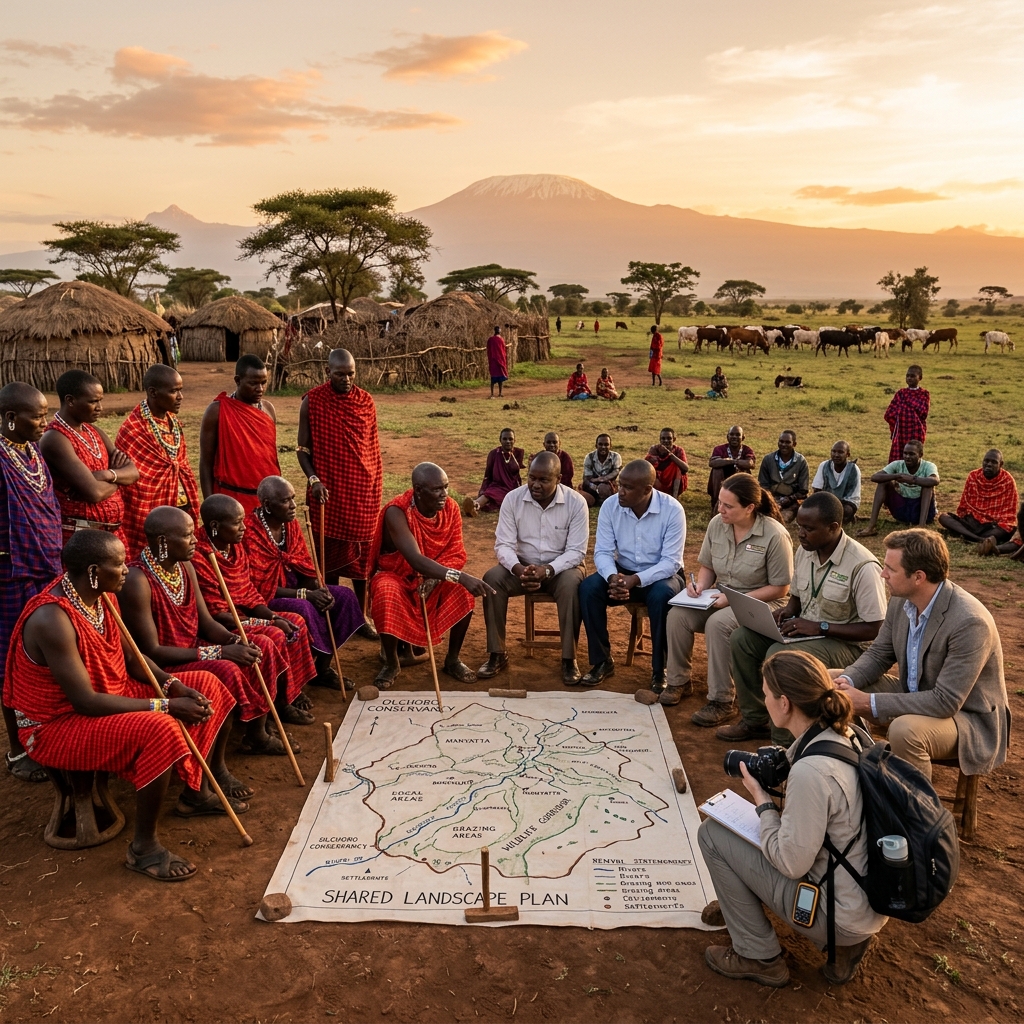
For LHCI-EEC, therefore, Community Capital is not simply a theoretical concept. It is the organising framework through which investments are prioritised, partnerships are aligned around a shared landscape vision, progress is measured and long-term landscape transformation is achieved. It provides the enduring foundation upon which resilient communities, thriving ecosystems, regenerative enterprises and living heritage can continue creating prosperity for present and future generations.
2.2.5 Why LHCI-EEC is Different
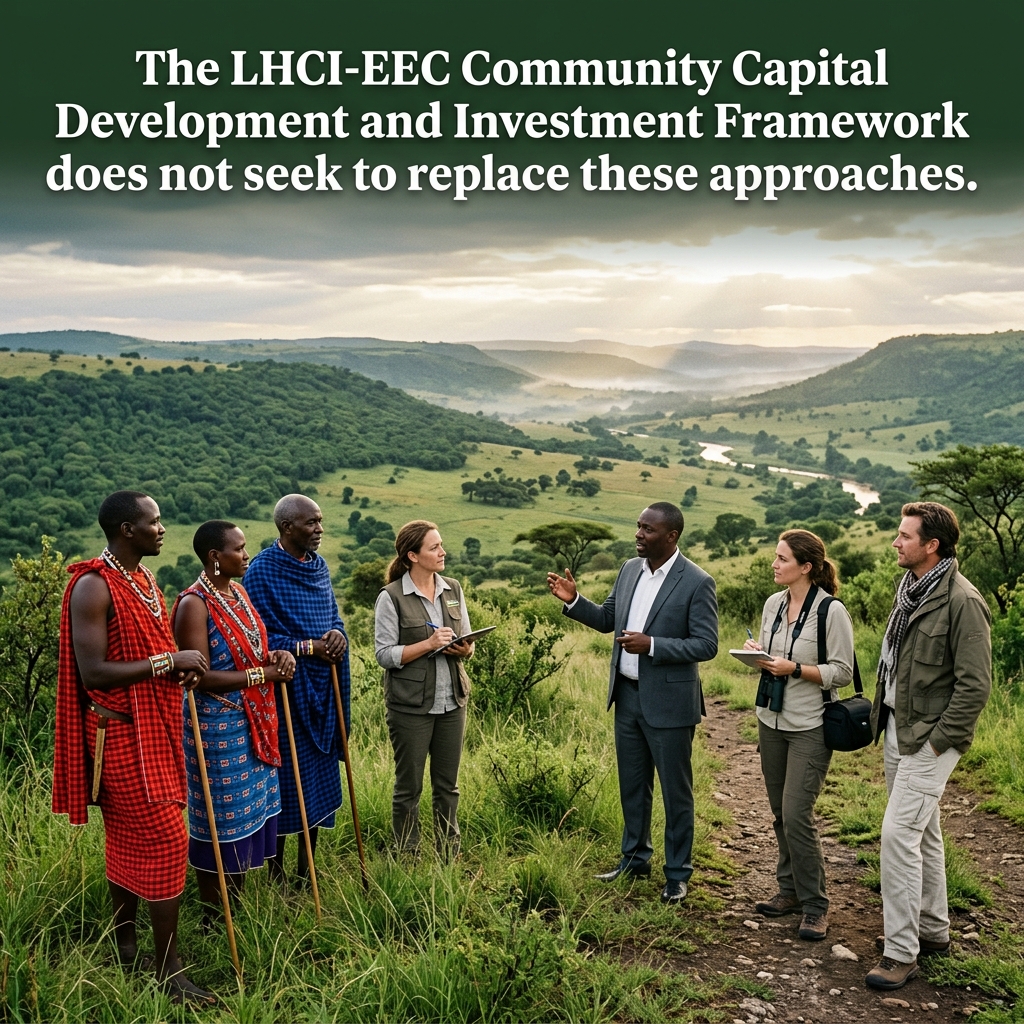
Communities, governments, development partners, philanthropic organisations, research institutions and private sector actors have developed numerous frameworks for advancing conservation, livelihoods, enterprise development and community resilience. Many of these have generated valuable results and continue to make important contributions within their respective areas of focus. The LHCI-EEC Community Capital Development and Investment Framework does not seek to replace these approaches. Rather, it provides an investment architecture through which their respective strengths can be brought together within a common long-term landscape vision.
The distinguishing feature of LHCI-EEC lies in its deliberate integration of Community Capital, productive assets, enterprise development, living heritage, ecosystem stewardship and institutional strengthening into a single investment framework. Instead of treating these as separate development themes, the framework recognises them as mutually reinforcing components of one interconnected community system. Every investment is therefore designed not only to achieve its immediate objectives but also to strengthen the broader Community Capital upon which future development depends.
Unlike conventional sector-based approaches, LHCI-EEC does not organise investments around isolated development programmes. Instead, investments are structured through interconnected Strategic Investment Platforms (SIPs), Wealth Investment Components (WICs) and Strategic Investment Areas (SIAs), enabling partners to invest according to their comparative strengths while contributing to shared landscape outcomes. This architecture allows specialised investments to reinforce one another rather than operating independently.
The framework also introduces a deliberate progression from Human Capital development to enterprise creation, infrastructure development, institutional strengthening and long-term wealth generation. Leadership development, skills enhancement, governance and community stewardship are therefore treated not as independent social interventions but as foundational investments that enable resilient enterprises, productive landscapes and inclusive local economies to emerge and thrive. Similarly, investments in infrastructure are designed as enabling systems that support enterprise growth, service delivery and community resilience rather than existing as isolated construction projects.
A further distinguishing characteristic of LHCI-EEC is its recognition of Living Heritage as a productive form of Community Capital. Indigenous knowledge systems, cultural landscapes, traditional institutions and community identity are not viewed merely as heritage to be preserved, but as strategic assets that contribute to conservation, innovation, education, enterprise development and long-term resilience. By integrating scientific knowledge with indigenous wisdom, the framework creates opportunities for culturally grounded and locally owned development pathways.
The framework further distinguishes itself by positioning the Enterprise Economy as a principal engine of Community Capital growth. Rather than supporting isolated business ventures, LHCI-EEC develops interconnected enterprise ecosystems that transform local biological resources, cultural assets, knowledge systems and natural capital into regenerative value chains capable of creating employment, expanding local wealth and sustaining conservation outcomes. Enterprise development therefore becomes both an economic objective and a mechanism for strengthening Community Capital across the landscape.
Equally important is the framework's commitment to measuring development through Community Capital growth rather than solely through project activities or financial expenditure. The introduction of the Community Capital Accounting System (CCAS), the Parsilet Index (PI) and Community Capital Returns provides a practical mechanism for assessing how investments strengthen communities over time. This enables governments, communities and investment partners to evaluate success not only by what has been delivered, but by the lasting assets, systems and capacities that remain.
Finally, LHCI-EEC is designed as a learning and investment platform rather than a single landscape programme. Parsilet Conservancy serves as the founding demonstration landscape where the framework is continuously applied, tested, refined and documented. Lessons generated through implementation are intended to inform adaptation, replication and scaling across other pastoral, conservation and community landscapes while remaining responsive to local priorities and institutional contexts.
For these reasons, LHCI-EEC represents more than a development framework. It is an integrated Community Capital Development and Investment Framework that enables diverse partners to align their investments, strengthen shared community assets and collectively contribute to resilient landscapes where people, nature, enterprises and living heritage continuously generate prosperity across generations.
2.3 The LHCI-EEC Community Capital Philosophy
The Living Heritage and Conservation Initiative – EcoHeritage Economy (LHCI-EEC) is founded on the belief that lasting community prosperity is created by investing in the assets, capacities, institutions and relationships that enable communities to continuously generate value for themselves over time. Rather than viewing development as the delivery of short-term projects or isolated interventions, the framework understands development as a long-term process of strengthening Community Capital through deliberate, strategic and mutually reinforcing investments.
Building Enduring Community Wealth
Development is not the delivery of isolated projects—it is the strategic accumulation of Community Capital over time.
Build on Community Assets
Recognize and expand indigenous knowledge, traditional governance, and local biodiversity rather than replacing existing community systems.
Active Co-Investors
Communities invest leadership, labor, and long-term ownership alongside partner financial and technical resources.
The Multiplier Effect
Every single investment is deliberately designed to reinforce multiple forms of Community Capital across the landscape.
Long-Term Stewardship
Success is measured by self-sustaining community resilience and asset accumulation, not short-term project completion.
This philosophy recognises that resilient communities are not built solely through financial resources or external assistance. They emerge when healthy ecosystems, capable people, productive enterprises, appropriate infrastructure, trusted institutions and living cultural heritage are continuously strengthened and connected in ways that reinforce one another. Community wealth therefore grows not simply through income generation, but through the accumulation and stewardship of diverse forms of Community Capital that together support resilient livelihoods, inclusive local economies and sustainable landscape transformation.
The LHCI-EEC Community Capital Philosophy also recognises that communities already possess valuable assets. Indigenous knowledge, traditional governance systems, biodiversity, cultural landscapes, local enterprises, social networks and community institutions represent forms of capital that have been developed and sustained across generations. Development therefore begins not by replacing existing community assets, but by recognising, strengthening, connecting and expanding them through carefully designed investments.
Within this philosophy, every investment is expected to create value beyond its immediate purpose. A training programme strengthens Human Capital while improving enterprise performance and institutional leadership. A water system strengthens Physical Capital while supporting livelihoods, conservation and local enterprise. A restored rangeland strengthens Natural Capital while improving livestock productivity, biodiversity and climate resilience. Each investment therefore contributes simultaneously to multiple forms of Community Capital, creating cumulative benefits that extend across the entire landscape.
The philosophy further embraces the principle that communities are not passive recipients of development but active investors in their own future. Governments, development partners, philanthropic organisations, financial institutions, research institutions and the private sector contribute important financial, technical and institutional resources, while communities contribute leadership, indigenous knowledge, labour, cultural stewardship, local institutions and long-term ownership. Landscape transformation is therefore understood as a shared investment journey in which every stakeholder contributes according to their comparative strengths.
Ultimately, the LHCI-EEC Community Capital Philosophy shifts attention from delivering projects to building enduring community wealth. Success is measured by the extent to which investments expand Community Capital, strengthen productive community systems, create resilient enterprises and enable communities to continuously improve their own well-being while conserving the natural and cultural assets upon which future generations depend.
2.4 The Community Capital Model
2.4.1 Understanding Community Capital
Community Capital refers to the collective assets, capacities, systems, relationships and resources that enable communities to sustain livelihoods, generate wealth, strengthen resilience and continuously improve their quality of life across generations. It recognises that long-term development is built not upon a single resource or sector, but upon a balanced portfolio of interconnected forms of capital that together support resilient people, thriving ecosystems and inclusive local economies.
Understanding Community Capital
A balanced portfolio of interconnected assets that enables communities to sustain livelihoods, generate wealth, and build resilience across generations.
Beyond Financial Metrics
Progress is measured by how investments strengthen the community's capital base and capacity to generate lasting ecological, social, cultural, and economic value.
Recognising Existing Strengths
Every community already possesses wealth—healthy ecosystems, indigenous knowledge, institutions, and heritage. Development begins by growing and integrating these assets.
The Framework Foundation
Serves as the philosophical and operational compass for designing investments, structuring partnerships, and driving landscape transformation across Parsilet.
Within the Living Heritage and Conservation Initiative – EcoHeritage Economy (LHCI-EEC), Community Capital provides the organising model through which development opportunities are identified, investments are prioritised and long-term landscape transformation is achieved. Rather than measuring progress solely through financial expenditure or project outputs, the framework focuses on how investments strengthen the community's overall capital base and increase its capacity to generate lasting ecological, social, cultural and economic value.
This perspective recognises that every community already possesses valuable forms of capital. Healthy ecosystems, indigenous knowledge, capable people, community institutions, productive enterprises, cultural heritage and physical infrastructure all represent assets that contribute to community well-being. Sustainable development therefore begins by recognising these existing strengths and strategically investing in their growth, integration and long-term stewardship.
A defining characteristic of the Community Capital Model is its emphasis on interconnectedness. Individual forms of capital do not function independently; they reinforce one another. Investments in people improve enterprise performance. Strong enterprises generate resources that support infrastructure development. Healthy ecosystems sustain productive livelihoods. Living heritage strengthens identity, stewardship and community cohesion. Together, these interactions create positive feedback loops that progressively strengthen the entire community system.
Accordingly, LHCI-EEC views Community Capital as a dynamic and continuously expanding asset base rather than a static inventory of resources. Every well-designed investment is expected to strengthen one or more forms of Community Capital while simultaneously creating benefits across the wider landscape. This integrated investment logic transforms isolated interventions into cumulative processes of community wealth creation, resilience building and regenerative landscape development.
The Community Capital Model therefore provides both the philosophical and operational foundation of the LHCI-EEC Community Capital Development and Investment Framework. It guides how investments are designed, how partnerships are structured, how progress is measured and how long-term landscape transformation is pursued across the Parsilet demonstration landscape and future landscapes adopting the framework.
2.4.2 The Six Forms of Community Capital
The LHCI-EEC Community Capital Development and Investment Framework recognises that resilient communities are built through the balanced growth of six interconnected forms of Community Capital. Together, these capitals represent the assets, capabilities, institutions and systems upon which long-term ecological sustainability, economic prosperity, social well-being and cultural continuity depend.
Rather than functioning independently, the six capitals continuously interact and reinforce one another. Investments that strengthen one form of capital frequently generate positive outcomes across several others, creating multiplier effects that accelerate community resilience and landscape transformation. The objective of the framework is therefore not to maximise a single form of capital, but to cultivate a balanced and continuously expanding Community Capital portfolio that enables communities to thrive across generations.
The six forms of Community Capital recognised within the LHCI-EEC framework are described below.
2.4.2.1 Natural Capital
Natural Capital comprises the ecosystems, biodiversity, landscapes, soils, water resources, vegetation, wildlife, pollinators and other natural assets that sustain life and support productive livelihoods. These resources provide the ecological foundation upon which pastoral production, food systems, conservation, tourism, climate resilience and nature-based enterprises depend.
Natural Capital
The living ecological foundation that sustains biodiversity, climate resilience, and long-term productive livelihoods.
Ecosystems & Biodiversity
Intact landscapes, native vegetation, and wildlife corridors that maintain balance.
Water & Soils
Watersheds, seasonal water pans, and fertile soils that support pastoral productivity.
Pollinators & Flora
Essential insect, bird, and plant networks that sustain natural regeneration.
Cultural Landscapes
Natural sites that embody both environmental stability and living heritage.
Within LHCI-EEC, Natural Capital is not viewed simply as an environmental resource to be protected, but as a productive asset that must be responsibly restored, managed and continuously strengthened to generate long-term ecological and economic value.
2.4.2.2 Human Capital
Human Capital represents the knowledge, skills, health, leadership, creativity, innovation, entrepreneurship and capabilities of people that enable them to improve their own well-being while contributing to community development. It includes formal and informal education, indigenous knowledge, technical competencies, professional expertise, leadership capacity and lifelong learning.
Human Capital
The knowledge, skills, health, creativity, and leadership of people that empower them to improve well-being and drive community development.
Education & Knowledge
Formal and informal education, lifelong learning, and professional expertise.
Indigenous Knowledge
Traditional ecological understanding and time-tested community practices.
Technical Competencies
Practical skills, entrepreneurship, creativity, and innovation capabilities.
Leadership & Health
Personal well-being and the leadership capacity needed to guide governance.
The framework recognises people as the principal drivers of transformation. Investments in Human Capital therefore strengthen the capacity of individuals and communities to innovate, solve problems, create enterprises, steward natural resources and sustain development over time.
2.4.2.3 Enterprise Capital
Enterprise Capital refers to the productive businesses, value chains, cooperatives, commercial innovations, investment opportunities, financial systems and market relationships that generate income, employment and local economic growth. It transforms community knowledge, natural resources and productive assets into sustainable economic value through responsible enterprise development.
Enterprise Capital
The productive commercial mechanisms, cooperatives, and market linkages that transform local assets into sustainable economic growth.
Productive Businesses
Local enterprises, cooperatives, and commercial innovations operating across the landscape.
Value Chains & Markets
Equitable value chains and established commercial relationships with reliable buyers.
Financial Systems
Accessible investment opportunities, financing mechanisms, and community capital funds.
Economic Dynamism
Recurring income generation, local job creation, and sustainable economic growth.
Within LHCI-EEC, Enterprise Capital is built through regenerative enterprises that simultaneously generate financial returns, strengthen livelihoods, conserve biodiversity and celebrate living heritage.
2.4.2.4 Physical Capital
Physical Capital comprises the infrastructure, facilities, equipment, technologies, utilities and productive physical assets that enable communities and enterprises to function effectively. This includes roads, water systems, renewable energy, processing facilities, digital infrastructure, community buildings, smart living spaces and other shared productive assets.
Physical Capital
The shared productive infrastructure, technologies, and utilities that enable communities and enterprises to operate effectively across the landscape.
Access Infrastructure
Roads, transport networks, and reliable water systems that underpin daily community function.
Energy & Digital Tech
Renewable energy generation, utilities, and digital infrastructure enabling modern communication.
Processing Facilities
Productive facilities, equipment, and technologies that support local commercial processing.
Community & Living Spaces
Community buildings, smart living spaces, and shared facilities that foster local operations.
Rather than constructing infrastructure as isolated projects, LHCI-EEC invests in Physical Capital as enabling systems that improve productivity, expand market access, strengthen service delivery and support long-term community resilience.
2.4.2.5 Social Capital
Social Capital represents the relationships, trust, cooperation, governance systems, institutions, networks and partnerships that enable communities to work collectively towards shared goals. Strong Social Capital improves collaboration, reduces conflict, strengthens accountability and increases the effectiveness of collective action.
Social Capital
The relationships, trust, governance systems, and partnerships that empower communities to work collectively toward shared landscape goals.
Relationships & Trust
The underlying interpersonal trust and social bonds that foster community unity and cohesion.
Governance & Institutions
Formal and informal institutions that guide resource management and transparent decision-making.
Networks & Partnerships
Strategic linkages connecting local communities to markets, allies, and external resources.
Cooperation Systems
Mechanisms that enable communities to organize, cooperate, and execute collective action.
Within the LHCI-EEC framework, Social Capital enables diverse stakeholders—including communities, conservancies, governments, academia, development partners and the private sector—to align their investments around a common landscape vision.
2.4.2.6 Heritage Capital
Heritage Capital comprises the living cultural heritage, indigenous knowledge systems, traditional institutions, languages, values, cultural landscapes, artistic expressions and historical identity that give communities their unique character and strengthen intergenerational continuity.
Heritage Capital
The living cultural heritage, indigenous knowledge, and artistic expressions that define community identity and serve as productive development assets.
Heritage & Identity
Living cultural traditions, historical identity, values, and indigenous languages.
Indigenous Knowledge
Time-tested ecological understanding and traditional community governance systems.
Cultural Landscapes
Landscapes and historic sites that carry deep intergenerational significance.
Artistic Expression
Artistic traditions, creative expressions, and cultural storytelling passed across generations.
Unlike many development approaches that treat culture primarily as something to preserve, LHCI-EEC recognises Heritage Capital as a productive development asset. Living heritage generates social identity, strengthens stewardship of natural resources, supports education, inspires innovation and creates opportunities for eco-cultural tourism, creative industries and heritage-based enterprises.
Collectively, these six forms of Community Capital provide the foundation upon which the LHCI-EEC Community Capital Development and Investment Framework is built. Every Strategic Investment Platform (SIP), Wealth Investment Component (WIC) and Strategic Investment Area (SIA) ultimately contributes to strengthening one or more of these capitals while reinforcing the others. It is this continuous interaction among the six capitals that enables communities to build resilient livelihoods, productive enterprises, healthy ecosystems and regenerative local economies capable of creating prosperity for present and future generations.
2.5 The LHCI-EEC Investment Architecture
The Living Heritage and Conservation Initiative – EcoHeritage Economy (LHCI-EEC) Community Capital Development and Investment Framework provides a structured architecture through which diverse investments are organised, implemented and measured. Rather than operating as a collection of independent projects, the framework establishes a common investment structure that enables governments, communities, development partners, philanthropic organisations, research institutions, financial institutions and the private sector to invest within a shared landscape development framework while advancing their respective institutional priorities.
The architecture translates a long-term landscape vision into an organised investment system that progressively converts financial, technical, institutional and community investments into strengthened Community Capital, productive assets, resilient community systems and measurable landscape transformation. Every investment, regardless of its size or source, enters the framework through the same structured pathway, ensuring strategic alignment, complementarity and cumulative impact.
The architecture also recognises that landscape transformation cannot be achieved through isolated interventions. Investments in youth leadership, livestock systems, enterprise development, infrastructure, governance or living heritage are deliberately designed to reinforce one another rather than compete for resources. This integrated structure enables different partners to invest where they possess comparative strengths while collectively contributing to a shared development vision.
Accordingly, the LHCI-EEC Investment Architecture organises every investment through a logical hierarchy that connects strategic vision with practical implementation and measurable results.
2.5.1 The Community Capital Investment Hierarchy
The operational structure of the LHCI-EEC Community Capital Development and Investment Framework follows a hierarchical investment pathway through which strategic investments are progressively translated into landscape transformation.
The Hierarchical Investment Pathway
How investments are progressively translated from strategic partnership inputs into long-term landscape transformation.
Investment Partner
The collaborating actors (community, government, developers, private sector) contributing comparative resources and assets.
Strategic Investment Platform (SIP)
Broad landscape-scale programmatic platforms that coordinate multi-stakeholder actions and resources.
Wealth Investment Component (WIC)
Targeted thematic investment components designed to address specific landscape needs and enablers.
Strategic Investment Area (SIA)
Spatially or programmatically scoped development areas focusing resources for high-impact outputs.
Investment Activities
Direct intervention programs, project works, and development activities executed on the ground.
Outputs
Immediate, quantifiable deliverables and tangible assets generated from the investment activities.
Outcomes
Short-to-medium-term improvements in community capacities, system efficiency, and resource access.
Community Capital Strengthened
Measurable net expansion and enrichment of the six forms of community capital stocks across generations.
Landscape Transformation
The ultimate goal: self-sustaining ecosystem health, resilient local economies, and community prosperity.
Each level within the hierarchy performs a distinct but complementary function.
Investment Partners—including community members, conservancies, governments, development partners, philanthropic organisations, research institutions, financial institutions and private sector actors among others — may contribute according to their respective comparative strengths. Communities may contribute indigenous knowledge, leadership, local institutions, labour, stewardship, cultural heritage, productive assets and long-term ownership. Other partners may contribute financial resources, technical expertise, innovation, policy support, research, market access and institutional capacity. Every ecosystem partner is therefore recognised as a potential investor in Community Capital, contributing in different but complementary ways towards long-term landscape transformation and sustainability. Together, these complementary investments strengthen Community Capital and collectively advance the shared vision of resilient landscape transformation.
Framework Logic & Core Flow
Strategic Investment Platforms organize investments around the principal systems that drive resilient landscape development.
Within each Strategic Investment Platform, Wealth Investment Components group related investment portfolios that collectively strengthen specific dimensions of Community Capital.
Each Wealth Investment Component is further organised into Strategic Investment Areas that define the major thematic investment priorities requiring long-term investment.
Strategic Investment Areas are implemented through carefully designed investment activities that generate measurable outputs, produce longer-term outcomes and ultimately strengthen one or more forms of Community Capital.
As Community Capital expands across the landscape, productive assets, resilient community systems, thriving enterprises, healthy ecosystems and inclusive local economies reinforce one another, progressively contributing to long-term landscape transformation.
This investment hierarchy provides a consistent structure through which all investments can be planned, implemented, monitored and evaluated while maintaining strategic coherence across the entire LHCI-EEC Community Capital Development and Investment Framework.
2.6 How the Strategic Investment Platforms Work Together
The Living Heritage and Conservation Initiative – EcoHeritage Economy (LHCI-EEC) Community Capital Development and Investment Framework is implemented through four interconnected Strategic Investment Platforms (SIPs). Rather than functioning as independent programmes, these platforms constitute an integrated investment system through which diverse partners invest in complementary areas of community development while contributing to a shared long-term vision for landscape transformation.
The four Strategic Investment Platforms were intentionally designed to reflect the interdependent nature of resilient community landscapes. Healthy ecosystems require capable people to steward them. Productive enterprises depend on both healthy ecosystems and skilled entrepreneurs. Community infrastructure enables enterprises, improves service delivery and strengthens quality of life. Together, these investments reinforce one another, generating cumulative improvements in Community Capital that no single intervention could achieve in isolation.
This integrated architecture enables governments, development partners, private sector actors, research institutions, philanthropic organisations and communities themselves to invest according to their respective priorities while contributing to a common Community Capital Development and Investment Framework. Each partner may support one or several Strategic Investment Platforms, yet every investment ultimately contributes to strengthening one or more forms of Community Capital and advancing the overall resilience of the landscape.
Importantly, the Strategic Investment Platforms do not compete for resources or operate sequentially. They function simultaneously as mutually reinforcing investment pathways. Progress within one platform strengthens the effectiveness and returns of investments made in the others. This systems-based approach transforms what would otherwise be separate projects into an integrated landscape investment portfolio capable of generating lasting ecological, social, cultural and economic value.
The following sections introduce the four Strategic Investment Platforms and explain how they function together to build Community Capital and support long-term landscape transformation.
2.6.1 The Four Strategic Investment Platforms
The LHCI-EEC Community Capital Development and Investment Framework is structured around four interconnected Strategic Investment Platforms (SIPs). Each SIP represents a major investment pathway designed to strengthen specific dimensions of Community Capital while contributing to the collective transformation of the landscape.
The four Strategic Investment Platforms are intentionally designed to address the interconnected systems required for resilient communities, sustainable economies and healthy ecosystems.
Table 2.1: The Four Strategic Investment Platforms
| Strategic Investment Platform (SIP) | Strategic Focus | Primary Community Capital Strengthened |
|---|---|---|
| SIP 1: Climate-Smart Livestock, Rangeland Restoration and Pastoral Resilience | Strengthening pastoral production systems, restoring rangelands, improving livestock productivity, enhancing climate resilience and safeguarding the natural systems that sustain community prosperity. | Natural Capital (with co-benefits to Human and Enterprise Capital) |
| SIP 2: Women, Youth, Community Leadership and Transformational Governance | Executive community leadership, women's empowerment, youth business incubation, financial literacy, cooperative governance, and transformational mindset development. | Human and Social Capital (with co-benefits to Enterprise Capital) |
| SIP 3: Nature-Based Enterprises, Green Value Chains and Regenerative Enterprise Economy | Developing inclusive enterprise ecosystems that transform community assets, biodiversity resources, indigenous knowledge and local production systems into sustainable economic opportunities. | Enterprise Capital (with co-benefits to Natural, Human and Heritage Capital) |
| SIP 4: EcoHeritage Infrastructure, Smart Community Systems and Living Spaces | Developing resilient community infrastructure, smart community systems, EcoHeritage facilities and living spaces that enable enterprise growth, community wellbeing and landscape transformation. | Physical Capital (with co-benefits to Heritage, Enterprise and Social Capital) |
Together, these four Strategic Investment Platforms constitute the integrated investment system through which the LHCI-EEC Community Capital Development and Investment Framework is implemented. Each platform has a distinct investment purpose, yet none is intended to operate in isolation. Instead, every platform contributes to strengthening Community Capital while simultaneously reinforcing the effectiveness and long-term sustainability of the others.
Rangeland Productivity & Livestock Systems
SIP 1 safeguards and enhances the natural resource base upon which pastoral livelihoods, biodiversity conservation and nature-based enterprises depend. Through investments in livestock systems, rangeland restoration and climate resilience, it strengthens the Natural Capital that supports the entire landscape economy.
Institutional Capacity & Transformation Governance
SIP 2 invests in the leadership, knowledge, skills and governance capacities required to transform opportunities into sustainable development outcomes. By strengthening women, empowering youth, building community leadership and promoting transformational governance, it develops the Human and Social Capital that enables communities to lead, manage and sustain long-term landscape transformation.
Nature-Based Enterprises & Regenerative Economy
SIP 3 converts Community Capital into inclusive economic opportunity. It develops regenerative enterprises, green value chains and local businesses that create employment, generate household incomes, add value to community resources and stimulate long-term Enterprise Capital growth.
EcoHeritage Infrastructure & Enabling Systems
SIP 4 provides the enabling infrastructure and community systems that allow people, enterprises and institutions to function effectively. Investments in EcoHeritage infrastructure, smart community systems and living spaces strengthen the Physical Capital required for productive livelihoods, quality service delivery, enterprise development and resilient communities.
The strength of the LHCI-EEC framework lies not in the individual Strategic Investment Platforms, but in the way they function together as one integrated Community Capital investment system.
For example, investments in SIP 2 prepare women, youth and community leaders with the knowledge, leadership and governance capacities required to establish and manage enterprises developed through SIP 3.
Likewise, enterprises developed under SIP 3 depend on the healthy ecosystems strengthened through SIP 1 and the infrastructure, smart community systems and living spaces developed through SIP 4.
At the same time, successful enterprises generate income that enables households and community institutions to reinvest in education, governance, conservation, infrastructure and enterprise expansion, thereby strengthening Community Capital across the entire landscape.
Rather than operating as four separate programmes, the Strategic Investment Platforms function as four mutually reinforcing investment pathways. Together, they create an integrated Community Capital Development and Investment Framework capable of delivering resilient livelihoods, healthy ecosystems, inclusive local economies and living heritage conservation over the long term.
2.7 How Community Capital Grows
Community Capital does not accumulate automatically. It grows through a deliberate cycle of investment, productive use, value creation, reinvestment and continuous stewardship. Every investment made through the LHCI-EEC Community Capital Development and Investment Framework is therefore designed not simply to deliver activities or short-term outputs, but to create assets and systems that continue generating value long after the initial investment has been made.
Unlike conventional development approaches, where investments often end with the completion of a project, the LHCI-EEC framework views every investment as the beginning of a long-term capital growth process. Financial resources are intentionally transformed into productive community assets, strengthened institutions, resilient enterprises and improved livelihood systems that continuously expand the stock of Community Capital available to present and future generations.
This investment philosophy recognises that resilient landscapes are created when capital continuously reproduces itself. Restored rangelands improve livestock productivity. Strong leadership improves governance. Better governance attracts additional investment. Enterprises generate household incomes. Household incomes stimulate savings and reinvestment. Reinvestment creates new productive assets, which in turn generate additional ecological, social and economic value. Through this continuous cycle, Community Capital grows progressively rather than remaining static.
The framework therefore measures success not only by what has been invested, but by the capacity of each investment to generate further investment opportunities, strengthen community systems and create long-term wealth for the landscape.
2.7.1 The Community Capital Growth Cycle
The LHCI-EEC Community Capital Development and Investment Framework applies a continuous investment cycle through which every intervention contributes to expanding Community Capital over time.
The Community Capital Growth Cycle
A continuous feedback loop showing how targeted investments compound to create self-sustaining intergenerational prosperity.
Investment
Strategic financial, technical, and institutional resources injected into the landscape by collaborating partners.
Creation of Productive Assets
Translation of resources into physical infrastructures, rangeland restoration, and enhanced community capacities.
Enterprise Development & Improved Livelihoods
Launch of regenerative local enterprises and value chains that boost commercial capacity and capacity bases.
Income Generation
Sustainable financial yields, enterprise profits, and employment returns entering local households.
Savings & Community Wealth Creation
Accumulation of reserve funds, localized investments, and shared community trust assets.
Reinvestment into Community Capital
Self-directed redirection of savings back into education, governance, natural conservation, and enterprise scaling.
Strengthened Landscape Resilience
Ecosystem restoration, buffered socio-ecological systems, and collective ability to withstand external climate shocks.
Intergenerational Prosperity
Continuous wealth preservation, cultural legacy stewardship, and thriving future generations.
Rather than representing a linear process, this cycle is continuous. Each successful investment generates new resources, knowledge, partnerships and productive capacity that become inputs for subsequent investments. In this way, Community Capital compounds over time, creating increasingly resilient ecological systems, stronger institutions, more competitive enterprises and more prosperous households.
Community Capital Compounding Core
Select any node in the cycle to explore how resources compound and reinforce one another.
1. Partner Investment
Strategic resources (financial capital, technical support, community labour, and cultural heritage stewardship) injected into the conservancy systems to activate new assets.
2.7.2 Reinvestment as the Engine of Sustainable Development
The long-term sustainability of the LHCI-EEC framework depends upon the ability of communities, enterprises and institutions to continuously reinvest part of the value they create.
For example, income generated through nature-based enterprises may be reinvested in expanding production, restoring degraded landscapes, strengthening community cooperatives, improving infrastructure, supporting youth entrepreneurship or conserving Living Heritage. Similarly, strengthened institutions can mobilise additional investment partners, while improved natural resources create new enterprise opportunities that further expand local economies.
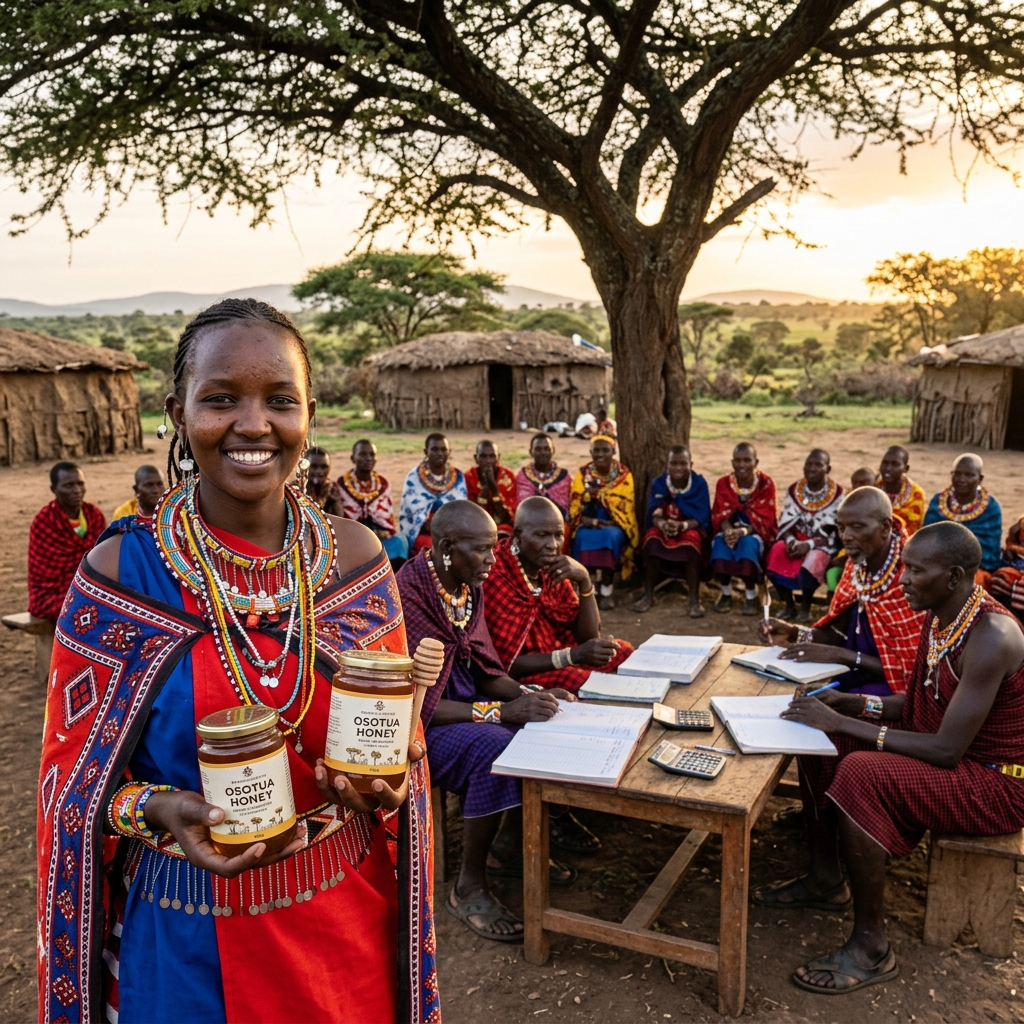
This continuous reinvestment transforms individual development interventions into self-reinforcing Community Capital growth systems that become progressively less dependent on external project financing.
2.7.3 Community Capital as an Intergenerational Investment
The ultimate objective of the LHCI-EEC framework is not simply to increase present-day incomes but to expand the stock of Community Capital inherited by future generations.
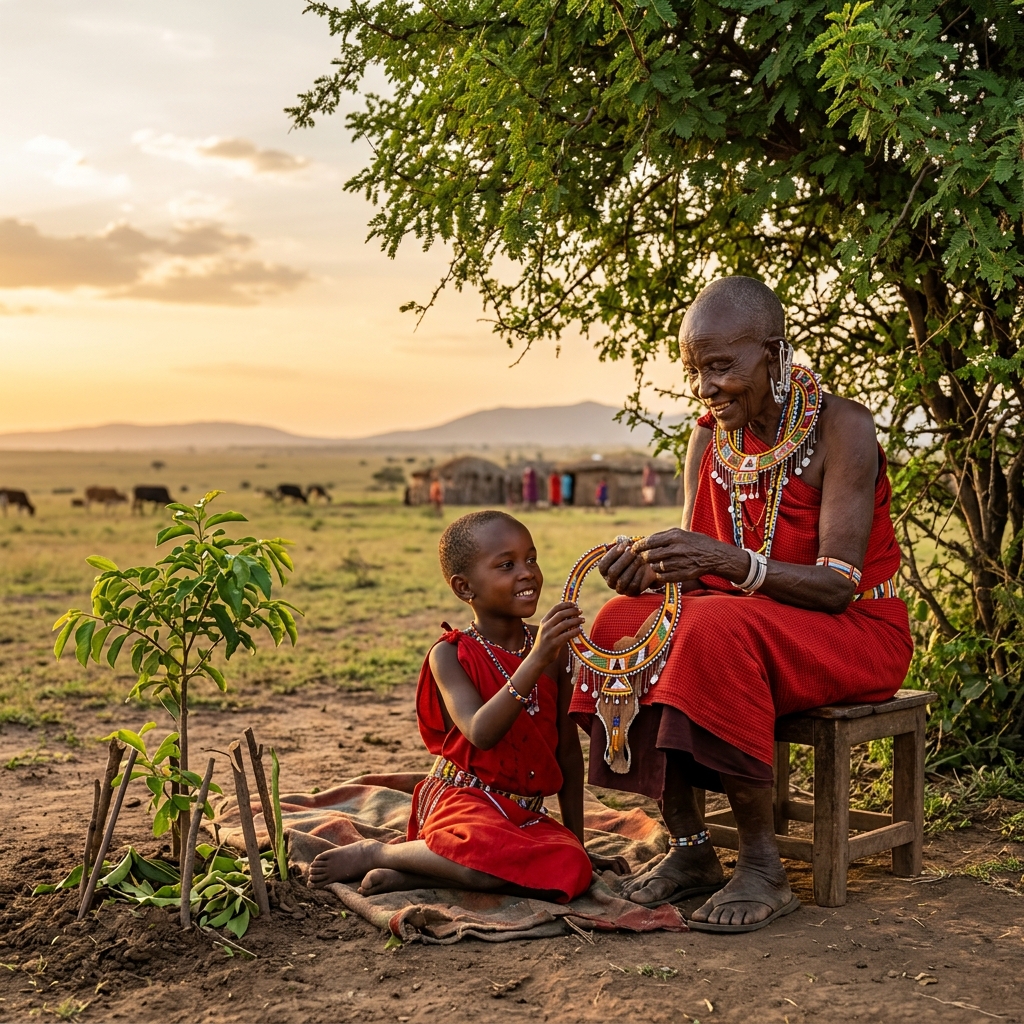
Healthy ecosystems, strong institutions, resilient enterprises, productive infrastructure, skilled people, vibrant cultural heritage and cohesive communities represent enduring assets that continue generating value over decades. By investing simultaneously in these interconnected forms of capital, the framework creates a foundation upon which future generations can continue building resilient livelihoods, thriving local economies and sustainable landscapes.
In this sense, Community Capital represents not only the outcome of today's investments but also the inheritance that today's communities intentionally create for tomorrow's generations.
2.8 The LHCI-EEC Enterprise Economy
One of the defining characteristics of the LHCI-EEC Community Capital Development and Investment Framework is its recognition that long-term community resilience cannot be achieved through conservation, infrastructure or human capacity development alone. While these investments create the enabling conditions for development, communities ultimately require productive economic systems capable of continuously generating income, employment, investment and wealth.
The LHCI-EEC Enterprise Economy therefore represents the productive engine of the Community Capital Framework. It provides the practical pathway through which Community Capital is transformed into sustainable economic value while simultaneously strengthening ecological integrity, living heritage and inclusive local development.
Unlike conventional rural development models that often promote isolated enterprises or single value chains, the LHCI-EEC Enterprise Economy adopts an integrated enterprise ecosystem approach. It recognizes that enterprises do not operate independently. Successful enterprises depend upon healthy ecosystems, capable people, appropriate infrastructure, strong institutions, functioning markets and vibrant cultural identity. Likewise, successful enterprises continuously reinvest in these same assets, creating a regenerative cycle of Community Capital growth.
The Enterprise Economy is therefore designed as an interconnected portfolio of nature-based, heritage-based, knowledge-based and service-based enterprises that collectively strengthen household resilience while contributing to broader landscape transformation. Every enterprise is expected not only to generate financial returns but also to create ecological, social and cultural value.
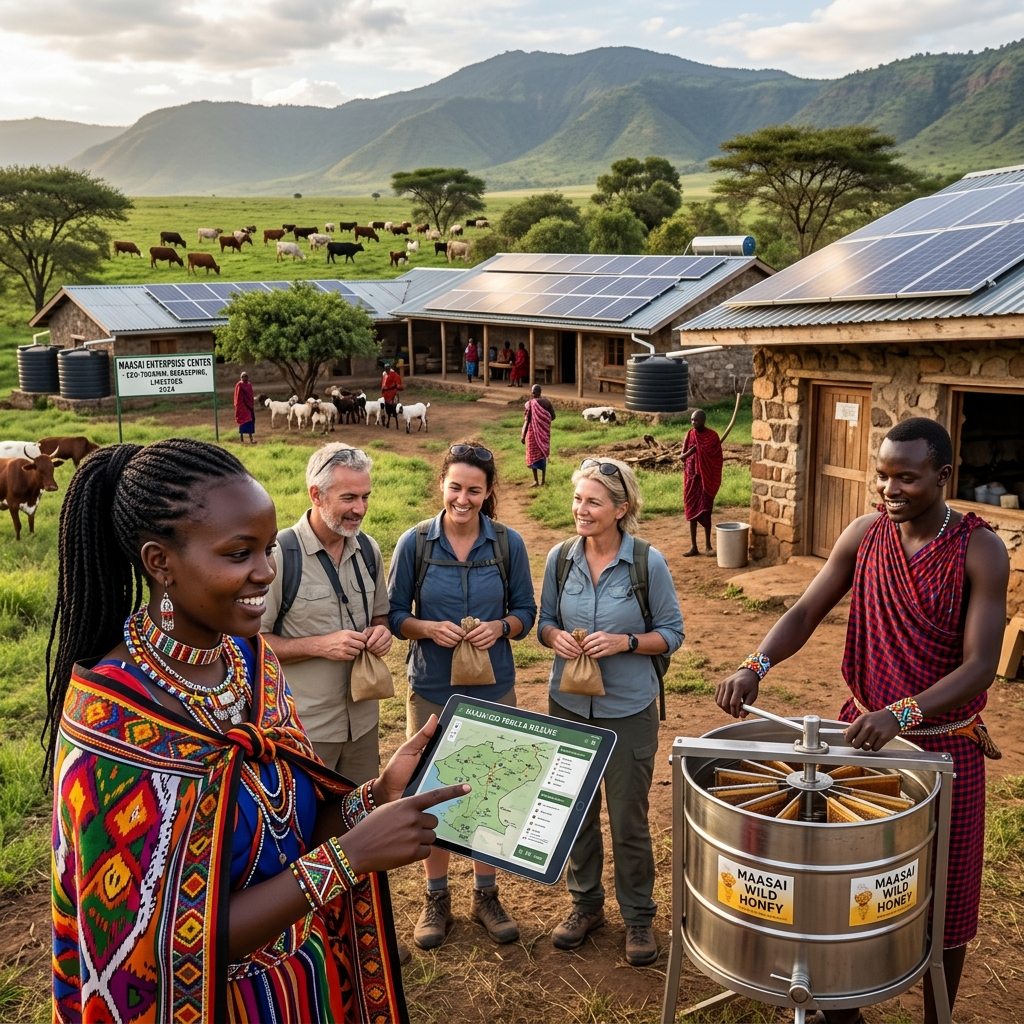
Rather than viewing conservation and economic development as competing objectives, the Enterprise Economy demonstrates that biodiversity conservation, regenerative pastoralism, indigenous knowledge, community innovation and commercial enterprise can reinforce one another. Healthy landscapes support productive enterprises, while successful enterprises generate the resources required to conserve landscapes and strengthen community wellbeing.
Within the LHCI-EEC framework, the Enterprise Economy serves four complementary purposes. It creates dignified employment and entrepreneurship opportunities, diversifies household income sources, expands local investment and wealth creation, and generates the financial resources required to continuously reinvest in Community Capital.
Accordingly, the Enterprise Economy becomes the practical mechanism through which investments made under the four Strategic Investment Platforms begin generating measurable and self-sustaining economic returns. Leadership developed through SIP 2 strengthens enterprise management. Climate-resilient production systems established through SIP 1 supply raw materials for enterprise development. Infrastructure and smart community systems developed through SIP 4 enable enterprise productivity, market access and innovation. In turn, successful enterprises generate the financial returns that sustain and expand investments across the entire Community Capital system.
The detailed enterprise ecosystems, value chains and investment opportunities that comprise the LHCI-EEC Enterprise Economy are presented under Strategic Investment Platform 3: Nature-Based Enterprises, Green Value Chains and Regenerative Enterprise Economy, where each enterprise ecosystem is developed as a strategic investment portfolio within the broader Community Capital Development and Investment Framework.
2.9 The LHCI-EEC Theory of Change
Traditional development theories of change are typically linear, predicting that if specific activities are implemented, specific outputs will occur, eventually leading to a desired outcome. While this logic is useful for short-term project management, it is often insufficient for achieving long-term, landscape-scale transformation because it rarely explains how development outcomes become self-sustaining beyond the lifespan of external interventions.
The Living Heritage and Conservation Initiative – EcoHeritage Economy (LHCI-EEC) adopts a systemic, regenerative and investment-driven Theory of Change. It illustrates how catalytic investments—whether financial, technical, institutional or indigenous—are systematically converted into productive assets, strengthened community systems and expanded Community Capital that continuously generates ecological, social, cultural and economic value over a 10-year implementation horizon and beyond.
Rather than viewing development as a sequence of isolated projects, the LHCI-EEC Theory of Change views landscape transformation as a continuously compounding investment system in which each successful investment strengthens the capacity of the landscape to generate the next.
This Theory of Change is founded on the core premise that resilient landscapes are built when Community Capital continuously reproduces, strengthens and reinvests itself. It maps the investment pathway through which strategic partnerships, community stewardship and productive investments progressively transform local assets into long-term intergenerational prosperity.
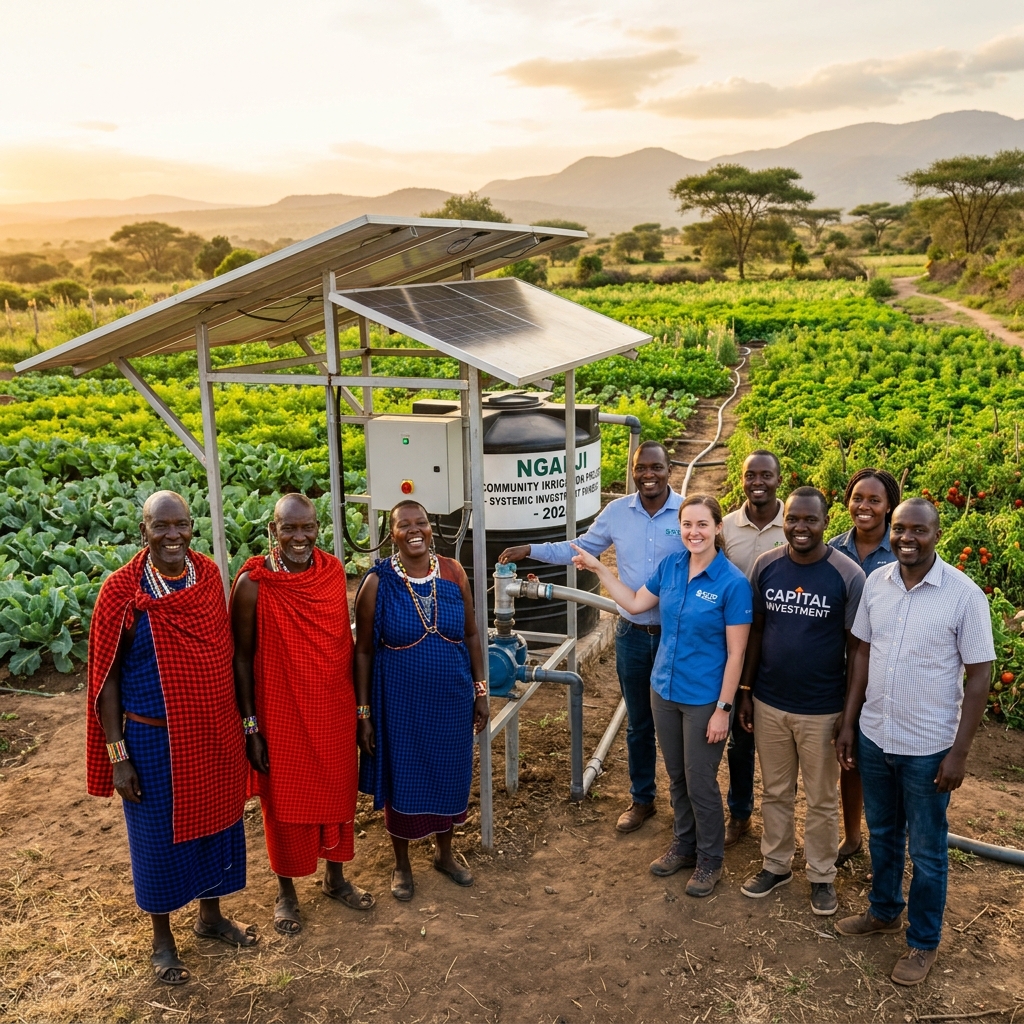
2.9.1 The Logic of Landscape Transformation
The Logic of Landscape Transformation
The systemic pathway through which aligned partner resources scale into compounding regional prosperity.
Aligned Resources
Strategic partners, governments, private sector, and community members align resources, technical expertise, indigenous knowledge, and stewardship around a shared landscape vision...
Integrated Channels
These investments are channeled through integrated Strategic Investment Platforms (SIPs) rather than isolated, short-term projects...
Systemic Outputs
The investments collectively create productive assets, strengthen community stewardship, and expand local human capabilities.
Capital Expansion
Measurable growth across the six forms of Community Capital: Natural, Human, Enterprise, Physical, Social, and Heritage Capital.
Landscape Drivers
Stimulating resilient livelihoods, regenerative enterprises, healthy ecosystems, stronger institutions, and inclusive local economies.
Compounding Legacy
A self-reinforcing landscape where Community Capital continuously generates new investment opportunities, improved wellbeing, and intergenerational prosperity.
2.9.2 The Integrated Investment Pathway
To achieve this transformation, the LHCI-EEC Theory of Change organises the development process into a structured, compounding investment pathway. Every investment enters the system as catalytic capital and progressively generates enduring landscape value.
1. Catalytic Investments
Transformation begins with the mobilisation of complementary investments from ecosystem partners. These may include public investment, private investment, development finance, philanthropy, climate finance, research and innovation, technical expertise, indigenous knowledge, community stewardship, land, labour and local enterprise.
2. Strategic Investment Platforms
These investments are strategically allocated through four interconnected Strategic Investment Platforms that organise implementation around the principal drivers of resilient landscape development.
SIP 1: Climate-Smart Livestock, Rangeland Restoration and Pastoral Resilience
SIP 2: Women, Youth, Community Leadership and Transformational Governance
SIP 3: Nature-Based Enterprises, Green Value Chains and the Regenerative Enterprise Economy
SIP 4: EcoHeritage Infrastructure, Smart Community Systems and Living Spaces
3. Productive Assets and Community Systems
The Strategic Investment Platforms convert investments into productive assets, strengthened institutions and improved community capabilities. Training develops skilled leaders and entrepreneurs. Infrastructure creates productive living environments. Ecological restoration strengthens natural systems. Enterprise investments create functioning value chains and local businesses.
4. Growth of Community Capital
Growth of Community Capital
As productive assets and community systems mature, they collectively expand these six interconnected dimensions of local wealth.
Natural Capital
Grows through healthier ecosystems, restored rangelands, improved biodiversity, and secure water resources.
Human Capital
Expands through leadership development, technical capabilities, entrepreneurship, and local innovation.
Enterprise Capital
Increases through resilient nature-based businesses, diversified green value chains, and local investment pools.
Physical Capital
Grows through productive community infrastructure, smart water/energy systems, and resilient living spaces.
Heritage Capital
Expands through the protection, revitalisation, and productive application of indigenous knowledge and living heritage.
5. Landscape Transformation
As Community Capital strengthens, the landscape becomes increasingly resilient, productive and self-sustaining. Households improve their livelihoods, enterprises expand, ecosystems recover, institutions become stronger and communities progressively reduce long-term dependence on external development assistance.
2.9.3 The Reinvestment Feedback Loop: The Engine of Compounding Community Capital
“The defining characteristic of the LHCI-EEC Theory of Change is that it does not end with outcomes. It continues through reinvestment.
”
As enterprises grow, livelihoods improve and institutions become stronger, part of the value created is deliberately reinvested into strengthening Community Capital.
Revenue generated through nature-based enterprises, eco-cultural tourism, regenerative agriculture, sustainable livestock systems or community-owned businesses is reinvested to restore ecosystems, improve infrastructure, strengthen governance, expand enterprise development and invest in future generations.
“This continuous reinvestment transforms Community Capital from an outcome into a renewable development asset.
”
Over time, the landscape progressively transitions from relying primarily on catalytic development finance to attracting commercial investment, generating internal revenue and sustaining its own long-term transformation.
“In this way, the Enkishon EcoHeritage Commons evolves into a self-reinforcing Community Capital ecosystem where each investment strengthens the capacity of the landscape to generate greater ecological health, stronger institutions, more resilient enterprises and increasing community prosperity for present and future generations.
”
2.10 Community Capital Measurement, Learning and Adaptive Management
For decades, governments, development partners, financial institutions, philanthropic organizations, research institutions, and communities themselves have made profound investments across pastoral and rural landscapes. To ensure accountability, these investments have been guided by robust Monitoring and Evaluation (M&E) systems that effectively track operational success—measuring the number of people trained, hectares of degraded land rehabilitated, kilometers of water infrastructure constructed, and enterprises established.
“These traditional M&E frameworks remain essential for tracking project implementation and operational delivery. As development practice has evolved from delivering projects to achieving long-term systems transformation, governments, development partners, investors and communities increasingly seek to understand not only whether activities were successfully implemented, but also whether those activities are permanently strengthening the assets upon which resilient communities depend.
”
The LHCI-EEC framework recognizes that delivering project outputs is the critical first step, but establishing long-term capital is the ultimate goal. To support our diverse stakeholders in demonstrating the true depth of their collective impact, the framework introduces a complementary measurement architecture designed to track the compounding growth of landscape assets.
2.10.1 The Community Capital Accounting System (CCAS)
To bridge the measurement gap between successful project implementation and long-term Community Capital growth, the LHCI-EEC framework utilizes the Community Capital Accounting System (CCAS).
CCAS is a proprietary accounting and performance management methodology developed by Innovative Academic Placement Solutions (INAPS) to quantify, monitor, and report changes across the six forms of Community Capital.
Designed to complement traditional financial accounting and M&E, CCAS treats the landscape much like a corporate balance sheet. Every contribution to the landscape—whether financial investment, technical expertise, policy support, indigenous knowledge, community stewardship, land, labour or enterprise—is recorded according to the form of Community Capital it strengthens. This allows all stakeholders to track the net growth of their shared investments over time.
The system maintains six primary ledgers:
Community Capital Ledger Accounts
Systemic accounts designed to track long-term valuation, ecological health, and institutional capacity bases.
Natural Capital Account
Tracking ecosystem health, biodiversity, and ecological resilience.
Human Capital Account
Tracking capability, executive leadership, and technical skills.
Enterprise Capital Account
Tracking economic productivity and wealth generation.
Physical Capital Account
Tracking productive infrastructure and enabling systems.
Heritage Capital Account
Tracking living heritage, indigenous knowledge, and cultural continuity.
Collectively, these six Community Capital Accounts function as the landscape's integrated balance sheet, providing a comprehensive picture of whether total Community Capital is appreciating or depreciating over time.
CCAS™ Intellectual Property Platform
The complete CCAS methodology—including specific capital variables, valuation algorithms, ledgers, audit tools, and digital applications—is maintained separately as an intellectual property platform within the proprietary CCAS™ Manual and digital platforms licensed through INAPS.
2.10.2 The Parsilet Index (PI)
If CCAS is the underlying accounting engine, the Parsilet Index (PI) is the operational dashboard.
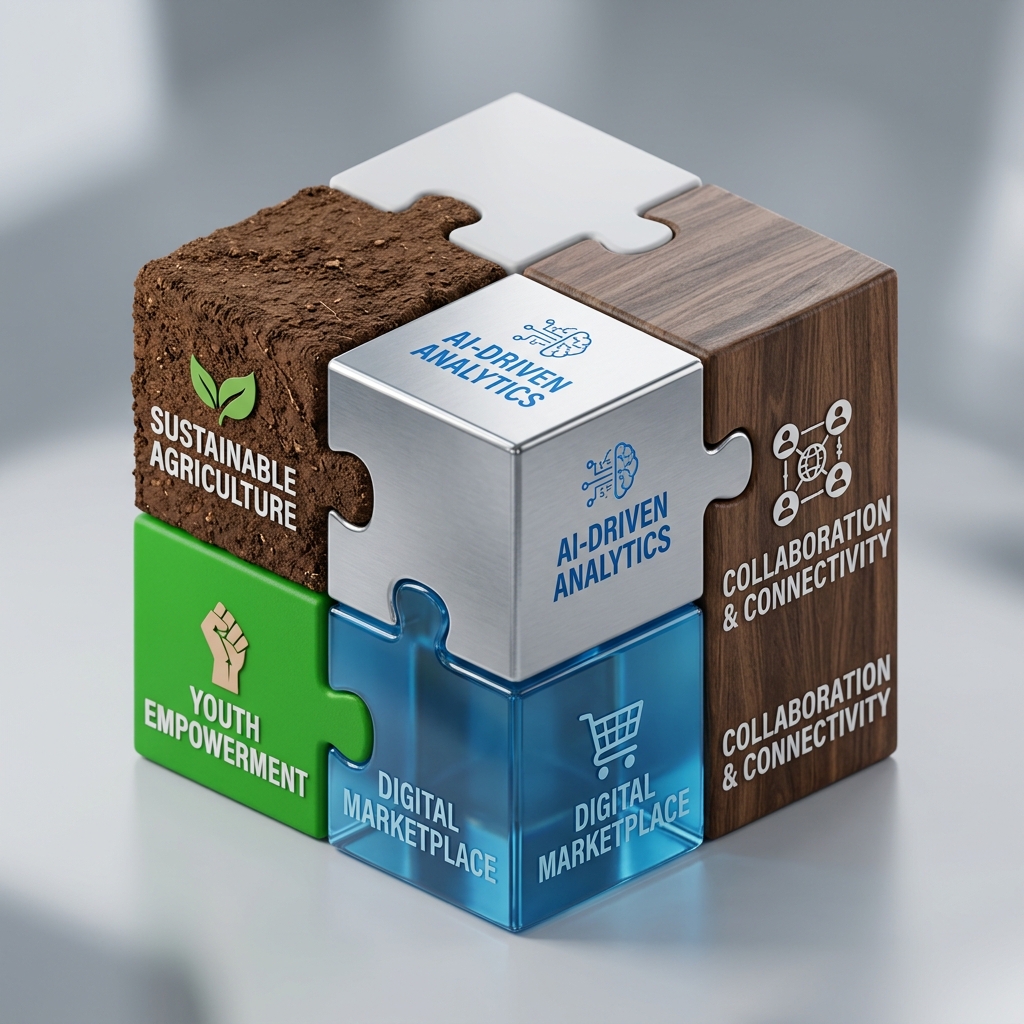
Developed as the first operational application of the CCAS framework, the Parsilet Index serves as the integrated landscape scorecard. It translates complex Community Capital Accounts into a single integrated landscape performance score, allowing both technical specialists and non-technical decision-makers to quickly understand whether the overall health of the landscape is improving over time. It transforms complex ecological, social, and economic data into clear, accessible investment intelligence that development partners, government officials, private investors, researchers, and community leaders can immediately utilize to assess overall landscape health.
2.10.3 Return on Community Capital (ROCC)
Investors and development partners rely on established metrics like Return on Investment (ROI), Net Present Value (NPV), and Social Return on Investment (SROI) to evaluate capital efficiency. The LHCI-EEC framework respects and builds upon these traditions by introducing an expanded metric tailored for integrated landscape development: Return on Community Capital (ROCC).
Traditional investment metrics such as ROI, NPV and SROI remain valuable because they demonstrate the financial or social efficiency of individual investments. ROCC extends this thinking by measuring the total Community Capital created through those investments, thereby revealing the true long-term value generated across the entire landscape.
While traditional reporting correctly confirms that an investment successfully restored a specific number of hectares, ROCC takes the analysis a step further. ROCC asks: How much Community Capital was created for every unit of investment?
Through ROCC, the CCAS methodology calculates exactly how much Natural Capital increased as a result of that restoration, and maps the corresponding spillover growth that occurred in Enterprise and Human Capital. This provides all funding partners, academic collaborators, and the investing community with an unprecedented level of precision, demonstrating the true multiplier effect of their deployed capital across the entire ecosystem.
ROCC therefore enables governments, development partners, financial institutions and communities to understand not only whether an investment succeeded, but whether it permanently strengthened the landscape's capacity to generate future prosperity.
2.10.4 Adaptive Learning and Continuous Improvement
The ultimate purpose of measuring Community Capital is to support dynamic, collaborative decision-making among all landscape partners.
By continuously tracking the six capital accounts, community leadership and investment partners can collaboratively adjust their strategies. If Enterprise Capital is compounding rapidly but Human Capital is lagging, future investment allocations can be swiftly realigned. If Natural Capital shows signs of pressure, interventions can be proactively deployed.
Through CCAS, measurement becomes an active management system rather than a reporting exercise. Evidence generated through Community Capital Accounts continuously informs investment prioritisation, partnership decisions, resource allocation and adaptive management, ensuring that the landscape becomes progressively stronger with every investment cycle.
While initially developed to support the LHCI-EEC Community Capital Development and Investment Framework, the Community Capital Accounting System (CCAS), the Parsilet Index (PI) and the Return on Community Capital (ROCC) methodology have been designed as transferable intellectual assets capable of supporting governments, development programmes, financial institutions, conservation landscapes, community organisations and private sector investments seeking to measure long-term Community Capital performance.
In this way, Community Capital measurement becomes more than a reporting requirement; it becomes a strategic decision-support system that enables every ecosystem partner to understand, demonstrate and continuously strengthen the lasting value created through their investments.
2.11 Scaling the LHCI-EEC Framework
The interconnected challenges of climate vulnerability, biodiversity loss, and economic marginalization are not unique to the Amboseli–Magadi ecosystem. They represent systemic risks facing pastoral and conservation landscapes across Kenya, the African continent, and dryland regions globally.
To meet the scale of these challenges, development models can no longer afford to be localized, isolated successes. The Living Heritage and Conservation Initiative – EcoHeritage Economy (LHCI-EEC) Community Capital Development and Investment Framework was intentionally engineered from its inception not simply as a landscape development initiative, but as a scalable Community Capital investment architecture capable of supporting long-term transformation across diverse ecological, cultural and institutional contexts.
Scaling the LHCI-EEC framework does not mean duplicating exact activities in new locations. Rather, it means transferring the investment logic, Community Capital philosophy, Strategic Investment Platform (SIP) architecture, and Community Capital Accounting System (CCAS), while enabling every landscape to design locally relevant investment portfolios that reflect its own opportunities, priorities and indigenous strengths.
2.11.1 Parsilet Conservancy: Africa's Living Laboratory
The scaling journey begins at the source. Parsilet Conservancy serves as the founding implementation landscape and the sovereign demonstration model for the LHCI-EEC framework.
Through the strategic partnership between the community, Innovative Academic Placement Solutions (INAPS), and its growing ecosystem of government institutions, development partners, research organisations, private sector actors and community investors, Parsilet functions as Africa's Living Laboratory for Community Capital Development and Investment. It provides a de-risked, practical environment where innovative investment models—ranging from climate-smart livestock systems to eco-cultural tourism, regenerative enterprise ecosystems, smart community infrastructure, and digital environmental intelligence—are designed, tested, documented, continuously improved and translated into practical investment knowledge.
By generating empirical evidence and practical lessons, Parsilet demonstrates that conservation, pastoralism, enterprise development, community leadership and infrastructure investment are not competing priorities, but mutually reinforcing investments that collectively strengthen Community Capital. This provides a practical demonstration platform from which governments, investors and development partners can confidently adapt the framework to other landscapes.
2.11.2 The Knowledge Multiplication Approach
Scaling a framework as comprehensive as LHCI-EEC thrives on robust institutional mechanisms for collaborative knowledge transfer. The framework achieves this through a structured Knowledge Multiplication Approach.
At the heart of this approach is the Oleng'oti Living Boardroom, which serves as the platform's flagship executive learning, investment dialogue, innovation, and knowledge exchange facility.
Rather than simply handing over a manual, the framework scales by building human capability and institutional confidence. Through executive training, structured Training of Trainers (ToT) programmes, professional attachments, investment immersion experiences, research collaboration and peer-learning exchanges, the Oleng'oti Living Boardroom brings together community leaders, government officials, academic researchers, development partners and private sector actors.
This creates an expanding Community Capital Learning Network capable of continuously sharing practical lessons, refining investment models and supporting responsible adaptation of the framework across different landscapes, rather than simply replicating projects.
2.11.3 Architectural Consistency and Local Adaptation
The strength of the LHCI-EEC scaling model lies in its deliberate balance between structural consistency and local flexibility.
When a development partner, government agency, philanthropic organization, research institution or community seeks to implement the LHCI-EEC framework within a new landscape, the underlying architecture provides a consistent investment logic while allowing complete flexibility in local implementation.
Across every landscape:
Investments are intentionally designed to strengthen one or more forms of Community Capital.
Interventions are organised through the four integrated Strategic Investment Platforms (SIPs).
Progress may be assessed through existing institutional financial management systems and Monitoring & Evaluation (M&E) frameworks, while organisations may also choose to complement these systems through the Community Capital Accounting System (CCAS) and Return on Community Capital (ROCC) methodology to better understand long-term Community Capital growth.
The specific investment activities, enterprise ecosystems, indigenous knowledge systems, biodiversity priorities, governance structures and local value chains will naturally differ from one landscape to another. This ensures that while the investment architecture remains institutionally consistent, implementation remains locally owned, culturally grounded and responsive to each community's unique development aspirations.
2.11.4 An Invitation to Ecosystem Partners
Scaling this framework requires collaborative leverage. No single institution possesses the mandate, expertise, financial resources or community relationships necessary to transform complex landscapes independently.
The LHCI-EEC framework therefore provides a common investment architecture through which governments, development partners, philanthropic organizations, research institutions, financial institutions, community organizations and responsible private sector actors can align their respective investments around a shared Community Capital vision while continuing to pursue their own institutional priorities and mandates.
Rather than replacing existing programmes, strategies or investment portfolios, the framework enables partners to position their individual investments within a broader landscape transformation pathway, thereby strengthening the collective impact of every contribution.
By learning from the Parsilet demonstration landscape, strengthening Community Capital, and investing through integrated Strategic Investment Platforms, ecosystem partners have the opportunity to move beyond isolated project success towards the long-term creation of resilient landscapes, regenerative local economies and intergenerational community prosperity.
In this way, the LHCI-EEC Community Capital Development and Investment Framework is intended not merely to scale projects, but to cultivate a growing global movement of ecosystem partners collectively investing in resilient communities, thriving landscapes and enduring Community Capital.
SECTION 3
The Parsilet Community Capital Development and Investment Framework
3.1 Introduction
Having established the philosophy, architecture and operating logic of the Living Heritage and Conservation Initiative – EcoHeritage Economy (LHCI-EEC) Community Capital Development and Investment Framework in Section 2, this section demonstrates how that framework is translated into practice within Parsilet Conservancy, the founding demonstration landscape of the Enkishon EcoHeritage Commons (EEC).
Rather than introducing a new development model, this section applies the Community Capital Development and Investment Framework to the ecological, social, cultural and economic realities of Parsilet Conservancy. It explains how the landscape's existing assets, indigenous knowledge systems, governance structures and development opportunities are strategically organised into a coherent long-term investment framework capable of generating resilient livelihoods, healthy ecosystems, thriving enterprises and enduring community prosperity.
Parsilet Conservancy provides an ideal demonstration landscape because it combines globally significant biodiversity, rich Maasai living heritage, strong community stewardship, extensive pastoral production systems and emerging opportunities for regenerative enterprise development within a single integrated landscape. These unique characteristics make the conservancy an appropriate environment for demonstrating how coordinated investments in Community Capital can simultaneously strengthen conservation, livelihoods, enterprise development, governance and cultural resilience. Accordingly, this section presents the Parsilet Conservancy Community Capital Development and Investment Framework—a landscape-specific application of the broader LHCI-EEC methodology. It establishes the strategic vision, development priorities, investment architecture and transformation pathway that guide all subsequent Strategic Investment Platforms (SIPs), Wealth Investment Components (WICs) and Strategic Investment Areas (SIAs) presented in this framework.
The purpose of this section is therefore to bridge the conceptual foundation presented in Section 2 with the practical investment portfolio that follows. It demonstrates how the LHCI-EEC Community Capital Development and Investment Framework becomes operational within Parsilet Conservancy, providing a structured pathway through which communities, government, development partners, research institutions, philanthropic organisations, financial institutions and responsible private sector actors can collectively invest in long-term landscape transformation.
3.2 The Parsilet Conservancy Landscape Context
3.2.1 The Strategic Importance of Parsilet Conservancy
Parsilet Conservancy occupies a unique position within Kenya's southern rangelands as a community-owned conservation landscape where biodiversity conservation, pastoral livelihoods, indigenous Maasai heritage and emerging regenerative enterprise systems coexist within one interconnected social-ecological system. Located within the greater Amboseli ecosystem in Kajiado County, the conservancy forms part of one of East Africa's most significant pastoral and wildlife landscapes, supporting critical ecological processes while sustaining community livelihoods that have evolved over generations.
Unlike many landscapes where conservation, production and community development are often implemented as separate agendas, Parsilet Conservancy presents an opportunity to demonstrate how these objectives can be pursued simultaneously through a single Community Capital Development and Investment Framework. Its approximately 15,000-acre community-owned landscape, comprising around sixty consolidated land parcels and more than three hundred registered community members, provides both the ecological scale and the institutional foundation required to pilot integrated landscape investment.
The conservancy possesses an exceptional combination of assets that make it strategically significant. These include extensive rangelands, wildlife movement corridors, indigenous grazing systems, rich biodiversity, living Maasai cultural heritage, traditional governance systems, conservation-linked tourism opportunities, and growing potential for regenerative enterprise development. Together, these assets represent far more than natural resources; they constitute the foundational Community Capital upon which long-term landscape prosperity can be built.
Equally important is the community itself. The stewardship of Parsilet Conservancy is anchored in indigenous Maasai knowledge, collective leadership and a shared commitment to safeguarding land, culture and livelihoods for future generations. This strong tradition of community ownership provides a practical foundation for demonstrating how local institutions, when strengthened through strategic investment, can become drivers of resilient and self-sustaining development.
For the Living Heritage and Conservation Initiative – EcoHeritage Economy (LHCI-EEC), Parsilet Conservancy is therefore more than a project location. It is the founding demonstration landscape where the Community Capital Development and Investment Framework is applied, tested, refined and continuously strengthened through real-world implementation. The experiences, innovations and evidence generated within the conservancy are intended to inform future adaptation and scaling across other pastoral, conservation and community landscapes while respecting the unique ecological, cultural and institutional characteristics of each location.
3.2.2 Community Assets and Development Opportunities
The development journey of Parsilet Conservancy begins not with scarcity, but with abundance. While the landscape continues to experience challenges associated with climate variability, biodiversity loss, changing markets and increasing pressure on natural resources, it is equally endowed with significant ecological, cultural, institutional and economic assets that provide a strong foundation for long-term transformation. The role of the LHCI-EEC Community Capital Development and Investment Framework is therefore not to replace community strengths, but to strategically invest in and unlock the full productive potential of these existing assets.
At the centre of this asset base is the conservancy's extensive natural landscape. Healthy rangelands, wildlife habitats, indigenous vegetation, seasonal rivers, grazing systems and rich biodiversity collectively support both conservation and pastoral production while providing opportunities for ecological restoration, climate resilience and nature-based enterprise development. These natural assets form the foundation of the landscape's Natural Capital and underpin the long-term sustainability of every other form of Community Capital.
Equally valuable is the living heritage of the Maasai community. Indigenous ecological knowledge, traditional livestock management systems, customary governance, oral traditions, cultural practices, local craftsmanship and community stewardship continue to shape the identity and resilience of Parsilet Conservancy. Rather than viewing heritage as something to be preserved in isolation, the framework recognises it as a productive development asset capable of generating cultural identity, innovation, learning, tourism opportunities and sustainable enterprise while strengthening intergenerational knowledge transfer.
The conservancy also possesses important institutional assets. Community leadership structures, participatory governance systems, collective stewardship mechanisms and strong local ownership provide an enabling environment for collaborative decision-making and long-term investment. These institutions create the trust, accountability and social cohesion required for communities, governments, development partners, researchers, investors and the private sector to work together within a shared landscape vision.
From an economic perspective, Parsilet Conservancy presents exceptional opportunities for developing a diversified regenerative enterprise economy. Sustainable livestock production, pollinator conservation, regenerative apiculture, indigenous food systems, eco-cultural tourism, nature-based products, community hospitality, conservation services, value addition, green enterprises and emerging circular economy opportunities collectively demonstrate that the landscape already contains the building blocks of an inclusive rural economy. The challenge is therefore not the absence of opportunity, but the need for integrated investment capable of transforming dispersed community assets into productive enterprises that continuously generate wealth while strengthening the landscape itself.
This asset-based perspective fundamentally shapes the implementation philosophy of the LHCI-EEC framework. Rather than beginning with community needs, the framework begins with Community Capital. It asks what assets already exist, how they can be strengthened, how they can generate additional value, and how that value can be reinvested to create even greater Community Capital over time. Through this approach, development becomes a continuous process of building upon existing strengths rather than repeatedly responding to deficits.
Accordingly, the investment strategy for Parsilet Conservancy is founded upon one central principle: lasting landscape transformation occurs when communities intentionally invest in the assets they already possess, systematically strengthen their Community Capital, and convert that capital into resilient livelihoods, regenerative enterprises and intergenerational prosperity.
3.2.3 Emerging Landscape Challenges
While Parsilet Conservancy possesses exceptional ecological, cultural, institutional and economic assets, these strengths exist within a rapidly evolving pastoral landscape that continues to experience interconnected environmental, social and economic pressures. The conservancy's extensive rangelands, seasonal rivers such as Lesongoye and Olmakau, the Parsilet Hills, surrounding landscapes including Kisapuk Hills, Oldonyo Orok and Longido Hills, together with culturally significant heritage sites such as Olasaru Indigenous Rock, all represent invaluable community assets whose long-term productivity depends upon deliberate stewardship and sustained investment. These realities reinforce—not diminish—the strategic importance of investing in Community Capital.
Climate variability remains one of the most significant drivers of landscape change. Increasingly unpredictable rainfall patterns, prolonged droughts and rising temperatures continue to influence grazing systems, livestock productivity, seasonal water availability and ecosystem health. During extended dry periods, pressure on critical grazing areas and seasonal water sources increases, creating additional stress on both pastoral production systems and wildlife habitats. Maintaining the ecological integrity of Parsilet Conservancy therefore requires continuous investment in regenerative rangeland management, water resilience and climate-smart pastoral systems.
At the same time, the economic environment surrounding Parsilet Conservancy is changing rapidly. Growing national and international demand for sustainably produced livestock products, pollinator-based products, indigenous foods, eco-cultural tourism experiences, green enterprises and nature-based products presents unprecedented opportunities for community wealth creation. However, much of this potential remains underdeveloped due to limited value addition, fragmented market participation, inadequate enterprise infrastructure, constrained investment capital and limited business incubation systems. Without strategic investment, communities risk remaining suppliers of raw products rather than becoming owners of diversified regenerative enterprise economies.
Demographic transformation presents both an opportunity and a responsibility. Parsilet Conservancy is home to a young and energetic population whose future will largely determine the long-term resilience of the landscape. Creating dignified employment, strengthening entrepreneurial capability, expanding digital innovation, nurturing transformational leadership and investing in women as drivers of household and community prosperity are therefore central to building resilient Community Capital. The future competitiveness of the conservancy depends not only on protecting natural resources but equally on unlocking the productive potential of its people.
Institutionally, Parsilet Conservancy already benefits from an established governance architecture, including an 11-member Executive Committee, a 33-member General Committee, and approximately 300 registered community member households working collectively to steward the conservancy. As investment opportunities continue to expand, these institutions must continuously strengthen their governance systems, financial management, strategic planning, partnership management and accountability mechanisms to effectively manage increasingly sophisticated investment portfolios while maintaining community ownership and public confidence.
These emerging challenges are not independent. Climate resilience influences enterprise development. Strong governance enables investment confidence. Infrastructure supports enterprise growth. Living heritage strengthens identity and stewardship. Enterprise prosperity generates resources for conservation. Consequently, the Living Heritage and Conservation Initiative – EcoHeritage Economy (LHCI-EEC) Community Capital Development and Investment Framework approaches these realities as interconnected dimensions of a single landscape system whose long-term resilience depends upon simultaneously strengthening all forms of Community Capital.
Rather than viewing these dynamics as barriers to development, LHCI-EEC recognises them as strategic investment opportunities. By intentionally strengthening Natural, Human, Enterprise, Physical, Social and Heritage Capital together, Parsilet Conservancy can transform present-day challenges into long-term drivers of resilience, regenerative enterprise, community prosperity and intergenerational landscape transformation.
3.3 The Parsilet Conservancy Community Capital Development Vision
The long-term transformation of Parsilet Conservancy requires more than individual projects or isolated investments. It requires a shared community vision that guides collective action over time while aligning diverse partners around a common landscape future. The Community Capital Development Vision provides this long-term direction by describing the future that the people of Parsilet Conservancy seek to build through sustained investment in their natural resources, people, enterprises, institutions, infrastructure and living heritage.
Grounded in the Living Heritage and Conservation Initiative – EcoHeritage Economy (LHCI-EEC) Community Capital Development and Investment Framework, this vision recognises that resilient landscapes are intentionally created through continuous investment in Community Capital. It therefore provides the strategic foundation upon which all subsequent Strategic Investment Platforms (SIPs), Wealth Investment Components (WICs), Strategic Investment Areas (SIAs) and individual investments within Parsilet Conservancy are aligned.
3.3.1 Long-Term Vision
To transform Parsilet Conservancy into a globally recognised model of resilient pastoral landscapes where thriving ecosystems, living Maasai heritage, empowered communities and regenerative enterprise economies continuously create Community Capital, shared prosperity and intergenerational wellbeing.
3.3.2 Development Mission
To mobilise, facilitate and steward collaborative investments that strengthen Community Capital by restoring ecosystems, advancing resilient pastoral livelihoods, nurturing transformational leadership, developing regenerative enterprise ecosystems, enhancing smart community infrastructure and celebrating living heritage for the sustainable prosperity of present and future generations.
3.3.3 Strategic Development Aspirations
Guided by this vision and mission, Parsilet Conservancy aspires to achieve the following long-term development outcomes:
A thriving ecological landscape where healthy rangelands, restored biodiversity, resilient water systems and climate-smart pastoral production sustain both people and nature.
A prosperous regenerative enterprise economy where community-owned enterprises transform local resources, indigenous knowledge and innovation into inclusive wealth, dignified employment and sustainable livelihoods.
Empowered women, youth and community leadership capable of driving innovation, entrepreneurship, accountable governance and long-term landscape stewardship.
Resilient community systems and smart living environments supported by appropriate infrastructure, digital technologies, productive assets and inclusive public services that improve quality of life while enabling enterprise growth.
Living heritage that continues to create value through the preservation, revitalisation and responsible commercialisation of Maasai knowledge systems, cultural practices, indigenous innovations and heritage landscapes.
Strong and accountable community institutions that effectively mobilise partnerships, manage investments, strengthen community ownership and ensure equitable sharing of development benefits.
A self-sustaining Community Capital economy where the wealth generated through regenerative enterprises is continuously reinvested into strengthening Natural, Human, Enterprise, Physical, Social and Heritage Capital, creating a virtuous cycle of landscape resilience and intergenerational prosperity.
A recognised demonstration landscape that continuously generates knowledge, innovation and practical investment models capable of informing adaptation and scaling across pastoral, conservation and indigenous landscapes nationally, regionally and globally.
3.4 Community Capital Development Objectives
The LHCI-EEC Community Capital Development and Investment Framework seeks to guide the long-term transformation of Parsilet Conservancy through a coherent set of strategic development objectives that collectively strengthen Community Capital and build a resilient, productive and regenerative landscape. These objectives provide the strategic direction for investment planning, partnership development, resource mobilisation and implementation over the ten-year planning horizon. They also establish the common outcomes towards which communities, governments, development partners, philanthropic organisations, financial institutions, academia, conservation organisations and responsible private sector actors collectively contribute through the framework.
Recognising that sustainable landscape transformation cannot be achieved through isolated interventions, the objectives are intentionally integrated and mutually reinforcing. Together, they provide the foundation upon which the four Strategic Investment Platforms (SIPs), Wealth Investment Components (WICs) and Strategic Investment Areas (SIAs) are subsequently designed and implemented.
Accordingly, the Community Capital Development and Investment Framework pursues the following strategic objectives:
3.4.1 Restore and Sustain Healthy Ecosystems
To strengthen the ecological integrity, productivity and climate resilience of Parsilet Conservancy through regenerative rangeland management, biodiversity conservation, sustainable natural resource stewardship and ecosystem restoration that secures the Natural Capital upon which community prosperity depends.
3.4.2 Build Human Capability and Transformational Leadership
To develop knowledgeable, skilled, innovative and values-driven women, youth and community leaders capable of stewarding Community Capital, driving enterprise development, strengthening governance and leading long-term landscape transformation.
3.4.3 Develop a Regenerative Enterprise Economy
To establish inclusive enterprise ecosystems that transform community assets, indigenous knowledge, biodiversity resources and local production systems into diversified economic opportunities capable of generating employment, household income, local investment and sustainable Community Wealth.
3.4.4 Strengthen Community Infrastructure and Smart Living Systems
To develop resilient physical infrastructure, smart community systems, productive facilities and living spaces that improve quality of life, enhance service delivery, enable enterprise development and strengthen long-term community resilience.
3.4.5 Conserve and Activate Living Heritage
To protect, revitalise and responsibly utilise Maasai living heritage, indigenous knowledge systems, cultural landscapes and traditional institutions as productive assets that strengthen community identity, innovation, education, stewardship and sustainable economic development.
3.4.6 Strengthen Community Institutions and Collaborative Governance
To build accountable, transparent and inclusive community institutions capable of mobilising partnerships, managing investments, coordinating collective action and ensuring equitable stewardship of Community Capital for present and future generations.
3.4.7 Establish Sustainable Community Capital Financing
To mobilise, facilitate and steward diversified public, private, philanthropic and community investment that continuously strengthens Community Capital while creating mechanisms through which locally generated wealth is progressively reinvested into long-term landscape development.
3.4.8 Generate Evidence, Innovation and Scalable Investment Models
To establish Parsilet Conservancy as a leading demonstration landscape that continuously generates knowledge, innovation, practical investment models and measurable evidence capable of informing replication and scaling across pastoral, conservation and indigenous landscapes nationally, regionally and globally.
3.5 Community Capital Development Principles
The successful implementation of the Parsilet Conservancy Community Capital Development and Investment Framework depends not only on strategic investments but also on the principles that guide how those investments are conceived, implemented and sustained. These principles provide the shared values and operating philosophy through which communities, governments, development partners, investors, research institutions, civil society organisations and the private sector collaboratively contribute towards long-term landscape transformation.
While these principles are fully aligned with the Living Heritage and Conservation Initiative – EcoHeritage Economy (LHCI-EEC), they are intentionally contextualised to reflect the ecological character, pastoral traditions, governance systems and development aspirations of Parsilet Conservancy. Collectively, they ensure that Community Capital grows in ways that are equitable, regenerative, locally owned and capable of creating lasting value for present and future generations.
3.5.1 Community Ownership and Stewardship
The people of Parsilet Conservancy are the primary custodians of their land, natural resources, living heritage and development future. All investments should strengthen community ownership, build local leadership, reinforce collective responsibility and enable communities to actively shape, manage and sustain their own development journey.
3.5.2 Living Heritage as a Development Asset
The Maasai living heritage of Parsilet Conservancy is recognised as a productive form of Community Capital rather than simply a cultural legacy. Indigenous knowledge, language, traditional institutions, cultural landscapes and customary stewardship systems should be protected, revitalised and responsibly integrated into contemporary development and enterprise.
3.5.3 Landscape Stewardship
Healthy ecosystems provide the ecological foundation upon which livelihoods, enterprises and community wellbeing depend. Every investment should contribute towards restoring, protecting or sustainably managing the natural systems that sustain the productivity and resilience of Parsilet Conservancy.
3.5.4 Partnership and Shared Investment
Landscape transformation is a shared responsibility. Sustainable impact is achieved when communities, governments, development partners, research institutions, philanthropic organisations, financial institutions and responsible private sector actors contribute their respective strengths towards a common Community Capital vision. Every ecosystem partner is recognised as a potential long-term investor in Community Capital.
3.5.5 Inclusiveness and Equitable Participation
Women, men, youth, elders and vulnerable members of the community should have equitable opportunities to participate in decision-making, access productive resources, contribute their knowledge and benefit from Community Capital investments. Inclusive development strengthens both social cohesion and long-term resilience.
3.5.6 Regenerative Development
The framework seeks not merely to sustain existing conditions but to regenerate ecological systems, strengthen community institutions, expand enterprise opportunities and continuously increase Community Capital. Every investment should leave the landscape, the community and its productive assets stronger than they were before.
3.5.7 Transparency, Accountability and Trust
Effective Community Capital development depends upon transparent governance, responsible stewardship of resources and mutual accountability among all ecosystem partners. Investments should be managed with integrity, openness and measurable responsibility to both current and future generations.
3.5.8 Learning, Innovation and Adaptive Management
Parsilet Conservancy is both an implementation landscape and a learning landscape. Continuous learning, applied research, innovation and adaptive management should guide investment decisions, strengthen implementation and enable the framework to evolve in response to new knowledge, emerging opportunities and changing landscape conditions.
3.6 The Parsilet Conservancy Community Capital Development Pathway
The transformation of Parsilet Conservancy into a resilient, prosperous and regenerative landscape does not occur through isolated investments or independent development projects. It occurs through a deliberate pathway that progressively converts the existing assets of the community into long-term Community Capital, productive systems and sustainable prosperity.
The Parsilet Conservancy Community Capital Development Pathway translates the philosophy of the Living Heritage and Conservation Initiative – EcoHeritage Economy (LHCI-EEC) into an operational landscape development process. It demonstrates how every investment contributes to a logical progression that continuously strengthens the ecological, economic, institutional and cultural foundations of the conservancy.
Rather than viewing development as a collection of separate activities, the pathway recognises that lasting transformation emerges when investments continuously reinforce one another. Each stage builds upon the previous one, creating a compounding cycle of Community Capital growth that becomes increasingly self-sustaining over time.
Accordingly, the Community Capital Development Pathway follows the following progression:
Illustration 3.6.1.1 of Parsilet Conservancy Community Capital Development Pathway
Layer 1
Natural Capital
Healthy rangelands, productive livestock, secure water resources, biodiversity, and functioning ecosystems supporting pastoral livelihoods.
Layer 2
Human Capital
Empowered individuals with the leadership, knowledge, skills, and confidence to drive sustainable development and stewardship.
Layer 3
Enterprise Capital
Thriving local businesses, expanded value chains, and robust financial networks that generate income and inclusive economic growth.
Layer 4
Physical Capital
Productive assets, resilient infrastructure, water systems, and technology that improve productivity and community well-being.
Layer 5
Social Capital
Strong institutions, social cohesion, inclusive governance, and collaborative networks that empower communities to act collectively.
Layer 6
Heritage Capital
Living cultural traditions, indigenous knowledge, and generational practices that form the unique identity of the landscape.
Community Assets
↓
Community Capital
↓
Productive Assets
↓
Community Systems
↓
Enterprise Economy
↓
Resilient Livelihoods
↓
Landscape Transformation
Illustration 3.6.1.2 of Parsilet Conservancy Community Capital Development Pathway
Livestock & Rangeland Resilience SIP 1
Women & Community Leadership SIP 2
Youth Innovation & Stewardship SIP 3
Nature-Based Green Value Chains SIP 4
EcoHeritage & Smart Living Spaces SIP 5
Living Heritage & Institutions SIP 6
Portfolio
COMMUNITY ASSETS
(What the Community Already Possesses)
────────────────────────────────────────────────────
Natural Resources • People • Indigenous Knowledge
Living Heritage • Institutions • Infrastructure
Partnerships • Local Innovation
│
▼
COMMUNITY CAPITAL
(Assets Strengthened Through Investment)
────────────────────────────────────────────────────
Natural Capital • Human Capital • Enterprise Capital
Physical Capital • Social Capital • Heritage Capital
│
▼
PRODUCTIVE ASSETS
(Capital Converted into Productivity)
────────────────────────────────────────────────────
Regenerative Rangelands • Skilled People
Community Enterprises • Smart Infrastructure
Cultural Products • Digital Platforms
│
▼
COMMUNITY SYSTEMS
(Assets Connected into Functional Systems)
────────────────────────────────────────────────────
Governance • Cooperatives • Knowledge Systems
Market Systems • Digital Systems
Financial Systems • Stewardship Systems
│
▼
ENTERPRISE ECONOMY
(Community Capital Creates Wealth)
────────────────────────────────────────────────────
Nature-Based Enterprises • Green Value Chains
Cultural Economy • Circular Economy
Regenerative Businesses • Innovation Ecosystems
│
▼
RESILIENT LIVELIHOODS
(Households Become More Prosperous)
────────────────────────────────────────────────────
Employment • Household Income
Food Security • Climate Resilience
Savings • Reinvestment • Community Wellbeing
│
▼
LANDSCAPE TRANSFORMATION
(The Ultimate Development Outcome)
────────────────────────────────────────────────────
Healthy Ecosystems • Strong Institutions
Thriving Communities • Living Heritage
Community Wealth • Intergenerational Prosperity
Figure 3.6.1 of Parsilet Conservancy Community Capital Development Pathway
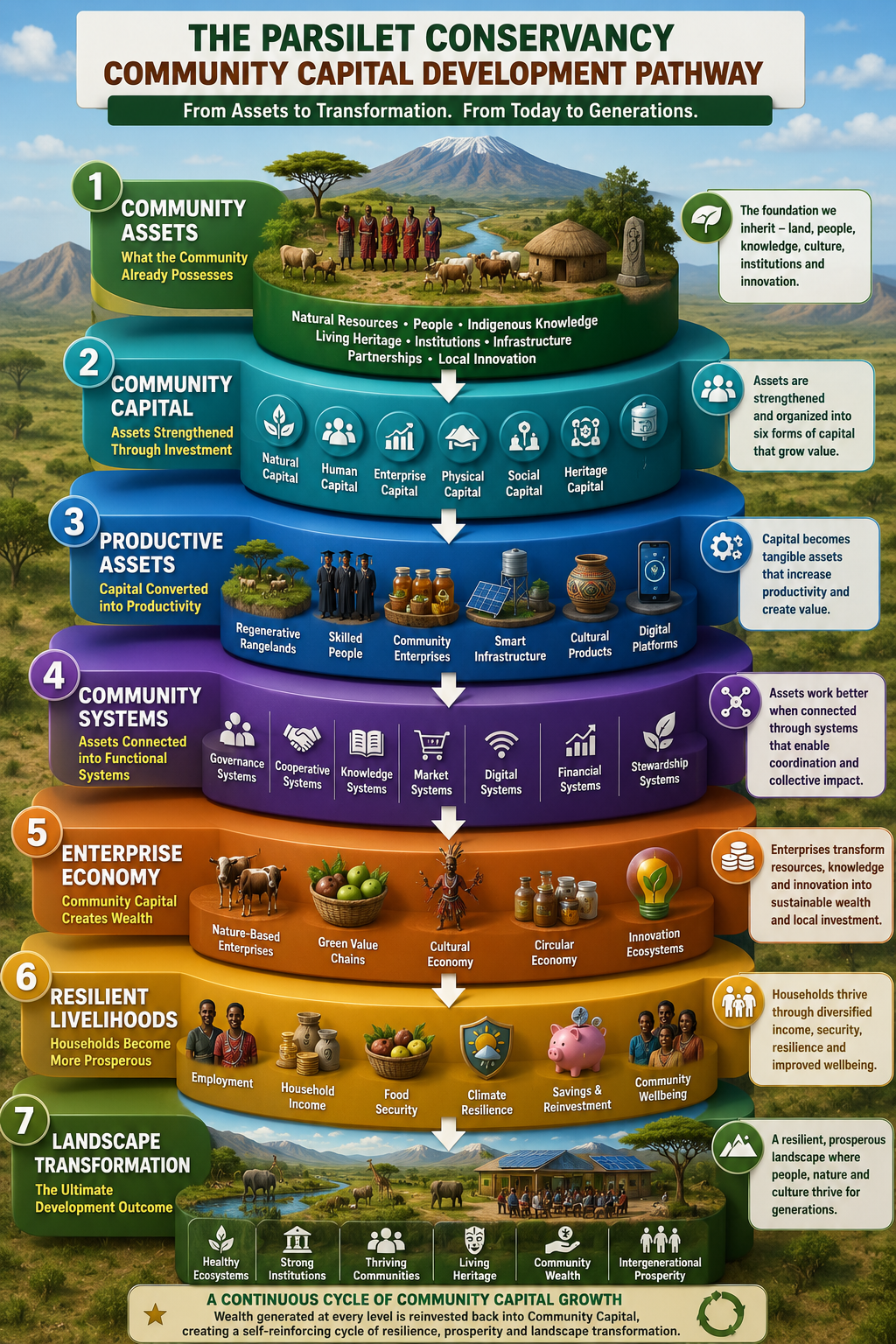
3.6.1 From Community Assets to Community Capital
Every community possesses valuable assets before external investment arrives. Parsilet Conservancy already possesses extensive rangelands, biodiversity, indigenous knowledge, living Maasai heritage, community leadership, pastoral production systems, social institutions and strong collective stewardship traditions.
The LHCI-EEC framework begins by recognising these existing assets as the true foundation of development. Rather than replacing them, strategic investments strengthen, expand and organise these assets into measurable forms of Community Capital capable of continuously generating long-term value.
3.6.2 From Community Capital to Productive Assets
As Community Capital grows, it creates productive assets that directly increase the community's capacity to generate social, ecological and economic returns.
Healthy rangelands become productive grazing systems.
Skilled young people become capable entrepreneurs.
Traditional knowledge becomes marketable cultural experiences.
Community institutions become investment-ready organisations.
Infrastructure becomes productive economic platforms.
The framework therefore views productive assets as the practical expression of strengthened Community Capital.
3.6.3 From Productive Assets to Community Systems
Intergenerational Prosperity
The ultimate legacy of the Platform Implementation Model. Strategic investments and localized delivery mature into enduring outcomes that secure the future of the landscape.
Resilient Communities
Landscape Restoration
Prosperity
Individual productive assets achieve their greatest value when they become connected through well-functioning community systems.
Livestock production becomes more resilient when supported by animal health systems, grazing management systems, cooperative governance, digital information platforms and market coordination.
Likewise, enterprise development flourishes when supported by financial systems, leadership structures, infrastructure networks and knowledge-sharing mechanisms.
The framework therefore prioritises strengthening systems rather than isolated assets, recognising that resilient communities depend upon the interaction between institutions, people, infrastructure, enterprises and ecosystems.
3.6.4 From Community Systems to a Regenerative Enterprise Economy
Strong community systems create the enabling environment within which inclusive enterprises can emerge, grow and diversify.
Within Parsilet Conservancy, the Enterprise Economy is built upon nature-based enterprises, regenerative value chains, cultural innovation, local entrepreneurship and community-owned businesses that transform Community Capital into sustainable economic opportunity.
Rather than extracting value from the landscape, the Enterprise Economy continuously regenerates the ecological, cultural and social systems upon which it depends.
3.6.5 From Enterprise Economy to Resilient Livelihoods
As the Enterprise Economy expands, households benefit through diversified income sources, increased employment opportunities, improved food security, stronger household savings, greater financial resilience and expanded opportunities for women and youth.
Importantly, livelihoods become less vulnerable to climate shocks because household prosperity is no longer dependent upon a single economic activity. Instead, resilience is created through diversified enterprise opportunities that reinforce one another while remaining firmly rooted within healthy landscapes.
3.6.6 From Resilient Livelihoods to Landscape Transformation
The final outcome of the Community Capital Development Pathway is not simply improved livelihoods but long-term landscape transformation.
As Community Capital continues to grow, communities generate increasing capacity to restore ecosystems, strengthen governance, expand enterprises, preserve living heritage and continuously reinvest locally generated wealth back into Community Capital.
Over time, this creates a self-reinforcing cycle in which ecological integrity, economic prosperity, social cohesion and cultural continuity evolve together, enabling Parsilet Conservancy to become a resilient landscape capable of sustaining both present and future generations.
3.7 The Parsilet Conservancy Investment Architecture
Having established the Community Capital Development Vision, guiding principles and development pathway, the next consideration is how strategic investments are organised to translate this vision into practical landscape transformation.
Within Parsilet Conservancy, investments are not implemented as isolated projects responding independently to emerging needs. Rather, they are intentionally structured within an integrated investment architecture that aligns diverse ecosystem partners, investment priorities and implementation pathways around a common Community Capital Development vision.
The Parsilet Conservancy Investment Architecture provides this organising structure. It ensures that individual investments—regardless of their source, size or thematic focus—contribute towards strengthening Community Capital while reinforcing one another to produce greater collective impact across the landscape.
3.7.1 Investment Philosophy
The Parsilet Conservancy Investment Architecture is founded on the belief that sustainable landscape transformation is achieved by investing in systems rather than isolated interventions.
Every investment is therefore viewed as a strategic contribution towards strengthening Community Capital. Whether an investment focuses on ecosystem restoration, leadership development, enterprise growth or community infrastructure, its ultimate purpose is to increase the community's long-term capacity to generate ecological, social, cultural and economic value.
Accordingly, investments are designed not simply to solve immediate challenges but to establish productive assets, strengthen community systems and create conditions through which prosperity can continuously expand over successive generations.
3.7.2 Investment Logic
Investment Delivery Flow
A structured, five-level process transforming strategic funding into enduring community assets and resilient landscapes.
1. Strategic Investment
Resources are mobilized from partners and aligned with the overarching landscape vision, securing the foundational funding needed for transformation.
2. Investment Pathways
Funding is channeled through targeted pathways designed to address specific ecological, social, and economic priorities within the community.
3. Strategic Investment Platforms (SIPs)
Investments are coordinated through localized platforms that leverage grassroots knowledge, science, and multi-sector partnerships.
4. Integrated Delivery
Implementations occur collaboratively on the ground, ensuring efficiency, transparency, and the seamless execution of the planned initiatives.
5. Productive Assets
The process culminates in the creation of enduring natural, physical, and human capital assets that sustain the community for generations.
The architecture follows a clear investment logic that transforms diverse contributions into measurable landscape outcomes.
Strategic partners, government institutions, community organisations, philanthropic foundations, research institutions, financial institutions, private sector actors and community members may contribute financial resources, technical expertise, policy support, indigenous knowledge, innovation, land, labour or institutional capacity according to their respective comparative strengths.
Rather than operating independently, these complementary investments are intentionally organised within a shared investment architecture that enables each contribution to reinforce the others while advancing the common objective of strengthening Community Capital.
This integrated investment logic enables Parsilet Conservancy to move beyond fragmented development towards a coordinated landscape investment ecosystem capable of delivering measurable, scalable and intergenerational impact.
3.7.3 The Four Strategic Investment Platforms
To operationalise this investment logic, the Parsilet Conservancy Community Capital Development and Investment Framework organises all strategic investments into four interconnected Strategic Investment Platforms (SIPs).
Each Strategic Investment Platform represents a major investment pathway through which partners contribute towards a specific dimension of Community Capital development while simultaneously reinforcing investments occurring across the other platforms.
Collectively, the four Strategic Investment Platforms constitute the complete Community Capital Investment Portfolio for Parsilet Conservancy.
| Strategic Investment Platform | Primary Strategic Purpose |
|---|---|
| SIP 1: Climate-Smart Livestock, Rangeland Restoration and Pastoral Resilience | Strengthens the ecological foundation upon which resilient livelihoods, biodiversity conservation and sustainable pastoral production depend. |
| SIP 2: Women, Youth, Community Leadership and Transformational Governance | Develops the human capability, leadership, institutional capacity and social cohesion required to steward long-term Community Capital development. |
| SIP 3: Nature-Based Enterprises, Green Value Chains and Regenerative Enterprise Economy | Transforms Community Capital into sustainable economic opportunities through inclusive enterprise ecosystems and regenerative value chains. |
| SIP 4: EcoHeritage Infrastructure, Smart Community Systems and Living Spaces | Establishes the physical, digital, cultural and institutional platforms that enable communities, enterprises and ecosystems to thrive together. |
While each platform has a distinct strategic purpose, they are deliberately designed to function as a single integrated investment system. Their collective strength lies not in operating independently, but in continuously reinforcing one another to create multiplier effects that no single investment could achieve in isolation.
Section 4 that will follow present each Strategic Investment Platform in detail, beginning with SIP 1: Climate-Smart Livestock, Rangeland Restoration and Pastoral Resilience, and progressively demonstrating how the four platforms collectively deliver the long-term Community Capital Development Vision of Parsilet Conservancy.
3.8 Investment Prioritisation Strategy
The Community Capital Development and Investment Framework recognises that while the development needs and opportunities within Parsilet Conservancy are extensive, financial, technical and institutional resources are always finite. Sustainable landscape transformation therefore requires deliberate investment choices that maximise long-term Community Capital returns while responding to the most strategic needs of the landscape.
Investment prioritisation within Parsilet Conservancy is consequently guided not by short-term funding opportunities, but by the long-term Community Capital Development Vision established in this framework. Every investment is assessed according to its capacity to strengthen Community Capital, reinforce other investments and generate lasting ecological, social, cultural and economic value.
The framework therefore adopts a strategic sequencing approach in which early investments create the enabling conditions required for subsequent investments to generate progressively greater returns.
3.8.1 Principles Guiding Investment Prioritisation
Investment priorities within Parsilet Conservancy are determined through six complementary considerations:
a) Community Priorities
Investments respond first to the development aspirations, indigenous knowledge and locally identified priorities of the people of Parsilet Conservancy, ensuring that Community Capital development remains community-led and locally owned.
b) Community Capital Contribution
Priority is given to investments capable of strengthening multiple forms of Community Capital simultaneously, thereby generating greater long-term landscape returns than isolated interventions.
c) Strategic Leverage
Preference is given to investments that unlock additional opportunities, attract further partnerships and create enabling conditions for future investment across the wider Community Capital system.
d) Landscape Resilience
Priority investments strengthen the ecological, institutional and economic resilience of the conservancy by reducing vulnerability to climate change, environmental degradation and socio-economic shocks.
e) Enterprise Readiness
Investments that progressively prepare communities, institutions, infrastructure and production systems for sustainable enterprise development receive particular emphasis, recognising that resilient enterprises depend upon strong Community Capital.
f) Partnership Alignment
The framework encourages investments that align the comparative strengths of governments, development partners, philanthropic organisations, research institutions, financial institutions, responsible private sector actors and community members around shared landscape outcomes.
3.8.2 The Logic of Investment Sequencing
The Community Capital Development and Investment Framework does not assume that every investment should occur simultaneously.
Instead, investments are intentionally sequenced so that each stage strengthens the foundation for the next.
Early investments focus on protecting the ecological systems, leadership capacity and institutional strength upon which long-term development depends.
As Community Capital grows, subsequent investments increasingly expand enterprise development, value addition, productive infrastructure and community wealth generation.
Over time, the Enterprise Economy begins generating locally retained revenue that progressively supports reinvestment into Community Capital, reducing long-term dependence on external financing while increasing local investment capacity.
This sequencing ensures that landscape transformation is built upon progressively stronger ecological, institutional and economic foundations rather than temporary project gains.
3.8.3 A Flexible and Adaptive Investment Portfolio
Although the framework provides a strategic sequence for Community Capital development, it remains intentionally adaptive.
Different ecosystem partners may enter the framework at different stages according to their respective mandates, expertise and investment priorities. Likewise, changing landscape conditions, emerging opportunities and new partnerships may influence the timing of individual investments.
The Community Capital Investment Architecture therefore provides strategic direction without limiting innovation or flexibility. What remains constant is not the sequence of individual projects, but the shared commitment that every investment contributes meaningfully towards strengthening Community Capital and advancing the long-term development vision of Parsilet Conservancy.
3.9 Community Capital Development Outcomes
The Community Capital Development and Investment Framework is designed to achieve transformative landscape outcomes that extend far beyond the completion of individual investments or project cycles. While individual Strategic Investment Platforms contribute to specific thematic results, the framework itself seeks to strengthen the entire ecological, social, institutional, cultural and economic fabric of Parsilet Conservancy.
These Community Capital Development Outcomes represent the collective impact expected from sustained investment over the ten-year implementation horizon. Together, they define what long-term landscape transformation will look like when Community Capital is intentionally strengthened through integrated investment.
Accordingly, the framework seeks to achieve the following long-term development outcomes.
3.9.1 A Regenerative and Climate-Resilient Landscape
Parsilet Conservancy functions as a healthy and productive ecological system where restored rangelands, protected biodiversity, improved water resources and climate-smart land management continuously sustain pastoral production, wildlife conservation and ecosystem resilience.
3.9.2 Prosperous and Resilient Households
Households experience diversified and sustainable livelihoods supported by productive enterprises, improved pastoral systems, expanded employment opportunities, increased household incomes, enhanced food security and greater resilience to climate and economic shocks.
3.9.3 A Thriving Community Enterprise Economy
An inclusive and regenerative Enterprise Economy flourishes across the conservancy, transforming Community Capital into sustainable businesses, competitive value chains, local investment opportunities and expanding community wealth while retaining greater economic value within the landscape.
3.9.4 Strong Community Institutions and Transformational Leadership
Community governance systems operate transparently, collaboratively and effectively, providing capable leadership, accountable stewardship, inclusive participation and strong institutional capacity to guide long-term Community Capital development.
3.9.5 Conserved Living Heritage and Strengthened Community Identity
Maasai living heritage, indigenous knowledge, cultural landscapes and traditional stewardship systems are actively protected, celebrated and productively integrated into education, enterprise, conservation and community life, ensuring their transmission across generations.
3.9.6 Smart, Inclusive and Resilient Community Systems
Community infrastructure, digital systems, productive facilities, public spaces and smart living environments provide equitable access to services, strengthen social wellbeing and enable sustainable enterprise development throughout the conservancy.
3.9.7 Sustainable Community Capital Growth
The six forms of Community Capital continuously increase through coordinated investment, responsible stewardship and local reinvestment, creating measurable improvements in ecological health, human capability, enterprise performance, physical assets, institutional strength and living heritage.
Outcomes
& Health
Systems
Enterprise
Skills
Research
Conservation
3.9.8 A Demonstration Landscape for Scalable Community Capital Development
Parsilet Conservancy becomes an internationally recognised demonstration landscape that generates practical investment models, applied knowledge, policy insights and measurable evidence capable of informing Community Capital development across pastoral, conservation and indigenous landscapes.
3.9.9 A Self-Sustaining Landscape Economy
Through continuous reinvestment, strengthened Community Capital and an expanding Enterprise Economy, Parsilet Conservancy progressively reduces dependence on external development financing while increasing its capacity to mobilise, generate and steward its own long-term development resources.
3.10 Investment Readiness and Partnership Opportunities
The successful implementation of the Parsilet Conservancy Community Capital Development and Investment Framework depends upon strong, long-term partnerships that bring together complementary expertise, investment resources and shared commitment to landscape transformation.
No single institution possesses all the financial resources, technical knowledge, policy mandate or community relationships required to transform an entire landscape. The strength of the framework therefore lies in creating an investment environment where multiple ecosystem partners contribute according to their respective comparative advantages while advancing a shared Community Capital Development Vision.
The framework is intentionally designed to provide clear entry points for governments, development partners, philanthropic organisations, financial institutions, investors, research institutions, universities, civil society organisations, private sector actors and community members themselves.
Rather than asking partners to replace their existing mandates or programmes, the framework enables them to align their investments with a broader landscape strategy that strengthens Community Capital while simultaneously achieving their own institutional objectives.
3.10.1 Partnership Opportunities for Government
National and County Governments may utilise the framework to align public investments, strengthen devolved planning, support climate resilience, enhance natural resource governance and promote inclusive local economic development while advancing national and county development priorities.
3.10.2 Partnership Opportunities for Development Partners and Philanthropic Organisations
Development partners and philanthropic foundations may invest within clearly defined Strategic Investment Platforms that generate measurable ecological, social, cultural and economic returns while contributing towards long-term Community Capital development rather than isolated project outcomes.
3.10.3 Partnership Opportunities for Financial Institutions and Impact Investors
Commercial banks, development finance institutions and impact investors may identify investment-ready enterprise ecosystems, blended finance opportunities, green enterprises and regenerative business models capable of generating both financial returns and measurable Community Capital growth.
3.10.4 Partnership Opportunities for Universities and Research Institutions
Academic and research institutions may contribute applied research, innovation, evidence generation, technology development, policy analysis, student placements and knowledge exchange that strengthen learning while producing practical solutions for landscape transformation.
3.10.5 Partnership Opportunities for the Private Sector
Responsible private sector organisations may participate through value chain development, responsible sourcing, market expansion, digital innovation, infrastructure investment, enterprise incubation, climate technologies and strategic corporate partnerships that simultaneously strengthen business performance and Community Capital.
3.10.6 Partnership Opportunities for Communities
Communities remain the principal custodians and long-term investors within the framework.
Community members contribute indigenous knowledge, leadership, stewardship, labour, land, cultural heritage, entrepreneurship, innovation and local investment that collectively form the foundation upon which all external investments generate sustainable value.
The framework therefore recognises communities not as beneficiaries of development, but as co-investors and co-creators of long-term landscape transformation.
3.10.7 An Open Invitation to Build the Future Together
Parsilet Conservancy represents the beginning of a much larger Community Capital movement.
The Community Capital Development and Investment Framework invites every ecosystem partner to become part of a shared journey that transforms investments into lasting community assets, resilient enterprises, healthy ecosystems, strong institutions and intergenerational prosperity.
Every partner enters the framework differently.
Every investment strengthens different forms of Community Capital.
Yet together, these diverse contributions become part of a single, integrated landscape transformation process whose benefits extend far beyond the lifespan of any individual project.
SECTION 4
Strategic Investment Platform (SIP 1)
Climate-Smart Livestock, Rangeland Restoration and Pastoral Resilience
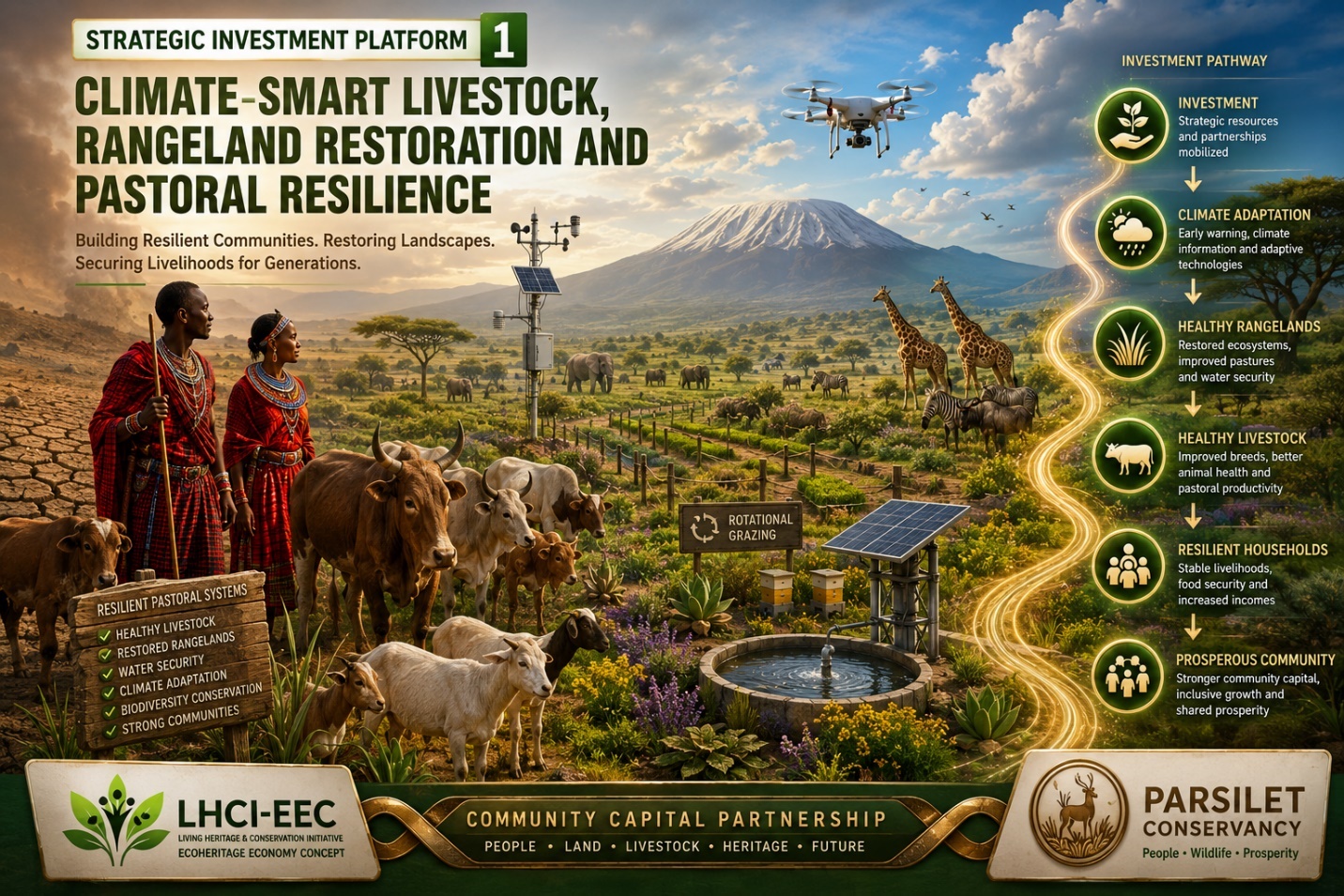
Strategic Investment Platform (SIP 1)
4.4.1 Climate-Smart Livestock, Rangeland Restoration and Pastoral Resilience
4.4.1.1 Introduction
Investing in the Natural Capital that Sustains Community Prosperity
Natural Capital forms the apex ecological foundation upon which all other forms of Community Capital are built. Healthy rangelands, productive livestock, secure watersheds, intact biodiversity, and fertile soils provide the essential assets that sustain pastoral livelihoods, drive inclusive local economies, preserve Living Heritage, and guarantee structural resilience against climate and economic volatility. Within pastoral landscapes such as Parsilet Conservancy, these natural assets are not merely passive environmental resources; they are highly productive capital that continuously generates food security, commercial income, ecosystem services, and intergenerational wealth.
Across Kenya and much of Africa, however, pastoral landscapes are experiencing unprecedented stress. Climate change, prolonged drought cycles, biodiversity collapse, land degradation, and volatile commodity markets act as systemic risks. These interconnected challenges threaten ecological integrity, depress livestock yields, weaken household solvency, and undermine the long-term viability of the pastoral economies that millions depend upon.
Despite these systemic pressures, pastoral communities possess extraordinary proprietary strengths that provide a powerful foundation for regeneration. Indigenous knowledge systems, customary grazing institutions, adaptive herd management, and robust community governance have enabled pastoral societies to thrive within highly variable environments for centuries. When this indigenous intellectual property is fused with modern scientific innovation, climate-smart technologies, and institutional-grade investment, it creates an unprecedented opportunity to engineer productive landscapes capable of sustaining both high-yield economies and thriving ecosystems.
The Living Heritage and Conservation Initiative – EcoHeritage Economy Concept (LHCI-EEC) recognizes that resilient macroeconomic development must begin with sustained, aggressive investment in Natural Capital. Accordingly, Strategic Investment Platform 1 (SIP 1) provides the integrated financial and operational framework through which climate-smart livestock production, regenerative rangeland management, and adaptive pastoral systems are capitalized as mutually reinforcing pillars of long-term landscape transformation.
Rather than addressing livestock development, ecological restoration and climate resilience as separate investment priorities, SIP 1 integrates them within a single Community Capital Investment Framework. Through this integrated approach, investments strengthen productive natural assets that generate lasting ecological, economic, social and cultural value while reinforcing the long-term resilience, productivity and sustainability of both the community and the landscape.
Operationally, SIP 1 is executed through three interconnected Wealth Investment Components (WICs) that collectively capitalize the principal dimensions of Natural Capital within the Parsilet landscape:
Each Wealth Investment Component addresses a distinct yet highly complementary dimension of pastoral landscape resilience. Collectively, they form an integrated investment architecture that strengthens Natural, Human, Enterprise and Heritage Capital by improving livestock productivity, restoring degraded ecosystems, enhancing water security and translating indigenous pastoral knowledge into resilient livelihood and enterprise opportunities.
As the founding Natural Capital platform within the LHCI-EEC portfolio, SIP 1 establishes the ecological baseline upon which all subsequent Strategic Investment Platforms depend. Healthy rangelands sustain productive livestock; high-yield livestock strengthen nature-based enterprises; restored ecosystems support EcoHeritage infrastructure; and well-managed natural resources preserve the Living Heritage that defines the prosperity of the Maasai people.
Through this integrated approach, Parsilet Conservancy is positioned to become Africa's premier Living Laboratory for Climate-Smart Pastoral Systems—a commercially viable, scalable demonstration landscape where indigenous wisdom, regenerative ecology, and strategic investment converge to create lasting intergenerational prosperity.
4.4.1.2 Goal
4.4.1.2.1 Goal Statement
To strengthen Natural Capital through integrated climate-smart livestock production, regenerative rangeland restoration and resilient pastoral systems that sustain healthy ecosystems, productive livelihoods, Living Heritage and long-term community prosperity.
4.4.1.2.2 Desired Future State
Parsilet Conservancy is envisioned as a resilient, climate-smart and regenerative pastoral landscape where healthy ecosystems, productive livestock systems, secure natural resources and empowered pastoral communities continuously strengthen Natural Capital while supporting resilient livelihoods and sustainable prosperity for present and future generations.
4.4.1.2.3 Investment Aspiration
This Strategic Investment Platform seeks to strengthen Natural Capital by supporting climate-smart livestock production, ecosystem restoration and resilient pastoral systems as interconnected drivers of sustainable landscape development. Through strategic investment, the platform enhances the productive capacity of pastoral ecosystems so that they continuously generate ecological, economic and social value while improving resilience to climate variability and other emerging risks. Rather than responding only after environmental degradation has occurred, SIP 1 promotes proactive investment in the long-term health, productivity and resilience of pastoral landscapes as a foundation for broader Community Capital development.
4.4.1.2.4 Long-Term Vision
By strengthening Natural Capital while reinforcing Human, Enterprise, Physical, Social and Heritage Capital, SIP 1 seeks to establish Parsilet Conservancy as a leading African model for climate-smart pastoral development. It envisions a landscape where indigenous knowledge systems, regenerative ecosystem management, scientific innovation and strategic partnerships work together to strengthen biodiversity conservation, resilient livelihoods and sustainable local economies. Over time, the investment models and lessons generated through SIP 1 will contribute to practical approaches that can inform similar pastoral landscapes across Kenya, Africa and other dryland regions.
4.4.1.3 Strategic Objectives
Strengthen climate-smart livestock production systems by improving livestock genetics, animal health, nutrition, welfare, productivity and adaptive management practices that enhance resilient pastoral livelihoods.
Restore, regenerate and sustainably manage rangelands, grazing systems, watersheds and associated ecosystems to improve ecological integrity, biodiversity, soil health, water security and long-term landscape productivity.
Enhance climate resilience and adaptive pastoral systems through integrated drought preparedness, climate risk management, early warning systems, resilient grazing strategies and indigenous pastoral knowledge.
Strengthen sustainable stewardship of Natural Capital by promoting responsible resource governance, ecosystem restoration, biodiversity conservation and the sustainable utilisation of land, water and other natural resources.
Build the technical knowledge, practical competencies, innovation capacity and institutional capabilities of pastoral communities to apply climate-smart technologies, regenerative practices and evidence-based natural resource management.
Promote integrated landscape management that harmonises livestock production, wildlife conservation, ecosystem restoration, water resource management and Living Heritage within a single Community Capital Investment Framework.
Strengthen research, innovation, digital technologies, monitoring systems and knowledge exchange to support adaptive decision-making, continuous learning and long-term stewardship of climate-smart pastoral landscapes.
Mainstream climate resilience, ecosystem restoration, biodiversity conservation and sustainable Natural Capital stewardship across all Strategic Investment Platforms to ensure that every LHCI-EEC investment contributes to resilient landscapes.
The Climate-Smart Livestock, Rangeland Restoration and Pastoral Resilience Strategic Investment Platform (SIP 1) seeks to achieve the following strategic objectives:
Objective 1: Strengthen climate-smart livestock production systems through strategic investments in improved genetics, animal health, nutrition, husbandry and adaptive herd management to enhance productivity, resilience and sustainable pastoral livelihoods.
Objective 2: Restore, regenerate and sustainably manage rangelands, grazing systems and watersheds to improve ecological integrity, biodiversity conservation, soil health and the long-term productivity of pastoral landscapes.
Objective 3: Strengthen climate resilience through integrated drought preparedness, climate information services, adaptive grazing systems and the application of indigenous ecological knowledge alongside appropriate scientific innovations.
Objective 4: Promote responsible community stewardship of land, water and natural resources through participatory governance, regenerative landscape management and sustainable ecosystem management.
Objective 5: Strengthen the technical knowledge, innovation capacity and institutional capabilities of pastoral households, community organisations and local institutions to adopt climate-smart technologies and evidence-based natural resource management practices.
Objective 6: Promote integrated landscape management that balances sustainable livestock production, wildlife conservation, ecosystem restoration and Living Heritage within a mutually reinforcing development framework.
Objective 7: Support applied research, innovation, digital technologies and continuous ecological monitoring to strengthen evidence-based decision-making, adaptive management and long-term landscape stewardship.
Objective 8: Integrate climate resilience, ecosystem restoration and Natural Capital stewardship across all Strategic Investment Platforms, ensuring that investments contribute to long-term landscape resilience, sustainable livelihoods and strengthened Community Capital.
4.4.1.4 Strategic Investment Logic
This framework serves as the operational bridge between the overarching Strategic Objectives and the targeted Wealth Investment Components (WICs).
4.4.1.4.1 Investment Philosophy
SIP 1 adopts a Community Capital Investment approach that recognises Natural Capital as the fundamental ecological and economic foundation upon which resilient livelihoods, inclusive local economies and Living Heritage depend. Through an integrated investment approach, the platform channels strategic investments into interconnected ecological, productive and institutional assets that reinforce one another, creating lasting ecological, economic, social and cultural value while strengthening long-term landscape resilience.
4.4.1.4.2 Strategic Investment Architecture
To operationalize this investment philosophy, SIP 1 is structured into three interconnected Wealth Investment Components (WICs). Each WIC represents a distinct but highly complementary investment portfolio designed to address a specific dimension of Natural Capital development while collectively advancing the master vision of climate-smart landscape transformation.
These three Wealth Investment Components provide the core organizational framework through which capital for livestock production, rangeland management, water security, and climate resilience is deployed, managed, and audited across the Parsilet landscape.
Each WIC is further operationalized through a series of Strategic Investment Areas (SIAs) that translate broad investment mandates into clearly defined, investable programmes of work. Every SIA provides a rigorous implementation framework comprising strategic activities, expected outputs, anticipated outcomes, and Key Performance Indicators (KPIs). This hierarchical architecture ensures that strategic priorities are seamlessly translated into practical, results-oriented operations capable of delivering measurable ROI in Natural Capital.
Table 4.1: Wealth Investment Components under Strategic Investment Platform 1 (SIP 1)
| Wealth Investment Component (WIC) | Strategic Focus | Primary Community Capital Developed |
|---|---|---|
| WIC 4.4.1: Climate-Smart Livestock Productivity and Animal Health | Climate-smart livestock production, resilient genetics, animal health, precision nutrition, herd productivity, digital livestock management, and adaptive production systems. | Natural Capital, with significant co-benefits to Human and Enterprise Capital. |
| WIC 4.4.2: Regenerative Rangelands, Integrated Water Security and Ecosystem Restoration | Regenerative grazing systems, rangeland restoration, biodiversity conservation, integrated water security, soil regeneration, invasive species management, and ecosystem monitoring. | Natural Capital, with significant co-benefits to Heritage, Physical, and Enterprise Capital. |
| WIC 4.4.3: Pastoral Resilience, Indigenous Knowledge and Adaptive Stewardship | Climate adaptation, drought preparedness, indigenous pastoral knowledge, adaptive mobility, predictive climate early warning systems, and continuous pastoral learning. | Natural Capital, with significant co-benefits to Human, Social, and Heritage Capital. |
4.4.1.4.3 Flexible Investment Entry Points
One of the defining strengths of SIP 1 is its ability to accommodate a diverse range of strategic partners—including governments, development partners, climate finance institutions, multilateral development banks, research institutions, conservation organisations, philanthropic foundations, responsible private sector actors and community organisations—within a single Community Capital Investment Framework.
Recognising that partners operate under different institutional mandates, investment priorities and financing mechanisms, the platform provides multiple and flexible entry points for participation while maintaining strategic alignment with the overall Community Capital Investment Framework. Partners may support the Strategic Investment Platform as a whole, invest within a specific Wealth Investment Component (WIC), or contribute to clearly defined Strategic Investment Areas (SIAs) that align with their respective priorities and expertise.
For example, a climate technology investor may support digital livestock management under WIC 4.4.1, while a watershed conservation organisation may invest in ecosystem restoration under WIC 4.4.2. Academic and research institutions may contribute applied research, innovation and technical expertise within WIC 4.4.3. This flexible architecture encourages blended financing, collaborative investment and complementary partnerships, enabling multiple organisations to contribute within the same Strategic Investment Area while enhancing efficiency, shared learning and collective impact.
Regardless of the chosen entry point, all investments remain aligned with the shared vision, guiding principles and Community Capital Investment Framework of SIP 1, ensuring that individual investments collectively strengthen Natural Capital while generating complementary benefits across the wider LHCI-EEC Community Capital Investment Platform.
4.4.1.4.4 Building Natural Capital for Landscape Transformation
The three Wealth Investment Components collectively provide an integrated investment architecture for strengthening the Natural Capital upon which the long-term resilience and productivity of the Parsilet landscape depend. Rather than addressing livestock development, ecosystem restoration and pastoral resilience as separate investment priorities, SIP 1 recognises these as interconnected systems that are mutually reinforcing and most effective when strengthened together.
The integrated design of SIP 1 enables investments within one Wealth Investment Component to reinforce outcomes across the others. Improved livestock genetics achieve greater productivity when supported by strong animal health systems, quality nutrition and resilient grazing landscapes. Likewise, productive livestock systems depend upon healthy rangelands, reliable water resources and well-managed ecosystems. Indigenous knowledge, scientific innovation, digital technologies and community stewardship together provide the knowledge systems and governance required to sustain these productive assets over the long term.
Through these complementary investments, SIP 1 strengthens Natural Capital as a productive community asset that continuously generates ecological, economic, social and cultural value. In doing so, it establishes the ecological foundation upon which the remaining LHCI-EEC Strategic Investment Platforms build, contributing to the long-term transformation of Parsilet Conservancy into a resilient, productive and regenerative pastoral landscape while generating practical investment models that can inform similar landscapes across Kenya, Africa and other dryland regions.
4.4.1 Wealth Investment Component (WIC 4.4.1)
Climate-Smart Livestock Productivity and Animal Health
4.4.1.1 Climate-Smart Livestock Productivity and Animal Health Investment Framework
Climate-Smart Livestock Productivity and Animal Health is the first Wealth Investment Component (WIC) under the Climate-Smart Livestock, Rangeland Restoration and Pastoral Resilience Strategic Investment Platform (SIP 1). It serves as the principal investment pathway through which the LHCI-EEC Community Capital Investment Platform strengthens productive livestock systems as one of the most valuable and renewable forms of Natural Capital within the Parsilet landscape.
Within pastoral economies, livestock represent far more than agricultural commodities. They are productive community assets that support food security, household incomes, wealth creation, ecological stewardship and long-term livelihood resilience. For the Maasai community, livestock also embody Living Heritage, reflecting the enduring cultural, social and economic relationship between people, livestock and the land. Consequently, investing in livestock productivity extends beyond improving agricultural performance; it strengthens the broader Community Capital upon which resilient pastoral development depends.
The productivity of pastoral livestock systems depends upon the effective interaction of multiple biological, ecological and institutional factors. Improved livestock genetics require strong animal health systems to realise their productive potential. Healthy herds depend upon quality nutrition, reliable water resources and responsible livestock husbandry. Long-term resilience is further strengthened through adaptive management, digital technologies, market information and continuous innovation that enable communities to respond effectively to changing climatic and market conditions. Weakness in any of these interconnected elements can reduce the overall performance and resilience of the livestock production system.
Recognising these interdependencies, LHCI-EEC adopts an integrated livestock investment approach that brings together genetics, animal health, nutrition, husbandry, water security and appropriate technologies within a single Community Capital Investment Framework. Rather than supporting these areas independently, investments are designed to reinforce one another, strengthening the resilience, productivity and sustainability of pastoral livestock systems.
This Wealth Investment Component also recognises that productive livestock systems and healthy ecosystems are mutually dependent. Commercially viable livestock enterprises rely upon healthy rangelands, secure water resources and functioning ecosystems, while responsible grazing management, appropriate stocking practices and evidence-based pastoral decision-making contribute to long-term ecological stewardship. Investments in livestock productivity therefore simultaneously strengthen both Natural Capital and pastoral livelihoods.
Through the Community Capital Investment Approach, investments in livestock production generate benefits that extend well beyond Natural Capital. Improved livestock productivity contributes to household food security, enterprise development, income diversification, local value addition and the preservation of pastoral knowledge and traditions. As a result, investments within this Wealth Investment Component also strengthen Human Capital, Enterprise Capital, Social Capital and Heritage Capital while reinforcing the ecological foundation upon which pastoral livelihoods depend.
Rather than promoting herd expansion alone, WIC 4.4.1 prioritizes improvements in livestock quality, productivity, resilience and sustainability. Success is measured through healthier livestock, reduced mortality, improved meat and milk productivity, stronger household incomes, enhanced climate resilience and the sustainable use of natural resources. In this way, the Wealth Investment Component supports the gradual transformation of pastoral livestock systems into resilient, climate-smart and regenerative enterprises capable of generating lasting benefits for present and future generations.
To translate this investment philosophy into practical implementation, this Wealth Investment Component is organised around six mutually reinforcing Strategic Investment Areas (SIAs). Together, these SIAs address the technical, institutional, knowledge and innovation systems required to strengthen modern climate-smart pastoral livestock production. While each Strategic Investment Area focuses on a distinct investment priority, they function collectively as an integrated investment portfolio in which progress within one area reinforces outcomes across the others.
Collectively, these six Strategic Investment Areas strengthen climate-smart livestock genetics, animal health systems, sustainable fodder production, adaptive herd management, digital livestock innovation and applied research. Working together, they provide a comprehensive investment framework that enables the Parsilet community to build resilient, productive and sustainable pastoral enterprises while safeguarding the natural resources upon which their long-term prosperity depends.
Accordingly, the Climate-Smart Livestock Productivity and Animal Health Wealth Investment Component is implemented through the following six Strategic Investment Areas:
Table 4.2: Strategic Investment Areas under Wealth Investment Component 4.4.1 – Climate-Smart Livestock Productivity and Animal Health
| Strategic Investment Area (SIA) | Strategic Investment Focus | Primary Community Capital Strengthened |
|---|---|---|
| SIA 1: Climate-Smart Livestock Genetics and Sustainable Breeding Systems | Community breeding programmes, climate-resilient livestock genetics, performance recording, appropriate reproductive technologies, and sustainable genetic resource management. | Natural Capital |
| SIA 2: Animal Health, Biosecurity and One Health Systems | Preventive animal health, disease surveillance, biosecurity, Community Animal Health Worker systems, veterinary services and One Health innovation. | Natural Capital |
| SIA 3: Climate-Smart Livestock Nutrition, Fodder and Water Security | Sustainable fodder production, livestock nutrition, forage conservation, water security systems and drought resilience. | Natural Capital |
| SIA 4: Sustainable Herd Management, Animal Welfare and Production Efficiency | Sustainable herd management, animal welfare, adaptive grazing systems, livestock performance improvement and climate-smart pastoral husbandry. | Natural Capital |
| SIA 5: Digital Livestock Innovation, Data Systems and SMART Pastoral Technologies | Digital livestock management, traceability systems, climate information services, GIS-supported rangeland management, data systems and SMART pastoral technologies. | Natural Capital, Human Capital |
| SIA 6: Continuous Learning, Research, Knowledge Exchange and Livestock Stewardship | Applied research, indigenous knowledge integration, innovation, capacity strengthening, knowledge exchange and adaptive livestock stewardship. | Human Capital, Heritage Capital, Natural Capital |
4.4.1.5.1 Strategic Investment Area 1 (SIA 1)
Climate-Smart Livestock Genetics and Sustainable Breeding Systems
4.4.1.5.1.1 Background and Investment Rationale
Livestock genetics represent one of the most important long-term investments in productive pastoral systems. Genetic quality influences livestock productivity, fertility, disease tolerance, climate resilience, feed conversion efficiency and the overall sustainability of pastoral livelihoods. Within Parsilet Conservancy, livestock are far more than productive assets; they constitute one of the most valuable forms of Natural Capital, supporting household incomes, cultural identity, ecological stewardship and intergenerational prosperity.
For generations, Maasai pastoralists have developed and sustained indigenous livestock breeds through practical knowledge, selective breeding and adaptive herd management. These indigenous genetic resources possess highly valuable traits, including drought tolerance, resilience to extreme environments, efficient utilization of marginal pastures and adaptation to localized disease pressures. However, increasing climate variability, changing production systems, unregulated breeding, declining genetic quality and limited access to structured breeding support are gradually reducing the productive potential of these pastoral herds.
At the same time, advances in animal breeding, performance recording, reproductive technologies and livestock genetics present significant opportunities to improve productivity while maintaining the resilience and adaptive qualities that have enabled indigenous pastoral systems to thrive for generations. The objective is therefore not to replace indigenous livestock genetics, but to strengthen them through climate-smart breeding systems that combine indigenous pastoral knowledge with appropriate scientific innovation. This integration supports the development of healthier, higher-yielding and climate-resilient livestock capable of sustaining profitable pastoral enterprises while maintaining ecological balance.
This Strategic Investment Area recognises livestock genetics as a foundational investment in Natural Capital. It seeks to establish structured community breeding systems that improve livestock productivity and climate resilience through systematic selection, performance recording, breeding planning and community-led genetic stewardship. Rather than pursuing volume-driven herd expansion, the emphasis is placed on improving the long-term quality, productivity and resilience of pastoral herds. By strengthening livestock genetics today, Parsilet Conservancy invests in productive Natural Capital that will continue generating ecological, economic and social value for households, ecosystems and future generations.
4.4.1.5.1.2 Priority Investment Activities
The programme will:
Activity 1: Establish the Parsilet Climate-Smart Community Breeding Programme to coordinate long-term livestock genetic improvement across the Conservancy.
Activity 2: Develop and implement community-led breeding strategies that integrate indigenous Maasai breeding knowledge with modern, evidence-based animal breeding approaches.
Activity 3: Identify, register and promote elite breeding bulls, rams and bucks based on agreed productivity, climate resilience, fertility and disease tolerance criteria.
Activity 4: Strengthen community capacity through training programmes in livestock selection, breeding planning, pedigree management and performance recording.
Activity 5: Promote the conservation and sustainable improvement of indigenous livestock genetic resources that are uniquely adapted to semi-arid pastoral environments.
Activity 6: Develop practical livestock performance recording systems to monitor growth rates, fertility, milk production, survival rates and climate adaptation performance.
Activity 7: Facilitate community access to appropriate reproductive technologies, including controlled breeding systems, artificial insemination and other scientifically validated innovations.
Activity 8: Develop and implement community breeding guidelines that minimize inbreeding while strengthening desirable productivity, resilience and adaptive traits within local livestock populations.
Activity 9: Establish demonstration breeding herds that serve as practical learning centres for pastoral households, producer groups and livestock cooperatives.
Activity 10: Strengthen strategic partnerships with national livestock research institutions, universities, veterinary agencies and breeding organisations to support continuous research, innovation and genetic improvement.
Activity 11: Promote meaningful participation of women and youth in livestock breeding management, performance recording, digital monitoring and community genetic stewardship.
Activity 12: Develop a Community Livestock Genetics Information System to support evidence-based breeding decisions, continuous learning and long-term genetic improvement.
4.4.1.5.1.3 Expected Outputs
Implementation of this Strategic Investment Area will deliver:
Output 1: A fully operational Parsilet Climate-Smart Community Breeding Programme coordinating community livestock genetic improvement across the Conservancy.
Output 2: Community-based livestock breeding plans developed and implemented using integrated indigenous knowledge and evidence-based breeding approaches.
Output 3: A verified community registry of elite breeding bulls, rams and bucks established and actively managed.
Output 4: Functional livestock performance recording and genetic information systems established to support evidence-based breeding decisions.
Output 5: Indigenous livestock genetic resources systematically conserved, documented and sustainably improved.
Output 6: Demonstration breeding herds established to support practical learning, applied research and community knowledge exchange.
Output 7: Community technical capacity strengthened in livestock breeding, genetic improvement, performance recording and responsible genetic stewardship.
4.4.1.5.1.4 Expected Outcomes
Implementation of this Strategic Investment Area will result in:
Outcome 1: Improved livestock productivity, fertility and climate resilience across participating pastoral herds.
Outcome 2: Increased resilience of livestock production systems to drought, disease pressures and climate variability.
Outcome 3: Enhanced household incomes through improved livestock productivity achieved alongside sustainable natural resource management.
Outcome 4: Strengthened conservation and sustainable utilization of valuable indigenous livestock genetic resources.
Outcome 5: Strengthened Natural Capital through healthier, more productive and climate-resilient livestock populations.
Outcome 6: Institutionalization of evidence-based livestock breeding systems that support continuous improvement in pastoral productivity across the Parsilet landscape.
4.4.1.5.1.5 Key Performance Indicators (KPIs)
Success will be measured through:
KPI 1: Number of households actively participating in the Community Breeding Programme.
KPI 2: Number of elite breeding bulls, rams and bucks identified, registered and actively managed.
KPI 3: Percentage improvement in livestock productivity among participating herds.
KPI 4: Number of community members trained in livestock breeding, genetic improvement and performance recording.
KPI 5: Number of livestock performance records captured and maintained within the Community Livestock Genetics Information System.
KPI 6: Percentage reduction in unplanned or uncontrolled breeding practices across participating communities.
KPI 7: Number of demonstration breeding herds established and actively utilized for training, research and community learning.
KPI 8: Percentage improvement in herd fertility, offspring survival rates and climate adaptation performance over time.
4.4.1.5.1.6 Investment Quote
"The future strength of pastoral livelihoods begins with the quality of today's breeding decisions. Every investment in resilient livestock genetics strengthens Natural Capital, improves household prosperity and safeguards the productive heritage that future generations will inherit."
4.4.1.5.2 Strategic Investment Area 2 (SIA 2)
Animal Health, Biosecurity and One Health Systems
4.4.1.5.2.1 Background and Investment Rationale
Healthy livestock form the foundation of productive pastoral systems and resilient Natural Capital. Regardless of the quality of livestock genetics or the availability of grazing resources, sustainable livestock productivity depends upon effective disease prevention, timely veterinary services and sound animal health management. Livestock diseases reduce productivity, increase mortality, constrain market access, diminish household incomes and weaken the ecological and economic resilience of pastoral communities.
Within Parsilet Conservancy, pastoral households possess generations of indigenous knowledge relating to livestock health, disease recognition, ethnoveterinary medicine and adaptive herd management. These traditional practices continue to contribute significantly to livestock resilience. However, increasing livestock mobility, climate variability, transboundary animal diseases, antimicrobial resistance and evolving market requirements require stronger integration of indigenous knowledge with modern, evidence-based veterinary science.
The health of livestock is also closely connected to the health of people and the surrounding environment. Many livestock diseases affect wildlife, human health, food safety and ecosystem sustainability. This interconnected relationship underscores the importance of adopting a One Health approach that promotes coordinated management of animal, human and environmental health to strengthen resilient pastoral systems.
This Strategic Investment Area therefore recognizes animal health as a strategic investment in Natural Capital. It seeks to strengthen preventive animal health systems through disease surveillance, community-based veterinary services, biosecurity, responsible livestock management and integrated One Health approaches. Rather than focusing primarily on responding to disease outbreaks, emphasis is placed on strengthening preventive systems that reduce biological risks, improve livestock productivity and support resilient pastoral livelihoods.
By investing in livestock health today, Parsilet Conservancy strengthens the productivity of its Natural Capital, enhances household food security, supports responsible ecosystem stewardship and contributes to the long-term resilience of the entire Community Capital Investment Platform.
4.4.1.5.2.2 Priority Investment Activities
The programme will:
Activity 1: Establish the Parsilet Community Animal Health and One Health Programme to strengthen preventive livestock health management across the Conservancy.
Activity 2: Develop community-based livestock disease surveillance, early warning and rapid response systems for endemic, emerging and transboundary animal diseases.
Activity 3: Train, certify and equip Community-Based Animal Health Workers (CBAHWs) to provide decentralized veterinary advisory, extension and animal health services.
Activity 4: Promote routine livestock vaccination, parasite control, herd health planning and preventive veterinary care across participating pastoral communities.
Activity 5: Strengthen livestock biosecurity systems and good husbandry practices that reduce disease transmission within herds, between neighbouring communities and across wildlife-livestock interfaces.
Activity 6: Promote the integration of validated indigenous ethnoveterinary knowledge with evidence-based veterinary science to strengthen animal health management while preserving valuable indigenous knowledge.
Activity 7: Promote the responsible use of veterinary medicines, antimicrobial stewardship and improved livestock husbandry practices to strengthen food safety and reduce antimicrobial resistance.
Activity 8: Strengthen livestock disease reporting through appropriate digital applications, mobile information systems and community-based animal health information networks.
Activity 9: Strengthen strategic partnerships with national veterinary services, public health institutions, wildlife authorities, universities and research organisations to advance integrated One Health systems.
Activity 10: Establish Community Animal Health Demonstration Centres to support practical learning, veterinary outreach, research and community capacity building.
Activity 11: Implement community education programmes on zoonotic diseases, food safety, public health, environmental hygiene and integrated One Health practices.
Activity 12: Develop livestock health monitoring and evaluation systems that support evidence-based decision-making, continuous learning and adaptive improvement of community veterinary services.
4.4.1.5.2.3 Expected Outputs
Implementation of this Strategic Investment Area will deliver:
Output 1: A fully operational Parsilet Community Animal Health and One Health Programme coordinating integrated livestock health management across the Conservancy.
Output 2: Functional community-based livestock disease surveillance, early warning and rapid response systems established and operational.
Output 3: A trained, certified and well-supported network of Community-Based Animal Health Workers (CBAHWs) providing decentralized animal health and veterinary extension services.
Output 4: Routine livestock vaccination, parasite control and preventive veterinary health programmes implemented across participating pastoral communities.
Output 5: Livestock biosecurity protocols and good animal husbandry practices strengthened and adopted across participating households.
Output 6: Functional digital animal health information systems and community disease reporting networks established to support evidence-based decision-making.
Output 7: Strategic One Health partnerships established among veterinary services, public health institutions, wildlife authorities, research organisations and community institutions.
4.4.1.5.2.4 Expected Outcomes
Implementation of this Strategic Investment Area will result in:
Outcome 1: Reduced incidence of priority livestock diseases, preventable livestock mortality and associated production losses.
Outcome 2: Improved livestock productivity, animal welfare and reproductive performance across participating pastoral systems.
Outcome 3: Increased resilience of pastoral households to livestock disease outbreaks and climate-related animal health risks.
Outcome 4: Improved integration of indigenous livestock health knowledge with evidence-based veterinary services and One Health approaches.
Outcome 5: Strengthened protection of animal, human and ecosystem health through coordinated implementation of One Health principles.
Outcome 6: Strengthened Natural Capital through healthier, more productive livestock populations that support resilient pastoral livelihoods and sustainable landscape stewardship.
4.4.1.5.2.5 Key Performance Indicators (KPIs)
Success will be measured through:
KPI 1: Number of Community-Based Animal Health Workers (CBAHWs) trained, certified and actively providing community animal health services.
KPI 2: Percentage of livestock receiving routine vaccinations, parasite control and preventive veterinary care.
KPI 3: Number of community livestock disease surveillance and early warning systems established and operational.
KPI 4: Percentage reduction in the incidence and mortality of priority livestock diseases.
KPI 5: Number of households implementing recommended livestock biosecurity and herd health management practices.
KPI 6: Number of strategic One Health partnerships established with veterinary services, public health institutions, wildlife authorities, universities and research organisations.
KPI 7: Percentage improvement in livestock productivity attributable to strengthened animal health management.
KPI 8: Number of community members reached through One Health awareness, livestock health education and preventive animal health programmes.
4.4.1.5.2.6 Investment Quote
"Healthy livestock are the foundation of resilient pastoral livelihoods. Every investment in preventive animal health strengthens Natural Capital, safeguards household prosperity, protects ecosystem health and builds more resilient pastoral communities for generations to come."
4.4.1.5.3 Strategic Investment Area 3 (SIA 3)
Climate-Smart Livestock Nutrition, Fodder and Water Security
4.4.1.5.3.1 Background and Investment Rationale
The productivity and resilience of pastoral livestock systems depend upon the continuous availability of quality livestock feed, reliable water resources and well-managed nutrition systems. Regardless of the quality of livestock genetics or animal health services, livestock cannot achieve their productive potential when nutrition is inadequate or when prolonged droughts limit access to pasture and water. Climate variability, recurrent droughts, land degradation and increasing pressure on grazing resources continue to pose significant challenges to sustainable livestock production across pastoral landscapes.
For generations, Maasai pastoralists have managed livestock nutrition through seasonal mobility, rotational grazing, pasture conservation and extensive indigenous ecological knowledge. These adaptive systems have enabled pastoral production to thrive under highly variable climatic conditions while maintaining the ecological balance of rangeland ecosystems. Today, these indigenous management systems remain an invaluable form of Heritage Capital. However, changing climatic conditions, reduced grazing mobility, increasing settlement, land fragmentation and recurrent droughts require complementary investments that strengthen traditional systems through climate-smart fodder production, improved water infrastructure and modern livestock nutrition practices.
This Strategic Investment Area therefore recognizes climate-smart livestock nutrition, sustainable fodder production and water security as strategic investments in Natural Capital. It seeks to strengthen year-round livestock feeding systems through integrated investments in climate-smart fodder production, pasture restoration, forage conservation, water resource development and adaptive grazing management. These investments enhance livestock productivity while strengthening the resilience of pastoral households and safeguarding ecosystem health.
Rather than relying primarily on emergency feed interventions during periods of drought, this Strategic Investment Area promotes long-term investments that strengthen local feed systems, improve water security and build resilient pastoral production systems capable of adapting to changing climatic conditions. By investing in climate-smart livestock nutrition and water security, Parsilet Conservancy strengthens its Natural Capital while supporting resilient livelihoods, healthy ecosystems and sustainable Community Capital development.
4.4.1.5.3.2 Priority Investment Activities
The programme will:
Activity 1: Establish the Parsilet Climate-Smart Fodder and Livestock Nutrition Programme to coordinate sustainable livestock nutrition and year-round fodder supply across the Conservancy.
Activity 2: Promote climate-smart fodder production using drought-tolerant grasses, nutritious forage legumes, fodder shrubs and indigenous forage species adapted to semi-arid pastoral environments.
Activity 3: Establish community fodder banks and strategic feed reserves to improve preparedness for drought and seasonal feed shortages.
Activity 4: Restore degraded grazing areas through pasture rehabilitation, indigenous grass reseeding and regenerative forage production practices.
Activity 5: Promote forage conservation technologies, including hay production, silage making and appropriate feed storage systems that reduce seasonal feed losses.
Activity 6: Develop climate-smart livestock feeding strategies that integrate seasonal grazing management, forage budgeting and adaptive herd management practices.
Activity 7: Develop Community Climate Resilience Water Hubs incorporating boreholes, rainwater harvesting systems, water storage facilities and livestock watering infrastructure to support livestock production, fodder development, Heritage Pastoral Gardens and wildlife conservation.
Activity 8: Strengthen integrated water resource management through groundwater stewardship, watershed protection, efficient water utilization and equitable allocation for community development and ecosystem restoration.
Activity 9: Strengthen community capacity in livestock nutrition planning, feed formulation and the efficient utilization of locally available feed resources.
Activity 10: Develop community monitoring systems that track pasture conditions, water availability and seasonal livestock nutrition requirements to support evidence-based planning and decision-making.
Activity 11: Strengthen strategic partnerships with agricultural research institutions, extension services, universities and technical organizations to promote continuous innovation in climate-smart livestock nutrition and fodder systems.
Activity 12: Promote the integration of indigenous rotational grazing knowledge with evidence-based pasture management practices to strengthen sustainable livestock feeding systems and long-term ecosystem resilience.
4.4.1.5.3.3 Expected Outputs
Implementation of this Strategic Investment Area will deliver:
Output 1: A fully operational Parsilet Climate-Smart Fodder and Livestock Nutrition Programme coordinating resilient livestock nutrition and fodder systems across the Conservancy.
Output 2: Community Climate Resilience Water Hubs established and operational, incorporating strategic production boreholes, rainwater harvesting systems, bulk water storage and distribution infrastructure supporting livestock, wildlife, Heritage Pastoral Gardens and climate-smart fodder production.
Output 3: Functional community fodder banks and strategic feed reserves established to strengthen preparedness for seasonal feed shortages and drought.
Output 4: Climate-smart fodder production areas established using drought-tolerant forage species and improved pasture management practices.
Output 5: Degraded grazing lands progressively rehabilitated through pasture restoration, indigenous grass reseeding and regenerative grazing management.
Output 6: Functional forage conservation systems established, including hay production, silage making and improved feed storage facilities.
Output 7: Community technical capacity strengthened in livestock nutrition planning, climate-smart fodder production, adaptive grazing management and community water resource stewardship.
Output 8: Functional community monitoring systems established to support pasture assessment, fodder forecasting, water resource management and evidence-based livestock nutrition planning.
4.4.1.5.3.4 Expected Outcomes
Implementation of this Strategic Investment Area will result in:
Outcome 1: Improved livestock nutrition, animal health, growth performance, reproductive efficiency and overall livestock productivity.
Outcome 2: Increased household resilience through reliable year-round access to quality livestock feed and improved water security.
Outcome 3: Reduced livestock mortality, production losses and livelihood vulnerability associated with drought and seasonal feed shortages.
Outcome 4: Improved ecological condition, carrying capacity and sustainable utilization of communal rangelands and grazing ecosystems.
Outcome 5: Strengthened water security supporting livestock production, climate-smart fodder systems, wildlife conservation and landscape restoration.
Outcome 6: Strengthened Natural Capital through integrated livestock nutrition, sustainable water resource management and climate-resilient pastoral production systems.
4.4.1.5.3.5 Key Performance Indicators (KPIs)
Success will be measured through:
KPI 1: Number of households adopting climate-smart fodder production and improved livestock nutrition practices.
KPI 2: Hectares of degraded rangeland rehabilitated through pasture restoration, indigenous grass reseeding and regenerative grazing management.
KPI 3: Number of functional community fodder banks and strategic feed reserves established and operational.
KPI 4: Quantity (metric tonnes) of fodder produced, conserved and stored annually through hay production, silage making and other forage conservation technologies.
KPI 5: Number of Community Climate Resilience Water Hubs established and operational.
KPI 6: Volume (cubic metres) of water supplied annually through Community Climate Resilience Water Hubs for livestock, wildlife, Heritage Pastoral Gardens and climate-smart fodder production.
KPI 7: Percentage reduction in livestock feed and water shortages during dry seasons and drought periods.
KPI 8: Percentage improvement in livestock body condition, productivity, reproductive performance and survival rates.
KPI 9: Number of community members trained in climate-smart livestock nutrition, adaptive grazing management and integrated water resource management.
KPI 10: Percentage of households reporting improved resilience to climate variability attributable to strengthened livestock nutrition and water security systems.
4.4.1.5.3.6 Investment Quote
"Resilient pastoral systems are built through sustained investment in the resources that livestock depend upon every day. By strengthening climate-smart nutrition, sustainable fodder systems and reliable water security, we build healthier herds, more resilient households and stronger Natural Capital for present and future generations."
4.4.1.5.4 Strategic Investment Area 4 (SIA 4)
Sustainable Herd Management, Animal Welfare and Production Efficiency
4.4.1.5.4.1 Background and Investment Rationale
The long-term productivity and resilience of pastoral livestock systems depend not only on improved genetics, quality nutrition and effective animal health services, but also on the quality of herd management practices applied throughout the livestock production cycle. Sustainable herd management integrates livestock productivity, animal welfare, responsible grazing, ecological stewardship and efficient resource utilization to ensure that pastoral systems remain productive, resilient and environmentally sustainable over time.
Within Parsilet Conservancy, Maasai pastoral communities have developed sophisticated herd management systems founded upon seasonal livestock mobility, adaptive grazing practices, strategic herd composition and indigenous ecological knowledge. These management systems have enabled pastoral households to sustain livestock production under highly variable climatic conditions while conserving biodiversity and maintaining ecological balance. Today, however, increasing climate variability, changing land-use patterns, reduced grazing mobility and evolving livestock market requirements require complementary investments that strengthen traditional practices through scientific management, digital technologies and evidence-based decision-making.
This Strategic Investment Area therefore recognizes sustainable herd management as a strategic investment in Natural Capital. It seeks to strengthen livestock productivity through improved herd planning, adaptive grazing management, reproductive performance, responsible stocking practices, animal welfare, performance monitoring and data-informed management systems. The emphasis is not on increasing herd numbers, but on improving livestock productivity, resource-use efficiency and the long-term sustainability of pastoral production systems.
Animal welfare is similarly recognized as an important component of sustainable livestock production. Healthy, well-managed animals generally demonstrate improved productivity, stronger reproductive performance, greater resilience to disease and increased market value. Investments that strengthen responsible animal welfare practices therefore contribute simultaneously to improved livestock performance, responsible resource management and enhanced market competitiveness while remaining consistent with internationally recognized environmental, social and governance (ESG) principles and the values of pastoral communities.
By strengthening sustainable herd management systems, Parsilet Conservancy seeks to optimize livestock productivity while maintaining healthy ecosystems, supporting resilient pastoral livelihoods and safeguarding Natural Capital for present and future generations.
4.4.1.5.4.2 Priority Investment Activities
The programme will:
Activity 1: Establish the Parsilet Sustainable Herd Management and Productivity Programme to strengthen integrated livestock management systems across the Conservancy.
Activity 2: Develop community-led herd management plans that optimize herd structure, livestock productivity, grazing management and sustainable utilization of available natural resources.
Activity 3: Promote adaptive rotational grazing systems that balance livestock production with pasture regeneration, seasonal resource availability and long-term rangeland health.
Activity 4: Strengthen livestock productivity through improved reproductive management, herd performance monitoring and evidence-based production planning.
Activity 5: Promote responsible animal welfare standards that strengthen humane livestock handling, low-stress transport, appropriate housing and good livestock husbandry while respecting indigenous pastoral practices.
Activity 6: Strengthen community capacity in sustainable stocking management, herd planning, livestock record management and climate-smart production planning.
Activity 7: Develop community livestock performance monitoring systems that track herd fertility, growth performance, feed efficiency and overall livestock productivity.
Activity 8: Strengthen participatory grazing management through rotational grazing plans, pasture recovery scheduling and sustainable management of communal grazing reserves.
Activity 9: Promote livestock identification, traceability and digital herd information systems that strengthen livestock management, disease control and access to quality markets.
Activity 10: Establish Sustainable Herd Management Demonstration Centres that support practical learning, innovation, research and community knowledge exchange.
Activity 11: Promote the integration of indigenous Maasai herd management knowledge with evidence-based livestock management practices to strengthen adaptive and resilient pastoral production systems.
Activity 12: Institutionalize continuous monitoring, evaluation, learning and adaptive management systems that support evidence-based herd management and long-term stewardship of Natural Capital.
4.4.1.5.4.3 Expected Outputs
Implementation of this Strategic Investment Area will deliver:
Output 1: A fully operational Parsilet Sustainable Herd Management and Productivity Programme coordinating integrated herd management across the Conservancy.
Output 2: Community-led herd management plans developed and implemented to strengthen livestock productivity, grazing management and sustainable resource utilization.
Output 3: Climate-smart rotational grazing systems established and operational across designated communal grazing areas.
Output 4: Functional livestock productivity and herd performance monitoring systems established to support evidence-based management.
Output 5: Responsible community animal welfare standards adopted and integrated into livestock management practices.
Output 6: Functional livestock identification, traceability and digital herd information systems established to strengthen livestock management and market access.
Output 7: Sustainable Herd Management Demonstration Centres established to support practical learning, applied research and community capacity development.
Output 8: Community technical capacity strengthened in adaptive herd management, livestock productivity improvement and responsible animal welfare practices.
4.4.1.5.4.4 Expected Outcomes
Implementation of this Strategic Investment Area will result in:
Outcome 1. Improved livestock productivity, reproductive performance and overall herd management efficiency through the adoption of climate-smart and evidence-informed management practices.
Outcome 2. Better alignment between herd sizes, grazing resources and the ecological carrying capacity of the landscape, supporting sustainable livestock production over time.
Outcome 3. Enhanced animal welfare standards that contribute to healthier livestock, improved production performance and increased market competitiveness.
Outcome 4. Improved condition and sustainable utilization of communal grazing resources through adaptive grazing management and responsible herd stewardship.
Outcome 5. Increased household resilience and livestock enterprise performance through more efficient herd management, improved resource utilization and better production planning.
Outcome 6. Strengthened Natural Capital through integrated herd management systems that balance livestock productivity, ecosystem stewardship and long-term landscape resilience.
4.4.1.5.4.5 Key Performance Indicators (KPIs)
Success will be measured through:
KPI 1. Number of registered households implementing sustainable herd management plans.
KPI 2. Percentage improvement in livestock productivity, reproductive performance and herd growth rates.
KPI 3. Percentage reduction in preventable livestock mortality attributable to improved herd management practices.
KPI 4. Hectares managed under adaptive rotational grazing systems.
KPI 5. Percentage of participating households adopting recommended animal welfare standards and responsible livestock management practices.
KPI 6. Number of livestock identified, registered and managed through community livestock information and traceability systems.
KPI 7. Number of Demonstration Herd Management and Learning Centres established and operational.
KPI 8. Number of community members trained in sustainable herd management, livestock production efficiency and animal welfare.
KPI 9. Percentage improvement in grazing resource condition and sustainable carrying capacity based on community and ecological monitoring systems.
KPI 10. Percentage increase in household livestock enterprise performance attributable to improved herd management practices.
4.4.1.5.4.6 Investment Quote
"Well-managed herds are the result of informed decisions made every day. By investing in sustainable herd management, responsible animal welfare and adaptive production systems, communities strengthen Natural Capital, improve livestock performance and build resilient pastoral economies for future generations."
4.4.1.5.5 Strategic Investment Area 5
SMART Pastoral Intelligence, Digital Innovation and Decision Support Systems
4.4.1.5.5.1 Background and Investment Rationale
The future competitiveness and resilience of climate-smart pastoral systems increasingly depends on the ability of communities to access timely information, apply appropriate digital technologies and utilize data to support informed decision-making. Digital innovation is creating new opportunities to strengthen livestock identification, disease surveillance, breeding management, climate forecasting, rangeland monitoring, market intelligence and overall pastoral productivity. When appropriately applied, these technologies can help pastoral communities improve productivity, strengthen climate resilience and enhance access to emerging market opportunities.
Within Parsilet Conservancy, pastoral households have for generations relied upon sophisticated indigenous knowledge systems to interpret weather patterns, understand livestock behaviour, assess pasture conditions and guide seasonal grazing decisions. These indigenous knowledge systems remain an invaluable form of Heritage Capital and continue to provide an essential foundation for adaptive pastoral management. As climatic variability, market integration and technological advancement continue to evolve, there is increasing opportunity to complement this indigenous knowledge with appropriate digital technologies that strengthen rather than replace community decision-making.
This Strategic Investment Area therefore recognizes digital innovation as an important enabler linking Human Capital and Natural Capital. Investments focus on strengthening the digital capabilities of pastoral households, Community Animal Health Workers, producer groups, conservancy leadership and technical partners through practical technologies that improve livestock management, ecosystem stewardship and evidence-based planning.
Rather than introducing technology for its own sake, this Strategic Investment Area prioritizes practical, locally appropriate and sustainable digital solutions that respond to community needs. Investments support digital data systems, climate information services, livestock traceability, decision-support tools and knowledge-sharing platforms that improve planning, strengthen accountability and enhance long-term landscape management.
By integrating indigenous pastoral knowledge with appropriate digital technologies, predictive information systems and applied innovation, Parsilet Conservancy seeks to demonstrate how SMART pastoral systems can strengthen resilient livelihoods, improve ecosystem stewardship and create a scalable model for climate-smart pastoral development across Kenya and other dryland landscapes.
4.4.1.5.5.2 Priority Investment Activities
The programme will:
Activity 1. Establish and operationalize the Parsilet SMART Pastoral Innovation Programme to coordinate digital transformation and technology adoption across livestock and landscape management systems.
Activity 2. Develop integrated digital livestock information systems supporting livestock identification, herd registration, breeding management, traceability and production records.
Activity 3. Deploy mobile and cloud-based platforms that strengthen community animal health surveillance, veterinary reporting and timely disease response.
Activity 4. Improve community access to climate information services, localized weather forecasting and early warning systems that support adaptive grazing and livestock management decisions.
Activity 5. Establish digital pasture and rangeland monitoring systems utilizing satellite imagery, remote sensing and appropriate digital technologies to support sustainable grazing management and ecosystem restoration.
Activity 6. Develop digital extension platforms that provide practical advisory services on livestock breeding, nutrition, animal health, climate-smart production and natural resource management.
Activity 7. Strengthen community capacity in digital literacy, livestock information management, mobile technologies and data-informed decision-making through practical training and continuous learning.
Activity 8. Promote the appropriate application of Geographic Information Systems (GIS), drone technologies and remote sensing to support landscape planning, livestock mobility and natural resource management.
Activity 9. Establish digital knowledge-sharing platforms that facilitate continuous learning, research collaboration, peer exchange and dissemination of good pastoral management practices.
Activity 10. Strengthen partnerships with technology companies, research institutions, universities, innovation hubs and government agencies to promote continuous learning and appropriate digital innovation for pastoral systems.
Activity 11. Develop digital market information systems that improve producer access to livestock market intelligence, price information, buyers and value chain opportunities.
Activity 12. Institutionalize digital monitoring, evaluation, learning and adaptive management systems that utilize real-time data to continuously improve livestock productivity, ecosystem stewardship and Community Capital performance.
4.4.1.5.5.3 Expected Outputs
Implementation of this Strategic Investment Area will deliver:
Output 1. A fully operational Parsilet SMART Pastoral Innovation Programme coordinating digital transformation across livestock production and landscape management.
Output 2. Integrated digital livestock information systems supporting herd registration, livestock identification, production records and traceability.
Output 3. Functional community-based digital animal health surveillance and disease reporting systems supporting timely veterinary response.
Output 4. Improved community access to climate information services, weather forecasting and early warning systems that support adaptive pastoral decision-making.
Output 5. Operational digital pasture, rangeland and natural resource monitoring systems generating information for evidence-based landscape management.
Output 6. A digitally skilled community workforce with enhanced capacity in livestock information management, digital technologies and data-informed decision-making.
Output 7. Strategic partnerships established with technology providers, research institutions, universities and innovation organizations supporting continuous digital innovation.
Output 8. Functional digital knowledge platforms supporting continuous learning, research collaboration, extension services and knowledge exchange across the LHCI-EEC Community Capital Investment Platform.
4.4.1.5.5.4 Expected Outcomes
Implementation of this Strategic Investment Area will result in:
Outcome 1: Improved livestock productivity and management efficiency through increased access to reliable digital information, advisory services and evidence-based decision-making.
Outcome 2: Strengthened climate resilience through improved access to predictive climate information, early warning systems and adaptive pastoral planning.
Outcome 3: Improved livestock identification, breeding management, disease surveillance and herd performance monitoring through integrated digital information systems.
Outcome 4: Increased digital inclusion and strengthened community capacity to utilize appropriate technologies for livestock management, Natural Capital stewardship and resilient pastoral development.
Outcome 5: Improved access to livestock markets, technical services, research partnerships and knowledge networks through strengthened digital connectivity.
Outcome 6: Enhanced recognition of Parsilet Conservancy as a demonstration landscape for SMART pastoral systems, digital innovation and climate-smart livestock management.
Outcome 7: Strengthened Human Capital and Natural Capital through responsible digital transformation that complements indigenous knowledge and supports resilient pastoral livelihoods.
4.4.1.5.5.5 Key Performance Indicators (KPIs)
Success will be measured through:
KPI 1: Number of registered households actively utilizing digital livestock management systems.
KPI 2: Number of livestock registered and managed through community digital livestock identification and traceability systems.
KPI 3: Percentage of Community-Based Animal Health Workers (CBAHWs) utilizing digital disease surveillance and reporting platforms.
KPI 4: Number of community members trained in digital livestock management, digital literacy and SMART pastoral technologies.
KPI 5: Percentage improvement in livestock management decisions attributable to climate information services, digital advisory platforms and evidence-based planning.
KPI 6: Number of operational GIS, satellite-based and digital rangeland monitoring systems supporting landscape management.
KPI 7: Number of strategic partnerships established with technology providers, research institutions, universities and digital innovation organizations.
KPI 8: Percentage increase in livestock producers utilizing digital market information systems and market-linkage platforms.
KPI 9: Number of functional digital knowledge platforms, information resources and innovation systems supporting Community Capital development.
KPI 10: Percentage improvement in livestock productivity and management performance attributable to the adoption of digital technologies and decision-support systems.
4.4.1.5.5.6 Investment Quote
"The future of pastoralism will be shaped by communities that combine the wisdom of indigenous knowledge with the opportunities created by responsible digital innovation. When technology strengthens local decision-making, enhances stewardship and expands opportunity, it becomes a powerful investment in resilient livelihoods, healthy ecosystems and enduring Community Capital."
4.4.1.5.6 Strategic Investment Area 6
Continuous Learning, Research, Knowledge Exchange and Livestock Stewardship
4.4.1.5.6.1 Background and Investment Rationale
The long-term sustainability and competitiveness of climate-smart pastoral systems depend not only on improving livestock productivity today, but also on strengthening the knowledge systems, research partnerships, institutional capacities and learning processes that enable communities to continuously adapt, innovate and steward their natural resources. Climate variability, emerging livestock diseases, changing market dynamics and rapid technological advancement require pastoral communities to become learning organizations that continuously integrate new knowledge while preserving and strengthening the indigenous wisdom that has sustained pastoral livelihoods for generations.
Within Parsilet Conservancy, indigenous pastoral knowledge represents one of the community's most valuable strategic assets. Through generations of observation, experience and adaptive management, Maasai pastoralists have developed extensive knowledge relating to livestock breeding, animal behaviour, rangeland ecology, drought adaptation, herd mobility and ecosystem stewardship. This Living Heritage provides an essential foundation for resilient pastoral development and deserves to be documented, safeguarded and transmitted across generations. At the same time, collaboration with research institutions, universities, technical agencies and innovation partners creates important opportunities to complement indigenous knowledge with scientific research, technological innovation and applied learning.
This Strategic Investment Area recognizes continuous learning, applied research and knowledge exchange as critical investments in Human Capital, Natural Capital and Heritage Capital. It seeks to position Parsilet Conservancy as a living landscape where communities, researchers, universities, development partners, the private sector and government institutions collaboratively generate, test, adapt and apply practical innovations that strengthen climate-smart pastoral development and Community Capital.
Rather than viewing training as a series of isolated events, this Strategic Investment Area establishes a continuous learning system that supports evidence generation, knowledge sharing, innovation and adaptive management across the Community Capital Investment Platform. Investments strengthen the institutional mechanisms through which knowledge is generated, documented, validated, shared and continuously applied to improve livestock systems, ecosystem stewardship and community resilience.
By embedding research, innovation and lifelong learning within everyday landscape management, Parsilet Conservancy seeks to become a recognized demonstration landscape where indigenous knowledge, scientific research and practical innovation continuously reinforce one another to strengthen resilient pastoral livelihoods and inform sustainable dryland development beyond the conservancy.
4.4.1.5.6.2 Priority Investment Activities
The programme will:
Activity 1. Establish and operationalize the Parsilet Climate-Smart Pastoral Learning and Innovation Centre as the principal knowledge, research and innovation hub supporting Community Capital development.
Activity 2. Design and implement structured lifelong learning programmes for pastoral households, livestock producers, Community Animal Health Workers (CBAHWs), youth leaders, women leaders, conservancy management and community institutions.
Activity 3. Strengthen long-term research partnerships with universities, research institutions, government agencies and private sector organizations to undertake collaborative applied research on climate-smart pastoralism, livestock productivity and ecosystem restoration.
Activity 4. Document, preserve and promote indigenous Maasai pastoral knowledge, ecological stewardship practices and traditional innovations as valuable Living Heritage assets while facilitating their responsible integration with scientific knowledge.
Activity 5. Establish participatory research and innovation platforms that enable communities to test, adapt and scale locally appropriate livestock technologies, management practices and landscape innovations.
Activity 6. Facilitate farmer-to-farmer learning exchanges, exposure visits, demonstration activities, knowledge-sharing forums and peer learning networks across pastoral landscapes.
Activity 7. Develop an integrated digital knowledge management system that captures operational experiences, research findings, good practices, innovation outcomes and lessons learned across all Strategic Investment Areas.
Activity 8. Promote evidence-informed policy dialogue and share successful pastoral innovations with county governments, national institutions, regional platforms and international development partners.
Activity 9. Establish internship programmes, university student placements, professional attachments and applied research fellowships through partnerships with INAPS and collaborating academic institutions.
Activity 10. Develop a centralized digital livestock knowledge repository integrating indigenous knowledge, scientific research, technical publications, landscape data and Community Capital learning resources.
Activity 11. Produce practical training manuals, extension materials, multimedia learning resources, technical guides and locally appropriate educational content supporting continuous community learning.
Activity 12. Strengthen adaptive management systems that utilize monitoring results, research findings and community feedback to continuously improve implementation across all Strategic Investment Platforms while generating evidence for future scaling.
4.4.1.5.6.3 Expected Outputs
Implementation of this Strategic Investment Area will deliver:
Output 1. A fully operational Parsilet Climate-Smart Pastoral Learning and Innovation Centre serving as the principal knowledge and innovation hub for the conservancy.
Output 2. Structured lifelong learning and leadership development programmes implemented for pastoral households, community leaders, Community Animal Health Workers and livestock producers.
Output 3. Active collaborative research partnerships established with universities, research institutions, government agencies, development partners and private sector organizations.
Output 4. Indigenous Maasai pastoral knowledge systematically documented, preserved and integrated within the LHCI-EEC Knowledge Management System.
Output 5. Functional participatory research, demonstration and innovation platforms supporting the testing and scaling of climate-smart pastoral technologies and management practices.
Output 6. An operational digital knowledge management system capturing research outputs, implementation experiences, innovation lessons and Community Capital knowledge resources.
Output 7. A centralized digital livestock knowledge repository supporting research, extension services, community learning and evidence-based decision-making.
Output 8. A comprehensive collection of technical publications, policy briefs, extension manuals, multimedia learning resources and training curricula developed and actively utilized.
Output 9. Structured internship, professional attachment and applied research programmes established through partnerships with INAPS and collaborating academic institutions.
Output 10. Adaptive management systems institutionalized across the Climate-Smart Livestock, Rangeland Restoration and Pastoral Resilience Strategic Investment Platform, enabling continuous learning, innovation and improvement.
4.4.1.5.6.5 Expected Outcomes
Implementation of this Strategic Investment Area will result in:
Outcome 1. Strengthened community capacity to continuously adapt livestock production systems in response to changing climatic conditions, technological advances, and evolving market opportunities.
Outcome 2. Effective integration of indigenous pastoral knowledge with scientific research, technological innovation, and evidence-based livestock management to strengthen resilient pastoral systems.
Outcome 3. Widespread adoption of climate-smart livestock production practices across the landscape through continuous learning, practical demonstration, peer learning, and applied research.
Outcome 4. Strong collaborative partnerships between the community, universities, research institutions, government agencies, development partners, and the private sector in generating and applying practical knowledge for pastoral development.
Outcome 5. Recognition of Parsilet Conservancy as a leading demonstration landscape for climate-smart pastoral systems, community-led innovation, and Community Capital development.
Outcome 6. Strengthened Human Capital, Natural Capital, and Heritage Capital through continuous learning, adaptive management, and the intergenerational transfer of indigenous and scientific knowledge.
Outcome 7. Increased innovation, livestock productivity, and landscape resilience through evidence-informed decision-making, collaborative learning, and continuous improvement.
Outcome 8. Practical, scalable pastoral development models generated through community-led research and innovation that can inform similar landscapes across Kenya, Africa, and other dryland regions.
4.4.1.5.6.6 Key Performance Indicators (KPIs)
Success will be measured through:
KPI 1. Number of community members participating annually in structured lifelong learning, leadership development, and technical capacity-building programmes.
KPI 2. Number of active collaborative research partnerships established with universities, research institutions, government agencies, development partners, and private sector organizations.
KPI 3. Number of applied research studies, innovation pilots, demonstration projects, and technology validation initiatives successfully implemented annually.
KPI 4. Volume of indigenous pastoral knowledge documented, appropriately safeguarded, and integrated into the LHCI-EEC Knowledge Management System.
KPI 5. Number of farmer learning exchanges, demonstration events, exposure visits, knowledge-sharing forums, and community learning activities conducted annually.
KPI 6. Number of university students, researchers, technical professionals, interns, and fellows undertaking placements within the Parsilet Learning and Innovation Platform.
KPI 7. Number of technical manuals, extension materials, policy briefs, multimedia learning resources, research publications, and knowledge products developed and disseminated.
KPI 8. Percentage of participating households applying climate-smart livestock management practices following participation in learning and capacity development programmes.
KPI 9. Number of learning, research, technical, policy, and investment missions hosted by Parsilet Conservancy annually.
KPI 10. Percentage improvement in livestock productivity, management effectiveness, and landscape resilience associated with the application of research findings, innovation, and continuous learning.
KPI 11. Number of community-led innovations successfully tested, refined, documented, and scaled through participatory research and innovation processes.
KPI 12. Percentage of Strategic Investment Areas within SIP 1 utilizing monitoring results, research findings, and continuous learning to inform adaptive management and implementation improvements.
4.4.1.5.6.7 Investment Quote
"The most resilient pastoral landscapes are those that continuously learn, innovate, and adapt. When indigenous knowledge, scientific research, and lifelong learning work together, communities strengthen their capacity to steward Natural Capital, improve livelihoods, and create lasting value for future generations."
4.4.2 Wealth Investment Component (WIC 4.4.2)
Regenerative Rangelands, Integrated Water Security and Ecosystem Restoration
4.4.2.5 Regenerative Rangelands, Integrated Water Security and Ecosystem Restoration Investment Framework
Regenerative Rangelands, Integrated Water Security and Ecosystem Restoration is the second Wealth Investment Component (WIC) under the Climate-Smart Livestock, Rangeland Restoration and Pastoral Resilience Strategic Investment Platform (SIP 1). It provides the principal investment pathway through which the LHCI-EEC Community Capital Investment Platform restores, regenerates and sustainably manages the ecological systems that underpin Natural Capital within the Parsilet landscape.
Healthy rangelands, functioning watersheds, productive soils, reliable water resources, indigenous vegetation and rich biodiversity form the ecological infrastructure upon which resilient pastoral systems depend. These interconnected assets sustain livestock production, regulate hydrological processes, conserve biodiversity, support wildlife, maintain critical ecosystem services and preserve the environmental conditions that enable resilient livelihoods, thriving local economies and Living Heritage. Their long-term health is therefore fundamental to the sustainable growth of Community Capital.
Across many pastoral landscapes, however, these ecological assets are experiencing increasing pressure from climate variability, prolonged droughts, historical land degradation, invasive species, changing land-use patterns and growing demand for natural resources. Collectively, these pressures reduce vegetation cover, accelerate soil erosion, diminish groundwater recharge, fragment wildlife habitats and weaken the ecological resilience required to sustain productive pastoral systems. Strengthening these ecological systems therefore represents both a conservation priority and a strategic investment opportunity for long-term landscape resilience.
Recognizing these interconnected dynamics, LHCI-EEC adopts an integrated regenerative landscape approach that treats ecosystem restoration, water security and sustainable rangeland management as mutually reinforcing investments rather than separate environmental interventions. Productive rangelands depend upon healthy soils, functioning watersheds and well-managed grazing systems. Likewise, resilient livestock production relies upon reliable water resources, healthy vegetation, biodiversity conservation and adaptive ecosystem processes. Together, these natural assets create the ecological foundation through which pastoral livelihoods continue to thrive under changing climatic conditions.
This Wealth Investment Component therefore directs strategic investments towards restoring the productive capacity of pastoral ecosystems while strengthening community stewardship of natural resources. Rather than viewing ecosystem restoration solely as an environmental objective, the framework positions healthy landscapes as productive community assets that continuously generate livestock feed, water security, biodiversity conservation, climate resilience and expanding opportunities for nature-based enterprises. In this way, investments in ecological restoration contribute directly to long-term community prosperity.
The Community Capital Investment Approach further recognizes that investments in regenerative landscapes generate benefits that extend well beyond Natural Capital. Restored ecosystems strengthen Heritage Capital by conserving culturally significant landscapes and supporting indigenous ecological knowledge. Reliable water systems reinforce Physical Capital through resilient community infrastructure. Healthy ecosystems expand Enterprise Capital by creating opportunities for nature-based enterprises, eco-cultural tourism, premium livestock production and emerging green value chains. Consequently, every investment within this Wealth Investment Component simultaneously strengthens multiple forms of Community Capital.
Rather than responding to environmental degradation after it has occurred, WIC 4.4.2 promotes proactive investment in ecological systems capable of sustaining resilient pastoral economies across generations. Success is demonstrated through measurable improvements in rangeland condition, watershed functionality, biodiversity conservation, ecosystem resilience and strengthened community stewardship. This investment philosophy shifts natural resource management from the maintenance of vulnerable environmental resources towards the long-term stewardship of productive ecological assets.
To translate this investment philosophy into practical implementation, the Wealth Investment Component is organised around six mutually reinforcing Strategic Investment Areas (SIAs). Together, these SIAs address the principal ecological, hydrological and landscape management priorities required to restore and sustain resilient pastoral ecosystems. While each SIA focuses on a distinct investment priority, they function as an integrated investment portfolio in which progress within one area strengthens outcomes across the others.
Collectively, the Strategic Investment Areas support investments in regenerative rangeland management, integrated water security, ecosystem restoration, biodiversity conservation, watershed protection, soil regeneration, invasive species management and digital landscape intelligence. Working together, they establish a comprehensive ecological investment framework that enables communities to restore degraded landscapes, strengthen ecosystem resilience and secure the Natural Capital upon which resilient livelihoods and long-term community prosperity depend.
Accordingly, the Regenerative Rangelands, Integrated Water Security and Ecosystem Restoration Wealth Investment Component is implemented through the following Strategic Investment Areas.
Table 4.2: Strategic Investment Areas under Wealth Investment Component 4.4.2 – Regenerative Rangelands, Integrated Water Security and Ecosystem Restoration
| Strategic Investment Area (SIA) | Strategic Focus | Primary Community Capital Strengthened |
|---|---|---|
| SIA 1: Regenerative Rangeland Restoration and Grazing Stewardship | Regenerative rotational grazing, pasture restoration, indigenous grass reseeding, ecological carrying capacity management and sustainable rangeland stewardship. | Natural Capital (with co-benefits to Enterprise and Heritage Capital) |
| SIA 2: Integrated Water Security, Watershed Protection and Hydrological Resilience | Watershed restoration, wetland conservation, groundwater recharge, catchment protection, riparian ecosystem management and climate-resilient water infrastructure. | Natural Capital (with co-benefits to Physical and Enterprise Capital) |
| SIA 3: Biodiversity Conservation, Wildlife Habitat Connectivity and Indigenous Vegetation Restoration | Wildlife habitat conservation, ecological corridor management, indigenous vegetation recovery, pollinator conservation, biodiversity stewardship and ecosystem connectivity. | Natural Capital (with co-benefits to Heritage and Enterprise Capital) |
| SIA 4: Soil Health, Landscape Restoration and Carbon Stewardship | Soil regeneration, erosion control, carbon sequestration, invasive species management, regenerative restoration and climate mitigation. | Natural Capital (with co-benefits to Enterprise and Physical Capital) |
| SIA 5: Environmental Intelligence, Digital Ecosystem Monitoring and SMART Landscape Management | GIS, remote sensing, digital ecological monitoring, climate intelligence, evidence-based landscape planning and adaptive ecosystem management. | Natural Capital (with co-benefits to Human Capital) |
| SIA 6: Continuous Learning, Research, Indigenous Ecological Knowledge and Landscape Stewardship | Applied research, preservation of indigenous ecological knowledge, continuous landscape innovation, adaptive management and long-term ecosystem stewardship. | Natural Capital (with co-benefits to Human and Heritage Capital) |
4.4.2.5.1 Strategic Investment Area 1 (SIA 1)
Regenerative Rangeland Restoration and Grazing Stewardship
4.4.2.5.1.1 Background and Investment Rationale
Healthy rangelands constitute the productive ecological foundation upon which resilient pastoral economies are built. They provide the forage that sustains livestock production, regulate water infiltration, stabilize soils, conserve biodiversity, sequester carbon and maintain the ecological processes that support wildlife, nature-based enterprises and resilient rural livelihoods. Within the LHCI-EEC Community Capital Investment Framework, healthy rangelands are recognized not simply as natural landscapes, but as productive Natural Capital that continuously generates ecological, economic, cultural and social value.
Within Parsilet Conservancy, the condition of the rangeland directly influences livestock productivity, household resilience and the long-term sustainability of the broader landscape. Healthy grazing ecosystems support productive livestock, strengthen household incomes, conserve biodiversity, improve climate resilience and sustain the Living Heritage that has enabled Maasai pastoral communities to steward these landscapes for generations.
For centuries, Maasai pastoralists have managed rangelands through sophisticated indigenous grazing systems based on seasonal mobility, rotational grazing, customary governance, protected grazing reserves and deep ecological understanding. These stewardship systems enabled communities to balance livestock production with ecological regeneration under highly variable climatic conditions. Today, this indigenous ecological knowledge remains one of the Conservancy's most valuable forms of Heritage Capital and provides an essential foundation upon which modern climate-smart rangeland management can continue to evolve.
Across many pastoral landscapes, however, increasing climate variability, prolonged droughts, invasive plant species, land fragmentation and growing pressure on natural resources are reducing the regenerative capacity of rangeland ecosystems. Declining vegetation cover, soil degradation, reduced biodiversity, increased erosion and weakened groundwater recharge collectively diminish livestock productivity and reduce ecosystem resilience. Addressing these interconnected challenges requires long-term investment in restoring ecological function rather than focusing solely on short-term increases in vegetation cover.
This Strategic Investment Area therefore positions regenerative rangeland restoration and adaptive grazing stewardship as long-term investments in Natural Capital. It seeks to restore the ecological processes that enable rangelands to regenerate while strengthening the productive relationship between healthy ecosystems and resilient pastoral livelihoods. Investments support regenerative grazing management, indigenous grass reseeding, pasture restoration, soil conservation, invasive species management, sustainable carrying-capacity planning and community-led stewardship that integrates indigenous ecological knowledge with appropriate scientific innovation.
Rather than approaching rangeland restoration as a one-time rehabilitation activity, this Strategic Investment Area establishes a continuous system of landscape stewardship that strengthens the long-term productivity and resilience of pastoral ecosystems. Healthy rangelands become productive community assets that sustain livestock production, conserve biodiversity, enhance groundwater recharge, strengthen carbon sequestration and expand opportunities for sustainable nature-based enterprises.
Through sustained investment in regenerative rangeland restoration and adaptive grazing stewardship, Parsilet Conservancy will demonstrate how strategic investments in Natural Capital can simultaneously restore ecosystems, strengthen pastoral livelihoods and enhance long-term landscape resilience. As a core component of the LHCI-EEC Community Capital Investment Platform, this Strategic Investment Area provides a practical investment model that can be adapted across pastoral and dryland landscapes facing similar ecological and climate challenges.
4.4.2.5.1.2 Priority Investment Activities
The programme will:
Activity 1: Establish and strengthen the Parsilet Regenerative Rangeland Restoration Programme to coordinate landscape restoration, regenerative grazing and sustainable rangeland stewardship across the Conservancy.
Activity 2: Develop and implement participatory community rangeland management plans that integrate indigenous Maasai grazing knowledge, ecological assessments and adaptive landscape management approaches.
Activity 3: Restore degraded rangelands through indigenous grass reseeding, assisted natural regeneration and other appropriate regenerative land management practices.
Activity 4: Promote climate-smart rotational grazing, planned pasture recovery periods and adaptive grazing systems that optimize forage production while maintaining long-term ecosystem health.
Activity 5: Strengthen community capacity in carrying-capacity assessment, grazing planning, pasture monitoring and adaptive rangeland management to support sustainable use of communal grazing resources.
Activity 6: Implement environmentally responsible programmes to manage invasive plant species, restore indigenous vegetation and improve ecological balance across degraded rangelands.
Activity 7: Protect, rehabilitate and sustainably manage strategic grazing reserves, seasonal grazing corridors and drought refuge areas to strengthen resilience during periods of climatic stress.
Activity 8: Support community-led landscape restoration through soil and water conservation measures, erosion control structures, water harvesting and vegetation recovery initiatives.
Activity 9: Establish Regenerative Rangeland Demonstration Sites that showcase practical approaches to regenerative grazing, pasture restoration and community-led ecosystem management.
Activity 10: Develop community-based rangeland monitoring systems that combine indigenous ecological indicators, participatory monitoring and scientific assessment to support evidence-based landscape management.
Activity 11: Strengthen strategic partnerships with research institutions, conservation organizations, universities and climate finance partners to advance restoration science, knowledge exchange and adaptive landscape management.
Activity 12: Institutionalize continuous monitoring, evaluation, learning and adaptive management to ensure that investments in regenerative rangeland restoration continually strengthen ecosystem health, livestock productivity and long-term landscape resilience.
4.4.2.5.1.3 Expected Outputs
Implementation of this Strategic Investment Area will deliver:
Output 1: A fully operational Parsilet Regenerative Rangeland Restoration Programme coordinating landscape-scale restoration and sustainable grazing stewardship.
Output 2: Community-approved rangeland management plans implemented through the integration of indigenous ecological knowledge and evidence-based rangeland management practices.
Output 3: Extensive areas of degraded rangelands restored through indigenous grass reseeding, assisted natural regeneration and regenerative landscape restoration practices.
Output 4: Climate-smart rotational grazing systems operational across priority communal grazing landscapes, supporting sustainable pasture utilization and ecosystem recovery.
Output 5: Strategic grazing reserves, seasonal grazing areas and drought refuge landscapes protected, restored and sustainably managed to strengthen climate resilience.
Output 6: Invasive plant species effectively managed, with progressive restoration of indigenous vegetation and ecological diversity.
Output 7: Fully operational Regenerative Rangeland Demonstration Sites supporting applied research, innovation, technical learning and community knowledge exchange.
Output 8: Community-based rangeland monitoring systems generating reliable ecological information to support adaptive landscape management and evidence-based decision-making.
Output 9: Strategic partnerships established with research institutions, conservation organizations, universities and other technical partners to strengthen restoration science, innovation and continuous learning.
Output 10: A well-trained community workforce equipped with practical knowledge and technical skills in regenerative grazing, ecological restoration and sustainable rangeland stewardship.
4.4.2.5.1.4 Expected Outcomes
Implementation of this Strategic Investment Area will result in:
Outcome 1: Improved ecological health, productivity and regenerative capacity of communal rangelands across the Parsilet landscape.
Outcome 2: Increased availability of quality pasture to support productive livestock systems, healthy wildlife populations and sustainable grazing management.
Outcome 3: Reduced land degradation, soil erosion and invasive species through sustained regenerative landscape management.
Outcome 4: Strengthened climate resilience through improved vegetation cover, healthier soils, enhanced groundwater recharge and increased ecosystem carbon storage.
Outcome 5: Strong community stewardship of communal grazing resources supported by participatory governance, indigenous ecological knowledge and adaptive management.
Outcome 6: Improved biodiversity conservation and strengthened ecological connectivity across grazing landscapes and wildlife habitats.
Outcome 7: Long-term strengthening of Natural Capital that supports resilient pastoral livelihoods, ecosystem restoration and sustainable landscape development.
Outcome 8: Recognition of Parsilet Conservancy as a practical demonstration landscape for regenerative rangeland restoration and climate-smart grazing stewardship, generating lessons that can inform similar pastoral landscapes.
4.4.2.5.1.5 Key Performance Indicators (KPIs)
Success will be measured through:
KPI 1: Total hectares of degraded rangeland restored through verified regenerative management and ecosystem restoration practices.
KPI 2: Total hectares reseeded with indigenous grasses and recovering through assisted natural regeneration.
KPI 3: Number of community rangeland management plans developed, formally adopted and actively implemented.
KPI 4: Percentage improvement in vegetation cover, pasture productivity and overall ecological condition across restored rangelands.
KPI 5: Number of strategic grazing reserves, seasonal grazing areas and drought refuge landscapes established and sustainably managed.
KPI 6: Total hectares affected by invasive plant species restored through effective management and indigenous vegetation recovery.
KPI 7: Number of community members trained in regenerative grazing, ecological restoration and sustainable rangeland stewardship.
KPI 8: Percentage improvement in ecological condition scores measured through community-based and scientific monitoring systems.
KPI 9: Percentage improvement in sustainable livestock carrying capacity resulting from improved rangeland condition and adaptive grazing management.
KPI 10: Number of Regenerative Rangeland Demonstration Sites established and actively supporting research, innovation and community learning.
KPI 11: Percentage improvement in biodiversity indicators, indigenous vegetation recovery and ecosystem resilience across restored landscapes.
KPI 12: Evidence of improvements in Natural Capital reflected through ecological restoration indicators, landscape health assessments and strengthened ecosystem services.
4.4.2.5.1.6 Investment Quote
"Healthy rangelands are among the most valuable assets of a pastoral landscape. Every hectare restored strengthens livestock production, conserves biodiversity, improves water security and builds the Natural Capital upon which resilient communities and future generations depend."
4.4.2.5.2 Strategic Investment Area 2 (SIA 2)
Integrated Water Security, Watershed Protection and Hydrological Resilience
4.4.2.5.2.1 Background and Investment Rationale
Water is among the most strategic forms of Natural Capital within the LHCI-EEC Community Capital Investment Framework. It sustains livestock production, supports wildlife populations, maintains healthy vegetation, replenishes groundwater resources, regulates ecosystem processes, and underpins the resilience of households, local enterprises and biodiversity. Within the semi-arid landscapes of Parsilet Conservancy, the availability, quality and sustainable management of water resources determine the long-term productivity and resilience of both ecological and socio-economic systems.
For generations, Maasai communities have managed water resources through sophisticated indigenous stewardship systems that recognized the ecological interconnectedness of grazing lands, seasonal rivers, wetlands, natural springs, forests and communal water points. Customary governance promoted responsible water use, protected environmentally sensitive landscapes and ensured equitable access to water for people, livestock and wildlife throughout seasonal cycles. These indigenous hydrological stewardship systems remain an invaluable component of Living Heritage. However, increasing climate variability, changing land-use patterns and growing pressure on natural resources require these traditional systems to be strengthened through integrated watershed management, scientific planning and climate-resilient investment.
Across many pastoral landscapes, prolonged droughts, declining vegetation cover, watershed degradation, soil erosion, sedimentation and unsustainable land management have weakened natural hydrological systems. Reduced groundwater recharge, declining water quality, destructive runoff and degraded riparian ecosystems threaten livestock production, biodiversity conservation and household resilience. Addressing these challenges requires more than constructing additional water infrastructure. It requires long-term investment in restoring the ecological systems that naturally capture, store, filter, regulate and distribute water across the landscape.
This Strategic Investment Area therefore treats Integrated Water Security, Watershed Protection and Hydrological Resilience as a strategic investment in Natural Capital. Rather than viewing water simply as a resource to be extracted and distributed, the framework recognizes healthy watersheds as productive ecological infrastructure that continuously generates water security, biodiversity conservation, groundwater recharge, climate resilience and sustainable livelihoods. Investment therefore focuses on restoring watershed functionality through watershed protection, groundwater recharge, wetland conservation, riparian restoration, soil and water conservation and community stewardship.
Integrated water security also provides the ecological foundation upon which the other Strategic Investment Platforms depend. Healthy watersheds strengthen climate-smart livestock production (SIP 1), support Nature-Based Enterprises and Green Value Chains (SIP 3), sustain EcoHeritage Infrastructure and Smart Living Spaces (SIP 4), and conserve the ecological integrity upon which Living Heritage depends (SIP 6). Consequently, investments in integrated water security generate multiplier effects throughout the entire LHCI-EEC Community Capital Investment Portfolio.
Accordingly, this Strategic Investment Area adopts an integrated landscape approach that combines indigenous ecological knowledge, scientific hydrology, ecosystem restoration, participatory governance and adaptive watershed management to strengthen long-term water security. By restoring ecological processes alongside appropriate water infrastructure, Parsilet Conservancy seeks to demonstrate how integrated watershed stewardship strengthens Natural Capital while supporting resilient livelihoods, productive ecosystems and sustainable landscape transformation.
4.4.2.5.2.2 Priority Investment Activities
The programme will:
Activity 1: Establish and operationalize the Parsilet Integrated Water Security and Watershed Stewardship Programme to coordinate landscape-scale water resource management, watershed restoration and hydrological resilience across the Conservancy.
Activity 2: Develop and implement integrated watershed management plans that combine indigenous ecological knowledge, scientific hydrological assessments and participatory community stewardship.
Activity 3: Restore, rehabilitate and protect critical watersheds, wetlands, natural springs, riparian ecosystems and groundwater recharge zones to strengthen long-term water security.
Activity 4: Implement integrated soil and water conservation measures, including terraces, check dams, contour bunds and infiltration structures, to reduce runoff, control erosion and improve groundwater recharge.
Activity 5: Restore degraded catchments through indigenous vegetation recovery, riverbank stabilization, erosion control, slope rehabilitation and sustainable land management practices.
Activity 6: Strengthen community capacity in integrated water resource management, watershed governance, hydrological planning and climate-resilient landscape stewardship.
Activity 7: Establish community-based watershed monitoring systems supported by appropriate digital technologies to monitor water quality, groundwater recharge, stream flows and ecosystem health.
Activity 8: Promote nature-based solutions that improve landscape water retention, regulate hydrological flows, restore ecosystem functions and strengthen climate resilience.
Activity 9: Protect environmentally sensitive catchment areas through participatory governance, community conservation agreements, sustainable land-use planning and responsible ecosystem stewardship.
Activity 10: Develop strategic partnerships with national water agencies, research institutions, universities, conservation organizations and development partners to strengthen hydrological research, innovation and integrated watershed management.
Activity 11: Implement community awareness and environmental education programmes that promote responsible water stewardship, watershed conservation and climate resilience.
Activity 12: Institutionalize continuous monitoring, evaluation, applied research and adaptive management to strengthen long-term water security, watershed resilience and Community Capital stewardship.
4.4.2.5.2.3 Expected Outputs
Implementation of this Strategic Investment Area will deliver:
Output 1: A fully operational Parsilet Integrated Water Security and Watershed Stewardship Programme coordinating landscape-scale water resource management.
Output 2: Integrated watershed management plans developed, approved and actively implemented across priority catchments.
Output 3: Critical watersheds, wetlands, riparian ecosystems, natural springs and groundwater recharge areas restored, protected and sustainably managed.
Output 4: Soil and water conservation structures established to improve water infiltration, reduce erosion and strengthen hydrological function.
Output 5: Community-based watershed monitoring systems generating reliable information to support evidence-based water resource management.
Output 6: Nature-based water retention and ecosystem restoration interventions implemented across priority landscapes.
Output 7: Community members equipped with practical knowledge and technical skills in integrated water resource management, watershed stewardship and climate-resilient hydrological planning.
Output 8: Strategic partnerships established to strengthen hydrological research, ecosystem restoration and adaptive watershed management.
Output 9: Community environmental education programmes promoting responsible water stewardship and watershed conservation.
Output 10: Continuous monitoring, applied research and adaptive management systems supporting long-term water security and landscape resilience.
4.4.2.5.2.4 Expected Outcomes
Implementation of this Strategic Investment Area will result in:
Outcome 1: Improved landscape water security through healthier watersheds, increased groundwater recharge and strengthened hydrological systems.
Outcome 2: More reliable year-round water availability and improved water quality supporting livestock production, ecosystem restoration, wildlife conservation and community well-being.
Outcome 3: Reduced soil erosion, sedimentation and watershed degradation through integrated landscape restoration and sustainable land management.
Outcome 4: Strengthened climate resilience through improved hydrological regulation, restored ecosystems and increased adoption of nature-based water management solutions.
Outcome 5: Strong community stewardship of watersheds, riparian ecosystems and environmentally sensitive landscapes through participatory governance and shared responsibility.
Outcome 6: Improved ecosystem resilience, biodiversity conservation and sustainable utilization of water resources across the Parsilet landscape.
Outcome 7: Long-term strengthening of Natural Capital through integrated water resource management that supports resilient livelihoods, productive ecosystems and landscape regeneration.
Outcome 8: Recognition of Parsilet Conservancy as a practical demonstration landscape for integrated watershed restoration, hydrological resilience and climate-smart water stewardship.
4.4.2.5.2.5 Key Performance Indicators (KPIs)
Success will be measured through:
KPI 1: Total hectares of watersheds, wetlands, riparian ecosystems and groundwater recharge areas restored and protected.
KPI 2: Number of integrated watershed management plans developed, approved and actively implemented.
KPI 3: Number of critical groundwater recharge areas, springs and priority catchments placed under active community stewardship.
KPI 4: Percentage improvement in water quality across monitored rivers, wetlands, springs and community water sources.
KPI 5: Percentage improvement in groundwater recharge, landscape water retention and overall hydrological resilience within priority restoration areas.
KPI 6: Total hectares treated through soil and water conservation measures and watershed restoration interventions.
KPI 7: Number of community members trained in integrated water resource management, watershed governance and hydrological stewardship.
KPI 8: Number of operational community watershed monitoring systems generating regular ecological and hydrological information.
KPI 9: Percentage reduction in soil erosion, sedimentation and catchment degradation across priority watersheds.
KPI 10: Number of strategic partnerships established to support integrated water security, hydrological research and watershed restoration.
KPI 11: Percentage improvement in ecosystem health indicators associated with watershed restoration and integrated water resource management.
KPI 12: Evidence of improvements in Natural Capital reflected through watershed condition assessments, ecosystem service indicators and strengthened landscape resilience.
4.4.2.5.2.6 Investment Quote
"Water security begins long before water reaches a river, spring or borehole. It begins with healthy watersheds, living soils, thriving vegetation and communities that steward their landscapes as the natural infrastructure upon which resilient livelihoods and future generations depend."
4.4.2.5.3 Strategic Investment Area 3 (SIA 3)
Biodiversity Conservation, Wildlife Habitat Connectivity and Indigenous Vegetation Restoration
4.4.2.5.3.1 Background and Investment Rationale
Biodiversity constitutes one of the most valuable forms of Natural Capital within the LHCI-EEC Community Capital Investment Framework. The diversity of wildlife, indigenous vegetation, pollinators, soil organisms and the ecological relationships that connect them sustains the natural processes upon which resilient pastoral landscapes depend. These living systems regulate ecosystem productivity, maintain healthy rangelands, support hydrological cycles, improve soil fertility, enhance climate resilience and provide the ecological foundation for sustainable livelihoods. Within Parsilet Conservancy, biodiversity is therefore not simply an environmental asset; it is productive ecological infrastructure that continuously generates ecological, cultural, social and economic value.
Strategically located within the globally significant Amboseli–Magadi Ecosystem, Parsilet Conservancy functions as an important wildlife dispersal landscape linking protected conservation areas with surrounding community rangelands. For generations, Maasai pastoral communities have successfully managed the coexistence of livestock, wildlife and natural ecosystems through indigenous stewardship systems founded upon seasonal grazing management, customary governance and deep ecological knowledge. These traditional management systems remain an invaluable component of Living Heritage and provide a strong foundation for integrated biodiversity conservation and landscape restoration.
Across many pastoral landscapes, however, increasing climate variability, habitat fragmentation, degradation of indigenous vegetation, invasive species, unsustainable land-use practices and growing pressure on natural resources are weakening ecological integrity and reducing biodiversity. Declining wildlife habitats, reduced pollinator populations, loss of indigenous plant species and disruption of ecological corridors diminish ecosystem services, reduce landscape resilience and ultimately affect livestock productivity, wildlife conservation and household well-being. Addressing these interconnected challenges requires coordinated, long-term investment that restores ecological systems while strengthening the productive capacity of Natural Capital.
This Strategic Investment Area therefore positions Biodiversity Conservation, Wildlife Habitat Connectivity and Indigenous Vegetation Restoration as a strategic investment in resilient landscapes. Rather than focusing solely on the protection of individual species or isolated habitats, the investment emphasizes restoring the ecological relationships that sustain healthy ecosystems. It supports the restoration of wildlife habitat connectivity, regeneration of indigenous vegetation, conservation of pollinator populations, rehabilitation of ecological corridors and strengthening of the natural ecological processes upon which resilient pastoral systems depend. These investments generate multiple returns by improving biodiversity conservation, supporting sustainable livestock production, strengthening ecosystem resilience, enhancing climate adaptation and creating opportunities for nature-based enterprises.
The Strategic Investment Area also recognizes that long-term biodiversity conservation can only be achieved through strong community ownership and stewardship. Community institutions, indigenous ecological knowledge, scientific research, conservation partnerships and adaptive ecosystem management are therefore integrated within a common investment framework that empowers local communities to become long-term custodians of biodiversity while generating tangible ecological, cultural and economic benefits. Biodiversity is consequently recognized not only as a global conservation priority but also as a productive community asset that continuously strengthens Natural Capital, Heritage Capital and inclusive local economies.
By restoring landscape-scale ecological connectivity rather than managing fragmented conservation sites in isolation, Parsilet Conservancy seeks to demonstrate how biodiversity conservation, resilient pastoral production and community stewardship can become mutually reinforcing drivers of sustainable landscape transformation. In doing so, this Strategic Investment Area strengthens the ecological foundation upon which all Strategic Investment Platforms depend, ensuring that healthy ecosystems continue supporting resilient livelihoods, conserving Living Heritage and generating long-term Community Capital for present and future generations.
4.4.2.5.3.2 Priority Investment Activities
The programme will implement the following strategic investment activities:
Activity 1: Establish and operationalize the Parsilet Biodiversity Conservation and Habitat Connectivity Programme as the coordinating framework for landscape-scale biodiversity conservation, ecosystem restoration, habitat connectivity and community stewardship across the Conservancy.
Activity 2: Identify, map, legally safeguard and progressively restore critical wildlife habitats, ecological corridors and biodiversity hotspots to strengthen ecological connectivity, ecosystem integrity and long-term landscape resilience.
Activity 3: Restore indigenous vegetation through assisted natural regeneration, community-led enrichment planting, indigenous seed systems and the protection of native plant communities adapted to semi-arid ecosystems.
Activity 4: Conserve and restore pollinator habitats by protecting indigenous flowering species, rehabilitating pollinator-friendly ecosystems and promoting community awareness of the ecological and economic importance of pollinators.
Activity 5: Strengthen community-based biodiversity stewardship through locally managed conservation groups that actively participate in habitat restoration, wildlife conservation, ecological monitoring and long-term ecosystem management.
Activity 6: Promote sustainable human-wildlife coexistence through community education, conflict prevention measures, participatory landscape planning and adaptive wildlife management approaches that balance conservation with local livelihoods.
Activity 7: Conserve and sustainably manage culturally significant wildlife species, sacred natural sites and ecologically important habitats that reinforce Living Heritage while strengthening indigenous ecological stewardship.
Activity 8: Establish integrated biodiversity monitoring systems that combine community observations, indigenous ecological knowledge, Geographic Information Systems (GIS), remote sensing technologies and scientific ecological assessments to support evidence-based decision-making and adaptive ecosystem management.
Activity 9: Develop strategic partnerships with conservation organizations, research institutions, universities, government agencies and climate finance partners to strengthen biodiversity research, ecological restoration, conservation innovation and sustainable financing.
Activity 10: Implement environmental education and community awareness programmes that promote appreciation of biodiversity, ecosystem services, indigenous species conservation and responsible landscape stewardship.
Activity 11: Promote biodiversity-friendly Nature-Based Enterprises under SIP 3 that generate sustainable livelihoods while creating long-term economic incentives for biodiversity conservation and ecosystem restoration.
Activity 12: Institutionalize continuous monitoring, evaluation, research and adaptive management systems that regularly assess biodiversity outcomes, capture lessons learned and guide the continuous improvement of biodiversity conservation, habitat restoration and Natural Capital stewardship across the Parsilet landscape.
4.4.2.5.3.3 Expected Outputs
Implementation of this Strategic Investment Area will deliver the following outputs:
Output 1: A fully operational Parsilet Biodiversity Conservation and Habitat Connectivity Programme coordinating biodiversity conservation, ecological restoration and community stewardship across the Conservancy.
Output 2: Critical wildlife habitats, ecological corridors and biodiversity hotspots identified, mapped, legally safeguarded and progressively restored through integrated landscape management.
Output 3: Extensive areas of indigenous vegetation restored through assisted natural regeneration, enrichment planting, indigenous seed systems and community-led ecological restoration initiatives.
Output 4: Pollinator habitats restored, protected and integrated into landscape restoration programmes to strengthen ecosystem health and ecological productivity.
Output 5: Functional community biodiversity stewardship groups established and actively participating in habitat restoration, biodiversity conservation and ecosystem management.
Output 6: Integrated biodiversity monitoring systems established, combining indigenous ecological knowledge, community observations, Geographic Information Systems (GIS), remote sensing technologies and scientific ecological assessments.
Output 7: Community-based human-wildlife coexistence programmes implemented to strengthen collaborative conservation while reducing wildlife-related conflicts.
Output 8: Strategic partnerships established with conservation organizations, research institutions, universities, government agencies and climate finance partners to support biodiversity conservation, applied research and ecological restoration.
4.4.2.5.3.4 Expected Outcomes
Implementation of this Strategic Investment Area will result in the following outcomes:
Outcome 1: Improved biodiversity conservation and strengthened ecological integrity across the Parsilet landscape.
Outcome 2: Restored ecological connectivity supporting healthy wildlife populations, improved ecosystem functionality and enhanced landscape resilience.
Outcome 3: Increased abundance, diversity and resilience of indigenous vegetation, pollinator populations and associated ecosystem services.
Outcome 4: Reduced human-wildlife conflict through strengthened community stewardship, participatory conservation planning and improved habitat management.
Outcome 5: Enhanced ecosystem services that support climate-smart livestock production, biodiversity conservation, nature-based enterprises and resilient community livelihoods.
Outcome 6: Strengthened Natural Capital through resilient biodiversity systems that continuously generate ecological, cultural, educational and economic benefits for present and future generations.
4.4.2.5.3.5 Key Performance Indicators (KPIs)
Success will be measured using the following indicators:
KPI 1: Total hectares of critical wildlife habitats, ecological corridors and biodiversity hotspots restored and effectively protected.
KPI 2: Number of indigenous plant species conserved, restored and monitored through ecological restoration programmes.
KPI 3: Percentage improvement in vegetation diversity, habitat quality and ecological integrity across priority restoration landscapes.
KPI 4: Number of pollinator habitats restored, protected and regularly monitored.
KPI 5: Number of community biodiversity stewardship groups established and actively implementing biodiversity conservation activities.
KPI 6: Number of biodiversity monitoring assessments conducted annually using integrated community-based and scientific monitoring systems.
KPI 7: Percentage reduction in reported human-wildlife conflict incidents within targeted intervention areas.
KPI 8: Number of strategic partnerships established to support biodiversity conservation, ecological restoration, applied research and conservation financing.
KPI 9: Number of community members trained and certified in biodiversity conservation, ecological restoration and landscape stewardship.
KPI 10: Number of biodiversity-friendly Nature-Based Enterprises established and operating sustainably while contributing to conservation outcomes and community livelihoods.
4.4.2.5.3.6 Investment Quote
"Biodiversity is the living infrastructure upon which resilient landscapes are built. Every restored habitat, protected species and thriving pollinator strengthens the Natural Capital that sustains pastoral livelihoods, healthy ecosystems and inclusive local economies. Investing in biodiversity today secures ecological resilience, community prosperity and intergenerational stewardship for the future."
4.4.2.5.4 Strategic Investment Area 4 (SIA 4)
Soil Health, Landscape Restoration and Carbon Stewardship
4.4.2.5.4.1 Background and Investment Rationale
Healthy soils constitute the productive biological foundation of resilient pastoral landscapes and represent one of the most valuable forms of Natural Capital within the LHCI-EEC Community Capital Investment Framework. They store and regulate water, recycle nutrients, support vegetation growth, sustain below-ground biodiversity, regulate carbon cycles and maintain the ecological processes that underpin productive rangelands, healthy watersheds, resilient livestock systems and sustainable livelihoods. Within Parsilet Conservancy, healthy soils are therefore recognized not simply as a natural resource, but as productive ecological infrastructure that continuously generates ecological, economic and social value for present and future generations.
The productivity of the Parsilet landscape is intrinsically linked to the health of its soils. Productive soils sustain indigenous vegetation, improve pasture quality, strengthen groundwater recharge, enhance biodiversity and increase the resilience of livestock production systems to climate variability. As the ecological foundation upon which pastoral livelihoods depend, healthy soils simultaneously strengthen ecosystem resilience, food security, water security and long-term community prosperity.
For generations, Maasai pastoral communities have maintained soil productivity through indigenous grazing systems founded on seasonal mobility, rotational grazing, pasture recovery and the careful management of ecological carrying capacity. These traditional stewardship systems enabled soils to retain fertility while supporting productive livestock systems, healthy wildlife populations and resilient ecosystems under highly variable climatic conditions. This indigenous ecological knowledge remains an invaluable component of Living Heritage and continues to provide a strong foundation for modern regenerative landscape management.
Across many pastoral landscapes, however, climate change, prolonged droughts, vegetation degradation, soil erosion, invasive species, unsustainable land-use practices and declining soil organic matter are progressively reducing the productive capacity of soils. Degraded soils lose their ability to retain water, recycle nutrients, support indigenous vegetation and regulate essential ecological processes. As soil health declines, pasture productivity decreases, groundwater recharge is reduced, biodiversity is weakened and pastoral communities become increasingly vulnerable to climatic and economic shocks.
Healthy soils also perform a critical role in global climate regulation through the sequestration and long-term storage of carbon. Regenerating degraded soils and restoring ecological landscapes increase carbon storage while simultaneously improving water retention, supporting vegetation recovery, strengthening biodiversity and enhancing ecosystem productivity. Investments in soil restoration therefore contribute not only to local climate adaptation but also to global climate mitigation while creating opportunities for participation in emerging carbon finance and ecosystem service markets.
This Strategic Investment Area positions Soil Health, Landscape Restoration and Carbon Stewardship as a strategic investment in resilient landscapes and productive Natural Capital. Rather than treating soil conservation, erosion control and carbon sequestration as isolated environmental interventions, it promotes an integrated regenerative landscape approach that restores ecological processes while strengthening livestock production, improving water security, enhancing biodiversity conservation and increasing long-term climate resilience. Investments focus on rebuilding soil organic matter, restoring degraded landscapes, improving nutrient cycling, controlling erosion, increasing vegetation productivity and strengthening the ecological functions that sustain resilient pastoral systems.
The Strategic Investment Area further recognizes that healthy soils and restored landscapes generate valuable environmental services that can support sustainable local economies. Carbon sequestration, ecosystem restoration and regenerative land management therefore become productive community assets capable of attracting climate finance, supporting nature-based enterprises and creating new opportunities for sustainable investment. In this way, soil restoration contributes simultaneously to ecological recovery, climate resilience and inclusive economic development.
Implementation will bring together community institutions, Parsilet Conservancy, government agencies, research institutions, conservation organizations, climate finance partners and the private sector within a collaborative landscape restoration framework. By integrating indigenous ecological knowledge with scientific research, innovation and evidence-based land management, the programme will demonstrate practical approaches to regenerative soil management that strengthen ecosystem resilience, improve livestock productivity and support sustainable rural development.
By restoring the biological health, productive capacity and regenerative function of soils, this Strategic Investment Area strengthens the ecological foundation upon which all other investments within the LHCI-EEC Community Capital Investment Platform depend. Healthy soils sustain productive rangelands, secure water resources, conserve biodiversity, increase carbon storage, support resilient pastoral systems and continuously strengthen the Natural Capital that underpins resilient communities and intergenerational prosperity.
4.4.2.5.4.2 Priority Investment Activities
The programme will implement the following strategic investment activities:
Activity 1: Establish and operationalize the Parsilet Soil Health, Landscape Restoration and Carbon Stewardship Programme as the coordinating framework for soil regeneration, landscape restoration and climate-smart land stewardship across the Conservancy.
Activity 2: Undertake comprehensive soil health assessments, ecological baseline studies and digital landscape degradation mapping to guide restoration planning, prioritize investments and establish long-term monitoring systems.
Activity 3: Implement regenerative land management practices that increase soil organic matter, improve soil structure, enhance biological activity and restore the long-term productive capacity of degraded landscapes.
Activity 4: Develop integrated soil and water conservation infrastructure, including contour bunds, check dams, erosion-control structures and vegetative stabilization measures, to reduce soil loss, improve water infiltration and strengthen landscape resilience.
Activity 5: Restore degraded landscapes through assisted natural regeneration, indigenous vegetation recovery, ecological restoration and climate-smart land rehabilitation practices that rebuild ecosystem functionality and landscape productivity.
Activity 6: Strengthen community capacity in sustainable soil management, erosion control, regenerative land stewardship and climate-smart restoration through practical training, farmer field schools, demonstration sites and continuous technical support.
Activity 7: Promote responsible carbon stewardship by implementing restoration practices that increase soil carbon sequestration, restore indigenous vegetation, strengthen ecosystem resilience and support access to emerging carbon finance opportunities.
Activity 8: Establish community demonstration landscapes that showcase practical approaches to soil regeneration, erosion control, carbon stewardship and integrated landscape restoration.
Activity 9: Develop strategic partnerships with research institutions, universities, government agencies, conservation organizations and climate finance partners to strengthen applied soil science, restoration innovation and evidence-based landscape management.
Activity 10: Establish community-based soil health monitoring systems that integrate indigenous ecological knowledge, scientific assessment and digital monitoring technologies to support adaptive landscape management.
Activity 11: Implement environmental education and community awareness programmes that promote understanding of the interdependence between healthy soils, productive rangelands, water security, biodiversity conservation, carbon stewardship and resilient pastoral livelihoods.
Activity 12: Institutionalize continuous monitoring, evaluation, applied research and adaptive management systems that support the ongoing improvement of soil restoration, ecosystem resilience and Natural Capital stewardship across the Parsilet landscape.
4.4.2.5.4.3 Expected Outputs
Implementation of this Strategic Investment Area will deliver the following outputs:
Output 1: A fully operational Parsilet Soil Health, Landscape Restoration and Carbon Stewardship Programme coordinating landscape-scale soil regeneration and ecological restoration across the Conservancy.
Output 2: Comprehensive soil health assessments, ecological baseline studies and digital landscape degradation maps completed and actively informing restoration planning and investment prioritization.
Output 3: Regenerative land management practices implemented across priority restoration areas, resulting in improved soil health and enhanced landscape productivity.
Output 4: Integrated soil and water conservation infrastructure established and maintained to reduce erosion, improve water infiltration and strengthen landscape resilience.
Output 5: Extensive areas of degraded landscapes restored through community-led ecological restoration, indigenous vegetation recovery and regenerative land management initiatives.
Output 6: Community demonstration landscapes established and actively showcasing best practices in soil regeneration, erosion control, carbon stewardship and regenerative landscape restoration.
Output 7: Community soil health monitoring systems established, integrating indigenous ecological knowledge, scientific assessment and digital monitoring technologies to support evidence-based decision-making.
Output 8: Strategic partnerships established with research institutions, universities, government agencies, conservation organizations and climate finance partners to strengthen applied soil science, restoration innovation and long-term landscape restoration.
4.4.2.5.4.4 Expected Outcomes
Implementation of this Strategic Investment Area will result in:
Outcome 1: Exponential, verified improvements in baseline soil fertility, physical structure, biological microbial activity, and total ecological function across the entire Parsilet landscape.
Outcome 2: The total cessation and reversal of topsoil erosion, severe land degradation, and the devastating loss of productive ecosystem services, achieved through highly disciplined regenerative land management.
Outcome 3: Massive, scientifically verified increases in soil carbon sequestration and permanently fortified climate resilience within all restored ecosystems.
Outcome 4: Exponentially improved deep-water infiltration, maximized soil moisture retention, and vastly enhanced long-term landscape productivity actively supporting highly resilient pastoral systems.
Outcome 5: Vastly enhanced, highly productive ecosystem services that perfectly support high-yield livestock production, thriving biodiversity conservation, robust watershed resilience, and highly sustainable economic livelihoods.
Outcome 6: The permanent compounding of Natural Capital, driven by healthy, living soils that continuously regenerate highly productive landscapes, hyper-resilient ecosystems, and long-term, intergenerational Community Capital.
4.4.2.5.4.5 Key Performance Indicators (KPIs)
Success will be measured using the following indicators:
KPI 1: Total hectares of degraded land restored through verified regenerative soil management and landscape restoration practices.
KPI 2: Percentage improvement in soil organic matter, soil fertility and key biological soil health indicators across targeted restoration landscapes.
KPI 3: Number of integrated soil and water conservation structures established, maintained and functioning effectively.
KPI 4: Total hectares protected from soil erosion through regenerative land management and sustainable landscape restoration interventions.
KPI 5: Estimated and verified tonnes of carbon sequestered annually through soil restoration, vegetation recovery and regenerative landscape management.
KPI 6: Number of community members trained and certified in regenerative soil management, carbon stewardship and climate-smart landscape restoration.
KPI 7: Number of community demonstration landscapes established and actively supporting applied learning, innovation and knowledge transfer.
KPI 8: Number of operational community soil health monitoring systems generating regular ecological and restoration data.
KPI 9: Percentage improvement in water infiltration, soil moisture retention and ecological productivity across restored landscapes.
KPI 10: Number of strategic partnerships established to support soil restoration, carbon stewardship, applied research and regenerative landscape management.
4.4.2.5.4.6 Investment Quote
"Healthy soils are the foundation of resilient landscapes and sustainable economies. Every investment in soil restoration strengthens water security, regenerates biodiversity, increases carbon storage and enhances the Natural Capital upon which productive pastoral systems, thriving ecosystems and future generations depend."
4.4.2.5.5 Strategic Investment Area 5 (SIA 5)
Environmental Intelligence, Digital Ecosystem Monitoring and SMART Landscape Management
4.4.2.5.5.1 Background and Investment Rationale
The long-term stewardship of resilient pastoral landscapes depends upon continuous access to timely, reliable and actionable environmental intelligence. As climate change, biodiversity loss, land degradation and increasingly complex land-use dynamics reshape pastoral ecosystems, sustainable landscape management requires more than periodic observation. It requires integrated environmental monitoring systems, digital technologies and evidence-based decision-making that enable communities, conservancy managers, researchers and development partners to anticipate ecological change, respond proactively and continuously improve landscape stewardship.
Within Parsilet Conservancy, environmental intelligence represents a strategic investment in Natural Capital because informed decisions strengthen ecosystem health, improve rangeland productivity, enhance water security, conserve biodiversity and increase the resilience of pastoral livelihoods. Reliable environmental information enables financial resources and restoration investments to be directed where they generate the greatest ecological, social and economic returns while supporting adaptive management across the landscape.
For generations, Maasai pastoralists have relied upon sophisticated indigenous ecological knowledge to interpret environmental conditions and guide natural resource management. Careful observations of livestock behaviour, wildlife movements, vegetation condition, seasonal rainfall patterns, water availability and pasture quality have informed grazing decisions and landscape stewardship across highly variable environments. These indigenous environmental monitoring systems remain an invaluable component of Living Heritage and continue to provide practical ecological intelligence that complements modern scientific approaches.
Rapid advances in Geographic Information Systems (GIS), satellite remote sensing, drone technology, mobile data collection platforms, environmental sensors, artificial intelligence, digital mapping and climate information services now provide significant opportunities to strengthen community-based environmental stewardship. When integrated with indigenous ecological knowledge, these technologies greatly enhance the ability to monitor ecosystem health, assess restoration progress, evaluate investment performance, anticipate climate-related risks and support adaptive landscape management.
Accordingly, this Strategic Investment Area does not promote technology as an end in itself. Rather, it positions digital innovation as an enabling tool that strengthens community leadership, supports scientific learning and improves evidence-based decision-making while reinforcing indigenous ecological knowledge. The objective is to establish an integrated environmental intelligence system in which local ecological observations and modern technologies work together to generate reliable information that supports long-term landscape stewardship.
This Strategic Investment Area further positions Parsilet Conservancy as a SMART Living Landscape where rangelands, watersheds, biodiversity, wildlife corridors, soil health and ecological restoration investments are continuously monitored, analysed and improved through integrated environmental intelligence systems. Such an approach provides the evidence required for adaptive management while demonstrating practical models of climate-smart pastoral landscape stewardship that can inform wider application across Kenya, Africa and other dryland regions.
Ultimately, environmental intelligence becomes a productive form of Community Capital that strengthens transparency, accountability, continuous learning and investment effectiveness across the LHCI-EEC Community Capital Investment Platform. By generating reliable ecological information and supporting informed decision-making, this Strategic Investment Area ensures that Natural Capital is not only restored but continuously monitored, understood and strengthened for the long-term benefit of present and future generations.
4.4.2.5.5.2 Priority Investment Activities
The programme will implement the following strategic investment activities:
Activity 1: Establish and operationalize the Parsilet SMART Landscape Intelligence and Environmental Monitoring Centre as the coordinating hub for ecosystem monitoring, environmental data management, predictive landscape analytics and evidence-based decision-making across the Conservancy.
Activity 2: Develop, deploy and maintain an integrated GIS-based Landscape Information System for high-resolution mapping of rangelands, biodiversity hotspots, watersheds, ecological restoration sites, wildlife habitats, community infrastructure and other productive landscape assets.
Activity 3: Deploy satellite remote sensing, drone technology, environmental sensors and other digital monitoring tools to assess vegetation dynamics, ecosystem health, wildlife habitat condition, water resources, restoration progress and climate-related environmental change.
Activity 4: Integrate indigenous ecological knowledge with scientific monitoring systems to strengthen community-based environmental intelligence, support adaptive management and improve long-term landscape stewardship.
Activity 5: Establish secure mobile environmental data collection platforms that enable community rangers, restoration teams, youth leaders and conservancy staff to collect, validate and transmit real-time ecological information for evidence-based management.
Activity 6: Develop integrated climate and environmental early warning systems that support proactive responses to drought, land degradation, wildfire risks, invasive species, biodiversity decline and other emerging environmental threats.
Activity 7: Strengthen community capacity in Geographic Information Systems (GIS), remote sensing, environmental monitoring, digital data management, ecological analysis and evidence-based landscape planning through structured training programmes.
Activity 8: Develop interactive environmental dashboards, decision-support systems and digital reporting platforms that strengthen operational transparency, collaborative governance, investment planning and adaptive landscape management.
Activity 9: Promote the responsible application of artificial intelligence, predictive analytics and environmental modelling to improve ecological forecasting, restoration planning, climate resilience and Natural Capital investment decision-making.
Activity 10: Establish strategic partnerships with universities, research institutions, technology providers, government scientific agencies and conservation organizations to strengthen digital innovation, applied research, technology transfer and SMART landscape management.
Activity 11: Produce and disseminate periodic State of the Landscape Reports that communicate ecological conditions, restoration progress, biodiversity trends, climate resilience indicators and Community Capital investment performance to communities, development partners, investors and policy-makers.
Activity 12: Institutionalize continuous environmental monitoring, evaluation, applied learning and adaptive management systems across all Strategic Investment Areas within WIC 4.4.2 to ensure that environmental intelligence continuously informs investment decisions, ecosystem restoration and Natural Capital stewardship.
4.4.2.5.5.3 Expected Outputs
Implementation of this Strategic Investment Area will deliver the following outputs:
Output 1: A fully operational Parsilet SMART Landscape Intelligence and Environmental Monitoring Centre established and coordinating integrated environmental intelligence and digital ecosystem monitoring across the Conservancy.
Output 2: A comprehensive GIS-based Landscape Information System developed, maintained and regularly updated to support precision landscape planning, ecosystem monitoring and Natural Capital management.
Output 3: Integrated digital ecosystem monitoring systems deployed and actively generating environmental data across rangelands, watersheds, biodiversity hotspots, ecological restoration sites and other priority landscapes.
Output 4: Community-based environmental monitoring teams established and actively collecting, validating and transmitting high-quality ecological data using integrated indigenous and digital monitoring systems.
Output 5: Indigenous ecological knowledge systematically documented, appropriately protected and integrated into scientific monitoring systems and digital decision-support platforms.
Output 6: Climate and environmental early warning systems established and operational, providing timely information to support proactive landscape management and climate resilience.
Output 7: Interactive environmental dashboards, decision-support platforms and periodic State of the Landscape Reports produced and utilized to strengthen evidence-based governance, investment planning and adaptive management.
Output 8: Strategic partnerships established with research institutions, technology providers, government agencies and conservation organizations to support digital innovation, applied ecological research, technology transfer and SMART landscape management.
4.4.2.5.5.4 Expected Outcomes
Implementation of this Strategic Investment Area will result in the following outcomes:
Outcome 1: Improved evidence-based decision-making that strengthens ecosystem restoration, biodiversity conservation and long-term Natural Capital stewardship.
Outcome 2: Enhanced capacity to detect, monitor and respond proactively to environmental change, climate variability and emerging ecological risks across the landscape.
Outcome 3: Increased effectiveness, efficiency and sustainability of ecological restoration investments through continuous environmental monitoring, adaptive management and data-informed planning.
Outcome 4: Effective integration of indigenous ecological knowledge and modern environmental intelligence technologies, resulting in stronger landscape governance and community stewardship.
Outcome 5: Greater operational transparency, institutional accountability, continuous learning and stakeholder confidence through reliable environmental information, ecological reporting and decision-support systems.
Outcome 6: Parsilet Conservancy established as a SMART Living Landscape that continuously generates environmental intelligence, innovation and applied knowledge to strengthen Natural Capital, Community Capital and long-term landscape resilience.
4.4.2.5.5.5 Key Performance Indicators (KPIs)
Success will be measured using the following indicators:
KPI 1: Operational establishment and sustained functionality of the Parsilet SMART Landscape Intelligence and Environmental Monitoring Centre.
KPI 2: Total hectares digitally mapped, monitored and regularly assessed through GIS, satellite remote sensing and integrated ecosystem monitoring systems.
KPI 3: Number of community members trained and certified in Geographic Information Systems (GIS), environmental monitoring, digital landscape management and ecological data analysis.
KPI 4: Number of State of the Landscape Reports, ecological monitoring reports and environmental intelligence bulletins produced and disseminated annually.
KPI 5: Number of active community users contributing verified ecological information through mobile environmental data collection platforms.
KPI 6: Percentage of landscape restoration planning and management decisions informed by environmental monitoring data, scientific evidence and indigenous ecological knowledge.
KPI 7: Number of climate and environmental early warning alerts generated, communicated and acted upon through established response systems.
KPI 8: Number of strategic partnerships established to support digital innovation, environmental research, technology transfer and SMART landscape management.
KPI 9: Percentage increase in environmental monitoring coverage across rangelands, watersheds, biodiversity conservation areas and ecological restoration sites.
KPI 10: Percentage of stakeholders reporting improved access to environmental information, decision-support services and landscape intelligence for planning and investment.
4.4.2.5.5.6 Investment Quote
"A resilient landscape is not only restored—it is continuously understood. When indigenous ecological wisdom is integrated with modern environmental intelligence, every observation strengthens knowledge, every decision improves stewardship, and every investment contributes to the long-term resilience of Natural Capital, thriving communities and future generations."
4.4.2.5.6 Strategic Investment Area 6 (SIA 6)
Research, Continuous Learning, Indigenous Ecological Knowledge and Landscape Stewardship
4.4.2.5.6.1 Background and Investment Rationale
The long-term sustainability of regenerative pastoral landscapes depends not only on restoring ecological systems but also on continuously generating, preserving, applying and transferring the knowledge required to steward those systems across generations. Healthy ecosystems remain productive when communities systematically learn from ecological change, evaluate management practices, integrate new scientific evidence and technological innovation, and deliberately transfer ecological stewardship from one generation to the next. Sustainable landscape transformation therefore requires institutions that continuously learn, communities that innovate, and leadership that adapts to changing environmental, climatic and socio-economic conditions.
Within the LHCI-EEC Community Capital Investment Framework, knowledge is recognized as a productive form of Community Capital rather than simply an academic resource. Every restored rangeland, protected watershed, regenerated habitat, biodiversity intervention and climate-smart investment generates valuable experience that strengthens future planning and improves investment performance. Capturing, analysing and applying this knowledge enables communities to continuously improve landscape stewardship while ensuring that successful innovations are institutionalized, replicated and scaled throughout the Conservancy and beyond.
For generations, the Maasai community has stewarded complex pastoral ecosystems through sophisticated indigenous ecological knowledge accumulated over centuries of interaction with the landscape. Deep understanding of seasonal grazing systems, wildlife behaviour, rainfall variability, indigenous vegetation, medicinal plants, water resources and ecosystem relationships has enabled pastoral communities to manage highly variable environments with remarkable resilience. These indigenous knowledge systems constitute an invaluable component of Living Heritage and remain the essential foundation upon which future landscape stewardship continues to evolve.
At the same time, accelerating climate change, biodiversity loss, technological advancement and changing socio-economic conditions require communities to complement indigenous knowledge with scientific research, technological innovation and continuous learning. Integrating these complementary knowledge systems enables communities to preserve valuable traditional ecological intelligence while adopting appropriate scientific methods, digital technologies and adaptive management practices capable of addressing increasingly complex environmental challenges.
This Strategic Investment Area therefore positions research, innovation, continuous learning and indigenous ecological knowledge as strategic investments in Natural Capital. Rather than treating research as an external academic activity, it establishes knowledge generation as a continuous, community-driven process that strengthens ecological stewardship, supports evidence-based decision-making and improves long-term landscape resilience. Investments focus on strengthening applied research, documenting indigenous ecological knowledge, promoting collaborative innovation, expanding community learning systems and institutionalizing adaptive management across the entire LHCI-EEC Community Capital Investment Platform.
The Strategic Investment Area further positions Parsilet Conservancy as a Living Landscape Laboratory where communities, conservancy leadership, universities, research institutions, government agencies, conservation organizations, development partners and responsible private-sector actors collaborate to generate practical knowledge that advances landscape restoration, biodiversity conservation, climate resilience and sustainable pastoral development. Knowledge generated within the Conservancy strengthens local decision-making while contributing to wider regional and global understanding of regenerative pastoral landscape management.
By investing in applied research, lifelong learning, indigenous ecological knowledge and responsible landscape stewardship, Parsilet Conservancy continuously strengthens its capacity to regenerate Natural Capital through informed leadership, adaptive management, scientific innovation and intergenerational knowledge transfer. In doing so, the Conservancy establishes itself as a centre of excellence for integrated landscape restoration, community-led conservation and Community Capital stewardship.
4.4.2.5.6.2 Priority Investment Activities
The programme will implement the following strategic investment activities:
Activity 1: Establish and operationalize the Parsilet Living Landscape Research and Learning Centre as the institutional hub coordinating applied ecological research, indigenous ecological knowledge documentation, landscape innovation, digital knowledge management and adaptive learning across the Conservancy.
Activity 2: Systematically document, preserve, protect and promote indigenous ecological knowledge related to regenerative rangeland stewardship, biodiversity conservation, integrated water resource management, traditional climate forecasting, indigenous medicinal plants and sustainable pastoral production systems.
Activity 3: Design and implement participatory applied research programmes that bring together community members, universities, research institutions, government agencies and conservation organizations to address priority challenges in landscape restoration, biodiversity conservation, climate resilience and sustainable pastoral development.
Activity 4: Strengthen community capacity in applied ecological research, environmental monitoring, adaptive management, participatory learning and evidence-based Natural Capital stewardship through structured training, mentoring and practical field-based learning.
Activity 5: Establish Living Landscape Demonstration Sites that showcase regenerative restoration practices, biodiversity conservation innovations, climate-smart ecosystem management and integrated Community Capital investment approaches.
Activity 6: Institutionalize regular community learning forums, ecological reflection sessions, peer-learning exchanges and collaborative knowledge-sharing platforms that strengthen landscape governance, adaptive management and continuous improvement.
Activity 7: Establish strategic national, regional and international research partnerships that position Parsilet Conservancy as a leading Living Landscape Laboratory for regenerative pastoral ecosystem management, Community Capital innovation and applied landscape research.
Activity 8: Develop secure community knowledge repositories, digital learning platforms, environmental information systems and ecological resource libraries that preserve, organize and make accessible both indigenous and scientific knowledge for present and future generations.
Activity 9: Promote the active participation and leadership of women, youth, community institutions and conservancy leadership in applied ecological research, innovation, leadership development and knowledge exchange programmes that strengthen long-term landscape stewardship.
Activity 10: Produce and disseminate peer-reviewed research publications, restoration case studies, indigenous ecological knowledge documentation, technical manuals, policy briefs and best-practice guidelines that strengthen evidence-based decision-making, inform policy and support wider replication of successful landscape models.
Activity 11: Organize the annual Parsilet Regenerative Landscape Learning Forum, bringing together communities, researchers, policy-makers, development partners, conservation practitioners, academic institutions and responsible private-sector actors to review progress, exchange innovations and strengthen collaborative landscape learning.
Activity 12: Institutionalize continuous learning, adaptive management, innovation and intergenerational ecological stewardship as core operating principles guiding the planning, implementation, monitoring and continuous improvement of all Natural Capital investments within the LHCI-EEC Community Capital Investment Platform.
4.4.2.5.5.3 Expected Outputs
Implementation of this Strategic Investment Area will deliver the following outputs:
Output 1: A fully operational Parsilet SMART Landscape Intelligence and Environmental Monitoring Centre established and coordinating integrated environmental intelligence and digital ecosystem monitoring across the Conservancy.
Output 2: A comprehensive GIS-based Landscape Information System developed, maintained and regularly updated to support precision landscape planning, ecosystem monitoring and Natural Capital management.
Output 3: Integrated digital ecosystem monitoring systems deployed and actively generating environmental data across rangelands, watersheds, biodiversity hotspots, ecological restoration sites and other priority landscapes.
Output 4: Community-based environmental monitoring teams established and actively collecting, validating and transmitting high-quality ecological data using integrated indigenous and digital monitoring systems.
Output 5: Indigenous ecological knowledge systematically documented, appropriately protected and integrated into scientific monitoring systems and digital decision-support platforms.
Output 6: Climate and environmental early warning systems established and operational, providing timely information to support proactive landscape management and climate resilience.
Output 7: Interactive environmental dashboards, decision-support platforms and periodic State of the Landscape Reports produced and utilized to strengthen evidence-based governance, investment planning and adaptive management.
Output 8: Strategic partnerships established with research institutions, technology providers, government agencies and conservation organizations to support digital innovation, applied ecological research, technology transfer and SMART landscape management.
4.4.2.5.5.4 Expected Outcomes
Implementation of this Strategic Investment Area will result in the following outcomes:
Outcome 1: Improved evidence-based decision-making that strengthens ecosystem restoration, biodiversity conservation and long-term Natural Capital stewardship.
Outcome 2: Enhanced capacity to detect, monitor and respond proactively to environmental change, climate variability and emerging ecological risks across the landscape.
Outcome 3: Increased effectiveness, efficiency and sustainability of ecological restoration investments through continuous environmental monitoring, adaptive management and data-informed planning.
Outcome 4: Effective integration of indigenous ecological knowledge and modern environmental intelligence technologies, resulting in stronger landscape governance and community stewardship.
Outcome 5: Greater operational transparency, institutional accountability, continuous learning and stakeholder confidence through reliable environmental information, ecological reporting and decision-support systems.
Outcome 6: Parsilet Conservancy established as a SMART Living Landscape that continuously generates environmental intelligence, innovation and applied knowledge to strengthen Natural Capital, Community Capital and long-term landscape resilience.
4.4.2.5.5.5 Key Performance Indicators (KPIs)
Success will be measured using the following indicators:
KPI 1: Operational establishment and sustained functionality of the Parsilet SMART Landscape Intelligence and Environmental Monitoring Centre.
KPI 2: Total hectares digitally mapped, monitored and regularly assessed through GIS, satellite remote sensing and integrated ecosystem monitoring systems.
KPI 3: Number of community members trained and certified in Geographic Information Systems (GIS), environmental monitoring, digital landscape management and ecological data analysis.
KPI 4: Number of State of the Landscape Reports, ecological monitoring reports and environmental intelligence bulletins produced and disseminated annually.
KPI 5: Number of active community users contributing verified ecological information through mobile environmental data collection platforms.
KPI 6: Percentage of landscape restoration planning and management decisions informed by environmental monitoring data, scientific evidence and indigenous ecological knowledge.
KPI 7: Number of climate and environmental early warning alerts generated, communicated and acted upon through established response systems.
KPI 8: Number of strategic partnerships established to support digital innovation, environmental research, technology transfer and SMART landscape management.
KPI 9: Percentage increase in environmental monitoring coverage across rangelands, watersheds, biodiversity conservation areas and ecological restoration sites.
KPI 10: Percentage of stakeholders reporting improved access to environmental information, decision-support services and landscape intelligence for planning and investment.
4.4.2.5.5.6 Investment Quote
"A resilient landscape is not only restored—it is continuously understood. When indigenous ecological wisdom is integrated with modern environmental intelligence, every observation strengthens knowledge, every decision improves stewardship, and every investment contributes to the long-term resilience of Natural Capital, thriving communities and future generations."
4.4.3 Wealth Investment Component (WIC 4.4.3)
Pastoral Resilience, Indigenous Knowledge and Adaptive Stewardship
4.4.3.5 Pastoral Resilience, Indigenous Knowledge and Adaptive Stewardship Investment Framework
Pastoralism represents one of humanity's oldest, most resilient and ecologically sophisticated livelihood systems. For centuries, pastoral communities have successfully navigated climatic variability, ecological uncertainty and resource scarcity through dynamic systems of indigenous knowledge, seasonal livestock mobility, collective resource governance, environmental observation and adaptive decision-making. These integrated systems have enabled communities to coexist with wildlife, sustainably utilize fragile ecosystems and maintain resilient livelihoods under environmental conditions that continue to challenge many conventional production systems.
Within Parsilet Conservancy, Maasai pastoralism extends far beyond livestock production. It is a living socio-ecological system in which ecological stewardship, indigenous knowledge, cultural values, customary institutions and adaptive management function together to sustain both people and nature. Traditional understanding of seasonal grazing cycles, livestock mobility, pasture condition, water availability, biodiversity, weather indicators and customary governance has enabled generations of pastoralists to respond effectively to environmental variability while maintaining the long-term productivity, ecological integrity and resilience of the Conservancy's nearly 15,000-acre landscape.
These indigenous pastoral systems constitute valuable forms of Natural Capital, Human Capital, Social Capital and Heritage Capital. They embody generations of accumulated experience, collective learning and environmental stewardship that continue to provide practical solutions for managing uncertainty, reducing risk and strengthening community resilience. Preserving and strengthening these systems is therefore not only a cultural responsibility but also a strategic investment in sustainable landscape development and long-term Community Capital formation.
At the same time, pastoral systems are increasingly confronted by accelerating climate change, prolonged droughts, evolving land-use patterns, growing pressure on natural resources, changing livestock markets, demographic transitions, technological transformation and increasing competition for land and water resources. These emerging realities require pastoral communities not only to preserve valuable indigenous knowledge but also to strengthen their capacity to integrate scientific innovation, climate information services, digital technologies and adaptive management into contemporary landscape stewardship.
The Living Heritage and Conservation Initiative – Enkishon EcoHeritage Commons (LHCI-EEC) therefore recognizes pastoral resilience as a strategic form of Community Capital. Resilience extends beyond the ability to recover from environmental or economic shocks. It encompasses the capacity of communities to anticipate change, adapt proactively, continuously learn, innovate responsibly and transform emerging risks into opportunities for sustainable development. Investments in pastoral resilience therefore strengthen Natural Capital while simultaneously reinforcing Human Capital, Social Capital and Heritage Capital through stronger knowledge systems, adaptive institutions, collaborative leadership and responsible community stewardship.
Accordingly, this Wealth Investment Component establishes an integrated investment framework for strengthening climate adaptation, indigenous pastoral knowledge, drought preparedness, adaptive grazing systems, climate information services, early warning systems, livestock mobility planning, landscape governance and continuous learning. Rather than replacing indigenous pastoral systems, the framework seeks to strengthen, modernize and future-proof them by integrating indigenous wisdom with scientific research, climate science, technological innovation and participatory governance.
A central objective of this Wealth Investment Component is to position Parsilet Conservancy as Africa's Living Laboratory for Climate-Resilient Pastoralism—a landscape where communities, conservancies, universities, research institutions, government agencies, development partners and responsible private-sector actors collaboratively generate practical knowledge, test innovative adaptation approaches and demonstrate evidence-based solutions for resilient pastoral landscape management. Through this collaborative learning ecosystem, Parsilet will strengthen its own adaptive capacity while generating practical knowledge capable of informing pastoral development, conservation policy and climate resilience initiatives across Kenya, Africa and other dryland regions.
Ultimately, this Wealth Investment Component recognizes that the future of pastoral landscapes depends not only upon healthy livestock, productive rangelands and restored ecosystems, but equally upon the continued capacity of communities to learn, innovate, adapt and steward their landscapes responsibly across generations. By investing in pastoral resilience, indigenous knowledge and adaptive stewardship, LHCI-EEC transforms centuries of accumulated pastoral wisdom into a dynamic foundation for future resilience, enabling Community Capital to continuously regenerate, evolve and create lasting prosperity for present and future generations.
Table 4.5: Strategic Investment Areas under Wealth Investment Component 4.4.3 – Pastoral Resilience, Indigenous Knowledge and Adaptive Stewardship
| Strategic Investment Area (SIA) | Strategic Focus | Primary Community Capital Strengthened |
|---|---|---|
| SIA 1: Climate Adaptation and Pastoral Resilience Systems | Community climate adaptation systems, climate risk and vulnerability assessment, adaptation planning, climate information services, resilience building, climate-smart pastoral planning and adaptive livelihood systems. | Natural Capital (with co-benefits to Human and Social Capital) |
| SIA 2: Indigenous Pastoral Knowledge Systems and Knowledge Integration | Indigenous pastoral knowledge documentation, preservation, intergenerational learning, knowledge integration, participatory research, community innovation and indigenous knowledge governance. | Natural Capital (with co-benefits to Heritage and Human Capital) |
| SIA 3: Drought Preparedness, Early Warning and Anticipatory Action Systems | Community drought preparedness, early warning systems, anticipatory action, climate monitoring, contingency planning, disaster preparedness and proactive pastoral resilience. | Natural Capital (with co-benefits to Human and Social Capital) |
| SIA 4: Adaptive Grazing Systems, Livestock Mobility and Climate-Smart Pastoral Planning | Adaptive grazing management, livestock mobility planning, grazing governance, grazing corridors, regenerative grazing, pasture monitoring and climate-smart pastoral planning. | Natural Capital (with co-benefits to Social, Human and Heritage Capital) |
| SIA 5: Environmental Intelligence, Landscape Monitoring and Adaptive Decision Support | Landscape intelligence systems, environmental monitoring, GIS and digital technologies, community monitoring, adaptive management, evidence-based decision support and Community Capital observatories. | Natural Capital (with co-benefits to Human Capital) |
| SIA 6: Continuous Learning, Leadership Succession and Adaptive Stewardship | Leadership development, succession planning, mentorship, continuous learning, adaptive stewardship, knowledge exchange, pastoral leadership excellence and Community Capital learning systems. | Natural Capital (with co-benefits to Human, Social and Heritage Capital) |
4.4.3.5.1 Strategic Investment Area 1 (SIA 1)
Climate Adaptation and Pastoral Resilience Systems
4.4.3.5.1.1 Background and Investment Rationale
Climate variability has always been an inherent characteristic of pastoral landscapes. For generations, Maasai pastoral communities have successfully adapted to highly dynamic environmental conditions through seasonal livestock mobility, adaptive grazing systems, indigenous climate forecasting, flexible herd management, reciprocal social support systems, and strong customary institutions. These integrated adaptation mechanisms enabled pastoral societies to thrive across highly variable ecosystems while simultaneously sustaining biodiversity, conserving natural resources, and maintaining ecological balance.
Today, however, climate change is altering both the scale and intensity of environmental variability beyond historical experience. Increasingly erratic rainfall patterns, prolonged droughts, rising temperatures, changing disease dynamics, invasive species, declining pasture productivity, growing pressure on land and water resources, and more frequent climate extremes are progressively reducing the adaptive capacity of many pastoral households. These environmental pressures are further compounded by demographic change, land fragmentation, expanding infrastructure, evolving livestock markets, technological disruption, and rapidly changing socio-economic conditions. Collectively, these interacting forces are placing unprecedented pressure on traditional pastoral production systems and increasing household vulnerability across pastoral landscapes.
While indigenous adaptation systems remain remarkably resilient, they can no longer operate in isolation. Future pastoral resilience requires the deliberate integration of indigenous ecological knowledge with modern climate science, adaptive planning, environmental intelligence, digital technologies, scientific research, and responsive community institutions. Climate resilience is therefore no longer simply about surviving environmental shocks; it is about strengthening the long-term capacity of communities to anticipate change, adapt proactively, innovate continuously, and transform uncertainty into opportunities for sustainable development.
Within the LHCI-EEC Community Capital Investment Framework, Climate Adaptation and Pastoral Resilience are recognised as strategic investments in Natural Capital because healthy ecosystems and resilient communities continuously reinforce one another. Productive rangelands, functioning watersheds, healthy biodiversity, and resilient climatic systems provide the ecological foundation upon which adaptive pastoral livelihoods depend. At the same time, investments in resilience simultaneously strengthen Human Capital through enhanced knowledge, technical skills, and adaptive leadership; Social Capital through stronger institutions, collective action, and collaborative governance; and Heritage Capital by preserving, strengthening, and transmitting indigenous adaptation knowledge that has sustained pastoral societies across generations.
Unlike conventional climate adaptation programmes that primarily focus on disaster response after climate shocks occur, this Strategic Investment Area adopts a proactive Community Capital Investment approach that systematically builds the adaptive capacity of communities before crises emerge. Investments are therefore directed towards strengthening climate risk assessment, anticipatory planning, adaptive grazing systems, climate information services, resilience-oriented decision-making, diversified livelihood systems, community learning, and continuous innovation. These investments reduce long-term vulnerability while enabling pastoral communities to remain productive under increasingly uncertain climatic conditions.
This Strategic Investment Area further recognises that climate resilience is not a stand-alone programme but an enabling investment that strengthens every Strategic Investment Platform within the LHCI-EEC Community Capital Investment Portfolio. Climate-resilient livestock systems improve the productivity of SIP 1; resilient women and youth strengthen SIP 2; climate-resilient enterprises reinforce SIP 3; resilient infrastructure supports SIP 4; adaptive institutions strengthen SIP 5; and resilient ecological stewardship enhances SIP 6. Consequently, investments in climate adaptation generate multiplier effects that extend across the entire landscape investment architecture.
Accordingly, this Strategic Investment Area establishes an integrated Climate Adaptation and Pastoral Resilience System that combines indigenous ecological intelligence, scientific climate information, adaptive governance, community innovation, environmental monitoring, participatory planning, and continuous learning into a unified resilience framework. Rather than viewing climate adaptation as a series of isolated interventions, the framework embeds adaptive thinking into every aspect of landscape governance, ecosystem management, enterprise development, and community investment.
Through this integrated investment approach, Parsilet Conservancy will progressively establish itself as one of Africa's leading demonstration landscapes for climate-resilient pastoral development, where resilient communities, healthy ecosystems, living heritage, adaptive institutions, and continuous innovation collectively strengthen Community Capital while safeguarding ecological integrity, productive pastoral systems, and sustainable prosperity for present and future generations.
4.4.3.5.1.2 Priority Investment Activities
The programme will implement the following strategic investment activities:
Activity 1: Establish and operationalize integrated Community Climate Adaptation and Pastoral Resilience Systems that strengthen the capacity of households, community institutions and conservancy leadership to anticipate, prepare for, respond to and recover from climate-related risks while safeguarding livelihoods, ecosystems and Community Capital.
Activity 2: Conduct comprehensive, participatory Climate Risk, Vulnerability and Resilience Assessments to identify priority climate hazards, exposure patterns, adaptive capacity gaps and locally appropriate resilience strategies across the Parsilet landscape.
Activity 3: Develop, implement and periodically update Community Climate Adaptation Plans that integrate indigenous pastoral knowledge, scientific climate information, environmental intelligence and landscape-specific adaptation priorities into long-term community development and ecosystem management.
Activity 4: Strengthen community capacity in climate-smart pastoral planning, adaptive decision-making, climate risk management and resilient livestock and natural resource management through continuous training, technical mentoring, leadership development and practical field-based learning.
Activity 5: Promote climate-resilient pastoral production systems that enhance the adaptive capacity of livestock enterprises, grazing systems and household livelihood strategies while maintaining ecological integrity, biodiversity conservation and sustainable Natural Capital stewardship.
Activity 6: Establish integrated Community Climate Information Services that combine indigenous weather forecasting, scientific climate modelling, seasonal forecasts and environmental intelligence to support timely, evidence-based decision-making at household, community and conservancy levels.
Activity 7: Establish Climate Adaptation Learning and Innovation Platforms that bring together communities, universities, research institutions, government agencies, development partners and the private sector to test, validate, document and scale practical climate adaptation solutions for pastoral landscapes.
Activity 8: Mainstream climate adaptation and resilience planning into conservancy governance systems, community development planning, landscape investment strategies and all Strategic Investment Platforms to ensure climate resilience becomes a cross-cutting principle of Community Capital development.
Activity 9: Promote diversified, climate-resilient livelihood systems that reduce household vulnerability to climate shocks while complementing sustainable pastoral production, strengthening income security and expanding adaptive economic opportunities.
Activity 10: Develop and operationalize comprehensive Community Climate Resilience Monitoring and Evaluation Systems that continuously measure adaptation performance, resilience outcomes, learning, innovation and adaptive management across the Conservancy.
Activity 11: Strengthen strategic partnerships with national and international climate adaptation programmes, research institutions, climate finance facilities, technical organizations and knowledge networks to mobilize investment, technology, innovation and technical expertise that strengthen community resilience.
Activity 12: Institutionalize climate adaptation as a continuous Community Capital Investment Process, embedding resilience planning, adaptive management, innovation and continuous learning into the planning, implementation, monitoring and improvement of every Strategic Investment Platform within the LHCI-EEC Community Capital Investment Framework.
4.4.3.5.1.3 Expected Outputs
Implementation of this Strategic Investment Area will deliver the following outputs:
Output 1: A fully operational Community Climate Adaptation and Pastoral Resilience System established across the Parsilet landscape, providing an integrated institutional framework for climate risk management, adaptation planning and resilience building.
Output 2: Comprehensive Community Climate Risk and Vulnerability Assessments completed and regularly updated, providing an evidence base for climate-informed investment planning, resource allocation and adaptive landscape management.
Output 3: Community Climate Adaptation Plans developed, formally adopted and fully integrated into conservancy governance, community development planning and Strategic Investment Platform implementation.
Output 4: Functional community climate information services established, successfully integrating indigenous weather forecasting systems with scientific climate information to support timely and evidence-based decision-making.
Output 5: Climate Adaptation Learning and Innovation Platforms operationalized, facilitating continuous experimentation, collaborative learning, knowledge exchange and the scaling of effective climate adaptation practices.
Output 6: Community institutions, conservancy leadership, women, youth and pastoral households equipped with enhanced capacities in climate-smart pastoral planning, adaptive decision-making, climate risk management and resilience building.
Output 7: Community resilience monitoring and adaptive management systems established to continuously assess climate risks, adaptation performance, resilience indicators and long-term landscape sustainability.
Output 8: Climate-resilient livelihood diversification initiatives successfully introduced, strengthening household adaptive capacity while complementing sustainable pastoral production systems.
Output 9: Strategic partnerships established with national and international climate adaptation programmes, research institutions, government agencies and development partners to strengthen technical support, innovation, financing and policy engagement.
Output 10: Climate adaptation fully institutionalized as a cross-cutting Community Capital investment principle guiding planning, implementation, monitoring and continuous improvement across the entire LHCI-EEC Community Capital Investment Platform.
4.4.3.5.1.4 Expected Outcomes
Implementation of this Strategic Investment Area will result in the following outcomes:
Outcome 1: Significantly strengthened adaptive capacity among pastoral households, community institutions and conservancy leadership, enabling proactive anticipation, preparation for and response to climate variability and environmental shocks.
Outcome 2: Substantially reduced vulnerability of pastoral production systems, natural resources and community livelihoods to droughts, erratic rainfall, extreme climatic events and other climate-related risks.
Outcome 3: Highly effective climate-informed decision-making institutionalized through the seamless integration of indigenous pastoral knowledge, scientific climate information, participatory planning and adaptive management.
Outcome 4: Enhanced resilience, productivity and sustainability of livestock production systems, grazing resources, water systems and broader landscape ecosystems under changing climatic conditions.
Outcome 5: Stronger multi-stakeholder collaboration among communities, conservancies, research institutions, government agencies, development partners and the private sector in advancing climate adaptation, innovation and resilient pastoral development.
Outcome 6: Long-term Community Capital significantly strengthened through continuous climate adaptation, institutional learning, adaptive governance and resilient landscape stewardship that safeguards ecological integrity, pastoral livelihoods and Living Heritage.
Outcome 7: Parsilet Conservancy established as a nationally and internationally recognized demonstration landscape for climate-resilient pastoral development, community-led adaptation innovation and integrated Community Capital investment.
4.4.3.5.1.5 Key Performance Indicators (KPIs)
Success will be measured through the following indicators:
KPI 1: Total number of comprehensive Community Climate Risk and Vulnerability Assessments completed, validated and periodically updated to support evidence-based climate adaptation planning.
KPI 2: Total number of Community Climate Adaptation Plans formally developed, adopted, financed and actively implemented across the Parsilet landscape.
KPI 3: Total number of pastoral households actively participating in climate adaptation, resilience-building and climate-smart pastoral development programmes.
KPI 4: Total number of community leaders, pastoralists, women, youth and community institutions formally trained and certified in climate-smart pastoral planning, adaptive management, climate risk reduction and resilience leadership.
KPI 5: Total number of fully operational Community Climate Information and Advisory Services successfully established, regularly updated and actively utilized by community members for climate-informed decision-making.
KPI 6: Total number of Climate Adaptation Learning and Innovation Platforms established and functioning annually, facilitating collaborative research, knowledge exchange, adaptive learning and innovation.
KPI 7: Percentage of participating households demonstrating measurable improvements in climate preparedness, adaptive capacity and resilience to climate-related shocks.
KPI 8: Percentage reduction in climate-related livelihood losses—including livestock mortality, pasture shortages and household production disruptions—attributable to proactive climate adaptation and resilience investments.
KPI 9: Total number of strategic partnerships formally established and actively supporting climate adaptation research, innovation, technical assistance, climate finance mobilization and resilient pastoral development.
KPI 10: Percentage improvement in overall community resilience, adaptive capacity and climate preparedness as measured through the LHCI-EEC Community Capital Monitoring and Evaluation Framework.
KPI 11: Percentage of conservancy planning, resource allocation and landscape investment decisions demonstrably informed by climate risk assessments, climate information services and adaptive management systems.
KPI 12: Percentage improvement in the overall Climate Resilience Index of the Parsilet landscape, reflecting strengthened ecological resilience, institutional adaptive capacity, household preparedness and long-term Community Capital sustainability.
4.4.3.5.1.6 Investment Quote
"Climate resilience is not built when drought arrives; it is built through every investment made before the first warning sign appears. Communities that continuously learn, anticipate, adapt and innovate transform climate uncertainty into resilience, resilience into opportunity, and opportunity into enduring Community Capital that sustains both people and landscapes across generations."
4.4.3.5.2 Strategic Investment Area 2 (SIA 2)
Indigenous Pastoral Knowledge Systems and Knowledge Integration
4.4.3.5.2.1 Background and Investment Rationale
Indigenous pastoral knowledge represents one of the most valuable, resilient and strategically significant assets within pastoral landscapes. Accumulated through centuries of continuous interaction with highly dynamic ecosystems, this knowledge embodies an extraordinary body of ecological intelligence that has enabled Maasai pastoral communities to sustainably manage livestock, rangelands, water resources, biodiversity and communal institutions under conditions of persistent climatic uncertainty. It reflects generations of observation, experimentation, adaptation and collective learning that continue to guide responsible stewardship of both natural resources and community livelihoods.
Within Parsilet Conservancy, indigenous knowledge is not merely an inherited cultural tradition or historical record; it is a living, evolving system of practical environmental intelligence that continues to influence everyday decision-making. Community elders, experienced pastoralists, women knowledge holders and traditional institutions possess profound understanding of seasonal grazing cycles, pasture ecology, livestock breeding, wildlife movements, medicinal plants, traditional weather forecasting, water resource management, animal health, conflict resolution and customary governance. These interconnected knowledge systems remain highly relevant for contemporary landscape management and continue to provide practical solutions for building resilient pastoral livelihoods under increasingly complex environmental conditions.
However, the continuity of this invaluable intellectual heritage is increasingly threatened by rapid socio-economic transformation, changing lifestyles, formal education systems, urbanization, demographic change, technological disruption and the gradual erosion of traditional intergenerational knowledge transfer mechanisms. As experienced knowledge holders age and fewer opportunities exist for structured transmission of indigenous wisdom, communities risk losing irreplaceable ecological knowledge that has sustained pastoral societies for generations. The loss of this intellectual capital would significantly weaken community resilience, adaptive capacity and long-term stewardship of pastoral landscapes.
At the same time, remarkable advances in climate science, ecological research, environmental monitoring, artificial intelligence, Geographic Information Systems (GIS), remote sensing, digital knowledge management and participatory research present unprecedented opportunities to strengthen pastoral resilience through evidence-based innovation. Rather than viewing indigenous knowledge and scientific knowledge as competing or mutually exclusive systems, the LHCI-EEC Community Capital Investment Framework recognizes them as complementary sources of environmental intelligence. Their integration enables communities to combine centuries of practical ecological wisdom with modern scientific evidence, technological innovation and adaptive management to generate locally appropriate, highly effective and scalable solutions for sustainable pastoral development.
Within the Community Capital Investment Framework, Indigenous Pastoral Knowledge constitutes a strategic investment that simultaneously strengthens Natural Capital, Human Capital, Social Capital and Heritage Capital. It enhances sustainable natural resource management, strengthens adaptive decision-making, reinforces community identity and social cohesion, preserves cultural continuity, promotes lifelong learning and expands the collective capacity of communities to respond effectively to environmental, economic and social change. Knowledge therefore becomes a productive community asset that continuously generates ecological resilience, innovation and long-term development outcomes.
Accordingly, this Strategic Investment Area establishes an integrated investment framework for documenting, preserving, revitalizing and applying indigenous pastoral knowledge while creating institutional mechanisms that facilitate continuous learning, collaborative research, adaptive innovation and structured knowledge exchange. Investments focus not only on preserving valuable traditional knowledge but also on ensuring that it remains dynamic, continuously validated through practical experience, enriched by scientific research and effectively applied to contemporary landscape management challenges.
Implementation will strengthen partnerships among communities, conservancies, universities, research institutions, government agencies, development partners and the private sector to establish Parsilet Conservancy as an internationally recognized Living Knowledge Landscape, where indigenous ecological wisdom and modern science continuously inform one another. Through collaborative research, participatory innovation and practical field application, the Conservancy will generate evidence-based solutions capable of strengthening resilient pastoral development both locally and across dryland regions globally.
Ultimately, investing in Indigenous Pastoral Knowledge is an investment in the intellectual foundation upon which resilient landscapes are built. By institutionalizing systems for knowledge preservation, intergenerational learning, collaborative innovation and adaptive application, the Living Heritage and Conservation Initiative – Enkishon EcoHeritage Commons (LHCI-EEC) ensures that the accumulated wisdom of past generations continues to guide present stewardship while inspiring the innovations required to sustain resilient pastoral landscapes, thriving communities and enduring Community Capital for generations to come.
4.4.3.5.2.2 Priority Investment Activities
The programme will implement the following strategic investment activities:
Activity 1: Architect, capitalize and operationalize the Parsilet Indigenous Pastoral Knowledge and Innovation Centre (PIPKIC) to serve as the apex institutional hub for documenting, preserving, generating, validating and disseminating indigenous pastoral knowledge, applied ecological intelligence, community innovation and adaptive landscape stewardship across the Conservancy.
Activity 2: Systematically document, digitally archive and legally safeguard indigenous knowledge relating to climate adaptation, seasonal grazing systems, livestock breeding, biodiversity conservation, medicinal plants, traditional veterinary practices, customary governance, environmental observation and holistic landscape stewardship.
Activity 3: Establish comprehensive Community Knowledge Repositories that preserve oral histories, ecological observations, indigenous environmental indicators, cultural narratives, customary institutions, traditional resource management practices and other forms of Living Heritage for present and future generations.
Activity 4: Institutionalize structured intergenerational knowledge transfer programmes through which elders, experienced pastoralists, women knowledge holders, youth leaders and community institutions actively exchange knowledge, mentor emerging leaders and strengthen long-term pastoral stewardship.
Activity 5: Facilitate highly participatory collaborative research programmes that bring together community knowledge holders, universities, research institutions, government agencies and development partners to validate, strengthen, expand and apply indigenous pastoral knowledge through rigorous scientific inquiry and practical field research.
Activity 6: Mainstream indigenous pastoral knowledge into climate adaptation planning, adaptive grazing systems, livestock production, biodiversity conservation, natural resource governance, environmental restoration and the implementation of all Strategic Investment Platforms within the LHCI-EEC Community Capital Investment Framework.
Activity 7: Design and deploy secure digital knowledge management systems that enable community members to document, access, continuously update and responsibly share indigenous knowledge while fully protecting community intellectual property rights, cultural ownership and customary governance protocols.
Activity 8: Promote community-led innovation that strategically integrates indigenous ecological wisdom with modern science, digital technologies and practical experimentation to develop locally appropriate solutions for resilient pastoral livelihoods, regenerative landscape management and Community Capital development.
Activity 9: Support the documentation, revitalization and preservation of indigenous languages, cultural expressions, ecological indicators, customary laws, traditional institutions and pastoral heritage that strengthen cultural identity, environmental stewardship and intergenerational learning.
Activity 10: Institutionalize the annual Parsilet Pastoral Knowledge and Innovation Forum as a premier knowledge exchange platform bringing together pastoral communities, researchers, universities, policymakers, development partners, conservation organizations and private-sector innovators to share experiences, showcase innovations and strengthen collaborative learning.
Activity 11: Strengthen institutional and policy frameworks that formally recognize indigenous pastoral knowledge as a strategic Community Capital asset informing community planning, education, applied research, environmental governance and evidence-based policy development.
Activity 12: Position Parsilet Conservancy as a nationally, regionally and internationally recognized Centre of Excellence for Indigenous Pastoral Knowledge, Applied Landscape Research and Community-Led Climate Adaptation, generating practical knowledge capable of informing pastoral development across Kenya, Africa and global dryland ecosystems.
4.4.3.5.2.3 Expected Outputs
Implementation of this Strategic Investment Area will deliver the following outputs:
Output 1: A fully capitalized and operational Parsilet Indigenous Pastoral Knowledge and Innovation Centre established and actively coordinating indigenous knowledge documentation, applied research, innovation and adaptive learning across the Conservancy.
Output 2: Comprehensive documentation, digital archiving and legal safeguarding of indigenous pastoral knowledge successfully completed, preserving critical ecological, cultural and pastoral intelligence for future generations.
Output 3: Community Knowledge Repositories established and fully operational, preserving oral histories, indigenous ecological knowledge, cultural heritage, traditional environmental indicators and customary governance systems.
Output 4: Functional intergenerational knowledge transfer programmes institutionalized, actively connecting elders, women knowledge holders, experienced pastoralists, youth leaders and community institutions through structured mentorship and continuous learning.
Output 5: High-value collaborative research partnerships established among communities, universities, research institutions, government agencies and development partners, generating practical evidence for resilient pastoral landscape management.
Output 6: Indigenous pastoral knowledge systematically integrated into climate adaptation planning, rangeland management, biodiversity conservation, livestock production, natural resource governance and landscape restoration initiatives.
Output 7: Secure digital knowledge management systems successfully established, enabling continuous knowledge documentation, responsible access and long-term protection of community intellectual property and cultural heritage.
Output 8: The annual Parsilet Pastoral Knowledge and Innovation Forum (PPKIF) fully institutionalized as a premier platform for collaborative learning, applied research dissemination, policy dialogue and community innovation.
Output 9: Community capacity significantly strengthened in indigenous knowledge documentation, participatory research, knowledge preservation, adaptive learning and landscape innovation through continuous training and technical support.
Output 10: Parsilet Conservancy formally established as a nationally and internationally recognized demonstration landscape for indigenous knowledge integration, adaptive pastoral learning, collaborative research and Community Capital innovation.
4.4.3.5.2.4 Expected Outcomes
Implementation of this Strategic Investment Area will result in the following outcomes:
Outcome 1: Indigenous pastoral knowledge systems sustainably preserved, revitalized and effectively transmitted across generations, ensuring the long-term continuity of community ecological intelligence and adaptive pastoral stewardship.
Outcome 2: Indigenous ecological knowledge and modern scientific research seamlessly integrated to strengthen climate adaptation, natural resource governance, landscape restoration and evidence-based pastoral development.
Outcome 3: Significantly enhanced community capacity to generate practical, locally appropriate and scientifically informed solutions that address emerging environmental, climatic, socio-economic and pastoral development challenges.
Outcome 4: Strengthened cultural identity, social cohesion and intergenerational stewardship through the active preservation, application and continuous revitalization of Living Heritage within community development and landscape management.
Outcome 5: Improved quality, relevance and practical application of ecological research, technological innovation and policy development through stronger collaboration among communities, universities, research institutions, government agencies and development partners.
Outcome 6: Increased resilience, sustainability and adaptive capacity of pastoral production systems through the systematic application of integrated indigenous and scientific knowledge across all Strategic Investment Platforms.
Outcome 7: Parsilet Conservancy nationally and internationally recognized as a premier Centre of Excellence for Indigenous Pastoral Knowledge, Applied Landscape Innovation and Climate-Resilient Pastoral Development, generating practical knowledge that informs pastoral policy and landscape stewardship across Kenya, Africa and global dryland ecosystems.
4.4.3.5.2.5 Key Performance Indicators (KPIs)
Success will be measured through the following indicators:
KPI 1: Total number of indigenous pastoral knowledge resources—including oral histories, ecological observations, customary practices, traditional environmental indicators and cultural records—successfully documented, digitized and securely archived.
KPI 2: Total number of fully operational Community Knowledge Repositories established, actively maintained and regularly utilized for knowledge preservation, learning and research.
KPI 3: Total number of elders, women knowledge holders, experienced pastoralists and community experts actively participating in structured indigenous knowledge documentation, mentorship and intergenerational learning programmes.
KPI 4: Total number of youth, emerging pastoral leaders and community institutions participating in formal indigenous knowledge mentorship, leadership development and adaptive learning initiatives.
KPI 5: Total number of collaborative research projects successfully implemented through partnerships with universities, research institutions, government agencies and community knowledge holders.
KPI 6: Total number of indigenous knowledge practices formally integrated into climate adaptation strategies, community development plans, landscape restoration initiatives and natural resource management frameworks.
KPI 7: Total number of secure digital knowledge resources, community databases and knowledge management platforms developed, maintained and actively accessed by community members and institutional partners.
KPI 8: Total number of annual Parsilet Pastoral Knowledge and Innovation Forums successfully convened, facilitating knowledge exchange, collaborative research, policy dialogue and innovation dissemination.
KPI 9: Percentage increase in community participation in indigenous knowledge documentation, preservation, application and intergenerational knowledge transfer initiatives.
KPI 10: Total number of national, regional and international institutions actively collaborating with Parsilet Conservancy as a recognized Centre of Excellence for Indigenous Pastoral Knowledge, Applied Landscape Research and Climate Adaptation Innovation.
KPI 11: Percentage increase in research outputs, technical publications, policy briefs and practical innovations generated through integrated indigenous knowledge and scientific collaboration.
KPI 12: Percentage improvement in community knowledge retention, intergenerational learning and adaptive stewardship as measured through the LHCI-EEC Community Capital Monitoring and Evaluation Framework.
4.4.3.5.2.6 Investment Quote
"The greatest wealth of pastoral societies is not measured only by the livestock they own or the landscapes they steward, but by the wisdom accumulated through generations of living in harmony with nature. When indigenous knowledge is preserved, strengthened and united with scientific innovation, it becomes a permanent form of Community Capital that empowers resilient landscapes, adaptive institutions and prosperous generations yet to come."
4.4.3.5.3 Strategic Investment Area 3 (SIA 3)
Drought Preparedness, Early Warning and Anticipatory Action Systems
4.4.3.5.3.1 Background and Investment Rationale
Drought remains the single greatest recurring systemic risk confronting pastoral landscapes. While drought has always been an inherent characteristic of arid and semi-arid ecosystems, the increasing frequency, duration, intensity and unpredictability of climatic extremes—driven largely by climate change and accelerating environmental degradation—are fundamentally altering the risk profile of pastoral communities. Extended dry seasons, declining pasture productivity, shrinking water resources, emerging livestock diseases, biodiversity loss and increasing competition over natural resources now threaten not only pastoral production systems but also the long-term ecological integrity upon which resilient landscapes depend.
Within pastoral systems, drought does not automatically translate into disaster. Rather, the severity of drought impacts is largely determined by the preparedness, adaptive capacity and collective response mechanisms of the communities affected. Communities possessing strong early warning systems, effective governance institutions, flexible resource management arrangements and timely access to actionable climate information consistently experience lower livestock mortality, reduced ecosystem degradation, faster recovery and greater long-term resilience than those relying primarily on reactive humanitarian interventions.
For centuries, Maasai pastoralists successfully managed recurrent drought through highly sophisticated indigenous resilience systems that combined continuous environmental observation, seasonal livestock mobility, flexible grazing arrangements, reciprocal social support networks, customary governance institutions and locally grounded ecological forecasting. Community elders interpreted livestock behaviour, vegetation dynamics, wildlife movements, wind patterns, flowering cycles and other ecological indicators to anticipate climatic change and guide timely management decisions. These indigenous early warning systems enabled communities to proactively protect productive assets, reduce risk and sustain livelihoods under highly variable environmental conditions.
However, rapid socio-economic transformation, land fragmentation, reduced pastoral mobility, changing settlement patterns, population growth, weakening customary institutions and increasing dependence on external support systems have progressively eroded many of these traditional resilience mechanisms. At the same time, climate change has introduced levels of uncertainty that increasingly exceed historical experience, requiring communities to complement indigenous knowledge with modern climate science, digital technologies and advanced environmental monitoring systems.
Fortunately, remarkable advances in climate forecasting, satellite remote sensing, Geographic Information Systems (GIS), environmental telemetry, mobile communication platforms and predictive analytics now provide unprecedented opportunities to transform drought governance from reactive crisis management into proactive anticipatory action. When these scientific tools are intentionally integrated with indigenous ecological intelligence and community-based decision-making, pastoral communities become significantly better equipped to anticipate climatic risks, activate preparedness measures, safeguard productive assets and minimize environmental degradation before drought conditions escalate into humanitarian emergencies.
Within the LHCI-EEC Community Capital Investment Framework, drought preparedness is therefore recognized as a high-yield strategic investment in Community Capital rather than simply an emergency response function. Investments in anticipatory action simultaneously strengthen Natural Capital by reducing unsustainable pressure on rangelands, water resources and biodiversity during climatic stress; reinforce Human Capital through improved knowledge, planning and adaptive capacity; strengthen Social Capital through coordinated governance, collective action and community preparedness; and preserve Heritage Capital by revitalizing indigenous forecasting systems and traditional resilience practices that have sustained pastoral societies for generations.
Accordingly, this Strategic Investment Area establishes an integrated Drought Preparedness, Early Warning and Anticipatory Action System that combines indigenous environmental knowledge, scientific climate forecasting, real-time environmental monitoring, participatory planning, community governance and adaptive management within a single operational framework. Rather than waiting for drought to trigger humanitarian interventions, the framework promotes continuous risk monitoring, proactive preparedness, timely decision-making and coordinated anticipatory investments that reduce vulnerability while protecting livelihoods, ecosystems and productive assets.
The Strategic Investment Area further positions Parsilet Conservancy as a leading demonstration landscape for proactive drought governance and anticipatory pastoral resilience. Through collaboration among communities, conservancy leadership, government agencies, research institutions, climate service providers, development partners and the private sector, Parsilet will demonstrate practical models for integrating indigenous forecasting systems with modern climate intelligence to strengthen adaptive stewardship across pastoral landscapes.
Ultimately, drought preparedness is transformed from a reactive disaster management activity into a permanent investment in resilient landscape governance. By institutionalizing continuous risk monitoring, anticipatory action, adaptive learning and coordinated community preparedness, LHCI-EEC ensures that climatic shocks become opportunities for strengthening Community Capital rather than recurring threats to pastoral livelihoods. In doing so, Parsilet Conservancy builds a future in which resilient ecosystems, informed communities and adaptive institutions collectively sustain prosperous pastoral landscapes for present and future generations.
4.4.3.5.3.2 Priority Investment Activities
The Community Drought Preparedness, Early Warning and Anticipatory Action Programme will implement the following strategic investment activities:
Activity 1: Establish and operationalize an integrated Community Drought Preparedness, Early Warning and Anticipatory Action System that combines indigenous climate forecasting, scientific weather information, real-time environmental monitoring, and community-based decision support to strengthen proactive drought risk management across the Parsilet landscape.
Activity 2: Undertake comprehensive community drought risk assessments, vulnerability mapping, and resilience profiling to identify priority hotspots, vulnerable households, critical grazing resources, water infrastructure, and strategic intervention areas for anticipatory action.
Activity 3: Develop, regularly update, and institutionalize Community Drought Preparedness and Contingency Plans that clearly define preparedness protocols, governance structures, trigger mechanisms, emergency response procedures, and recovery pathways before climate shocks occur.
Activity 4: Establish and strengthen Community Climate and Rangeland Observation Networks involving trained pastoralists, women, youth, elders, community leaders, conservancy staff, and local institutions to generate timely field-based information on rainfall, pasture conditions, water resources, livestock health, disease outbreaks, and ecosystem change.
Activity 5: Integrate satellite remote sensing, GIS technologies, digital environmental monitoring systems, artificial intelligence-supported forecasting tools, and indigenous ecological indicators to improve drought prediction accuracy, landscape intelligence, and evidence-based pastoral decision-making.
Activity 6: Design and operationalize highly responsive community communication systems capable of rapidly disseminating drought alerts, seasonal climate forecasts, livestock advisories, water availability updates, pasture condition reports, and preparedness guidance to all households and community institutions.
Activity 7: Promote anticipatory livestock management practices including strategic herd restructuring, planned livestock mobility, pasture reservation, emergency fodder production, supplementary feeding systems, livestock health preparedness, emergency water management, and climate-responsive grazing management.
Activity 8: Establish community emergency resource coordination mechanisms that strengthen strategic fodder reserves, emergency water access, livestock support services, community safety nets, and coordinated response capacity during periods of climatic stress.
Activity 9: Conduct regular community simulation exercises, preparedness drills, scenario planning workshops, and institutional learning events to strengthen coordination, operational readiness, and effective multi-stakeholder response during drought emergencies.
Activity 10: Strengthen strategic partnerships with the Kenya Meteorological Department, the National Drought Management Authority (NDMA), research institutions, universities, humanitarian organizations, development partners, and climate service providers to improve forecasting, technical support, innovation, and coordinated anticipatory action.
Activity 11: Develop integrated drought monitoring, resilience assessment, and adaptive management systems that continuously evaluate preparedness performance, response effectiveness, ecosystem recovery, and community resilience outcomes to inform continuous improvement.
Activity 12: Institutionalize anticipatory action as a permanent Community Capital investment principle by embedding drought preparedness, early warning, resilience planning, and adaptive management into conservancy governance, landscape planning, and all Strategic Investment Platforms within the LHCI-EEC Community Capital Investment Framework.
4.4.3.5.3.3 Expected Outputs
Implementation of this Strategic Investment Area will deliver the following outputs:
Output 1: A fully operational Community Drought Preparedness, Early Warning and Anticipatory Action System established and actively supporting climate risk management across the Parsilet landscape.
Output 2: Comprehensive community drought risk assessments, vulnerability maps, and resilience profiles completed to guide evidence-based preparedness planning and investment prioritization.
Output 3: Community Drought Preparedness and Contingency Plans developed, adopted, periodically reviewed, and fully integrated into conservancy governance and community development planning processes.
Output 4: Functional Community Climate and Rangeland Observation Networks established and continuously generating high-quality field-based environmental intelligence.
Output 5: Integrated drought forecasting systems successfully combining indigenous ecological knowledge, scientific climate information, GIS technologies, remote sensing, and digital monitoring tools to improve forecasting accuracy and decision-making.
Output 6: Community communication systems established and operational for the rapid dissemination of drought alerts, climate advisories, preparedness guidance, and emergency response information.
Output 7: Climate-responsive livestock management practices—including strategic mobility planning, pasture reservation, emergency fodder systems, and water management interventions—widely adopted across the conservancy.
Output 8: Community emergency preparedness mechanisms, strategic resource reserves, and coordinated response systems established to strengthen resilience before and during drought events.
Output 9: Regular community preparedness drills, simulation exercises, and adaptive learning programmes institutionalized to improve operational readiness and collective response capacity.
Output 10: Strategic partnerships established with national meteorological agencies, drought management authorities, research institutions, humanitarian organizations, and climate service providers to strengthen forecasting, technical support, innovation, and coordinated resilience programming.
Output 11: Integrated drought monitoring, resilience assessment, and adaptive management systems operational and continuously generating evidence to guide preparedness, response, and long-term resilience planning.
Output 12: Anticipatory action fully institutionalized as a core Community Capital investment approach across conservancy governance, landscape management, and all Strategic Investment Platforms within the LHCI-EEC framework.
4.4.3.5.3.4 Expected Outcomes
Implementation of this Strategic Investment Area will result in the following outcomes:
Outcome 1: Community households, pastoral institutions and conservancy leadership demonstrate significantly enhanced capacity to anticipate, prepare for, and respond proactively to drought and other climate-related shocks through integrated early warning and anticipatory action systems.
Outcome 2: Livestock mortality, emergency asset sales, household livelihood losses and drought-related economic disruptions are substantially reduced through timely implementation of anticipatory livestock management, contingency planning and climate-informed decision-making.
Outcome 3: Community institutions routinely utilize integrated indigenous knowledge, scientific climate information, environmental monitoring and digital decision-support systems to guide evidence-based drought preparedness and adaptive landscape management.
Outcome 4: Rangeland condition, water resources, grazing reserves and other critical Natural Capital assets are more effectively protected during drought periods through coordinated anticipatory interventions that reduce ecological degradation and strengthen landscape resilience.
Outcome 5: Collaboration among communities, conservancy leadership, government agencies, meteorological institutions, research organizations and humanitarian partners is significantly strengthened, resulting in faster, more coordinated and more effective drought preparedness and response.
Outcome 6: Community resilience is progressively strengthened through institutionalized anticipatory action systems that transform drought management from reactive emergency response into continuous risk management, adaptive learning and long-term resilience building.
Outcome 7: Parsilet Conservancy becomes a recognized demonstration landscape for community-led drought preparedness, anticipatory action and climate-resilient pastoral governance capable of informing policy, research and investment across Kenya and other dryland regions.
4.4.3.5.3.5 Key Performance Indicators (KPIs)
Success will be measured using the following indicators:
KPI 1: Number of Community Drought Preparedness and Contingency Plans developed, formally adopted and periodically updated by community institutions.
KPI 2: Percentage of pastoral households receiving, understanding and acting upon community drought alerts, seasonal climate advisories and early warning information.
KPI 3: Number of fully operational Community Climate and Rangeland Observation Networks actively generating timely environmental monitoring data.
KPI 4: Number of drought early warning bulletins, climate advisories and anticipatory action alerts disseminated annually through community communication systems.
KPI 5: Percentage reduction in livestock mortality, emergency livestock sales and household livelihood losses during drought periods compared with established historical baseline conditions.
KPI 6: Number of anticipatory livestock management interventions—including strategic destocking, supplementary feeding, grazing reserve activation, livestock mobility planning and emergency water management—implemented before peak drought conditions.
KPI 7: Number of community simulation exercises, drought preparedness drills and institutional coordination exercises successfully conducted annually.
KPI 8: Number of strategic technical partnerships actively supporting drought preparedness, climate forecasting, environmental monitoring, anticipatory action and resilience planning.
KPI 9: Percentage improvement in community drought preparedness and institutional response capacity as measured through the LHCI-EEC Community Capital Monitoring Framework.
KPI 10: Percentage reduction in response time between issuance of drought early warning information and implementation of agreed community anticipatory actions.
4.4.3.5.3.6 Investment Quote
"The cost of responding to drought will always exceed the cost of preparing for it. Every investment in early warning, anticipatory action and community preparedness protects livelihoods, conserves Natural Capital and enables pastoral communities to transform climate uncertainty into informed, resilient and confident action."
4.4.3.5.4 Strategic Investment Area 4 (SIA 4)
Adaptive Grazing Systems, Livestock Mobility and Climate-Smart Pastoral Planning
4.4.3.5.4.1 Background and Investment Rationale
Adaptive grazing lies at the heart of resilient pastoral production systems and represents one of the most valuable expressions of indigenous ecological intelligence. For centuries, Maasai pastoralists have sustainably managed highly variable dryland ecosystems through carefully coordinated livestock mobility, seasonal grazing arrangements, customary grazing governance, and continuous observation of pasture, wildlife, water resources, and climatic conditions. Rather than maximizing short-term livestock production, traditional pastoral systems have historically optimized the long-term productivity of entire landscapes by balancing livestock needs with the regenerative capacity of rangelands.
Within Parsilet Conservancy, adaptive grazing is far more than a livestock management practice. It is an integrated ecological stewardship system that simultaneously regulates grazing pressure, conserves biodiversity, restores soil health, protects water resources, supports wildlife movements, and strengthens household resilience. Decisions regarding when livestock graze, where they move, how long grazing occurs, and when landscapes are allowed to recover directly influence vegetation productivity, ecological integrity, carrying capacity, carbon sequestration, and the long-term sustainability of pastoral livelihoods. Well-managed grazing systems therefore create positive ecological feedback loops that continuously regenerate Natural Capital while supporting productive livestock enterprises.
However, contemporary pastoral grazing systems increasingly face complex pressures arising from climate change, prolonged droughts, changing rainfall patterns, invasive species, land fragmentation, expanding settlements, competing land uses, infrastructure development, reduced livestock mobility, and evolving socio-economic conditions. These pressures often disrupt traditional grazing patterns, increase localized overgrazing, accelerate land degradation, reduce pasture quality, intensify competition for water resources, and weaken the ecological resilience upon which pastoral production depends. Without deliberate investment in adaptive grazing systems, both ecosystem health and pastoral livelihoods become increasingly vulnerable to climatic and economic shocks.
At the same time, advances in rangeland ecology, climate science, Geographic Information Systems (GIS), satellite monitoring, digital landscape intelligence, livestock tracking technologies, and participatory land-use planning create unprecedented opportunities to strengthen traditional grazing systems rather than replace them. When modern scientific tools are respectfully integrated with indigenous grazing knowledge, communities gain significantly greater capacity to anticipate pasture dynamics, optimize livestock movement, manage grazing pressure, protect critical ecological assets, and continuously adapt management decisions to changing environmental conditions.
Within the LHCI-EEC Community Capital Investment Framework, adaptive grazing and livestock mobility are recognized as strategic investments in Natural Capital because healthy grazing systems directly regenerate ecological productivity while simultaneously strengthening Human Capital through improved planning and technical capacity, Social Capital through collaborative resource governance, and Heritage Capital through the continued practice and transmission of indigenous pastoral stewardship systems. Investments in adaptive grazing therefore generate multiple ecological, economic, social, and cultural returns that reinforce one another across the landscape.
Accordingly, this Strategic Investment Area establishes an integrated framework for climate-smart grazing management that combines indigenous pastoral knowledge, participatory grazing governance, scientific rangeland monitoring, climate information services, digital decision-support systems, and adaptive landscape planning. Rather than treating grazing as a routine livestock management activity, the framework positions adaptive grazing as a strategic ecosystem management tool capable of restoring degraded rangelands, improving livestock productivity, strengthening biodiversity conservation, enhancing climate resilience, and sustaining resilient pastoral economies.
By demonstrating integrated adaptive grazing systems, climate-smart livestock mobility, and collaborative rangeland governance, Parsilet Conservancy will establish itself as a leading Living Landscape where productive pastoralism, healthy ecosystems, wildlife conservation, and indigenous stewardship function as mutually reinforcing pillars of resilient landscape development. In doing so, the Conservancy will provide practical evidence that investing in adaptive grazing today secures the ecological productivity, economic resilience, and Community Capital upon which future generations of pastoral communities will depend.
4.4.3.5.4.2 Priority Investment Activities
The programme will implement the following strategic investment activities:
Activity 1: Architect, develop, and operationalize Integrated Adaptive Grazing Management Systems that align seasonal livestock movements with pasture condition, water availability, biodiversity conservation priorities, climate forecasts, and long-term landscape resilience objectives.
Activity 2: Strengthen community-based grazing governance by reinforcing customary institutions, participatory grazing committees, conservancy leadership structures, and collaborative decision-making mechanisms that coordinate equitable and sustainable use of grazing resources.
Activity 3: Design and deploy SMART Grazing Decision Support Systems that integrate indigenous ecological indicators, satellite-derived rangeland intelligence, climate information services, GIS mapping, pasture monitoring, and digital landscape analytics to guide evidence-based grazing decisions.
Activity 4: Identify, legally secure, restore, and sustainably manage traditional grazing corridors, dry-season grazing reserves, livestock mobility routes, strategic water points, and climate refuge areas that strengthen long-term pastoral resilience.
Activity 5: Promote regenerative grazing approaches including rotational grazing, deferred grazing, planned resting periods, adaptive stocking strategies, and climate-responsive grazing calendars that enhance pasture recovery, soil regeneration, biodiversity conservation, and ecosystem productivity.
Activity 6: Build community capacity in climate-smart grazing management, livestock mobility planning, rangeland ecology, pasture assessment, adaptive decision-making, and sustainable pastoral stewardship through continuous training, coaching, demonstration sites, and technical support.
Activity 7: Institutionalize continuous pasture condition monitoring, carrying-capacity assessments, livestock productivity analysis, vegetation recovery monitoring, and ecological performance evaluation to guide adaptive grazing management across the Conservancy.
Activity 8: Facilitate conflict-sensitive resource governance that strengthens cooperation among neighbouring communities, conservancies, customary institutions, and government agencies to promote peaceful access to shared grazing lands, migration corridors, and strategic water resources.
Activity 9: Establish Living Demonstration Rangelands that showcase innovative adaptive grazing models combining indigenous pastoral wisdom, regenerative grazing science, ecological restoration, livestock productivity enhancement, and climate-smart landscape management.
Activity 10: Promote community-led innovation by testing, evaluating, documenting, and scaling locally appropriate grazing innovations that improve resilience under changing climatic, ecological, and socio-economic conditions.
Activity 11: Strengthen partnerships with rangeland research institutions, universities, government agencies, conservation organizations, livestock development programmes, and digital technology providers to accelerate scientific innovation, applied research, and evidence-based grazing management.
Activity 12: Institutionalize adaptive grazing as a continuous Community Capital investment process by embedding regular monitoring, learning, innovation, ecological feedback, and adaptive management into all grazing governance and landscape stewardship systems.
4.4.3.5.4.3 Expected Outputs
Implementation of this Strategic Investment Area will deliver the following outputs:
Output 1: Comprehensive Community Adaptive Grazing Management Plans developed, formally adopted, and operationalized across the Parsilet landscape to guide climate-responsive livestock mobility and sustainable rangeland utilization.
Output 2: Fully operational SMART Grazing Decision Support Systems established, integrating indigenous ecological knowledge, climate information, GIS technologies, pasture monitoring, and digital landscape intelligence to support evidence-based grazing decisions.
Output 3: Community grazing governance structures strengthened through active participation of customary institutions, conservancy leadership, grazing committees, women, youth, and pastoral households in collaborative resource management.
Output 4: Traditional grazing corridors, strategic livestock mobility routes, dry-season grazing reserves, and climate refuge areas identified, legally protected, restored, and sustainably managed.
Output 5: Climate-smart regenerative grazing practices—including rotational grazing, deferred grazing, adaptive stocking strategies, and planned pasture recovery—widely promoted and implemented across priority grazing landscapes.
Output 6: Living Demonstration Rangelands established and actively showcasing integrated adaptive grazing systems that combine indigenous pastoral wisdom with scientific rangeland management and climate-smart innovation.
Output 7: Community members, grazing committees, and conservancy leadership equipped with enhanced technical capacity in adaptive grazing management, climate-smart pastoral planning, rangeland ecology, and sustainable landscape stewardship.
Output 8: Integrated pasture condition monitoring, livestock carrying-capacity assessment systems, vegetation recovery monitoring, and ecological performance evaluation systems fully operational to guide continuous adaptive management.
Output 9: Collaborative agreements and conflict-sensitive governance mechanisms established to strengthen peaceful management of shared grazing lands, livestock mobility routes, and strategic water resources among neighbouring communities.
Output 10: Strategic partnerships established with universities, rangeland research institutions, government agencies, conservation organizations, livestock development programmes, and digital innovation partners to strengthen adaptive grazing research, technical support, and continuous learning.
Output 11: Adaptive grazing information, ecological performance indicators, and landscape intelligence fully integrated into Community Capital monitoring systems, conservancy planning processes, and long-term landscape investment decision-making.
Output 12: Continuous adaptive management institutionalized across the Parsilet landscape through regular monitoring, evaluation, applied learning, innovation, and evidence-based refinement of grazing management systems.
4.4.3.5.4.4 Expected Outcomes
Implementation of this Strategic Investment Area will result in the following outcomes:
Outcome 1: Significantly improved productivity, resilience, and sustainability of pastoral grazing systems through integrated adaptive grazing management and climate-smart livestock mobility.
Outcome 2: Enhanced regeneration of rangelands, improved vegetation recovery, healthier soils, and strengthened ecosystem integrity resulting from regenerative grazing practices and improved grazing governance.
Outcome 3: Increased livestock productivity, improved herd health, and enhanced household incomes through optimized pasture utilization, strategic mobility planning, and climate-informed livestock management.
Outcome 4: Reduced land degradation, overgrazing, soil erosion, and pressure on fragile ecosystems through evidence-based grazing planning and continuous ecological monitoring.
Outcome 5: Strengthened community cooperation, collective resource governance, and peaceful management of shared grazing lands and water resources, resulting in reduced conflicts and improved social cohesion.
Outcome 6: Improved adaptive capacity of pastoral households and community institutions to respond proactively to climatic variability through integrated grazing intelligence, continuous learning, and adaptive management.
Outcome 7: Strengthened stewardship of Natural Capital through sustainable grazing systems that simultaneously support biodiversity conservation, climate resilience, ecosystem restoration, and productive pastoral livelihoods.
Outcome 8: Parsilet Conservancy established as a nationally and regionally recognized demonstration landscape for adaptive grazing systems, regenerative rangeland management, and climate-smart pastoral planning.
4.4.3.5.4.5 Key Performance Indicators (KPIs)
Success will be measured using the following indicators:
KPI 1: Number of Community Adaptive Grazing Management Plans developed, formally adopted, and actively implemented.
KPI 2: Total number of pastoral households adopting climate-smart adaptive grazing practices and sustainable livestock mobility systems.
KPI 3: Total number of hectares managed under integrated adaptive grazing systems and regenerative rangeland management practices.
KPI 4: Number and total length of grazing corridors, livestock mobility routes, strategic grazing reserves, and climate refuge areas legally protected and sustainably managed.
KPI 5: Percentage improvement in pasture condition, vegetation cover, forage productivity, and ecological health across monitored grazing landscapes.
KPI 6: Number of community members, grazing committee members, conservancy leaders, women, and youth trained in adaptive grazing management, rangeland ecology, and climate-smart pastoral planning.
KPI 7: Number of fully operational SMART Grazing Decision Support Systems actively supporting community grazing management and landscape planning.
KPI 8: Percentage reduction in reported grazing-related conflicts, resource disputes, and unsustainable grazing practices within targeted landscapes.
KPI 9: Percentage improvement in livestock productivity, herd condition, and livestock survival rates attributable to improved grazing management and strategic mobility planning.
KPI 10: Number of Living Demonstration Rangelands established, maintained, and utilized annually for applied learning, community training, and technology transfer.
4.4.3.5.4.6 Investment Quote
"Healthy rangelands are not created by chance but through disciplined stewardship. Every well-planned grazing decision regenerates pastures, strengthens livestock productivity, restores ecosystems, and transforms pastoral mobility into enduring Community Capital for present and future generations."
4.4.3.5.5 Strategic Investment Area 5 (SIA 5)
Environmental Intelligence, Landscape Monitoring and Adaptive Decision Support
4.4.3.5.5.1 Background and Investment Rationale
Effective stewardship of resilient pastoral landscapes increasingly depends upon the quality, timeliness, accessibility, and intelligent application of environmental information. For generations, Maasai pastoralists have successfully managed highly dynamic ecosystems through continuous observation of rainfall patterns, pasture conditions, livestock behaviour, wildlife movements, seasonal vegetation changes, water availability, and numerous indigenous ecological indicators that collectively guided highly adaptive decision-making. These sophisticated observations constituted an indigenous environmental intelligence system through which communities continuously interpreted environmental change, anticipated emerging risks, optimized resource use, and maintained the ecological integrity of pastoral landscapes across generations.
Within Parsilet Conservancy, environmental intelligence is not merely the collection of ecological information; it is the strategic process through which knowledge is transformed into practical management decisions that strengthen ecosystem resilience, improve pastoral productivity, conserve biodiversity, and safeguard Community Capital. Every grazing decision, restoration intervention, biodiversity investment, water development programme, and climate adaptation initiative depends fundamentally upon the quality of environmental intelligence available to community leaders, conservancy management, development partners, and pastoral households.
Rapid advances in Geographic Information Systems (GIS), satellite remote sensing, drone technologies, environmental sensors, mobile data collection platforms, artificial intelligence, predictive climate modelling, digital mapping, and ecological analytics now provide unprecedented opportunities to strengthen traditional environmental observation systems. These technologies enable continuous monitoring of vegetation dynamics, pasture productivity, biodiversity health, wildlife movements, water resources, land degradation, climate variability, and ecosystem restoration performance with levels of accuracy and speed previously unimaginable. When integrated respectfully with indigenous ecological knowledge and community-based monitoring, modern technologies significantly enhance the capacity of pastoral communities to understand complex environmental processes and make evidence-based management decisions.
At the same time, increasing climate variability, prolonged droughts, changing land-use patterns, expanding infrastructure, growing investment in conservation, and rapidly evolving socio-economic conditions require landscape governance systems that are highly adaptive, participatory, transparent, and continuously informed by reliable environmental evidence. Static planning approaches are no longer sufficient. Communities require dynamic environmental intelligence systems capable of continuously identifying emerging risks, evaluating restoration performance, forecasting ecological change, optimizing investment priorities, and supporting proactive rather than reactive landscape management.
Within the LHCI-EEC Community Capital Investment Framework, Environmental Intelligence is recognized as a strategic investment in Natural Capital because it directly strengthens the capacity of communities to understand, protect, restore, and sustainably utilize ecological assets. Simultaneously, it reinforces Human Capital through enhanced technical skills and analytical capacity, Social Capital through collaborative monitoring and shared decision-making, and Heritage Capital through the systematic integration of indigenous ecological observation with modern environmental science. Environmental intelligence therefore functions as an enabling form of Community Capital that continuously improves the quality, efficiency, accountability, and long-term impact of every landscape investment.
Accordingly, this Strategic Investment Area establishes an integrated Landscape Intelligence and Adaptive Decision Support System that combines indigenous ecological knowledge, scientific environmental monitoring, digital technologies, participatory governance, and evidence-based planning into a unified decision-support framework. Rather than treating monitoring as an isolated technical activity, the framework positions environmental intelligence as a continuous strategic management function that guides landscape restoration, climate adaptation, biodiversity conservation, adaptive grazing, pastoral resilience, and Community Capital investment across the entire Conservancy.
Furthermore, this Strategic Investment Area positions Parsilet Conservancy as an emerging SMART Living Landscape, where ecological monitoring, environmental analytics, indigenous knowledge, and adaptive management operate as mutually reinforcing systems that continuously generate actionable intelligence for community leaders, researchers, policymakers, investors, and development partners. The landscape therefore becomes not only a site of ecological restoration but also a Living Laboratory for environmental innovation, applied research, and evidence-based pastoral landscape governance.
By institutionalizing environmental intelligence as a permanent component of Community Capital Investment, Parsilet Conservancy will demonstrate that resilient pastoral landscapes are built not only through physical investments in ecosystems, but equally through continuous learning, reliable ecological information, adaptive decision-making, and collaborative stewardship. In doing so, the Conservancy will generate practical knowledge capable of informing landscape restoration, climate adaptation, and resilient pastoral development across Kenya, Africa, and dryland regions worldwide.
4.4.3.5.5.2 Priority Investment Activities
The programme will implement the following strategic investment activities:
Activity 1: Architect, capitalize, and operationalize the Parsilet Landscape Intelligence and Adaptive Decision Support Centre as the executive coordination hub responsible for integrated environmental intelligence, landscape monitoring, evidence-based pastoral planning, and Community Capital investment management across the Conservancy.
Activity 2: Design, develop, and continuously maintain a fully integrated Parsilet Landscape Intelligence and Monitoring System that generates high-quality ecological, climatic, livestock, biodiversity, socio-economic, and Community Capital data to support adaptive landscape governance and strategic investment decision-making.
Activity 3: Integrate sovereign indigenous environmental observations with Geographic Information Systems (GIS), satellite imagery, drone technologies, remote sensing, mobile data collection platforms, artificial intelligence, and digital analytics to create a comprehensive environmental intelligence architecture capable of supporting continuous adaptive management.
Activity 4: Establish highly functional community-based environmental monitoring networks comprising pastoralists, women, youth, conservancy staff, community rangers, indigenous knowledge holders, and local institutions responsible for generating, validating, and continuously updating field-based ecological intelligence.
Activity 5: Design and deploy interactive digital landscape dashboards that provide real-time information on pasture conditions, water resources, biodiversity status, wildlife movements, livestock productivity, climate risks, ecosystem restoration performance, and Community Capital indicators for informed decision-making.
Activity 6: Conduct comprehensive periodic Landscape Health Assessments that evaluate ecological integrity, rangeland condition, grazing performance, biodiversity conservation outcomes, carbon sequestration, soil health, climate resilience, and overall landscape functionality using scientifically validated monitoring protocols.
Activity 7: Strengthen community technical capacity in environmental monitoring, GIS, digital data collection, remote sensing interpretation, ecological analysis, spatial planning, and evidence-based adaptive decision-making through continuous training, mentorship, and practical field application.
Activity 8: Broker and strengthen high-value strategic partnerships with universities, research institutions, meteorological agencies, conservation organizations, technology providers, government scientific agencies, and international development partners to continuously enhance landscape intelligence, technological innovation, applied research, and environmental monitoring capacity.
Activity 9: Develop transparent, community-friendly environmental reporting and knowledge dissemination systems that communicate monitoring results, ecological trends, investment performance, and landscape intelligence in accessible formats for households, community institutions, policymakers, investors, and development partners.
Activity 10: Institutionalize adaptive management through structured environmental review processes, community reflection forums, participatory learning platforms, evidence-informed planning sessions, and continuous refinement of Community Capital investments based on monitoring results.
Activity 11: Establish and operationalize the Parsilet Community Capital Observatory as a permanent monitoring and knowledge platform responsible for tracking long-term changes in Natural Capital, Human Capital, Enterprise Capital, Physical Capital, Social Capital, and Heritage Capital while generating strategic intelligence for landscape governance and investment planning.
Activity 12: Position Parsilet Conservancy as a continental SMART Living Landscape Demonstration Site for integrated environmental intelligence, adaptive pastoral stewardship, digital landscape governance, and evidence-based Community Capital Investment through continuous innovation, knowledge exchange, applied research, and international collaboration.
4.4.3.5.5.3 Expected Outputs
Implementation of this Strategic Investment Area will deliver:
Output 1: A fully capitalized and operational Parsilet Landscape Intelligence and Environmental Monitoring System established to provide continuous, integrated environmental intelligence supporting evidence-based pastoral planning, conservation, and Community Capital Investment.
Output 2: Fully functional community-based environmental monitoring teams established, trained, equipped, and actively generating high-quality ecological, climatic, livestock, biodiversity, and socio-economic information across the Parsilet landscape.
Output 3: Integrated digital landscape intelligence dashboards developed and operational, providing real-time information on pasture conditions, water resources, biodiversity status, livestock productivity, climate risks, ecosystem health, and Community Capital performance.
Output 4: Indigenous ecological observation systems successfully integrated with Geographic Information Systems (GIS), satellite imagery, remote sensing technologies, drone-based monitoring, mobile data collection platforms, and scientific environmental assessment methodologies.
Output 5: Comprehensive periodic Landscape Health Assessment Reports, ecosystem performance assessments, and adaptive management reports regularly produced and actively informing community planning, investment prioritization, and landscape governance.
Output 6: A fully operational Community Capital Observatory established to continuously monitor, analyze, and report long-term changes across Natural Capital, Human Capital, Enterprise Capital, Physical Capital, Social Capital, and Heritage Capital.
Output 7: Enhanced institutional and community capacity in environmental monitoring, GIS, remote sensing, spatial analysis, digital data management, adaptive management, and evidence-based landscape planning.
Output 8: High-value strategic partnerships formally established with universities, research institutions, conservation organizations, technology providers, government agencies, and development partners supporting continuous innovation in landscape intelligence and environmental monitoring.
Output 9: Community-friendly environmental reporting systems, digital knowledge-sharing platforms, and stakeholder communication mechanisms established to improve transparency, accountability, learning, and informed participation in landscape stewardship.
Output 10: Adaptive management permanently institutionalized across all Strategic Investment Platforms through systematic analysis of monitoring data, participatory reflection processes, scientific evaluation, and evidence-based Community Capital investment planning.
4.4.3.5.5.4 Expected Outcomes
Implementation of this Strategic Investment Area will result in:
Outcome 1: Significantly improved evidence-based planning, investment prioritization, and executive decision-making across the Parsilet landscape through continuous access to reliable environmental intelligence.
Outcome 2: Enhanced community and institutional capacity to detect environmental change, anticipate emerging ecological risks, and implement timely adaptive management interventions that strengthen landscape resilience.
Outcome 3: Increased effectiveness, transparency, accountability, and long-term sustainability of Community Capital investments through continuous monitoring, rigorous performance evaluation, and adaptive learning.
Outcome 4: Stronger integration of indigenous ecological knowledge and modern environmental technologies, creating a comprehensive landscape intelligence system that supports resilient pastoral stewardship and ecosystem management.
Outcome 5: Improved ecological integrity, sustainable pastoral productivity, biodiversity conservation, watershed protection, and climate resilience resulting from continuous monitoring and adaptive landscape governance.
Outcome 6: Increased confidence among communities, investors, government agencies, development partners, and conservation organizations through transparent environmental reporting, measurable investment outcomes, and reliable landscape intelligence.
Outcome 7: Parsilet Conservancy positioned as Africa's leading SMART Pastoral Landscape, Community Capital Observatory, and Living Laboratory for evidence-based pastoral landscape management, environmental intelligence, and adaptive stewardship.
4.4.3.5.5.5 Key Performance Indicators (KPIs)
Success will be measured through:
KPI 1: Total number of fully operational environmental monitoring systems, digital landscape intelligence platforms, and integrated monitoring networks established and maintained across the Conservancy.
KPI 2: Total number of community members, conservancy staff, youth monitors, women leaders, and local institutions trained and actively participating in environmental monitoring, GIS, remote sensing, spatial analysis, and digital landscape management.
KPI 3: Total number of comprehensive Landscape Health Assessments, ecological performance reviews, and Community Capital monitoring reports successfully completed and utilized annually.
KPI 4: Total number of operational digital dashboards, environmental intelligence platforms, mobile monitoring applications, and decision-support systems actively supporting landscape governance.
KPI 5: Percentage of strategic management decisions, investment plans, restoration interventions, and conservancy governance actions demonstrably informed by environmental monitoring data, indigenous ecological observations, and scientific evidence.
KPI 6: Total number of Community Capital indicators continuously monitored, analysed, publicly reported, and incorporated into adaptive investment planning through the Community Capital Observatory.
KPI 7: Total number of active strategic partnerships supporting environmental intelligence, scientific research, digital innovation, technology transfer, and evidence-based pastoral landscape management.
KPI 8: Percentage improvement in ecological monitoring coverage across rangelands, biodiversity habitats, grazing areas, water resources, restoration sites, and other priority landscape assets.
KPI 9: Total number of adaptive management reviews, community reflection forums, monitoring feedback sessions, and evidence-based planning exercises successfully conducted each year.
KPI 10: Total number of external institutions, universities, research organizations, government agencies, investors, and development partners utilizing Parsilet environmental intelligence, Community Capital data, and landscape monitoring systems for research, policy development, investment planning, and knowledge exchange.
4.4.3.5.5.6 Investment Quote
"A resilient pastoral landscape is not governed by assumption—it is guided by intelligence. When indigenous wisdom, community observation, scientific evidence, and digital innovation converge, every insight strengthens stewardship, every decision protects Community Capital, and every investment builds a more resilient future for people, nature, and generations yet to come."
4.4.3.5.6 Strategic Investment Area 6 (SIA 6)
Continuous Learning, Leadership Succession and Adaptive Stewardship
4.4.3.5.6.1 Background and Investment Rationale
The long-term sustainability of resilient pastoral landscapes depends not only upon healthy ecosystems, productive livestock systems, and effective institutions, but equally upon the continuous development of capable leaders who possess the knowledge, values, practical skills, and stewardship ethic necessary to guide community landscapes through changing environmental, social, economic, and institutional conditions. Landscapes remain resilient because leadership remains resilient.
For generations, Maasai pastoral societies have developed highly effective leadership systems grounded in age-set institutions, customary governance, collective responsibility, experiential learning, mentorship, and intergenerational knowledge transfer. Elders, community leaders, women knowledge holders, and experienced pastoralists have traditionally guided younger generations through progressive leadership responsibilities while transmitting ecological knowledge, cultural values, conflict resolution skills, and community stewardship responsibilities. These systems have ensured continuity of leadership while strengthening community cohesion and adaptive capacity.
However, rapid demographic change, modernization, changing educational pathways, urban migration, technological transformation, and evolving governance systems increasingly challenge these traditional leadership development processes. Many young people possess formal education but limited exposure to indigenous stewardship systems, while experienced community leaders often have limited opportunities to transfer their accumulated knowledge before generational transitions occur. Unless deliberate investment is made in leadership succession, valuable institutional memory, indigenous knowledge, and practical stewardship experience risk being permanently lost.
At the same time, contemporary pastoral landscapes require leaders capable of navigating increasingly complex realities involving climate adaptation, biodiversity conservation, digital technologies, natural resource governance, enterprise development, climate finance, community investment planning, partnership management, and evidence-based decision-making. Future pastoral leadership therefore requires an integrated approach that combines indigenous wisdom, modern management competencies, scientific understanding, technological literacy, ethical governance, and lifelong learning.
Within the LHCI-EEC Community Capital Investment Framework, leadership succession and continuous learning constitute strategic investments that strengthen Human Capital through leadership development and technical competence, Social Capital through stronger institutions and collaborative governance, Heritage Capital through preservation of indigenous stewardship values, and Natural Capital through improved long-term landscape management. Strong leadership ultimately enables every other form of Community Capital to flourish.
This Strategic Investment Area therefore seeks to institutionalize continuous learning, structured leadership development, succession planning, mentorship, peer learning, executive coaching, knowledge exchange, and adaptive stewardship throughout Parsilet Conservancy. Rather than relying upon informal leadership transitions, LHCI-EEC establishes systematic pathways through which current and future leaders continuously acquire the competencies required to steward resilient pastoral landscapes across generations.
By investing in adaptive leadership today, Parsilet Conservancy positions itself to become a continuously learning landscape where capable leaders, informed communities, responsive institutions, and adaptive governance systems collectively strengthen ecological resilience, pastoral prosperity, and long-term Community Capital. In doing so, the Conservancy provides a practical demonstration of how leadership itself becomes one of the most valuable investments in sustainable pastoral landscape transformation.
4.4.3.5.6.2 Priority Investment Activities
The programme will implement the following strategic investment activities:
Activity 1: Architect, capitalize, and operationalize the Parsilet Pastoral Leadership and Adaptive Stewardship Academy, anchored at the Oleng'oti Living Boardroom, as the principal platform for executive leadership development, lifelong learning, Training of Trainers (ToT), applied research, investment dialogue, pastoral innovation and Community Capital stewardship.
Activity 1.1 Develop and operationalize the Oleng'oti Living Boardroom as the flagship executive leadership, investment dialogue and Community Capital learning facility within the LHCI-EEC Platform.
Activity 1.2 Design and deliver certified executive leadership and Training of Trainers (ToT) programmes for community leaders, conservancy managers, government officers, development practitioners and ecosystem partners.
Activity 1.3 Host regular leadership dialogues, policy roundtables, investor forums, innovation showcases and strategic partnership engagements.
Activity 1.4 Establish the Community Capital Knowledge Repository containing training materials, case studies, indigenous knowledge documentation and investment learning resources.
Activity 1.5 Position the Oleng'oti Living Boardroom as the principal learning and replication centre supporting the transfer of the LHCI-EEC Framework to other pastoral landscapes.
Activity 2: Design and implement structured leadership succession pathways that systematically identify, mentor, prepare, and empower women, youth, pastoral leaders, conservancy executives, producer organizations, and community institutions to assume future leadership and landscape stewardship responsibilities.
Activity 3: Institutionalize the annual Community Capital Learning and Adaptive Stewardship Forum as the flagship knowledge-sharing platform through which communities, universities, research institutions, government agencies, development partners, investors, and conservation organizations collectively evaluate progress, exchange innovations, and strengthen evidence-based adaptive management.
Activity 4: Establish comprehensive community mentorship and coaching programmes that connect elders, experienced pastoralists, women leaders, professionals, conservancy executives, and emerging leaders to facilitate structured intergenerational leadership development, indigenous knowledge transfer, and stewardship succession.
Activity 5: Promote continuous professional development for conservancy staff, community institutions, producer organizations, youth groups, and local governance structures through accredited training in adaptive landscape governance, climate resilience, pastoral economics, natural resource management, leadership excellence, and Community Capital investment.
Activity 6: Strengthen applied research, innovation, and action-learning systems that continuously evaluate pastoral production systems, biodiversity conservation, climate adaptation, institutional performance, and Community Capital investment models while generating practical evidence for continuous improvement.
Activity 7: Develop structured community knowledge exchange programmes linking Parsilet Conservancy with other conservancies, pastoral communities, universities, regional learning networks, international centres of excellence, and global pastoral innovation platforms to accelerate peer learning, collaborative research, and institutional innovation.
Activity 8: Establish the annual Parsilet Pastoral Stewardship Excellence Awards to recognize and celebrate outstanding leadership, environmental stewardship, community innovation, indigenous knowledge preservation, climate resilience, youth leadership, women's leadership, and exemplary Community Capital investment practices.
Activity 9: Architect and institutionalize adaptive management frameworks that ensure environmental monitoring results, applied research findings, operational experience, indigenous knowledge, and community reflections continuously inform strategic planning, policy development, investment prioritization, and long-term landscape governance.
Activity 10: Design, develop, and continuously maintain digital learning platforms, Community Capital knowledge portals, virtual learning environments, and interactive resource libraries that provide unrestricted access to training materials, technical manuals, case studies, research publications, best practices, and innovation opportunities for all community stakeholders.
Activity 11: Broker high-value strategic partnerships with universities, technical and vocational institutions, professional training organizations, leadership academies, research institutions, global pastoral networks, conservation organizations, and international development partners to position Parsilet Conservancy as a recognized centre of excellence for pastoral leadership, adaptive stewardship, and Community Capital learning.
Activity 12: Institutionalize a culture of continuous learning, adaptive leadership, ethical governance, innovation, mentorship, evidence-based decision-making, and responsible stewardship as permanent operational principles guiding every Strategic Investment Platform within the LHCI-EEC Community Capital Investment Framework.
4.4.3.5.6.3 Expected Outputs
Implementation of this Strategic Investment Area will deliver:
Output 1: A fully capitalized and operational Parsilet Pastoral Leadership and Adaptive Stewardship Academy established as the premier institutional platform for leadership development, lifelong learning, executive training, and Community Capital education.
Output 2: Structured leadership succession programmes successfully implemented across conservancy governance structures, community institutions, producer organizations, women and youth groups, ensuring systematic preparation of future pastoral leaders.
Output 3: Fully functional mentorship and executive coaching networks established, linking elders, experienced pastoralists, women leaders, professionals, conservancy executives, and emerging leaders to facilitate continuous intergenerational leadership development and stewardship succession.
Output 4: The annual Community Capital Learning and Adaptive Stewardship Forum institutionalized as the flagship platform for knowledge exchange, collaborative learning, applied innovation, and evidence-based adaptive management.
Output 5: Continuous professional development programmes fully operational, providing accredited training in adaptive landscape governance, climate resilience, Community Capital investment, pastoral leadership, natural resource management, and institutional excellence.
Output 6: Applied research, innovation, action-learning, and adaptive management systems fully integrated into pastoral production, biodiversity conservation, climate adaptation, institutional governance, and Community Capital investment planning.
Output 7: High-value national, regional, and international knowledge exchange partnerships formally established with universities, research institutions, leadership academies, conservation organizations, technical institutions, and global pastoral learning networks.
Output 8: The annual Parsilet Pastoral Stewardship Excellence Awards institutionalized to recognize outstanding leadership, environmental stewardship, innovation, indigenous knowledge preservation, climate resilience, and Community Capital excellence.
Output 9: Fully operational digital Community Capital learning platforms, virtual knowledge portals, interactive resource libraries, and online learning systems providing continuous access to technical resources, research findings, best practices, and innovation opportunities.
Output 10: Adaptive management permanently institutionalized across the LHCI-EEC Community Capital Investment Platform through systematic integration of monitoring results, applied research, community learning, and evidence-based investment planning.
4.4.3.5.6.4 Expected Outcomes
Implementation of this Strategic Investment Area will result in:
Outcome 1: Strengthened long-term leadership continuity through structured succession planning, mentorship, executive development, and institutional capacity strengthening across community organizations and conservancy governance.
Outcome 2: Significantly improved community capacity for continuous learning, adaptive leadership, innovation, evidence-based decision-making, and resilient pastoral landscape management.
Outcome 3: Enhanced preservation, revitalization, and intergenerational transmission of indigenous stewardship values, customary governance systems, and traditional ecological knowledge while integrating contemporary scientific and technological innovation.
Outcome 4: Improved effectiveness, efficiency, transparency, and long-term sustainability of Community Capital investments through continuous applied research, adaptive management, and organizational learning.
Outcome 5: Stronger collaboration among communities, universities, research institutions, government agencies, development partners, conservation organizations, and global pastoral networks in advancing pastoral innovation, leadership excellence, and resilient landscape governance.
Outcome 6: Sustainable intergenerational stewardship of Natural Capital, Human Capital, Social Capital, and Heritage Capital supported by capable leaders, adaptive institutions, and continuously learning communities.
Outcome 7: Parsilet Conservancy positioned as Africa's premier Living Laboratory for Climate-Resilient Pastoral Leadership, Adaptive Stewardship, Community Capital Learning, and Landscape Governance Excellence, generating practical models capable of informing pastoral development across Kenya, Africa, and other dryland regions.
4.4.3.5.6.5 Key Performance Indicators (KPIs)
Success will be measured through:
KPI 1: Total number of community leaders, conservancy executives, women leaders, youth leaders, and institutional representatives successfully completing leadership, stewardship, and Community Capital development programmes annually.
KPI 2: Total number of active mentorship and executive coaching relationships established, maintained, and successfully supporting structured leadership succession across community institutions.
KPI 3: Total number of Community Capital Learning and Adaptive Stewardship Forums successfully organized and the number of stakeholders participating annually.
KPI 4: Total number of applied research, innovation, action-learning, and adaptive management initiatives completed and integrated into pastoral landscape planning and Community Capital investment.
KPI 5: Total number of strategic partnerships formally established and actively maintained with universities, research institutions, technical organizations, leadership academies, conservation organizations, and international pastoral learning networks.
KPI 6: Total number of community institutions, conservancy committees, producer organizations, and local governance structures adopting and implementing formal leadership succession plans.
KPI 7: Percentage of monitoring findings, research recommendations, community learning outcomes, and adaptive management reviews incorporated into annual strategic planning, policy development, and Community Capital investment decisions.
KPI 8: Total number of users actively accessing digital learning platforms, Community Capital knowledge portals, virtual resource libraries, and online training systems each year.
KPI 9: Total number of individuals, institutions, innovations, and stewardship initiatives formally recognized through the annual Parsilet Pastoral Stewardship Excellence Awards.
KPI 10: Percentage improvement in institutional performance, leadership effectiveness, adaptive governance, organizational learning, and overall community stewardship capacity as measured through the LHCI-EEC Community Capital Monitoring Framework.
4.4.3.5.6.6 Investment Quote
"The greatest legacy of a resilient pastoral landscape is neither its livestock nor its restored ecosystems, but the leaders it prepares to steward them. By investing in continuous learning, adaptive leadership, and intergenerational stewardship, we ensure that Community Capital grows stronger with every generation, securing lasting prosperity for people, nature, and the landscapes they call home."
Strategic Investment Platform (SIP) 2
Women, Youth and Community Leadership
Investing in People as the Catalysts of Landscape Transformation
STRATEGIC INVESTMENT PLATFORM 2 (SIP 2)
Women, Youth and Community Leadership
5.1 Introduction: Investing in Human Capital as the Catalysts of Landscape Transformation
Women, youth, and community leadership constitute the human foundation upon which resilient pastoral landscapes, thriving local economies, and sustainable conservation systems are built. Across the Parsilet landscape, they provide the knowledge, labour, leadership, innovation, and stewardship that sustain households, manage natural resources, preserve cultural heritage, and shape the future of community development. Investing in people is therefore not simply a social development priority—it is a long-term investment in the leadership, institutional capacity, innovation, and stewardship required to sustain resilient landscapes, competitive local economies, and enduring Community Capital.
The Living Heritage and Conservation Initiative – EcoHeritage Economy (LHCI-EEC) recognizes that lasting landscape transformation cannot be achieved through investments in physical infrastructure, livestock production, enterprise development, or environmental conservation alone. These investments generate sustainable returns only when the people who manage them possess the knowledge, leadership capacity, resources, opportunities, and institutional support required to sustain them. Women who manage households and enterprises, young people who drive innovation, and community leaders who steward shared resources collectively determine whether investments succeed, adapt to changing conditions, and continue generating ecological, economic, social, and cultural value across generations.
Within many pastoral landscapes, however, these critical demographic groups continue to face systemic barriers that limit their ability to fully realize their potential. Women often bear disproportionate responsibilities for household welfare, water collection, livestock care, food production, and family well-being while simultaneously facing limited access to productive resources, finance, technology, markets, and leadership opportunities.
Young people frequently encounter constrained access to quality education, technical skills, employment, entrepreneurship opportunities, and participation in decision-making despite representing the future custodians of the landscape's Community Capital. Community institutions similarly face increasing demands to respond to climate change, population growth, market dynamics, and evolving governance responsibilities while strengthening institutional performance, preserving indigenous knowledge, promoting social cohesion, and safeguarding cultural identity.
These constraints are often more pronounced for vulnerable members of the community—including persons with disabilities, the elderly, female-headed households, widows, orphans, and other marginalized groups—whose participation and access to opportunities may be further limited by social, economic, or environmental factors. LHCI-EEC is therefore committed to ensuring that investments under this Strategic Investment Platform are inclusive, equitable, and responsive to the diverse needs and aspirations of all community members so that no one is left behind.
Recognizing these realities, LHCI-EEC positions Women, Youth and Community Leadership as one of the four Strategic Investment Platforms within the Community Capital Development and Investment Framework. The Platform invests in people as strategic assets by strengthening Human Capital, Social Capital, and Enterprise Capital through leadership development, institutional strengthening, entrepreneurship, knowledge exchange, innovation, inclusive participation, and transformational governance. In doing so, it creates the human and institutional capacity required to maximize the effectiveness, sustainability, and long-term returns of every investment implemented across the LHCI-EEC Platform.
By investing in women, youth, and community leadership, LHCI-EEC seeks to unlock the collective potential of community members to drive transformative change from within. Resilient households become better equipped to adapt to environmental, economic, and social change. Empowered women strengthen household welfare, enterprise development, financial resilience, and community leadership. Skilled youth accelerate innovation, entrepreneurship, conservation, and local economic transformation.
Strong community institutions promote transparent governance, accountability, collaborative decision-making, and responsible stewardship of Community Capital. Together, these investments reinforce every other Strategic Investment Platform within LHCI-EEC, demonstrating that people are not simply participants in landscape transformation—they are the primary investors, implementers, innovators, and custodians of its long-term success.
5.2 Background and Investment Rationale
5.2.1 Human Capital as the Foundation
The long-term resilience of pastoral landscapes is determined not simply by the volume of financial resources invested, but by the capacity of people and institutions to transform those investments into productive assets, resilient enterprises, healthy ecosystems, and thriving communities. Experience consistently demonstrates that investments in livestock, agriculture, conservation, infrastructure, and enterprise generate sustainable returns only when accompanied by investments in leadership, skills, innovation, and strong community institutions. For this reason, the Living Heritage & Conservation Initiative – EcoHeritage Economy (LHCI-EEC) recognizes Human Capital as one of the most valuable and enduring forms of Community Capital, positioning investment in women, youth, and community leadership at the centre of long-term landscape transformation.
5.2.2 The Socio-Economic Architecture of Landscape Transformation
The Parsilet landscape is far more than an ecologically significant geographical area; it is a dynamic socio-ecological system in which people, livestock, wildlife, natural resources, and living heritage are deeply interconnected. Every grazing decision influences rangeland health. Every household enterprise contributes to local economic resilience. Every community leader shapes collective stewardship. Every young person represents innovation potential. Every woman with equitable access to resources, knowledge, finance, and enterprise opportunities strengthens not only her household but the resilience of the entire landscape. Consequently, investments in landscapes must be matched by investments in the people and institutions that sustain them.
5.2.3 Compounding Community Capital Through People
Within the LHCI-EEC Community Capital Investment Framework, investments in women, youth, and community leadership are not treated as isolated social interventions. They are strategic investments that simultaneously strengthen Human Capital, Social Capital, and Enterprise Capital while reinforcing every other form of Community Capital. Empowered women improve household resilience and enterprise productivity. Skilled youth accelerate innovation and entrepreneurship. Strong community leadership enhances governance, accountability, and stewardship of shared resources. Together, these investments generate multiplier effects that increase the effectiveness, sustainability, and long-term returns of investments across all Strategic Investment Platforms.
5.2.4 Recognizing Women as Drivers of Household and Community Resilience
Women occupy a central position within pastoral households and local economies. They manage households, support livestock production, strengthen food and nutrition security, secure water and energy resources, preserve indigenous knowledge, and increasingly participate in enterprise development. Despite these contributions, many continue to face limited access to productive resources, finance, technology, markets, and leadership opportunities. Investing in women therefore represents one of the highest-return opportunities for strengthening household resilience, expanding inclusive economic growth, and accelerating sustainable landscape transformation.
5.2.5 Capitalizing the Youth Demographic Dividend
The future sustainability of pastoral landscapes depends upon equipping young people as innovators, entrepreneurs, conservation leaders, and future custodians of Community Capital. Rapid technological advancement, changing labour markets, and increasing climate uncertainty require a generation with advanced technical skills, digital literacy, entrepreneurial capability, and leadership capacity. Rather than viewing youth as beneficiaries, LHCI-EEC positions them as strategic partners in driving climate-smart innovation, nature-based enterprises, eco-cultural tourism, digital transformation, and community resilience. Investment in youth is therefore an investment in the long-term adaptability and competitiveness of the entire landscape.
5.2.6 Strengthening Community Leadership and Institutional Stewardship
Strong, transparent, and accountable community institutions provide the governance foundation upon which sustainable landscape development depends. Traditional leadership structures, conservancy governance systems, producer organizations, savings groups, women's associations, youth networks, and other community institutions coordinate collective action, manage natural resources, resolve conflicts, and preserve living heritage. As pastoral communities navigate environmental, economic, and social change, these institutions require continuous strengthening to improve governance, accountability, inclusive participation, and adaptive decision-making. Effective leadership builds community confidence, enhances institutional performance, and safeguards the long-term stewardship of Community Capital.
5.2.7 Ensuring Inclusive Community Participation
LHCI-EEC recognizes that resilient landscapes are built through the meaningful participation of all members of society. Women, youth, persons with disabilities, the elderly, widows, female-headed households, and other marginalized groups possess valuable knowledge, experience, and capabilities that contribute to community transformation when equitable opportunities are created. Inclusive investment strengthens social cohesion, broadens economic participation, and ensures that the benefits of Community Capital development are shared equitably across the landscape.
5.2.8 An Integrated Investment Strategy
This Strategic Investment Platform is designed as an integrated investment strategy rather than a stand-alone programme. Investments in women, youth, and community leadership reinforce climate-smart livestock production, nature-based enterprises, EcoHeritage infrastructure, institutional strengthening, and the conservation of Living Heritage. Likewise, progress achieved through these complementary Strategic Investment Platforms expands leadership opportunities, enterprise growth, employment, and institutional capacity. This reciprocal relationship enables Community Capital investments to generate outcomes that are significantly greater than those achieved through isolated interventions.
5.2.9 Investment Rationale
Investing in women, youth, and community leadership is both a strategic economic investment and a long-term development imperative. It strengthens household productivity, expands enterprise development, improves governance, enhances conservation outcomes, builds climate resilience, and develops the leadership and institutional capacity required for sustainable stewardship of Community Capital. Every investment implemented under this Strategic Investment Platform contributes to building resilient people, stronger institutions, competitive local economies, and healthy ecosystems. Through this integrated approach, LHCI-EEC positions people not merely as beneficiaries of development, but as the principal investors, innovators, leaders, and custodians of resilient landscapes and lasting prosperity.
5.3 Problem Statement
5.3.1 Human Potential Constrained by Systemic Barriers
The women, youth, and community institutions of Parsilet Conservancy possess remarkable resilience, extensive indigenous knowledge, and a deep commitment to sustaining pastoral livelihoods, conserving biodiversity, and preserving Maasai living heritage. Every day, households make decisions that influence livestock productivity, rangeland health, wildlife coexistence, food security, and community well-being. However, increasing climate variability, changing socio-economic conditions, human–wildlife conflict, limited rural infrastructure, and constrained access to productive opportunities continue to limit the full realization of this human potential. Unless these constraints are addressed, the long-term returns from investments in livestock, conservation, infrastructure, and enterprise development will remain below their full potential.
5.3.2 Reducing Women's Time Poverty
Women remain the backbone of household resilience and pastoral production. They manage households, care for children, support livestock production, secure water and fuel, preserve indigenous knowledge, and increasingly participate in community enterprises. Yet these responsibilities are accompanied by heavy daily workloads that consume significant amounts of productive time.
Limited access to water infrastructure, clean energy, labour-saving technologies, productive assets, and financial services restricts opportunities for education, leadership, enterprise development, and income generation. Reducing these constraints represents one of the greatest opportunities for increasing household productivity, women's economic participation, and overall community resilience.
5.3.3 Infrastructure Constraints Limiting Productivity
Access to reliable water, clean energy, digital connectivity, and labour-saving technologies remains inadequate across many parts of the landscape. Families frequently depend on seasonal water sources shared by people, livestock, and wildlife, requiring women and girls to spend several hours each day collecting water under physically demanding and sometimes unsafe conditions.
These infrastructure deficits reduce household productivity, constrain enterprise development, increase exposure to health and safety risks, and divert valuable time from education, innovation, and income-generating activities. Strategic investment in resilient rural infrastructure therefore represents a direct investment in Human Capital and local economic growth.
5.3.4 Underdeveloped Enterprise Opportunities
The Parsilet landscape possesses significant enterprise potential based on indigenous knowledge, natural resources, and cultural heritage. Products such as honey, beeswax, botanical oils, beadwork, hides, skins, leather products, indigenous crops, and eco-cultural experiences offer substantial opportunities for value addition and local wealth creation.
However, limited access to business development services, finance, technology, organized markets, processing facilities, and commercial partnerships constrains enterprise growth. As a result, many products are sold in raw form or remain underutilized, reducing household incomes and limiting the development of resilient local value chains.
5.3.5 Unlocking Youth Potential
Young people represent one of the landscape's greatest strategic assets. They possess the energy, creativity, adaptability, and technological curiosity required to drive conservation, enterprise development, digital transformation, and climate-smart innovation.
Despite this potential, many young people continue to face limited access to technical skills, mentorship, entrepreneurship support, employment pathways, and emerging green economy opportunities. Without deliberate investment, the landscape risks losing a generation capable of accelerating sustainable economic transformation.
5.3.6 Strengthening Community Institutions
Community leadership institutions—including customary governance systems, conservancy leadership, producer organizations, women's associations, youth networks, cooperatives, and community committees—provide the governance architecture through which collective action, resource stewardship, and local development are coordinated.
As the landscape responds to increasing environmental, economic, and institutional complexity, these organizations require continuous strengthening in leadership, governance, organizational management, accountability, succession planning, and adaptive decision-making. Strong institutions remain fundamental to sustaining Community Capital over the long term.
5.3.7 Advancing Inclusive Development
Certain groups—including persons with disabilities, elderly community members, widows, female-headed households, and other marginalized populations—continue to experience barriers to participation, access to opportunities, and equitable benefit sharing.
Unless investments intentionally address these barriers, existing inequalities may deepen while valuable knowledge, experience, and leadership remain underutilized. Inclusive investment therefore represents both a social responsibility and a strategic approach for maximizing Community Capital across the landscape.
5.3.8 Landscape-Wide Implications
These interconnected constraints extend well beyond individual households. They influence livestock productivity, enterprise competitiveness, natural resource stewardship, conservation outcomes, food security, institutional performance, and the long-term resilience of the Parsilet landscape.
Every hour spent overcoming basic infrastructure constraints reduces productive capacity. Every unrealized enterprise limits household income. Every young person without opportunity represents untapped innovation. Every institution lacking capacity weakens collective landscape stewardship. Addressing these constraints therefore generates returns that extend across every form of Community Capital.
5.3.9 The Investment Opportunity
While these challenges are significant, they also present substantial investment opportunities. Strategic investments that reduce women's workload, expand youth opportunities, strengthen leadership institutions, improve infrastructure, support enterprise development, promote inclusion, and enhance institutional capacity can generate multiplier effects across the entire Community Capital portfolio.
By unlocking the potential of the people who sustain the Parsilet landscape, LHCI-EEC seeks to transform resilience into long-term prosperity, enabling stronger households, competitive enterprises, effective institutions, restored ecosystems, and resilient local economies. Investments under this Strategic Investment Platform therefore serve as critical enablers of success across every other Strategic Investment Platform within the LHCI-EEC Community Capital Development and Investment Framework.
Field Operational Reflection – Parsilet Conservancy, July 2026
A field observation conducted during implementation in July 2026 illustrated the practical realities faced by many pastoral households. Before sunrise, a young mother with an infant was milking livestock while caring for a toddler. Shortly thereafter, she loaded water containers onto donkeys fitted with basic saddles before walking to a seasonal water source shared by livestock and wildlife, including elephants. Her day continued with firewood collection, food preparation, childcare, and crop protection.
This observation reflects not vulnerability, but extraordinary resilience constrained by limited access to basic infrastructure and labour-saving technologies. It reinforces the investment case for strengthening women's productivity, reducing time poverty, and expanding access to infrastructure, technology, and enterprise opportunities as essential components of long-term landscape resilience.
5.4 Investment Goal
5.4.1 Investment Goal
To strengthen Human Capital as a strategic driver of resilient pastoral landscapes by investing in women, youth, community leadership, and inclusive institutions that enhance household resilience, expand economic opportunities, strengthen Community Capital stewardship, and accelerate sustainable landscape transformation across Parsilet Conservancy.
5.4.2 Desired Future State
Parsilet Conservancy is a resilient and inclusive pastoral landscape where empowered women lead prosperous households, innovative youth drive enterprise and technological transformation, accountable community institutions steward Community Capital effectively, and local communities actively shape a thriving EcoHeritage Economy.
5.4.3 Investment Aspiration
This Strategic Investment Platform seeks to position people as the most valuable investment asset within the LHCI-EEC Community Capital Development and Investment Framework. By strengthening leadership, technical skills, entrepreneurship, institutional capacity, and inclusive participation, the Platform aims to unlock the full productive potential of women, youth, and community institutions as catalysts of long-term ecological, social, cultural, and economic transformation.
5.4.4 Long-Term Vision
Over the ten-year investment period, SIP 2 seeks to cultivate a new generation of empowered women leaders, skilled youth entrepreneurs, and accountable community institutions capable of sustaining resilient households, competitive local enterprises, effective landscape governance, and responsible stewardship of Community Capital. Success will be reflected in stronger families, inclusive local economies, transparent institutions, thriving ecosystems, and a community that possesses both the capacity and confidence to lead its own sustainable development journey.
5.5 Strategic Objectives and Capital Allocation Targets
The Women, Youth and Community Leadership Strategic Investment Platform (SIP 2) seeks to achieve the following strategic objectives:
Objective 1: Strengthen women's leadership, economic empowerment, household resilience, and participation in governance through investments in leadership development, financial inclusion, entrepreneurship, and equitable access to productive opportunities.
Objective 2: Develop a skilled, innovative, and entrepreneurial generation of young people equipped with technical competencies, digital capabilities, leadership skills, and enterprise development opportunities that support resilient local economies.
Objective 3: Strengthen community governance systems, institutional performance, transparency, accountability, and social cohesion to enhance participatory decision-making and long-term stewardship of Community Capital.
Objective 4: Expand equitable access to lifelong learning, technical skills development, mentorship, digital inclusion, and leadership opportunities for women, youth, and other vulnerable and marginalized community members.
Objective 5: Promote entrepreneurial leadership, financial literacy, cooperative development, and institutional readiness that enable community members to participate competitively in nature-based enterprises, green value chains, and regional markets.
Objective 6: Institutionalize continuous learning, knowledge management, innovation, leadership succession, and adaptive capacity-building systems that strengthen community-led landscape transformation over the long term.
Objective 7: Mainstream gender equity, youth empowerment, social inclusion, and community participation across all Strategic Investment Platforms to ensure that Community Capital investments remain inclusive, responsive, and sustainable.
Figure 5.1: SIP 2 Investment Logic (This figure illustrates the 3D Investment Architecture, detailing the progression from Strategic Objectives down to the ultimate Landscape Transformation and Intergenerational Prosperity)
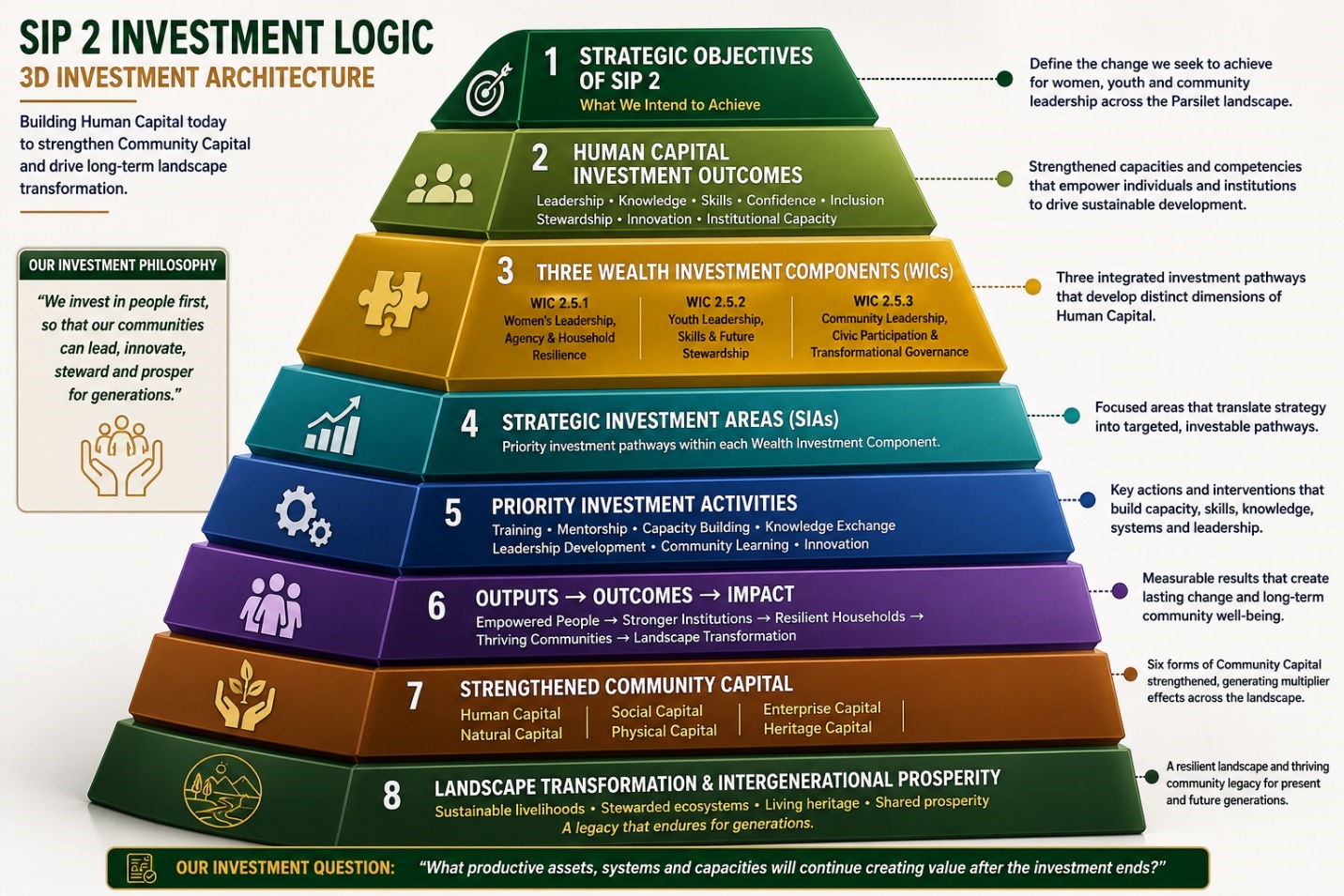
5.6 Wealth Investment Components (WICs)
5.6.1 Translating Strategy into Investable Community Capital Pathways
The Women, Youth and Community Leadership Strategic Investment Platform (SIP 2) is operationalized through three interconnected Wealth Investment Components (WICs). Together, these components translate the strategic objectives of SIP 2 into structured investment pathways that enable partners to invest in clearly defined areas of Human Capital development while contributing to broader Community Capital outcomes.
Each Wealth Investment Component focuses on a distinct investment priority while remaining fully integrated within the Community Capital Investment Framework. Collectively, they strengthen household resilience, inclusive leadership, institutional performance, entrepreneurship, social cohesion and long-term community stewardship, providing the human foundation upon which all other Strategic Investment Platforms depend.
5.6.2 An Integrated Human Capital Investment Architecture
Although each Wealth Investment Component has a distinct strategic focus, the three components are intentionally designed to function as an integrated Human Capital investment system rather than as independent social programmes. Investments made within one component reinforce outcomes across the others, creating complementary benefits that strengthen the overall performance of the Community Capital Investment Portfolio.
For example, investments in women's leadership, financial inclusion and entrepreneurship improve household resilience, strengthen local enterprises and expand community participation in governance. Investments in youth leadership and technical skills introduce innovation, digital transformation and climate-smart solutions that enhance enterprise competitiveness and environmental stewardship. Investments in community leadership and governance strengthen institutional effectiveness, accountability, collaboration and social trust, creating an enabling environment within which women and young people can thrive.
This integrated investment architecture generates cumulative ecological, social, cultural and economic returns that extend beyond the outcomes of individual interventions while strengthening the long-term sustainability of Community Capital investments.
5.6.3 Flexible Entry Points for Investment Partners
The Wealth Investment Components provide flexible investment entry points through which governments, development partners, philanthropic organisations, financial institutions, private investors, research institutions and civil society organisations can align their investments with clearly defined Community Capital priorities.
Partners may choose to:
Support an individual Wealth Investment Component.
Co-invest across multiple Wealth Investment Components.
Finance specific Strategic Investment Areas (SIAs) or Priority Investment Activities.
Provide technical assistance, innovation support, research, capacity development or institutional strengthening.
Mobilize catalytic financing that leverages additional public, private and community investment.
Regardless of the entry point, every investment remains aligned with the strategic objectives of SIP 2 and the broader LHCI-EEC Community Capital Development and Investment Framework, ensuring coordinated implementation, reduced duplication, strengthened partnerships and measurable long-term development outcomes.
Table 5.1: Wealth Investment Components under Strategic Investment Platform 2 (SIP 2)
| Wealth Investment Component (WIC) | Strategic Focus | Primary Community Capital Strengthened |
|---|---|---|
| WIC 5.1: Women's Leadership, Agency and Household Resilience | Women's leadership, household resilience, entrepreneurship, financial inclusion, digital literacy, labour-saving technologies, mentorship, governance participation and Community Capital stewardship. | Human Capital (with co-benefits to Social and Enterprise Capital) |
| WIC 5.2: Youth Leadership, Skills and Future Stewardship | Youth leadership, technical and digital skills, green innovation, entrepreneurship, environmental stewardship, indigenous knowledge transfer, mentorship and workforce preparedness. | Human Capital (with co-benefits to Enterprise and Social Capital) |
| WIC 5.3: Community Leadership, Civic Participation and Transformational Governance | Community governance, institutional strengthening, ethical leadership, participatory decision-making, financial accountability, peacebuilding, indigenous governance systems and Community Capital stewardship. | Human Capital (with co-benefits to Social and Heritage Capital) |
5.6.4 Building Human Capital for Landscape Transformation
Collectively, the three Wealth Investment Components establish a comprehensive investment architecture for strengthening the leadership, knowledge, technical skills, institutional capacity and entrepreneurial capabilities required to sustain long-term landscape transformation.
Rather than treating women, youth and community leadership as separate social programmes, SIP 2 recognizes them as strategic investments that determine the long-term effectiveness of every other investment made across the LHCI-EEC Community Capital Development and Investment Framework.
By investing first in people and institutions, SIP 2 creates the capacity required to successfully implement investments in Climate-Smart Livestock, Nature-Based Enterprises and Green Value Chains, and EcoHeritage Infrastructure and Smart Living Spaces. This integrated approach ensures that future investments are locally owned, effectively managed, continuously improved and sustained by capable community leaders, entrepreneurs and institutions, allowing Community Capital to grow progressively across generations.
5.5.1 Wealth Investment Component (WIC 5.5.1)
Women's Leadership, Agency and Household Resilience
5.5.1.5 Women's Leadership, Agency and Household Resilience Investment Framework
5.5.1.5.1 Strategic Investment Area 1 (SIA 1)
Women's Leadership, Agency and Transformational Empowerment
5.5.1.5.1.1 Background and Investment Rationale
Women play a central role in sustaining pastoral households, strengthening local economies, conserving indigenous knowledge, preserving cultural heritage and supporting the stewardship of natural resources. Across the Parsilet landscape, they contribute significantly to household well-being, food security, livestock management, enterprise development, environmental stewardship and community resilience. Despite these contributions, many women continue to experience barriers that limit their participation in leadership, decision-making, access to productive resources, financial services, markets, technology and economic opportunities.
The long-term success of the LHCI-EEC Community Capital Development and Investment Framework depends upon recognizing women not simply as beneficiaries of development interventions, but as leaders, entrepreneurs, innovators, investors and co-stewards of Community Capital. Strengthening women's leadership, confidence, economic participation and decision-making capacity therefore represents a strategic investment that generates positive outcomes across households, enterprises, community institutions and future generations.
This Strategic Investment Area focuses on expanding women's leadership opportunities, strengthening economic agency, enhancing participation in governance, improving access to knowledge and productive resources, and creating an enabling environment in which women can actively contribute to inclusive landscape development. The approach combines leadership development, entrepreneurship, financial inclusion, institutional participation, mentorship and continuous learning to strengthen Human Capital while generating complementary benefits for Social and Enterprise Capital.
By investing in women's leadership and agency, LHCI-EEC seeks to strengthen resilient households, inclusive institutions, competitive local enterprises and accountable community governance, creating a stronger foundation for sustainable Community Capital development across the Parsilet landscape.
5.5.1.5.1.2 Priority Investment Activities
The programme will:
Activity 1
Design and implement leadership development programmes that strengthen women's leadership competencies, confidence, governance capacity and participation in community development.
Activity 2
Strengthen women's economic agency, financial decision-making and participation in household, enterprise and community-level planning and decision-making processes.
Activity 3
Promote and support women's meaningful representation and leadership within conservancy governance structures, community institutions, producer organizations, cooperatives and local decision-making platforms.
Activity 4
Build women's capacities in strategic communication, negotiation, advocacy, public engagement, networking and collaborative leadership to strengthen their influence within community institutions.
Activity 5
Establish structured mentorship and coaching programmes linking emerging women leaders with experienced community leaders, professionals, entrepreneurs, researchers and development practitioners.
Activity 6
Promote civic, legal and financial literacy that strengthens women's understanding of leadership responsibilities, institutional governance, resource rights, business opportunities and Community Capital stewardship.
Activity 7
Strengthen women's capacities in conflict prevention, dialogue facilitation, collaborative problem-solving, peacebuilding and community leadership.
Activity 8
Support women's active participation in community planning, investment prioritization, natural resource governance, Community Capital stewardship and long-term landscape development.
Activity 9
Facilitate leadership exchange programmes, learning visits, peer-to-peer networks and exposure opportunities that enable women to learn from successful community-led development initiatives.
Activity 10
Recognize, document and celebrate exemplary women leaders, entrepreneurs and innovators whose contributions strengthen community resilience, enterprise development, conservation and living heritage.
Activity 11
Develop strategic partnerships with government institutions, academic organizations, financial institutions, private sector partners, civil society organizations and development agencies to expand women's leadership and economic opportunities.
Activity 12
Institutionalize continuous women's leadership development, mentorship, entrepreneurship and capacity building as a long-term investment within the LHCI-EEC Community Capital Development and Investment Framework.
5.5.1.5.1.3 Expected Outputs
Implementation of this Strategic Investment Area will deliver:
Output 1: Women equipped with strengthened leadership, governance, communication and decision-making competencies through structured leadership development programmes.
Output 2: Increased participation and representation of women within conservancy governance structures, community institutions, producer organizations, cooperatives and local decision-making platforms.
Output 3: Functional mentorship, coaching and peer-learning networks connecting emerging women leaders with experienced professionals, entrepreneurs, community leaders and development partners.
Output 4: Women with improved financial literacy, civic awareness, entrepreneurship skills and knowledge of governance, resource stewardship and Community Capital management.
Output 5: Strong partnerships established with government, academic institutions, financial institutions, civil society organizations, private sector partners and development agencies supporting women's leadership and economic empowerment.
Output 6: Institutionalized systems for continuous leadership development, recognition, learning and participation that support women's long-term contribution to Community Capital development.
5.5.1.5.1.4 Expected Outcomes
Implementation of this Strategic Investment Area will result in:
Outcome 1: Increased confidence, leadership capability and economic agency among women, enabling them to participate more effectively in household, enterprise and community decision-making.
Outcome 2: Stronger and more inclusive governance systems characterized by greater participation of women in leadership, planning and institutional decision-making.
Outcome 3: Improved household resilience through enhanced women's entrepreneurship, financial management and access to productive economic opportunities.
Outcome 4: Increased collaboration among women, community institutions and strategic partners, strengthening social cohesion and collective stewardship of Community Capital.
Outcome 5: Stronger community institutions that benefit from women's leadership in governance, conflict resolution, planning and sustainable landscape management.
Outcome 6: Enhanced Human Capital that contributes to inclusive economic growth, resilient households and long-term landscape transformation across Parsilet Conservancy.
5.5.1.5.1.5 Key Performance Indicators (KPIs)
Success will be measured through:
KPI 1: Number of women completing leadership development, governance, entrepreneurship and capacity-building programmes.
KPI 2: Percentage increase in women's representation within conservancy governance structures, community institutions, producer organizations and local leadership committees.
KPI 3: Number of women participating in mentorship, coaching, leadership exchange and peer-learning programmes.
KPI 4: Number of women establishing, expanding or strengthening enterprises, cooperatives or income-generating initiatives following programme participation.
KPI 5: Percentage of programme participants demonstrating improved leadership confidence, financial literacy, governance knowledge and decision-making capacity.
KPI 6: Number of strategic partnerships established to support women's leadership, entrepreneurship, mentorship and institutional development.
KPI 7: Percentage of women reporting increased participation in household financial decisions, community planning and natural resource governance.
KPI 8: Community satisfaction with women's participation and contribution to local leadership, governance and Community Capital stewardship.
5.5.1.5.1.6 Investment Quote
"When women are empowered with leadership, knowledge and economic opportunity, households become more resilient, institutions become more inclusive, and communities become better equipped to steward their natural, social and cultural assets. Investing in women's leadership is therefore an investment in stronger Community Capital and sustainable landscape transformation."
5.5.1.5.2 Strategic Investment Area 2 (SIA 2)
Knowledge, Skills Development and Lifelong Learning
5.5.1.5.2.1 Background and Investment Rationale
Long-term community resilience depends not only on the availability of natural resources and financial investment but also on the ability of people to continuously acquire, apply and adapt knowledge throughout their lives. As climate change, technology, markets and governance systems continue to evolve, communities require new knowledge and skills while preserving the indigenous wisdom that has sustained pastoral livelihoods for generations.
Women across the Parsilet landscape possess extensive indigenous knowledge relating to livestock management, household nutrition, environmental stewardship, medicinal plants, cultural heritage and community resilience. However, many continue to face limited access to formal learning opportunities, technical training, digital technologies, financial literacy, business development services and contemporary leadership skills. Without deliberate investment in lifelong learning, much of this valuable knowledge remains undocumented, while opportunities created by emerging green economies, digital transformation and changing markets remain inaccessible.
Within the LHCI-EEC Community Capital Investment Framework, lifelong learning is recognized as a strategic investment in Human Capital. Expanding access to quality knowledge, technical skills, digital competencies, financial capability and leadership development enables women to improve household resilience, strengthen enterprises, participate effectively in governance, manage natural resources responsibly and contribute meaningfully to local economic transformation.
This Strategic Investment Area therefore promotes an integrated lifelong learning ecosystem that combines indigenous knowledge, scientific research, technical training, digital learning, mentorship and practical demonstration. Rather than viewing learning as a one-time activity, LHCI-EEC promotes continuous knowledge acquisition, innovation and adaptive learning as essential foundations for resilient households, competitive enterprises and sustainable Community Capital stewardship.
By investing in knowledge and lifelong learning, LHCI-EEC seeks to strengthen the adaptive capacity of women, improve household productivity, expand economic opportunities and ensure that the community remains equipped to respond confidently to future environmental, economic and technological change.
5.5.1.5.2.2 Priority Investment Activities
The programme will:
Activity 1: Establish community-based lifelong learning programmes that provide continuous opportunities for women to acquire practical knowledge, technical competencies and leadership skills throughout different stages of life.
Activity 2: Strengthen adult literacy, numeracy, financial literacy and communication skills to improve household decision-making, business management and participation in community development.
Activity 3: Build practical competencies in leadership, problem solving, critical thinking, negotiation, decision-making and adaptive management to prepare women for increasing leadership responsibilities.
Activity 4: Establish community learning circles, demonstration centres, peer-learning platforms and practical field schools that promote continuous knowledge sharing and experiential learning.
Activity 5: Strengthen knowledge exchange between indigenous knowledge holders, technical experts, research institutions and government agencies to integrate traditional knowledge with scientific innovation.
Activity 6: Build climate literacy, environmental education and natural resource management competencies that strengthen sustainable ecosystem stewardship and climate resilience.
Activity 7: Strengthen household financial management, savings culture, investment planning, business record keeping and responsible resource management through practical financial capability training.
Activity 8: Expand women's access to digital technologies, online learning resources, market information systems and digital communication platforms that support continuous learning and enterprise development.
Activity 9: Provide technical and vocational skills development aligned with emerging opportunities in climate-smart agriculture, livestock systems, nature-based enterprises, renewable energy, eco-tourism and green value chains.
Activity 10: Promote documentation, preservation and intergenerational transfer of indigenous knowledge through community knowledge repositories, storytelling, digital documentation and learning exchanges.
Activity 11: Establish strategic partnerships with universities, technical institutions, research organizations, private sector actors and development partners to expand learning opportunities, certification programmes and technical support.
Activity 12: Institutionalize lifelong learning as a permanent investment pillar within the LHCI-EEC Community Capital Investment Framework, ensuring continuous skills development, innovation and knowledge renewal across generations.
5.5.1.5.2.3 Expected Outputs
Implementation of this Strategic Investment Area will deliver:
Output 1: Community-based lifelong learning programmes established and operational, providing continuous opportunities for women's education, skills development and leadership growth.
Output 2: Women with improved literacy, numeracy, financial capability, communication skills, leadership competencies and practical technical knowledge.
Output 3: Functional community learning circles, peer-learning networks, demonstration centres and digital learning platforms supporting continuous knowledge exchange.
Output 4: Strengthened integration of indigenous knowledge with scientific research, technical innovation and practical community learning.
Output 5: Strategic partnerships established with universities, technical institutions, research organizations, private sector actors and development partners to support lifelong learning and technical capacity development.
Output 6: Community knowledge management systems established to document, preserve and promote indigenous knowledge while expanding access to contemporary learning resources and digital technologies.
5.5.1.5.2.4 Expected Outcomes
Implementation of this Strategic Investment Area will result in:
Outcome 1: Increased knowledge, technical competencies and adaptive capacity among women, enabling them to respond effectively to changing environmental, economic and technological conditions.
Outcome 2: Improved household decision-making, enterprise management and financial planning through enhanced literacy, financial capability and practical life skills.
Outcome 3: Greater participation of women in leadership, enterprise development, environmental stewardship and Community Capital management as a result of continuous learning.
Outcome 4: A strong culture of lifelong learning, innovation and knowledge sharing embedded within households, community institutions and local enterprises.
Outcome 5: Improved preservation, documentation and application of indigenous knowledge through its integration with scientific research, digital technologies and practical community learning.
Outcome 6: Strengthened Human Capital that supports resilient households, competitive enterprises, inclusive governance and sustainable landscape transformation.
5.5.1.5.2.5 Key Performance Indicators (KPIs)
Success will be measured through:
KPI 1: Number of women participating in and successfully completing lifelong learning, literacy, technical skills and leadership development programmes.
KPI 2: Percentage improvement in literacy, numeracy, financial literacy, digital literacy and technical competency among programme participants.
KPI 3: Number of community learning circles, peer-learning groups, demonstration centres and digital learning platforms established and operational.
KPI 4: Number of indigenous knowledge documentation initiatives, knowledge exchange programmes and technical learning activities implemented.
KPI 5: Number of strategic partnerships established with academic institutions, research organizations, technical institutions and development partners supporting lifelong learning.
KPI 6: Percentage of participants reporting improved confidence, knowledge application, financial management and leadership capacity following programme participation.
KPI 7: Number of learning materials, digital resources, technical manuals and community knowledge products developed and actively utilized within community learning programmes.
KPI 8: Percentage of participants applying newly acquired knowledge and skills within households, enterprises, community institutions or Community Capital initiatives.
5.5.1.5.2.6 Investment Quote
"Knowledge is one of the few forms of capital that grows through sharing. Every new skill acquired, every lesson exchanged and every generation empowered through lifelong learning strengthens Human Capital, expands opportunity and increases the community's capacity to steward its natural, cultural and economic assets for future generations."
5.5.1.5.3 Strategic Investment Area 3 (SIA 3): Financial Capability, Household Decision-Making and Community Wealth Stewardship
5.5.1.5.3.1 Background and Investment Rationale
Household resilience depends not only on income generation but also on the ability to make informed financial decisions, manage resources responsibly, plan for the future, and invest in productive assets. Across pastoral landscapes, financial capability influences household food security, education, health, livestock management, enterprise development, and the long-term stewardship of natural and cultural resources.
Although women increasingly participate in economic activities and household financial management, many families continue to face constraints in financial planning, savings culture, investment decision-making, record keeping, and risk management. These limitations often reduce the ability of households to accumulate assets, withstand economic shocks, and benefit fully from emerging livelihood opportunities.
LHCI-EEC therefore recognizes financial capability as a strategic investment in Human Capital. Rather than focusing solely on access to finance, this Strategic Investment Area develops the knowledge, attitudes, confidence, and practical skills required for responsible financial management throughout the household life cycle.
The programme promotes informed household decision-making, prudent resource management, structured savings, investment planning, digital financial inclusion, and intergenerational wealth stewardship. By strengthening financial capability, households become better positioned to invest in education, livestock improvement, enterprise development, conservation, and community well-being while contributing to the long-term resilience of the Parsilet landscape.
5.5.1.5.3.2 Priority Investment Activities
The programme will:
Activity 1: Deliver practical financial capability programmes covering household budgeting, savings, investment planning, responsible borrowing, and financial goal setting.
Activity 2: Strengthen household financial planning by promoting participatory family budgeting, expenditure prioritization, and long-term asset planning.
Activity 3: Promote savings culture through community savings groups, cooperative financial systems, and structured household saving practices.
Activity 4: Build practical understanding of investment options, productive asset accumulation, financial risk management, and long-term wealth creation.
Activity 5: Strengthen knowledge of responsible borrowing, micro-insurance, emergency preparedness, and financial resilience.
Activity 6: Facilitate household dialogue that promotes joint financial planning, shared decision-making, and equitable management of family resources.
Activity 7: Develop practical skills in financial record keeping, household bookkeeping, and simple business accounting.
Activity 8: Promote safe and responsible use of digital financial services, including mobile banking, digital payments, electronic savings, and emerging financial technologies.
Activity 9: Establish community financial mentorship and peer-learning networks that provide continuous guidance, coaching, and financial support.
Activity 10: Integrate indigenous values of reciprocity, collective responsibility, prudent resource management, and intergenerational stewardship into community financial education.
Activity 11: Facilitate partnerships with financial institutions, cooperatives, government agencies, and development partners to expand financial education and inclusion opportunities.
Activity 12: Institutionalize continuous financial capability development as a core investment within the LHCI-EEC Human Capital strategy.
5.5.1.5.3.3 Expected Outputs
Implementation of this Strategic Investment Area will deliver:
Output 1: Community-based financial capability programmes established and operational across the Parsilet landscape.
Output 2: Women and households equipped with practical financial planning, budgeting, savings, and investment management skills.
Output 3: Increased adoption of household financial planning, savings practices, and responsible financial management.
Output 4: Community financial mentorship networks established to support continuous learning and peer coaching.
Output 5: Expanded partnerships with financial institutions and development organizations supporting financial inclusion and household resilience.
Output 6: Indigenous financial stewardship principles documented and integrated into community financial education.
5.5.1.5.3.4 Expected Outcomes
Implementation of this Strategic Investment Area will result in:
Outcome 1: Improved household financial decision-making and long-term financial resilience.
Outcome 2: Increased savings, productive investment, and responsible management of household resources.
Outcome 3: Greater financial confidence among women and improved participation in household economic decisions.
Outcome 4: Increased adoption of digital financial services and modern financial management practices.
Outcome 5: Stronger household preparedness for climate, economic, and livelihood shocks.
Outcome 6: Sustainable financial stewardship supporting long-term Community Capital development.
5.5.1.5.3.5 Key Performance Indicators (KPIs)
Success will be measured through:
KPI 1: Number of women and households completing financial capability training programmes.
KPI 2: Percentage of participating households implementing household budgets and financial plans.
KPI 3: Percentage increase in household savings among participating families.
KPI 4: Number of community financial mentors trained and actively supporting households.
KPI 5: Number of households adopting digital financial services and electronic payment systems.
KPI 6: Percentage of participants demonstrating improved financial literacy and financial decision-making skills.
KPI 7: Number of strategic partnerships established with financial institutions, cooperatives, and financial service providers.
5.5.1.5.3.6 Investment Quote
"Financial capability transforms income into opportunity, opportunity into productive assets, and productive assets into resilient Community Capital. By strengthening the financial knowledge, discipline, and decision-making capacity of women and households, we invest not only in today's livelihoods but in the long-term prosperity of future generations."
5.5.1.5.4 Strategic Investment Area 4 (SIA 4): Digital Inclusion, Information Access and Digital Economic Participation
5.5.1.5.4.1 Background and Investment Rationale
Digital transformation is rapidly reshaping how individuals access information, participate in markets, manage enterprises, access financial services and create economic opportunities. Across pastoral landscapes, digital technologies have become essential enablers of inclusive development, climate resilience, entrepreneurship and household prosperity. However, significant disparities in digital access, connectivity, affordability and digital capability continue to exclude many rural women, girls and young women from fully participating in the expanding digital economy.
Within Parsilet Conservancy, digital inclusion extends far beyond access to mobile phones or internet connectivity. It represents the ability of women to confidently access information, communicate effectively, manage enterprises, utilize digital financial services, reach new markets, preserve indigenous knowledge and participate meaningfully in emerging economic opportunities. Strengthening these capabilities enables women to improve household resilience while contributing directly to the growth of Community Capital.
Despite their central role in household management, enterprise development and community well-being, many women and girls continue to face barriers in accessing digital technologies, digital skills, affordable connectivity and online economic opportunities. These limitations reduce their ability to access market information, utilize digital financial services, promote products, participate in e-commerce, engage in online learning and benefit from rapidly evolving digital innovations. As economies become increasingly digital, failure to address these barriers risks widening existing social and economic inequalities.
The LHCI-EEC Community Capital Investment Framework therefore recognizes digital inclusion as a strategic investment in Human Capital that simultaneously strengthens Enterprise Capital and Social Capital. Rather than promoting technology as an end in itself, this Strategic Investment Area equips women with practical digital capabilities that enhance entrepreneurship, strengthen household financial management, improve access to information, expand market participation and increase resilience within an increasingly knowledge-driven economy.
Digital inclusion also serves as a critical enabler of the broader EcoHeritage Economy. Women artisans can promote EcoHeritage products through digital marketplaces, access new buyers, receive secure digital payments, utilize artificial intelligence to improve business operations, document and preserve Living Heritage, and strengthen connections with customers, partners and investors beyond the local landscape. These capabilities increase the competitiveness of women-led enterprises while supporting the commercialization of indigenous knowledge and nature-based products.
Through this Strategic Investment Area, LHCI-EEC seeks to ensure that digital transformation becomes an inclusive driver of women's empowerment, enterprise growth and household prosperity. By investing in women's digital participation today, the platform strengthens the adaptive capacity of households, expands opportunities within the EcoHeritage Economy and reinforces the long-term resilience and sustainability of Community Capital.
5.5.1.5.4.2 Priority Investment Activities
The programme will:
Activity 1: Strengthen digital literacy among women, girls and young women by providing practical training in the safe, confident and productive use of smartphones, computers, internet services and emerging digital technologies.
Activity 2: Build women's capacity to use digital financial services, including mobile money, digital banking, electronic payments, online savings platforms and other appropriate financial technologies that strengthen household financial resilience.
Activity 3: Support women entrepreneurs to market EcoHeritage products and services through digital platforms, social media, e-commerce channels and other appropriate online marketing systems that expand market access beyond local communities.
Activity 4: Develop practical competencies in digital business management, including digital record keeping, customer relationship management, inventory management, electronic bookkeeping and business performance tracking for women-led enterprises.
Activity 5: Improve women's access to market intelligence by strengthening their ability to obtain timely information on prices, buyers, weather forecasts, production opportunities, quality standards and business regulations through digital information systems.
Activity 6: Introduce women entrepreneurs to appropriate artificial intelligence (AI)-assisted business tools that improve business planning, product development, marketing content creation, customer engagement and enterprise decision-making.
Activity 7: Support the digital documentation, preservation and responsible transmission of indigenous knowledge, Living Heritage practices, traditional craftsmanship and community stories led by women as custodians of cultural heritage.
Activity 8: Promote the use of digital communication platforms that strengthen networking, peer learning, mentorship, collaboration and information sharing among women entrepreneurs, producer groups and community organizations.
Activity 9: Improve women's access to digital business opportunities by strengthening their capacity to participate in online procurement systems, business registration services, government digital platforms and emerging digital marketplaces.
Activity 10: Facilitate partnerships with technology providers, financial institutions, telecommunications companies, academic institutions and development partners to expand affordable digital access, devices and digital support services for women.
Activity 11: Promote responsible digital citizenship by strengthening awareness of digital safety, cybersecurity, online privacy, ethical technology use and protection against digital fraud and misinformation.
Activity 12: Institutionalize digital inclusion as a long-term Community Capital investment by integrating digital capability development across women's leadership, household resilience, entrepreneurship and Community Capital stewardship within the LHCI-EEC Community Capital Investment Framework.
5.5.1.5.4.3 Expected Outputs
Implementation of this Strategic Investment Area will deliver:
Output 1: Women, girls and young women equipped with practical digital competencies that enable them to confidently access information, communicate effectively and participate in the digital economy.
Output 2: Women-led enterprises adopting digital technologies for business management, digital marketing, financial management, customer engagement and market expansion.
Output 3: Increased utilization of secure digital financial services, digital payment systems and financial technologies among women entrepreneurs and households.
Output 4: Community-based digital learning and business support systems established to provide continuous technical assistance, mentorship and access to digital business opportunities for women.
Output 5: Women-led EcoHeritage enterprises connected to digital marketplaces, market information systems and wider commercial networks that expand market access beyond the local landscape.
Output 6: Indigenous knowledge, cultural heritage, traditional craftsmanship and women-led innovations systematically documented, preserved and promoted through appropriate digital platforms.
5.5.1.5.4.4 Expected Outcomes
Implementation of this Strategic Investment Area will result in:
Outcome 1: Significantly improved digital inclusion among women, girls and young women, enabling equitable participation in the evolving digital economy.
Outcome 2: Increased competitiveness, productivity and commercial sustainability of women-led enterprises through the effective application of digital technologies.
Outcome 3: Improved household financial resilience through wider adoption of digital financial services, better financial management and expanded access to economic opportunities.
Outcome 4: Enhanced market participation by women entrepreneurs through stronger digital visibility, wider customer reach and improved integration into regional and international value chains.
Outcome 5: Strengthened preservation, promotion and commercialization of Living Heritage through responsible digital documentation, storytelling and knowledge management.
Outcome 6: Increased contribution of digitally empowered women to the long-term growth of the EcoHeritage Economy and the strengthening of Community Capital across the Parsilet landscape.
5.5.1.5.4.5 Key Performance Indicators (KPIs)
Success will be measured through:
KPI 1: Number of women, girls and young women successfully completing practical digital inclusion and digital enterprise development programmes.
KPI 2: Percentage of trained women regularly applying digital technologies in enterprise management, digital marketing, financial management or business communication.
KPI 3: Number of women-led enterprises actively utilizing digital payment systems, mobile banking or other digital financial services.
KPI 4: Number of women-led enterprises successfully accessing digital marketplaces, online customers or electronic business platforms.
KPI 5: Percentage increase in sales, customer reach or market access attributable to digital business participation among supported women entrepreneurs.
KPI 6: Number of indigenous knowledge products, EcoHeritage stories, cultural assets or traditional production practices digitally documented, preserved or promoted by women.
KPI 7: Number of strategic partnerships established with technology providers, financial institutions, telecommunications companies, research institutions or development partners supporting women's digital inclusion.
KPI 8: Percentage of programme participants reporting increased confidence in using digital technologies to improve household resilience, enterprise development and economic participation.
5.5.1.5.4.6 Investment Quote
"Digital inclusion is no longer about technology alone; it is about expanding opportunity. Every woman who confidently accesses information, reaches new markets, manages her enterprise digitally and preserves her Living Heritage strengthens not only her household, but also the resilience, competitiveness and future prosperity of the entire EcoHeritage Economy. Investing in women's digital participation is therefore an investment in the next generation of Community Capital."
5.5.1.5.5 Strategic Investment Area 5 (SIA 5): Mentorship, Women's Leadership Networks and Intergenerational Leadership Development
5.5.1.5.5.1 Background and Investment Rationale
Sustainable community transformation depends not only on developing capable women leaders today but also on ensuring that leadership knowledge, practical experience, institutional memory and community values are intentionally transferred to future generations. Leadership becomes truly transformative when it is continuously nurtured, shared and renewed rather than concentrated within a few individuals.
Across pastoral communities, women have traditionally transmitted indigenous knowledge, cultural values, practical skills and social leadership through families, age-set relationships, women's groups and community institutions. These informal systems have sustained household resilience and social cohesion for generations. However, rapid socio-economic change, climate variability, technological advancement and evolving leadership responsibilities require stronger institutional mechanisms that intentionally prepare the next generation of women leaders while preserving the knowledge and experience accumulated by previous generations.
The LHCI-EEC Community Capital Investment Framework recognizes mentorship and intergenerational leadership development as strategic investments in Human Capital that simultaneously strengthen Social Capital and Heritage Capital. Experienced women leaders possess practical knowledge, lived experience and leadership wisdom that cannot be replaced by formal training alone. Creating structured opportunities for mentorship allows this invaluable knowledge to strengthen emerging women leaders while reinforcing community identity, institutional continuity and collective resilience.
This Strategic Investment Area therefore seeks to establish a culture in which leadership development becomes a continuous community process rather than a one-time training event. Through structured mentorship relationships, women leadership networks, peer learning, leadership succession planning, knowledge exchange and strategic partnerships, women leaders are supported not only to succeed personally but also to deliberately develop other women and girls as future custodians of Community Capital.
By institutionalizing mentorship and intergenerational leadership development, LHCI-EEC strengthens the long-term sustainability of the EcoHeritage Economy. Every experienced woman leader becomes a mentor. Every emerging leader becomes a future mentor. In this way, leadership continuously reproduces itself, ensuring that Community Capital remains resilient, adaptive and locally owned across successive generations.
5.5.1.5.5.2 Priority Investment Activities
The programme will:
Activity 1: Establish structured mentorship programmes that intentionally connect experienced women leaders with emerging women, girls and young women to strengthen leadership development, confidence, professional growth and Community Capital stewardship.
Activity 2: Develop and strengthen women's leadership networks that promote peer learning, collaboration, mutual support, experience sharing and collective problem-solving across the Parsilet landscape.
Activity 3: Facilitate structured intergenerational dialogue and knowledge exchange that enables experienced women, respected elders and emerging women leaders to preserve indigenous knowledge, leadership values and Living Heritage while embracing appropriate innovation.
Activity 4: Design and implement women's leadership succession programmes that intentionally prepare future female leaders for governance responsibilities within conservancy structures, cooperatives, community enterprises and local institutions.
Activity 5: Organize periodic women leaders' forums, leadership dialogues and experience-sharing platforms that promote continuous reflection, collaborative learning and adaptive leadership for sustainable landscape development.
Activity 6: Document, preserve and disseminate successful leadership experiences, indigenous knowledge, community innovations and good practices through appropriate digital and community knowledge management systems.
Activity 7: Strengthen mentoring, coaching and facilitation skills among experienced women leaders to establish a self-sustaining community-based mentorship ecosystem capable of continuously developing future leaders.
Activity 8: Build strategic partnerships with academic institutions, leadership development organizations, government agencies, civil society organizations and development partners to expand opportunities for women's leadership development and mentorship.
Activity 9: Facilitate women's participation in regional, national and international leadership exchanges, conferences, study visits and professional learning platforms that broaden perspectives, strengthen networks and expose women to emerging development practices.
Activity 10: Promote a culture of reflective leadership, ethical stewardship, innovation, collaboration and continuous personal growth that strengthens women's long-term contribution to community transformation.
Activity 11: Establish community leadership knowledge platforms that facilitate continuous documentation, sharing and exchange of leadership experiences, practical lessons and emerging best practices among women leaders.
Activity 12: Institutionalize mentorship, women's leadership succession and intergenerational leadership development as permanent Community Capital investment functions within the LHCI-EEC Community Capital Investment Framework, ensuring that leadership capacity continues to grow across successive generations.
5.5.1.5.5.3 Expected Outputs
Implementation of this Strategic Investment Area will deliver:
Output 1: A structured Women's Leadership Mentorship Programme established, linking experienced women leaders, professionals, elders and emerging women leaders through formal mentoring relationships.
Output 2: Functional intergenerational leadership networks created to facilitate continuous knowledge exchange between women leaders, elders, young women and community institutions.
Output 3: Leadership succession pathways established to prepare the next generation of women leaders for governance, enterprise leadership and Community Capital stewardship.
Output 4: Regular women-focused leadership forums, learning exchanges, coaching sessions and innovation dialogues institutionalized across the Parsilet landscape.
Output 5: Community leadership knowledge, indigenous leadership practices, successful case studies and mentoring resources systematically documented and made accessible through digital and community knowledge platforms.
Output 6: Strategic partnerships established with universities, leadership institutions, government agencies, private sector organizations and development partners to strengthen long-term women's leadership development.
5.5.1.5.5.4 Expected Outcomes
Implementation of this Strategic Investment Area will result in:
Outcome 1: Increased leadership confidence, decision-making capability and strategic influence among women across households, enterprises and community institutions.
Outcome 2: Strong intergenerational leadership continuity, ensuring that leadership knowledge, indigenous values and Community Capital stewardship are transferred across generations.
Outcome 3: A sustained culture of mentoring, peer learning, collaboration and continuous leadership improvement embedded within community institutions.
Outcome 4: Increased representation of capable women leaders within governance structures, producer organizations, cooperatives, enterprises and community development platforms.
Outcome 5: Stronger institutional resilience through structured leadership succession, reducing dependency on individual leaders while strengthening long-term organizational continuity.
Outcome 6: Enhanced Human Capital through sustained leadership development, mentoring and knowledge exchange that reinforces every Strategic Investment Platform within the LHCI-EEC Community Capital Investment Framework.
5.5.1.5.5.5 Key Performance Indicators (KPIs)
Success will be measured through:
KPI 1: Number of formal mentorship relationships established and actively maintained between experienced women leaders and emerging women leaders.
KPI 2: Number of women completing structured leadership mentoring, coaching and executive development programmes.
KPI 3: Percentage of participants demonstrating measurable improvement in leadership confidence, decision-making capacity and mentoring competencies.
KPI 4: Number of women assuming new leadership responsibilities within conservancy governance, cooperatives, enterprises and community institutions.
KPI 5: Number of intergenerational leadership forums, coaching sessions, peer-learning events and knowledge exchange activities conducted annually.
KPI 6: Number of leadership resources, indigenous leadership practices and mentoring case studies documented, digitized and shared through community knowledge platforms.
KPI 7: Number of strategic partnerships established to support women's leadership development, mentoring, coaching and leadership succession.
KPI 8: Percentage of participating institutions with documented leadership succession and mentoring plans integrated into their organizational development systems.
5.5.1.5.5.6 Investment Quote
"Sustainable leadership is not inherited by chance—it is intentionally cultivated through mentoring, continuous learning and intergenerational knowledge transfer. By investing in women's leadership today, we strengthen the Human Capital that will steward Community Capital, inspire future generations and sustain resilient landscapes for decades to come."
5.5.2 Wealth Investment Component (WIC 5.5.2)
Youth Leadership, Skills and Future Stewardship
5.5.2.1 Translating Youth Potential into Community Capital
The Youth Leadership, Skills and Future Stewardship Wealth Investment Component (WIC 5.5.2) represents the second Human Capital investment pathway under Strategic Investment Platform 2 (SIP 2). While WIC 5.5.1 focuses on strengthening women's leadership, household resilience and economic agency, WIC 5.5.2 invests strategically in young people as the next generation of innovators, entrepreneurs, skilled professionals, conservation leaders and custodians of Community Capital.
Young people represent one of the greatest strategic assets within the Parsilet landscape. They possess the creativity, adaptability, technological curiosity and entrepreneurial energy required to respond to rapidly changing environmental, economic and social conditions. As climate change, digital transformation and evolving markets reshape pastoral livelihoods, youth will increasingly determine how communities adopt innovation, develop enterprises, strengthen governance and conserve natural and cultural heritage.
Despite this potential, many young people continue to encounter barriers that limit their ability to contribute meaningfully to landscape development. Limited access to technical training, enterprise development, mentorship, digital technologies, employment pathways and investment capital often constrains their transition into productive livelihoods. Without deliberate investment, this demographic dividend risks becoming an unrealized opportunity for both the community and the broader landscape economy.
Recognising these realities, LHCI-EEC positions youth not as passive beneficiaries of development interventions but as active partners in building a resilient EcoHeritage Economy. Through targeted investments in leadership, technical competencies, entrepreneurship, innovation and environmental stewardship, this Wealth Investment Component seeks to strengthen Human Capital while simultaneously generating co-benefits for Enterprise Capital, Social Capital, Natural Capital and Heritage Capital.
5.5.2.2 An Integrated Youth Development Framework
Rather than implementing isolated youth projects, the component develops complementary competencies that prepare young people to participate effectively across every Strategic Investment Platform within the LHCI-EEC Community Capital Investment Portfolio. Leadership training strengthens governance participation. Technical skills improve employability and enterprise development. Digital competencies expand access to information, markets and financial services. Entrepreneurship stimulates local economic growth, while environmental stewardship strengthens long-term conservation outcomes.
By integrating these investments, the platform enables young people to become productive contributors to household resilience, community institutions, local enterprises and landscape stewardship while creating multiplier effects across multiple forms of Community Capital.
5.5.2.3 Flexible Investment Opportunities for Strategic Partners
This Wealth Investment Component provides multiple entry points for governments, development partners, financial institutions, philanthropic organisations, research institutions and responsible private sector actors seeking to invest in youth development.
Partners may support leadership development, technical and vocational education, entrepreneurship, digital innovation, climate-smart employment, mentorship programmes, business incubation, environmental stewardship or workforce readiness according to their institutional priorities. Individual investments remain fully aligned with the wider Community Capital Investment Framework, ensuring that specialised interventions contribute to shared landscape outcomes while avoiding duplication of effort.
This flexible investment architecture enables partners to combine financial investment, technical assistance, innovation support, research collaboration and institutional capacity strengthening within a common implementation framework.
5.5.2.4 Building the Next Generation of Community Capital Stewards
The component is implemented through a series of Strategic Investment Areas that progressively develop young people as ethical leaders, skilled professionals, entrepreneurs, innovators and custodians of Community Capital.
Collectively, these Strategic Investment Areas establish a long-term leadership and succession pathway that equips young people with the competencies required to sustain investments in climate-smart livestock systems, nature-based enterprises, EcoHeritage infrastructure, community institutions and Living Heritage conservation.
Rather than viewing succession as a future concern, WIC 5.5.2 deliberately prepares today's youth to assume increasing leadership responsibilities while learning alongside experienced community leaders, technical experts and indigenous knowledge holders. In doing so, the platform strengthens continuity, institutional resilience and long-term stewardship across the Parsilet landscape.
5.5.2.5 Investment Philosophy
"Investing in young people is investing in the future productive capacity of the landscape. Every young person equipped with leadership, skills, innovation and purpose becomes a catalyst for stronger enterprises, resilient communities, healthier ecosystems and enduring Community Capital. Today's investment in youth creates tomorrow's custodians of the EcoHeritage Economy."
5.5.2.1 Investment Goal
To develop a skilled, innovative and values-driven generation of young women and men equipped with the leadership, technical competencies, entrepreneurial capabilities and stewardship ethic required to strengthen Community Capital and lead the long-term transformation of the Parsilet EcoHeritage Economy.
5.5.2.1.1 Desired Future State
Parsilet is served by a confident, skilled and innovative generation of young women and men who actively participate in community leadership, create sustainable enterprises, conserve natural and cultural heritage, embrace digital innovation, and contribute meaningfully to resilient households, thriving local economies and effective Community Capital stewardship.
5.5.2.1.2 Investment Aspiration
This Wealth Investment Component seeks to transform youth from an underutilised demographic into a strategic driver of Community Capital development. Through coordinated investments in leadership development, technical and vocational skills, entrepreneurship, digital inclusion, climate-smart innovation, mentorship and lifelong learning, the component prepares young people to become productive citizens, ethical leaders, business creators, environmental stewards and active contributors to community governance.
Rather than focusing solely on employment, the investment aims to expand the capacity of young people to create opportunities for themselves and others while strengthening the resilience of households, enterprises, institutions and ecosystems across the Parsilet landscape.
5.5.2.1.3 Long-Term Vision
Over the long term, WIC 5.5.2 seeks to cultivate a generation of young leaders, skilled professionals, entrepreneurs, innovators and conservation champions capable of sustaining the long-term growth of the EcoHeritage Economy.
By strengthening Human Capital while generating complementary benefits for Enterprise Capital, Social Capital, Natural Capital and Heritage Capital, the component will contribute to stronger local institutions, more competitive rural enterprises, increased youth employment, improved environmental stewardship and the preservation of indigenous knowledge. Success will ultimately be reflected in a community where each generation intentionally prepares, mentors and empowers the next to steward Community Capital and sustain inclusive landscape transformation.
5.5.2.2 Strategic Objectives
The Youth Leadership, Skills and Future Stewardship Wealth Investment Component (WIC 5.5.2) seeks to achieve the following strategic objectives:
Objective 1: Strengthen youth leadership, ethical values and civic responsibility by developing confident young women and men who actively participate in community governance, institutional leadership and Community Capital stewardship.
Objective 2: Equip young people with market-relevant technical, vocational, digital and entrepreneurial skills that improve employability, enterprise development and participation in the emerging EcoHeritage Economy.
Objective 3: Promote innovation, business incubation and youth enterprise development that create sustainable livelihoods, strengthen local value chains and expand inclusive economic opportunities.
Objective 4: Strengthen youth participation in climate resilience, biodiversity conservation, regenerative rangeland management and Living Heritage stewardship as active custodians of the landscape.
Objective 5: Expand equitable access to mentorship, lifelong learning, career guidance and professional networks that support continuous personal and professional development.
Objective 6: Enhance youth participation in digital transformation through investments in digital literacy, emerging technologies, innovation platforms and responsible use of digital tools for education, enterprise and community development.
Objective 7: Mainstream meaningful youth participation across all Strategic Investment Platforms, ensuring that young people contribute to planning, implementation, innovation, monitoring and long-term stewardship throughout the LHCI-EEC Community Capital Investment Portfolio.
5.5.2.3 Investment Philosophy
"Investing in young people is investing in the future productive capacity of the landscape. Every young person equipped with leadership, skills, innovation and purpose becomes a catalyst for stronger enterprises, resilient communities, healthier ecosystems and enduring Community Capital. Today's investment in youth creates tomorrow's custodians of the EcoHeritage Economy."
Table 5.5.2: Strategic Investment Areas under Wealth Investment Component 5.5.2 – Youth Leadership, Skills and Future Stewardship
| Strategic Investment Area (SIA) | Strategic Focus | Primary Community Capital Strengthened |
|---|---|---|
| SIA 1: Youth Leadership, Civic Participation and Future Stewardship | Developing ethical young leaders equipped for community governance, civic responsibility, institutional leadership, peacebuilding, Community Capital stewardship and intergenerational succession. | Human Capital (with co-benefits to Social and Heritage Capital) |
| SIA 2: Technical Skills Development, Employability and Lifelong Learning | Building market-relevant technical, vocational, digital and professional competencies that prepare youth for employment, enterprise, innovation and continuous learning. | Human Capital (with co-benefits to Enterprise Capital) |
| SIA 3: Youth Entrepreneurship, Green Enterprise Innovation and EcoHeritage Business Development | Supporting youth entrepreneurship, enterprise incubation, innovation, business capability development, value addition, financial capability, digital entrepreneurship and preparation for active participation in the LHCI-EEC EcoHeritage Economy. | Human Capital (with strategic co-benefits to Enterprise Capital). |
| SIA 4: Climate Leadership, Environmental Stewardship and Living Heritage Conservation | Preparing youth as custodians of biodiversity, regenerative rangelands, climate resilience, indigenous knowledge systems and Living Heritage through practical conservation leadership. | Human Capital (with co-benefits to Natural and Heritage Capital) |
| SIA 5: Digital Inclusion, Innovation and Global Youth Connectivity | Expanding digital literacy, AI readiness, GIS, digital storytelling, e-commerce, market intelligence, innovation networks and responsible participation in the digital economy. | Human Capital (with co-benefits to Enterprise, Social and Heritage Capital) |
5.5.2.3 Strategic Investment Areas
Developing the Next Generation of Community Capital Leaders
The Youth Leadership, Innovation and Future Stewardship Wealth Investment Component is operationalized through five interconnected Strategic Investment Areas (SIAs) that translate the strategic vision of WIC 5.5.2 into practical, investable and measurable pathways for strengthening Human Capital across the Parsilet landscape.
Rather than implementing fragmented youth programmes, the five SIAs provide an integrated investment architecture that prepares young women and men to become productive citizens, ethical leaders, skilled professionals, entrepreneurs, innovators and long-term stewards of Community Capital. Collectively, they strengthen the capabilities required for young people to participate meaningfully in community governance, create sustainable enterprises, conserve natural and cultural heritage, and contribute to the long-term growth of the EcoHeritage Economy.
Each Strategic Investment Area focuses on a distinct but complementary dimension of youth development. Together, they create a continuous development pathway that enables young people to progressively acquire leadership experience, technical competencies, entrepreneurial capability, environmental stewardship skills and digital readiness. This integrated approach ensures that investments in one area reinforce progress across the others, generating multiplier effects that strengthen households, enterprises, institutions and ecosystems simultaneously.
Leadership development equips young people to participate confidently in community governance and institutional decision-making. Technical and vocational skills improve employability and workforce readiness. Entrepreneurship and innovation enable youth to create enterprises and expand local economic opportunities. Environmental stewardship strengthens biodiversity conservation and climate resilience, while digital inclusion enhances access to information, markets, technology and emerging economic opportunities. Collectively, these investments position youth as active contributors to every Strategic Investment Platform within the LHCI-EEC Community Capital Investment Portfolio.
The five Strategic Investment Areas therefore function as complementary investment pathways rather than independent programmes. By integrating leadership, skills development, enterprise creation, environmental stewardship and digital transformation, WIC 5.5.2 develops the adaptive capacity required for young people to respond to changing social, economic, technological and environmental conditions while preserving the ecological and cultural assets that define the Parsilet landscape.
Beyond improving individual livelihoods, these investments deliberately prepare the next generation of Community Capital stewards. As successive cohorts of young women and men acquire leadership experience, professional skills, entrepreneurial confidence, conservation values and digital competencies, Parsilet Conservancy progressively strengthens its capacity to sustain resilient households, inclusive local economies, effective community institutions and healthy ecosystems over the long term.
Through this integrated Human Capital investment architecture, WIC 5.5.2 establishes a sustainable pipeline of future leaders capable of driving innovation, supporting inclusive economic growth, strengthening community governance and advancing the long-term transformation of the Parsilet EcoHeritage Economy. In doing so, it reinforces the broader LHCI-EEC Community Capital Investment Framework while providing practical lessons and scalable investment models for other pastoral landscapes.
5.5.2.3.1 Strategic Investment Area 1 (SIA 1)
Youth Leadership, Civic Participation and Future Stewardship
5.5.2.3.1.1 Background and Investment Rationale
Young people represent one of the greatest long-term investments in the resilience, prosperity and sustainability of the Parsilet landscape. As future household heads, entrepreneurs, professionals, conservation champions and community leaders, they will inherit the responsibility of managing natural resources, strengthening local institutions, preserving Living Heritage and driving the continued growth of the EcoHeritage Economy. Investing in youth leadership is therefore an investment in the future stewardship of Community Capital.
Across pastoral landscapes, young people possess enormous potential to contribute fresh ideas, technological innovation, entrepreneurial energy and adaptive leadership. However, many continue to face barriers that limit meaningful participation in governance, leadership development, civic engagement and strategic decision-making. Limited exposure to leadership opportunities, mentorship, practical governance experience and structured succession pathways often prevents youth from fully contributing to community development despite their willingness and potential.
The LHCI-EEC Community Capital Investment Framework therefore positions youth leadership as a strategic Human Capital investment that strengthens the long-term resilience of community institutions. Rather than preparing young people only for employment, this Strategic Investment Area seeks to develop ethical leaders, responsible citizens and future custodians of Community Capital who are capable of guiding inclusive development, strengthening community institutions and responding effectively to emerging environmental, economic and social challenges.
This Strategic Investment Area emphasizes values-based leadership, civic responsibility, institutional participation, intergenerational collaboration and stewardship of natural and cultural heritage. It creates structured pathways through which young women and men progressively acquire leadership experience while working alongside community elders, conservancy leaders, public institutions and development partners. In doing so, it strengthens leadership continuity while preserving indigenous knowledge and community identity.
By investing in youth leadership today, LHCI-EEC seeks to ensure that future generations inherit not only productive assets and healthy ecosystems, but also the knowledge, values, confidence and institutional capacity required to sustain the long-term transformation of the Parsilet EcoHeritage Economy.
5.5.2.3.1.2 Priority Investment Activities
The programme will:
Activity 1: Establish and operationalize the Parsilet Youth Leadership Academy to nurture ethical, service-oriented and visionary young leaders for community institutions, enterprises and landscape stewardship.
Activity 2: Deliver structured leadership development programmes covering ethical leadership, civic responsibility, governance, communication, negotiation, teamwork, systems thinking and strategic decision-making.
Activity 3: Create formal pathways for youth participation in conservancy governance structures, Community Capital planning processes, Strategic Investment Platform implementation and community decision-making forums.
Activity 4: Establish structured mentorship programmes that connect emerging youth leaders with experienced community leaders, women leaders, elders, professionals and development partners to strengthen leadership succession and knowledge transfer.
Activity 5: Promote intergenerational dialogue and indigenous knowledge exchange by facilitating learning platforms where elders and youth jointly explore leadership, cultural heritage, environmental stewardship and community development.
Activity 6: Organize youth leadership forums, innovation dialogues, civic engagement programmes and community service initiatives that strengthen practical leadership experience and community ownership.
Activity 7: Support youth participation in local, national and international leadership exchanges, policy dialogues, conferences and learning networks to broaden leadership exposure and build strategic partnerships.
Activity 8: Develop structured leadership succession frameworks that prepare competent young leaders for future roles within conservancy governance, producer organizations, community enterprises and other local institutions.
Activity 9: Promote volunteerism, environmental stewardship and civic engagement through youth participation in conservation activities, landscape restoration, community awareness campaigns and public service initiatives.
Activity 10: Recognize and celebrate outstanding young leaders whose innovation, integrity, community service and leadership contribute to strengthening Community Capital and inspiring future generations.
5.5.2.3.1.3 Expected Outputs
Implementation of this Strategic Investment Area will deliver:
Output 1: A fully operational Parsilet Youth Leadership Academy established as the primary platform for nurturing ethical, service-oriented and community-centred youth leaders.
Output 2: A growing cohort of young women and men equipped with leadership competencies, civic responsibility, governance knowledge, communication skills and stewardship values.
Output 3: Structured mechanisms established for meaningful youth participation in conservancy governance, Strategic Investment Platform implementation, community planning and decision-making processes.
Output 4: Functional mentorship and intergenerational learning networks linking youth with experienced community leaders, women leaders, elders, professionals and development partners.
Output 5: Regular youth leadership forums, civic engagement programmes, community service initiatives and leadership exchanges institutionalized across the Parsilet landscape.
Output 6: Leadership succession pathways established to prepare capable young leaders for future responsibilities within conservancy governance, community institutions and Community Capital stewardship.
Output 7: Increased recognition and visibility of outstanding youth leaders through structured awards, leadership showcases and community recognition programmes.
5.5.2.3.1.4 Expected Outcomes
Implementation of this Strategic Investment Area will result in:
Outcome 1: Young women and men demonstrate increased confidence, ethical leadership, civic responsibility and commitment to Community Capital stewardship.
Outcome 2: Youth participate meaningfully in community governance, planning and institutional leadership, strengthening inclusive and intergenerational decision-making.
Outcome 3: Stronger leadership continuity is achieved through structured mentorship, succession planning and intergenerational knowledge transfer.
Outcome 4: Community institutions benefit from a growing pipeline of competent, values-driven and future-ready leaders capable of guiding long-term landscape transformation.
Outcome 5: Greater collaboration and mutual respect between generations strengthens social cohesion, preserves Living Heritage and reinforces community identity.
Outcome 6: Youth demonstrate increased ownership of community development, conservation and the long-term growth of the Parsilet EcoHeritage Economy.
5.5.2.3.1.5 Key Performance Indicators (KPIs)
Success will be measured through:
KPI 1: Number of young women and men completing structured youth leadership development programmes.
KPI 2: Percentage increase in youth representation within conservancy governance structures, community committees and Strategic Investment Platform implementation teams.
KPI 3: Number of active mentorship relationships established between youth and experienced community leaders, women leaders, elders, professionals and partner institutions.
KPI 4: Number of youth leadership forums, civic engagement initiatives, community service programmes and leadership exchanges conducted annually.
KPI 5: Number of youth participating in conservancy planning processes, governance meetings, community consultations and leadership responsibilities.
KPI 6: Number of young leaders progressing into formal leadership roles within conservancy governance, community organizations, producer groups, cooperatives and other local institutions.
KPI 7: Percentage of programme participants demonstrating measurable improvements in leadership competencies, communication, ethical decision-making and civic engagement.
KPI 8: Number of outstanding youth leaders formally recognized for leadership, community service, innovation and stewardship of Community Capital.
5.5.2.3.1.6 Investment Quote
"The future of the Parsilet EcoHeritage Economy will be shaped not by the assets inherited by young people, but by the leadership, values and stewardship capacities they develop. Investing in youth leadership today is an investment in generations of ethical custodians who will strengthen Community Capital, sustain Living Heritage and guide resilient landscape transformation long into the future."
5.5.2.3.2 Strategic Investment Area 2 (SIA 2)
Technical Skills Development, Lifelong Learning and Future Workforce Readiness
5.5.2.3.2.1 Background and Investment Rationale
The long-term competitiveness and resilience of the Parsilet EcoHeritage Economy depend upon a skilled, adaptable and future-ready workforce capable of responding to evolving environmental, technological and market conditions. As pastoral livelihoods diversify and new opportunities emerge across conservation, regenerative agriculture, renewable energy, tourism, value addition and digital services, young people require practical competencies that enable them to participate productively in both local and regional economies.
While many young women and men possess valuable indigenous knowledge and practical experience, opportunities to acquire industry-relevant technical skills, professional certification and structured career pathways remain limited. The mismatch between available skills and emerging labour market opportunities constrains youth employment, enterprise development and the long-term growth of community institutions.
The LHCI-EEC Community Capital Investment Framework therefore positions technical skills development as a strategic investment in Human Capital that strengthens enterprise competitiveness, increases employability and enhances the adaptive capacity of the entire landscape. Rather than viewing vocational training as a stand-alone intervention, this Strategic Investment Area promotes an integrated lifelong learning ecosystem that combines technical competence, practical experience, professional ethics and continuous skills upgrading.
Priority investments focus on developing competencies directly linked to the Strategic Investment Platforms, including climate-smart livestock production, regenerative rangeland management, apiculture, eco-cultural tourism, renewable energy, community enterprise management, conservation technologies, value addition and other emerging sectors within the EcoHeritage Economy. Equal emphasis is placed on transferable workplace competencies such as communication, teamwork, occupational safety, financial literacy and problem-solving, which enable young people to adapt successfully across multiple career pathways.
By strengthening technical capability and fostering a culture of continuous learning, this Strategic Investment Area prepares young women and men not only for employment but also for lifelong productivity, innovation and leadership within a rapidly evolving pastoral economy. In doing so, it contributes to building a skilled workforce capable of sustaining Community Capital and supporting long-term landscape transformation.
5.5.2.3.2.2 Priority Investment Activities
The programme will:
Activity 1: Establish and strengthen the Parsilet Community Skills and Workforce Development Centre as a coordinated platform for technical training aligned with the Strategic Investment Platforms.
Activity 2: Conduct periodic labour market and skills assessments to identify current and emerging competency requirements across the EcoHeritage Economy and continuously align training programmes with evolving employment opportunities.
Activity 3: Deliver competency-based technical training in priority sectors including climate-smart livestock production, regenerative rangeland management, apiculture, eco-cultural tourism, renewable energy, value addition, conservation technologies and community enterprise management.
Activity 4: Develop strategic partnerships with Technical and Vocational Education and Training (TVET) institutions, universities, research organizations and industry partners to expand access to accredited technical education and professional certification.
Activity 5: Promote workplace readiness by strengthening communication, teamwork, occupational safety, financial literacy, project management, work ethics and problem-solving competencies across all technical training programmes.
Activity 6: Facilitate internships, apprenticeships, industrial attachments and experiential learning opportunities through collaboration with conservancies, private sector organizations, government agencies and development partners.
Activity 7: Support continuous professional development, refresher training and reskilling programmes that enable young people to respond to changing technologies, evolving industries and future employment demands.
Activity 8: Strengthen career guidance, coaching and employment support services that help young people make informed education, career and professional development decisions.
Activity 9: Promote Recognition of Prior Learning (RPL), competency certification and professional accreditation to improve workforce mobility and employment competitiveness.
Activity 10: Institutionalize lifelong learning as a core principle of youth development by establishing continuous learning pathways that encourage skills upgrading, professional growth and long-term workforce resilience throughout the LHCI-EEC Community Capital Investment Platform.
5.5.2.3.2.3 Expected Outputs
Implementation of this Strategic Investment Area will deliver:
Output 1: A fully operational Parsilet Community Skills and Workforce Development Centre established as the primary technical capacity-building platform supporting implementation of the LHCI-EEC Community Capital Investment Framework.
Output 2: Competency-based technical training programmes developed and continuously updated to meet the workforce requirements of the six LHCI-EEC Strategic Investment Platforms, including climate-smart livestock production, regenerative rangeland management, nature-based enterprises, eco-cultural tourism, renewable energy, community enterprise development and conservation technologies.
Output 3: Increased access for young women and men to accredited technical education, vocational training, professional certification and continuous skills upgrading opportunities.
Output 4: Strategic partnerships established with TVET institutions, universities, research organizations, industry partners and government agencies to support technical education, certification, apprenticeships and workforce development.
Output 5: Structured internship, apprenticeship and experiential learning programmes providing youth with practical workplace experience across LHCI-EEC implementation landscapes and partner institutions.
Output 6: Career guidance, employment support and lifelong learning systems established to enable continuous professional growth and workforce adaptability.
Output 7: Recognition of Prior Learning (RPL), competency assessment and professional accreditation mechanisms promoted to strengthen workforce mobility and employment competitiveness.
5.5.2.3.2.4 Expected Outcomes
Implementation of this Strategic Investment Area will result in:
Outcome 1: Young women and men demonstrate significantly improved technical competencies, professional confidence and workplace readiness across priority sectors of the EcoHeritage Economy.
Outcome 2: Increased youth employment, self-employment and professional engagement within climate-smart enterprises, community institutions, conservation initiatives and other LHCI-EEC Strategic Investment Platforms.
Outcome 3: Community enterprises, conservancy institutions and local businesses benefit from a growing pool of technically competent, adaptable and professionally prepared young people.
Outcome 4: Lifelong learning becomes institutionalized as a core principle of workforce development, enabling youth to continuously upgrade their competencies in response to changing technologies, markets and environmental conditions.
Outcome 5: Stronger collaboration between education institutions, industry, government and community organizations improves the quality, relevance and sustainability of workforce development systems.
Outcome 6: Human Capital is strengthened through the development of a skilled workforce capable of supporting long-term implementation, innovation and sustainability across the LHCI-EEC Community Capital Investment Portfolio.
5.5.2.3.2.5 Key Performance Indicators (KPIs)
Success will be measured through:
KPI 1: Number of young women and men completing competency-based technical and vocational training programmes aligned with LHCI-EEC Strategic Investment Platforms.
KPI 2: Number of participants obtaining nationally recognized technical qualifications, competency certifications or professional accreditations.
KPI 3: Number of internships, apprenticeships, industrial attachments and experiential learning placements successfully completed.
KPI 4: Percentage of programme graduates securing employment, self-employment or productive engagement within twelve months of programme completion.
KPI 5: Number of strategic partnerships established with TVET institutions, universities, research organizations, private sector employers and government agencies supporting workforce development.
KPI 6: Number of continuous professional development, refresher training and workforce reskilling programmes implemented annually.
KPI 7: Percentage improvement in technical competency, workplace readiness and professional confidence as measured through standardized pre- and post-training assessments.
KPI 8: Percentage of graduates applying acquired technical skills within enterprises, community institutions, conservation programmes or other LHCI-EEC implementation initiatives.
5.5.2.3.2.6 Investment Quote
"A resilient landscape is sustained by a skilled workforce. Investing in technical competence, lifelong learning and professional capability transforms young women and men into the practitioners, innovators and problem-solvers who operationalize the LHCI-EEC Community Capital Investment Framework and ensure that every investment in nature, enterprise and heritage is supported by capable human hands and informed minds."
5.5.2.3.3 Strategic Investment Area 3 (SIA 3): Youth Entrepreneurship, Green Enterprise Innovation and EcoHeritage Business Development
5.5.2.3.3.1 Background and Investment Rationale
The future competitiveness and resilience of pastoral economies will increasingly depend on the capacity of young people to identify opportunities, innovate responsibly, establish viable enterprises and create economic value from the natural, cultural and knowledge assets available within their own landscapes. As demographic change accelerates and traditional employment opportunities become increasingly constrained, youth entrepreneurship represents one of the most important pathways for expanding inclusive economic participation while strengthening long-term Community Capital.
The Parsilet landscape presents significant opportunities for youth-led enterprise development. Climate-smart livestock services, regenerative rangeland solutions, sustainable apiculture, millet and indigenous food systems, leather and hide innovation, EcoHeritage tourism, digital services, renewable energy, environmental restoration and cultural industries all provide emerging opportunities through which young entrepreneurs can simultaneously create livelihoods, strengthen conservation outcomes and contribute to resilient local economies. However, many young people continue to encounter structural constraints that limit enterprise creation and growth, including limited entrepreneurial competencies, inadequate access to business development services, weak innovation ecosystems, insufficient mentorship, constrained access to finance, limited market intelligence and restricted exposure to commercially scalable enterprise models.
Within the LHCI-EEC Community Capital Investment Framework, entrepreneurship is recognised as one of the principal mechanisms through which Human Capital is transformed into Enterprise Capital. Accordingly, this Strategic Investment Area focuses primarily on developing entrepreneurial capability rather than financing enterprises directly. It prepares young women and men to become opportunity-driven innovators, responsible business leaders and future enterprise developers capable of participating effectively within the broader Nature-Based Enterprises and Green Value Chains Strategic Investment Platform (SIP 3).
The emphasis therefore extends beyond conventional business start-up training. Investments seek to strengthen entrepreneurial mindsets, innovation capacity, business opportunity identification, enterprise planning, financial capability, investment readiness, digital entrepreneurship, market intelligence, product innovation, leadership and commercial decision-making. Through structured incubation, mentorship, enterprise coaching and practical business learning, young entrepreneurs acquire the competencies required to establish, manage and expand commercially viable enterprises over time.
Particular emphasis is placed on Green Enterprise Innovation and EcoHeritage Business Development. Young entrepreneurs are encouraged to develop enterprises that generate economic value while restoring ecosystems, strengthening climate resilience, promoting circular resource use, preserving living heritage and supporting inclusive local development. These enterprises contribute directly to the long-term vision of the LHCI-EEC Community Capital Investment Platform by demonstrating that conservation, culture and enterprise development are mutually reinforcing drivers of sustainable prosperity.
Importantly, this Strategic Investment Area functions as a strategic enterprise catalyst across the broader LHCI-EEC Community Capital Investment Framework. The entrepreneurial capabilities developed through this investment enable young people to transform opportunities emerging across the Community Capital Investment Portfolio into viable, sustainable enterprises. Youth entrepreneurs become better positioned to establish climate-smart livestock and regenerative agriculture enterprises under SIP 1, develop value-added EcoHeritage products, circular green businesses and local enterprises under SIP 3, and leverage the digital infrastructure, innovation ecosystems and smart community platforms established under SIP 4 to expand market access, improve business performance and strengthen enterprise competitiveness. In this way, investments in entrepreneurial Human Capital do not operate in isolation; they provide the entrepreneurial engine through which innovations, productive assets and market opportunities generated across the LHCI-EEC framework are translated into inclusive economic growth, enterprise expansion and long-term Community Capital accumulation.
By investing strategically in youth entrepreneurship, Green Enterprise Innovation and EcoHeritage Business Development, LHCI-EEC seeks to cultivate a new generation of enterprise leaders capable of creating productive businesses, generating dignified employment, strengthening local value chains and contributing to resilient, regenerative and inclusive landscape economies. Rather than producing business owners alone, this Strategic Investment Area develops the entrepreneurial leadership upon which future Community Capital investment and long-term economic transformation will increasingly depend.
5.5.2.3.3.2 Priority Investment Activities
The programme will:
Activity 1: Establish and operationalise the LHCI-EEC Youth Enterprise Innovation Hub as the principal platform for entrepreneurship development, innovation incubation, enterprise coaching and business acceleration.
Activity 2: Deliver structured entrepreneurship development programmes covering entrepreneurial mindset development, opportunity identification, business model innovation, enterprise planning, financial capability, investment readiness and responsible business leadership.
Activity 3: Strengthen youth capacity to develop commercially viable Green Enterprise and EcoHeritage business concepts aligned with the LHCI-EEC Community Capital Investment Portfolio and the Nature-Based Enterprises Strategic Investment Platform (SIP 3).
Activity 4: Promote enterprise innovation through business incubation programmes, innovation challenges, product design laboratories, prototype development, enterprise boot camps and practical business acceleration initiatives.
Activity 5: Establish executive mentorship networks linking emerging youth entrepreneurs with successful business leaders, enterprise practitioners, investors, producer organisations, technical experts and experienced innovators.
Activity 6: Build competencies in product development, value addition, branding, quality assurance, packaging, certification, customer development, market intelligence, digital marketing and commercial competitiveness.
Activity 7: Strengthen enterprise management capabilities in corporate governance, financial management, business ethics, environmental and social responsibility, customer relationship management and sustainable enterprise growth.
Activity 8: Improve youth access to enterprise finance by strengthening investment readiness, business proposal development, financial literacy, investor engagement, savings mobilisation and strategic financing partnerships.
Activity 9: Promote digital entrepreneurship through e-commerce, digital business management, AI-assisted enterprise support, digital payments, business analytics, online marketing and technology-enabled enterprise operations.
Activity 10: Facilitate youth participation in producer organisations, cooperatives, business associations, innovation networks, trade fairs, investment forums and commercial partnership platforms that expand market opportunities and enterprise growth.
Activity 11: Organise enterprise learning exchanges, innovation missions and partnerships with successful entrepreneurial ecosystems to expose youth to emerging technologies, scalable business models and best practices in regenerative enterprise development.
Activity 12: Institutionalise continuous enterprise coaching, post-incubation business advisory services, enterprise performance monitoring and long-term business support to strengthen enterprise survival, growth and contribution to Community Capital.
5.5.2.3.3.3 Expected Outputs
Implementation of this Strategic Investment Area will deliver:
Output 1: A fully operational LHCI-EEC Youth Enterprise and Innovation Hub established as a community platform for entrepreneurship development, enterprise incubation, innovation support and business mentorship.
Output 2: A structured pipeline of young women and men equipped with entrepreneurial competencies in opportunity identification, enterprise planning, financial management, innovation, investment readiness and responsible business leadership.
Output 3: Youth-led enterprise concepts developed and incubated across priority Community Capital value chains, including climate-smart livestock, regenerative agriculture, apiculture, EcoHeritage products, digital enterprises, tourism and circular green economy opportunities.
Output 4: Functional enterprise mentorship networks connecting young entrepreneurs with business leaders, cooperatives, financial institutions, technical experts and strategic investment partners.
Output 5: Strengthened youth competencies in product development, value addition, branding, quality assurance, certification, digital commerce and market development.
Output 6: Expanded access to enterprise finance through strengthened investment readiness, business proposal development, savings mechanisms, enterprise competitions and strategic financing partnerships.
Output 7: Youth participation strengthened within enterprise networks, producer cooperatives, business associations, innovation platforms, trade exhibitions and commercial partnership ecosystems.
Output 8: A continuous enterprise coaching and business advisory system supporting youth entrepreneurs from enterprise ideation through incubation, growth and long-term business sustainability.
5.5.2.3.3.4 Expected Outcomes
Implementation of this Strategic Investment Area will result in:
Outcome 1: Increased entrepreneurial capability among youth to identify opportunities, establish commercially viable enterprises and contribute to inclusive local economic development.
Outcome 2: Improved enterprise innovation capacity enabling young entrepreneurs to develop competitive products, services and business models that respond to emerging market opportunities.
Outcome 3: Greater participation of youth in the EcoHeritage Economy through value addition, green enterprise development, digital entrepreneurship and market-oriented business growth.
Outcome 4: Increased investment readiness and improved access to enterprise finance, enabling youth-led enterprises to mobilise capital for business establishment and expansion.
Outcome 5: Stronger business resilience through improved enterprise management, financial discipline, digital commerce, market intelligence and strategic business partnerships.
Outcome 6: Enhanced employment creation and income generation through the growth of youth-led enterprises and expanding local value chains.
Outcome 7: Stronger integration between youth entrepreneurship and the broader LHCI-EEC Community Capital Investment Portfolio, creating multiplier effects across regenerative production systems, EcoHeritage value chains and inclusive local economies.
5.5.2.3.3.5 Key Performance Indicators (KPIs)
Success will be measured through:
KPI 1: Number of youth completing structured entrepreneurship and enterprise development programmes.
KPI 2: Number of youth-led enterprise ideas successfully incubated through the LHCI-EEC Youth Enterprise and Innovation Hub.
KPI 3: Percentage of supported youth entrepreneurs developing complete business plans and investment-ready enterprise proposals.
KPI 4: Number of youth-led enterprises established or strengthened within Community Capital priority value chains.
KPI 5: Number of youth entrepreneurs participating in enterprise mentorship, coaching and business advisory programmes.
KPI 6: Number of youth enterprises accessing finance through savings groups, financial institutions, grants, competitions or investment partnerships.
KPI 7: Percentage of supported enterprises adopting digital business management, digital marketing, e-commerce or digital payment systems.
KPI 8: Number of youth enterprises participating in producer cooperatives, trade fairs, enterprise networks and commercial market platforms.
KPI 9: Number of new employment and internship opportunities created through supported youth-led enterprises.
KPI 10: Percentage of supported youth enterprises remaining operational after two years of incubation and business support.
KPI 11: Number of youth-developed products or services successfully introduced into local, regional or national markets.
KPI 12: Percentage of supported enterprises demonstrating annual business growth in sales, customers, partnerships or investment mobilisation.
5.5.2.3.3.6 Investment Quote
"Entrepreneurship is not merely the creation of businesses; it is the disciplined application of knowledge, innovation and leadership to transform community opportunities into lasting economic value. By investing in entrepreneurial capability today, LHCI-EEC cultivates the next generation of enterprise leaders who will strengthen local economies, expand the EcoHeritage Economy and convert Human Capital into enduring Community Capital."
5.5.2.3.4 Strategic Investment Area 4 (SIA 4)
Climate Leadership, Environmental Stewardship and Living Heritage Conservation
5.5.2.3.4.1 Background and Investment Rationale
The long-term resilience of pastoral landscapes depends not only on the conservation of ecosystems today but on preparing future generations with the knowledge, values and practical competencies required to steward those ecosystems over time. As climate variability intensifies, biodiversity declines and pressures on natural resources increase, the ability of young people to understand ecological systems, lead climate adaptation, conserve biodiversity and safeguard indigenous knowledge has become a strategic investment priority for sustainable landscape development.
Within the Parsilet landscape, young people represent the future custodians of rangelands, water resources, wildlife habitats, indigenous livestock systems and Maasai Living Heritage. The ecological decisions they make over the coming decades will directly influence ecosystem health, household resilience, food security, climate adaptation, cultural continuity and the long-term productivity of Community Capital. Yet many young people have limited opportunities to participate meaningfully in practical conservation leadership, climate adaptation planning, indigenous ecological knowledge transmission or landscape restoration initiatives.
The LHCI-EEC Community Capital Investment Platform therefore positions environmental stewardship as an investment in Human Capital that simultaneously strengthens Natural Capital and Heritage Capital. Rather than treating conservation as the responsibility of specialists alone, the framework seeks to cultivate a generation of environmentally responsible young leaders who possess the scientific knowledge, indigenous ecological understanding and practical leadership skills required to steward community landscapes throughout their lives.
This Strategic Investment Area promotes an integrated stewardship model that combines modern environmental science with indigenous Maasai ecological knowledge. Youth are supported to understand ecosystem dynamics, regenerative rangeland management, biodiversity conservation, climate resilience, sustainable natural resource governance and Living Heritage conservation as mutually reinforcing components of resilient landscape management. In doing so, they become active contributors to ecological restoration while strengthening the cultural values and stewardship traditions that have sustained pastoral systems for generations.
Importantly, this Strategic Investment Area creates strong horizontal linkages across the LHCI-EEC investment architecture. Youth environmental leadership strengthens climate-smart production systems under SIP 1, supports regenerative enterprises and nature-positive value chains under SIP 3, and contributes to community governance, environmental accountability and collective stewardship under SIP 4. Through these interconnections, investments in youth environmental stewardship generate long-term ecological, cultural and economic returns that reinforce the broader Community Capital Investment Portfolio.
By investing in climate leadership, environmental stewardship and Living Heritage conservation, LHCI-EEC seeks to cultivate a new generation of young custodians who not only inherit healthy landscapes but possess the competence, commitment and leadership required to restore, protect and continuously strengthen them for future generations.
5.5.2.3.4.2 Priority Investment Activities
The programme will:
Activity 1: Establish and operationalise the LHCI-EEC Youth Climate Leadership and Stewardship Programme to develop a new generation of young environmental leaders capable of advancing climate resilience, biodiversity conservation and Community Capital stewardship.
Activity 2: Deliver structured training in climate science, climate adaptation, ecosystem restoration, regenerative rangeland management, biodiversity conservation, sustainable natural resource governance and landscape resilience.
Activity 3: Facilitate practical youth participation in landscape restoration initiatives, including rangeland rehabilitation, tree growing, watershed protection, invasive species management, habitat restoration and biodiversity monitoring.
Activity 4: Strengthen intergenerational learning by creating structured platforms through which community elders, indigenous knowledge custodians, conservation practitioners and young people exchange ecological knowledge, traditional stewardship practices and scientific innovations.
Activity 5: Develop youth competencies in environmental monitoring, ecological data collection, GIS, remote sensing, citizen science, digital biodiversity monitoring and climate information systems to strengthen evidence-based landscape management.
Activity 6: Promote youth-led environmental innovation by supporting locally appropriate climate adaptation solutions, ecosystem restoration technologies, circular resource management, renewable energy applications and community environmental innovations.
Activity 7: Strengthen youth leadership in Living Heritage conservation through documentation, revitalisation and responsible transmission of indigenous ecological knowledge, cultural landscapes, traditional stewardship systems and Maasai environmental values.
Activity 8: Support youth participation in environmental governance through conservancy committees, climate action platforms, community resource management structures, conservation forums and landscape planning processes.
Activity 9: Facilitate youth participation in national, regional and international climate leadership programmes, conservation exchanges, environmental conferences and knowledge-sharing platforms that broaden leadership exposure and strengthen strategic partnerships.
Activity 10: Institutionalise continuous environmental stewardship through youth conservation clubs, climate leadership networks, environmental volunteer programmes, peer learning platforms and long-term stewardship mentoring that sustain active participation throughout the youth development pathway.
5.5.2.3.4.3 Expected Outputs
Implementation of this Strategic Investment Area will deliver:
Output 1: A fully operational LHCI-EEC Youth Climate Leadership and Stewardship Programme providing structured leadership development, practical conservation experience and long-term environmental mentorship.
Output 2: A highly skilled cohort of young women and men equipped with competencies in climate adaptation, regenerative landscape management, biodiversity conservation, ecosystem restoration and environmental leadership.
Output 3: Youth-led environmental stewardship initiatives actively contributing to rangeland restoration, biodiversity conservation, watershed protection, habitat rehabilitation and climate resilience across the Parsilet landscape.
Output 4: Functional intergenerational knowledge exchange platforms facilitating the continuous transfer and integration of indigenous ecological knowledge, Living Heritage practices and contemporary environmental science.
Output 5: Strengthened youth capacity in environmental monitoring, ecological data collection, climate information systems, GIS applications and digital biodiversity management supporting evidence-based landscape stewardship.
Output 6: Youth-led environmental innovation initiatives generating practical solutions for climate adaptation, ecosystem restoration, renewable energy adoption, circular resource management and community environmental resilience.
Output 7: Increased youth participation within conservancy governance, environmental committees, community natural resource management structures and climate action platforms.
Output 8: A sustained network of youth conservation clubs, climate leadership networks, stewardship mentors and environmental volunteer initiatives promoting continuous environmental learning, leadership and Community Capital stewardship.
5.5.2.3.4.4 Expected Outcomes
Implementation of this Strategic Investment Area will result in:
Outcome 1: A new generation of environmentally responsible young leaders equipped with the knowledge, practical competencies and stewardship values required to lead climate resilience, biodiversity conservation and sustainable landscape management.
Outcome 2: Increased youth participation in environmental governance, community stewardship and climate decision-making, strengthening inclusive and intergenerational management of natural resources across the Parsilet landscape.
Outcome 3: Improved integration of indigenous ecological knowledge with contemporary environmental science, enabling culturally grounded and evidence-based approaches to conservation, climate adaptation and Living Heritage stewardship.
Outcome 4: Enhanced youth capacity to anticipate, respond to and lead local solutions for climate-related risks through practical application of climate adaptation, ecosystem restoration and environmental innovation.
Outcome 5: Strengthened environmental awareness, stewardship ethics and long-term commitment among youth towards the conservation of biodiversity, regenerative rangelands, water resources and Maasai Living Heritage.
Outcome 6: Increased availability of youth-generated environmental information, ecological monitoring data and locally generated knowledge that strengthens evidence-based planning and adaptive landscape management across the LHCI-EEC Community Capital Investment Platform.
Outcome 7: Long-term strengthening of Human Capital that continuously reinforces Natural Capital and Heritage Capital by preparing successive generations to steward the ecological and cultural assets upon which resilient community landscapes depend.
5.5.2.3.4.5 Key Performance Indicators (KPIs)
Success will be measured through:
KPI 1: Number of young women and men successfully completing structured climate leadership, environmental stewardship and Living Heritage conservation programmes.
KPI 2: Percentage of programme participants demonstrating measurable improvement in climate literacy, environmental knowledge and stewardship competencies through pre- and post-training assessments.
KPI 3: Number of youth actively participating in ecosystem restoration, biodiversity conservation, regenerative rangeland management and environmental volunteer initiatives.
KPI 4: Number of functional youth conservation clubs, climate leadership networks and stewardship mentoring groups established and continuously operating.
KPI 5: Number of intergenerational knowledge exchange activities successfully conducted between youth, community elders, indigenous knowledge custodians and environmental practitioners.
KPI 6: Number of youth trained in ecological monitoring, GIS applications, digital biodiversity monitoring, climate information systems and environmental data management.
KPI 7: Number of youth-led environmental innovation initiatives, climate adaptation solutions or community conservation projects successfully developed and implemented.
KPI 8: Percentage increase in youth participation within conservancy environmental committees, community resource management structures and climate governance platforms.
KPI 9: Number of environmental exchange visits, conservation learning programmes, climate leadership forums and strategic partnerships successfully completed by participating youth.
KPI 10: Percentage of programme alumni remaining actively engaged in conservation leadership, environmental stewardship or climate resilience initiatives two years after programme completion.
5.5.2.3.4.6 Investment Quote
"Every resilient landscape depends upon a generation that understands not only how to inherit nature, but how to restore it, govern it and pass it forward. Investing in youth climate leadership and environmental stewardship is an investment in the future custodians of Community Capital—leaders who transform knowledge into action, conserve Living Heritage and ensure that healthy ecosystems continue generating prosperity for generations to come."
5.5.2.3.5 Strategic Investment Area 5 (SIA 5)
Digital Leadership, Knowledge Systems and Global Youth Connectivity
5.5.2.3.5.1 Background and Investment Rationale
Digital technologies are rapidly transforming how communities learn, communicate, innovate, manage natural resources, preserve cultural heritage and participate in increasingly interconnected local and global economies. For today's youth, digital capability is no longer an optional technical skill but a foundational competency that shapes leadership, employability, innovation, knowledge exchange and participation in future development pathways. Communities that fail to invest strategically in youth digital capability risk widening inequalities, limiting innovation and reducing their ability to participate effectively in the emerging knowledge economy.
Within the Parsilet landscape, digital transformation presents significant opportunities to strengthen community development. Digital technologies can improve climate information access, support ecological monitoring, strengthen enterprise management, facilitate financial inclusion, expand educational opportunities, preserve indigenous knowledge, improve institutional communication and connect local innovations with regional and global learning networks. However, realizing these opportunities depends fundamentally upon developing young people who possess both advanced digital competencies and the leadership capacity to apply technology responsibly for community benefit.
The LHCI-EEC Community Capital Investment Framework therefore positions digital leadership as a strategic investment in Human Capital that enables innovation across the entire Community Capital Investment Portfolio. Rather than focusing exclusively on digital literacy, this Strategic Investment Area seeks to cultivate digitally empowered young leaders capable of using technology to strengthen environmental stewardship, improve enterprise competitiveness, enhance community governance, expand knowledge exchange and accelerate inclusive development.
Young people supported through this Strategic Investment Area become important knowledge brokers linking indigenous knowledge with contemporary science, local innovation with global learning, and community priorities with emerging digital opportunities. They strengthen digital communication, data management, environmental monitoring, enterprise support, digital storytelling and collaborative learning while ensuring that technological advancement remains grounded in local culture, ethical leadership and responsible stewardship.
Importantly, this Strategic Investment Area functions as a cross-cutting enabler for the broader LHCI-EEC investment architecture. Digital capabilities developed here support climate-smart production systems under SIP 1, strengthen enterprise innovation, value chains and market access under SIP 3, and improve community governance, knowledge management, digital services and institutional effectiveness under SIP 4. In doing so, investments in digital Human Capital generate multiplier effects that improve the performance, connectivity and long-term resilience of the entire Community Capital Investment Platform.
By investing strategically in digital leadership, knowledge systems and global youth connectivity, LHCI-EEC seeks to prepare a generation of digitally confident young leaders capable of harnessing technology to strengthen resilient livelihoods, conserve Living Heritage, support inclusive local economies and continuously expand Community Capital across present and future generations.
5.5.2.3.5.2 Priority Investment Activities
The programme will:
Activity 1: Establish and operationalise the LHCI-EEC Youth Digital Leadership and Innovation Hub as a community platform for advanced digital skills development, collaborative innovation, knowledge exchange and technology-enabled leadership.
Activity 2: Deliver structured digital leadership programmes covering digital literacy, productivity tools, digital collaboration, information management, responsible technology use and digital problem-solving.
Activity 3: Build advanced youth competencies in Geographic Information Systems (GIS), remote sensing, artificial intelligence applications, environmental data management, digital mapping and community information systems supporting Community Capital development.
Activity 4: Strengthen youth capacity in digital communication, multimedia production, photography, videography, storytelling, podcasting and digital content creation for community learning, Living Heritage documentation and knowledge sharing.
Activity 5: Develop competencies in digital entrepreneurship, digital marketing, e-commerce, online collaboration, digital business management and technology-enabled service delivery that complement youth enterprise development under SIA 3.
Activity 6: Promote responsible digital citizenship through training in cyber security, data protection, digital ethics, online safety, responsible artificial intelligence and secure information management.
Activity 7: Support youth-led digital documentation, archiving and preservation of indigenous knowledge, community history, cultural heritage and environmental information through secure community knowledge systems.
Activity 8: Expand youth participation in regional and global digital learning networks, virtual exchanges, innovation communities, research collaborations and technology partnerships.
Activity 9: Build youth competencies in digital monitoring, evaluation, learning, knowledge management and data visualisation to strengthen evidence-based planning and adaptive management across the LHCI-EEC framework.
Activity 10: Promote youth-led technology innovation through digital solution challenges, innovation laboratories, hackathons and collaborative technology design addressing community development priorities.
Activity 11: Establish strategic partnerships with universities, technology companies, research institutions and development partners to strengthen access to digital infrastructure, learning resources, technical mentorship and emerging technologies.
Activity 12: Institutionalise continuous digital learning through peer learning networks, digital ambassadors, technology mentoring, online learning platforms and lifelong digital competency development that ensures youth remain responsive to emerging technologies and future workforce demands.
5.5.2.3.5.3 Expected Outputs
Implementation of this Strategic Investment Area will deliver:
Output 1: A fully operational LHCI-EEC Youth Digital Leadership and Innovation Hub established as the primary platform for digital learning, innovation, collaboration and technology-enabled community problem solving.
Output 2: A cadre of digitally competent youth leaders equipped with practical skills in digital productivity, GIS, AI-assisted decision support, digital communication, cybersecurity, digital collaboration and technology-enabled community leadership.
Output 3: Community-managed digital knowledge systems established for documenting, preserving and sharing indigenous knowledge, Living Heritage, conservation experiences, enterprise innovations and Community Capital learning resources.
Output 4: Youth-led digital communication and multimedia teams actively producing high-quality digital content that promotes Community Capital investments, EcoHeritage enterprises, conservation initiatives and community success stories.
Output 5: Functional digital collaboration platforms established to strengthen communication, knowledge exchange and coordinated learning among youth, community institutions, implementation partners and external technical organisations.
Output 6: Strategic partnerships established with universities, technology companies, innovation centres and digital development organisations that expand youth access to emerging technologies, technical mentorship and digital learning opportunities.
Output 7: Youth-led digital innovation initiatives developed and tested to improve community information systems, environmental monitoring, enterprise development, education, governance and landscape management.
Output 8: Inclusive digital access mechanisms established to ensure young women, persons with disabilities and vulnerable youth participate equitably in digital learning and innovation opportunities.
5.5.2.3.5.4 Expected Outcomes
Implementation of this Strategic Investment Area will result in:
Outcome 1: Youth demonstrate increased digital leadership and confidently apply digital technologies to strengthen community development, enterprise growth, environmental stewardship and institutional performance.
Outcome 2: Community institutions increasingly utilise digital systems for communication, knowledge management, planning, monitoring, reporting and evidence-based decision making.
Outcome 3: Youth contribute actively to technology-enabled innovation across the four Strategic Investment Platforms, improving efficiency, collaboration and community problem solving.
Outcome 4: Indigenous knowledge, Living Heritage and Community Capital experiences are increasingly documented, preserved and shared through secure and accessible digital platforms.
Outcome 5: Young entrepreneurs expand their participation in digital markets, online business management, e-commerce, digital financial services and technology-enabled enterprise development.
Outcome 6: Stronger national and international digital partnerships increase youth exposure to emerging technologies, collaborative innovation and global knowledge networks.
Outcome 7: Digital inclusion reduces participation barriers for young women and other underserved groups, enabling more equitable access to information, innovation and economic opportunities.
Outcome 8: Digital capability becomes a permanent strategic asset that strengthens Human Capital while reinforcing Enterprise Capital, Social Capital and Heritage Capital across the LHCI-EEC Community Capital Investment Portfolio.
5.5.2.3.5.5 Key Performance Indicators (KPIs)
Success will be measured through:
KPI 1: Number of youth completing certified digital leadership, digital innovation and technology competency programmes.
KPI 2: Percentage of trained youth applying digital tools within enterprises, community institutions, conservation initiatives or Community Capital projects.
KPI 3: Number of digital platforms, knowledge portals or information management systems established and actively utilised by community institutions.
KPI 4: Number of indigenous knowledge resources, Living Heritage materials, enterprise case studies and Community Capital learning products digitally documented and archived.
KPI 5: Number of youth-led digital innovations, applications or technology solutions developed, piloted or adopted within the LHCI-EEC Community Capital Investment Platform.
KPI 6: Number of digital communication products produced annually, including multimedia stories, online campaigns, educational content, digital learning resources and knowledge products.
KPI 7: Number of strategic digital partnerships established with technology firms, universities, innovation hubs or digital development organisations.
KPI 8: Percentage increase in youth participation in digital commerce, online business management, digital marketing and technology-enabled enterprise operations.
KPI 9: Percentage of women and vulnerable youth participating in digital leadership and innovation programmes.
KPI 10: Number of Community Capital Investment initiatives across the four Strategic Investment Platforms supported by youth-led digital systems or technology-enabled solutions.
5.5.2.3.5.6 Investment Quote
"Digital leadership is not simply about mastering technology; it is about equipping young people to use knowledge, innovation and connectivity to strengthen communities, grow regenerative enterprises, conserve living heritage and expand Community Capital. Every digitally empowered young leader becomes a bridge between local wisdom and global opportunity, ensuring that the future of the Parsilet landscape is both deeply rooted and globally connected."
5.5.3 Institutional Leadership, Community Governance and Community Capital Stewardship
Communities do not become resilient solely because they possess capable individuals. They become resilient because they build trusted institutions that consistently convert individual leadership into collective action, transparent governance and long-term stewardship of shared assets. Within the LHCI-EEC Community Capital Investment Platform, governance is therefore recognized not as an administrative function but as a strategic investment in Human Capital that enables every other form of Community Capital to grow, perform and endure across generations.
As investments expand across climate-smart production systems, community enterprises, EcoHeritage infrastructure and landscape restoration, the demand for capable community institutions becomes increasingly significant. Conservancies, producer organizations, community enterprises, cooperative societies, natural resource committees, customary institutions and local leadership structures collectively provide the governance architecture through which Community Capital is mobilized, protected, coordinated and continuously renewed.
This Wealth Investment Component therefore invests in strengthening the institutional capacities required to govern complex community investment systems. Rather than concentrating solely on individual leadership development, it focuses on building accountable governance systems, effective community institutions, collaborative leadership cultures, strategic partnerships and stewardship mechanisms capable of sustaining long-term landscape transformation. The component deliberately integrates indigenous governance traditions with contemporary institutional management approaches to create governance systems that are locally legitimate, professionally managed and highly adaptive to changing ecological, economic and social realities.
Through these investments, LHCI-EEC seeks to institutionalize Community Capital stewardship as a permanent governance philosophy in which leadership is exercised as a public trust, decision-making is inclusive and evidence-informed, partnerships are strategically coordinated, and community institutions continuously strengthen the productive, ecological, cultural and social assets entrusted to them. In this way, governance itself becomes a productive Community Capital asset that safeguards the long-term sustainability of every investment undertaken across the LHCI-EEC platform.
5.5.3.1 Investment Goal
5.5.3.1.1 Desired Future State
To establish resilient, accountable and highly adaptive community institutions that provide ethical leadership, inclusive governance and effective stewardship of Community Capital, enabling the people of Parsilet Conservancy to collaboratively guide sustainable landscape transformation, strengthen social cohesion and secure long-term ecological, cultural and economic resilience.
5.5.3.1.2 Investment Aspiration
This Wealth Investment Component seeks to transform community governance from routine institutional administration into a dynamic system of Community Capital stewardship. Through strategic investments in institutional leadership, accountable governance, organizational excellence, collaborative decision-making, partnership development and continuous institutional learning, WIC 5.5.3 strengthens the governance architecture required to coordinate, protect and continuously grow Community Capital across generations.
Rather than supporting governance as an end in itself, the component deliberately builds institutions capable of effectively mobilising community assets, managing strategic investments, coordinating multiple stakeholders and sustaining long-term development outcomes beyond individual projects and funding cycles. In doing so, governance becomes an enduring productive asset that continuously creates public value, institutional resilience and community confidence.
5.5.3.1.3 Long-Term Vision
By strengthening Human Capital while reinforcing Social and Heritage Capital, WIC 5.5.3 envisions a landscape governed by trusted institutions that are transparent, inclusive, professionally managed and locally legitimate. Community leadership is exercised as stewardship rather than authority; institutions continuously learn, innovate and adapt; partnerships generate shared value; and governance systems consistently safeguard the ecological, cultural, social and economic assets upon which future generations depend.
Ultimately, Parsilet Conservancy aspires to become a recognised Living Community Capital Landscape where strong institutions provide the foundation for resilient communities, regenerative local economies and long-term stewardship of Community Capital, offering a practical governance model for pastoral landscapes across Kenya and beyond.
5.5.3.1.4 Investment Philosophy
"Community Capital grows where institutions are trusted, leadership is accountable, and stewardship is shared. By investing in strong community governance today, we create the institutional foundations that protect collective assets, coordinate strategic investments and enable every generation to inherit communities that are stronger, more resilient and better governed than those before them."
5.5.3.2 Strategic Objectives
The Institutional Leadership, Community Governance and Community Capital Stewardship Wealth Investment Component (WIC 5.5.3) seeks to achieve the following strategic objectives:
Objective 1: Strengthen Institutional Leadership and Ethical Stewardship
Strengthen ethical, accountable and service-oriented institutional leadership capable of providing strategic direction, safeguarding Community Capital, strengthening public trust and guiding long-term landscape transformation across the Parsilet Conservancy.
Objective 2: Institutionalize Inclusive Community Governance
Institutionalize transparent, participatory and inclusive governance systems that enable women, youth, elders and other community members to meaningfully contribute to planning, decision-making, implementation, oversight and stewardship of Community Capital investments.
Objective 3: Build High-Performing Community Institutions
Strengthen the governance, management and operational performance of conservancies, producer organizations, cooperatives, community enterprises and other local institutions to improve organizational effectiveness, financial accountability, institutional resilience and collaborative service delivery.
Objective 4: Promote Collaborative Stewardship and Social Cohesion
Strengthen indigenous governance systems, peaceful conflict management, collaborative leadership and community ownership to reinforce social cohesion, sustainable natural resource governance and collective responsibility for Community Capital stewardship.
Objective 5: Strengthen Strategic Partnerships and Institutional Resource Mobilization
Expand the capacity of community institutions to develop strategic partnerships, mobilize financial and technical resources, influence policy, and effectively engage governments, research institutions, development partners, philanthropic organizations and responsible private sector investors.
Objective 6: Institutionalize Adaptive Governance and Organizational Learning
Embed continuous organizational learning, evidence-based planning, innovation, performance management and knowledge systems that enable community institutions to continuously improve governance effectiveness while responding to emerging ecological, economic and social challenges.
Objective 7: Mainstream Community Capital Stewardship Across All Institutions
Institutionalize Community Capital stewardship as the guiding governance philosophy across all LHCI-EEC-supported institutions, ensuring that governance decisions consistently strengthen Natural, Human, Enterprise, Physical, Social and Heritage Capital while safeguarding long-term landscape resilience.
5.5.3.3 Strategic Investment Areas
Institutionalizing Community Capital Through Leadership, Governance and Stewardship
The Institutional Leadership, Community Governance and Community Capital Stewardship Wealth Investment Component (WIC 5.5.3) is operationalized through four interconnected Strategic Investment Areas (SIAs). Collectively, these SIAs translate the strategic vision, investment objectives and Human Capital Investment Approach of WIC 5.5.3 into coherent, investable and measurable pathways for strengthening the institutions responsible for governing, coordinating and sustaining Community Capital across the Parsilet landscape.
Rather than supporting isolated governance projects or short-term institutional strengthening initiatives, these Strategic Investment Areas collectively establish a long-term institutional investment architecture that develops ethical leadership, strengthens organizational performance, promotes collaborative stewardship and continuously improves governance effectiveness. Each Strategic Investment Area addresses a distinct dimension of institutional capacity while reinforcing the others to create governance systems capable of supporting resilient communities, productive local economies and healthy ecosystems.
This integrated investment approach recognizes that strong institutions are fundamental productive assets within the Community Capital Investment Framework. Ethical leadership strengthens public trust; effective governance improves investment performance; capable community organizations coordinate collective action; indigenous stewardship reinforces social legitimacy; and strategic partnerships expand access to financial resources, knowledge and innovation. Together, these mutually reinforcing investments generate multiplier effects that strengthen both Human Capital and the wider Community Capital Investment Portfolio.
The Strategic Investment Areas are deliberately designed to provide flexible investment entry points for governments, conservancies, development partners, philanthropic organizations, research institutions and responsible private sector actors. Partners may support specific governance priorities—including institutional leadership development, organizational strengthening, indigenous governance systems, collaborative partnerships or adaptive governance—while remaining fully aligned with the broader objectives of SIP 2 and the LHCI-EEC Community Capital Investment Platform.
Although each Strategic Investment Area has a distinct institutional focus, they operate as complementary components of a single governance ecosystem. Investments in institutional leadership improve organizational performance; stronger organizations enhance collaborative stewardship; effective partnerships expand institutional capacity; and adaptive governance enables continuous learning and improvement. Together, these interactions ensure that community institutions remain capable of coordinating investments, safeguarding Community Capital and leading long-term landscape transformation.
Accordingly, WIC 5.5.3 is organized around four interconnected Strategic Investment Areas that collectively strengthen the institutional foundations upon which the entire LHCI-EEC Community Capital Investment Platform depends.
Table 5.5.3: Strategic Investment Areas under Wealth Investment Component 5.5.3 – Institutional Leadership, Community Governance and Community Capital Stewardship
| Strategic Investment Area (SIA) | Strategic Focus | Primary Community Capital Strengthened |
|---|---|---|
| SIA 1: Institutional Leadership and Participatory Community Governance | Strengthening ethical leadership, accountable governance, inclusive decision-making, community ownership and institutional stewardship across community organizations. | Human Capital (with co-benefits to Social Capital) |
| SIA 2: Community Institutions, Cooperative Development and Organizational Excellence | Strengthening conservancies, cooperatives, producer organizations, community enterprises, organizational management, governance systems and institutional performance. | Human Capital (with co-benefits to Social and Enterprise Capital) |
| SIA 3: Social Cohesion, Indigenous Governance and Collaborative Stewardship | Promoting indigenous governance systems, conflict transformation, social cohesion, collaborative leadership, cultural stewardship and sustainable management of shared community resources. | Human Capital (with co-benefits to Social and Heritage Capital) |
| SIA 4: Strategic Partnerships, Adaptive Governance and Community Capital Stewardship | Strengthening strategic partnerships, policy engagement, institutional learning, evidence-based governance, knowledge management, performance improvement and long-term Community Capital stewardship. | Human Capital (with co-benefits to Social, Enterprise and Heritage Capital) |
5.5.3.4.1 Strategic Investment Area 1 (SIA 1)
Institutional Leadership and Participatory Community Governance
5.5.3.4.1.1 Background and Investment Rationale
Strong institutions are the foundation upon which resilient communities, effective resource stewardship and long-term landscape transformation are built. Within the LHCI-EEC Community Capital Investment Platform, governance is recognised not merely as an administrative function but as a productive institutional asset that enables communities to coordinate investments, manage shared resources, build public trust and sustain Community Capital across generations.
The long-term success of the LHCI-EEC framework depends upon community institutions that are ethical, accountable, inclusive and capable of making informed decisions in increasingly complex ecological, social and economic environments. While the Parsilet landscape possesses strong indigenous governance traditions founded on collective responsibility, customary leadership and consensus-building, these systems must continuously evolve to respond to emerging development opportunities, expanding partnerships, increasing investment flows and changing community expectations.
This Strategic Investment Area therefore strengthens both institutional leadership and participatory governance by building the capacity of community leaders, conservancy committees, village institutions and governance structures to provide transparent leadership while ensuring that community members remain active participants in planning, implementation, monitoring and stewardship of Community Capital investments.
Rather than treating participation as a consultation exercise, LHCI-EEC recognises participatory governance as an institutional process through which communities collectively shape development priorities, strengthen accountability, improve investment performance and reinforce community ownership. Strong leadership and inclusive governance reduce institutional risk, improve public confidence, facilitate partnership development and increase the long-term sustainability of investments across the Community Capital Investment Portfolio.
By investing in institutional leadership and participatory governance, this Strategic Investment Area contributes directly to strengthening Human Capital while generating significant co-benefits for Social Capital through stronger community relationships, improved trust and more effective collective action.
5.5.3.4.1.2 Priority Investment Activities
The programme will:
Activity 1: Strengthen the leadership capacity of conservancy boards, community committees, producer organizations and local institutions through structured leadership development, governance training and executive coaching.
Activity 2: Establish and operationalise participatory governance forums that enable communities to contribute meaningfully to planning, implementation, monitoring and review of Community Capital investments.
Activity 3: Develop and institutionalise governance policies, leadership guidelines, codes of conduct and accountability frameworks that promote ethical leadership, transparency and responsible stewardship.
Activity 4: Strengthen community capacities in participatory planning, public dialogue, collaborative decision-making and inclusive governance processes that actively engage women, youth, elders and vulnerable groups.
Activity 5: Support institutional mechanisms for community accountability, public information sharing, feedback management and participatory performance review across LHCI-EEC investments.
Activity 6: Promote leadership succession planning, mentorship and institutional continuity to ensure long-term governance stability within community organizations.
Activity 7: Strengthen governance competencies in strategic planning, financial oversight, risk management, policy implementation and institutional performance improvement.
Activity 8: Facilitate peer learning, governance exchange programmes and institutional networking between Parsilet Conservancy and other community governance institutions to promote continuous improvement and shared learning.
5.5.3.4.1.3 Expected Outputs
Implementation of this Strategic Investment Area will deliver:
Output 1: Community governance institutions strengthened through improved leadership capacity, governance systems and institutional management practices.
Output 2: Functional participatory governance platforms established and regularly facilitating inclusive planning, consultation and decision-making across the Parsilet landscape.
Output 3: Governance policies, codes of conduct, accountability mechanisms and leadership guidelines adopted and operationalised by community institutions.
Output 4: Community leaders, board members and governance committees equipped with practical competencies in ethical leadership, strategic governance and institutional stewardship.
Output 5: Institutional leadership succession, mentorship and governance continuity systems established to strengthen long-term organizational sustainability.
Output 6: Community feedback, accountability and participatory monitoring mechanisms functioning effectively across LHCI-EEC investments.
5.5.3.4.1.4 Expected Outcomes
Implementation of this Strategic Investment Area will result in:
Outcome 1: Stronger, more accountable and professionally managed community institutions capable of effectively stewarding Community Capital.
Outcome 2: Increased community confidence, transparency and public trust in local leadership and governance institutions.
Outcome 3: More inclusive and participatory decision-making that strengthens community ownership of development investments.
Outcome 4: Improved institutional effectiveness in coordinating partnerships, managing investments and supporting sustainable landscape transformation.
Outcome 5: Long-term institutional stability supported through ethical leadership, succession planning and continuous governance improvement.
5.5.3.4.1.5 Key Performance Indicators (KPIs)
Success will be measured through:
KPI 1: Number of community leaders, board members and governance committees completing institutional leadership and governance development programmes.
KPI 2: Percentage of community institutions implementing approved governance policies, accountability systems and codes of conduct.
KPI 3: Number of participatory governance forums conducted annually with documented community representation and decisions.
KPI 4: Percentage of women, youth and other underrepresented groups actively participating in institutional governance structures.
KPI 5: Improvement in institutional governance performance scores based on agreed governance assessment frameworks.
KPI 6: Number of governance decisions implemented through documented participatory planning and consultation processes.
KPI 7: Community satisfaction levels regarding institutional transparency, accountability and participation.
KPI 8: Number of community institutions implementing leadership succession and mentorship plans.
5.5.3.4.1.6 Investment Quote
"Community Capital is protected not by institutions alone, but by institutions that are trusted, accountable and owned by the people they serve. When leadership is ethical and governance is participatory, every investment gains stronger stewardship, greater legitimacy and lasting impact."
5.5.3.4.2 Strategic Investment Area 2 (SIA 2)
Community Institutions, Cooperative Development and Organizational Excellence
5.5.3.4.2.1 Background and Investment Rationale
Resilient communities require resilient institutions. While capable leadership provides strategic direction, long-term landscape transformation depends upon strong community organizations that possess the governance systems, organizational capacity and institutional performance necessary to coordinate investments, mobilize collective action and sustain Community Capital over time.
Across the Parsilet landscape, conservancies, producer cooperatives, community enterprises, self-help groups, grazing associations, natural resource committees and other community institutions play central roles in managing shared resources, coordinating economic activities, delivering services and representing community interests. As LHCI-EEC investments expand across multiple sectors, these institutions must evolve into professionally managed organizations capable of operating within increasingly complex technical, financial and partnership environments.
Many community organizations, however, continue to face institutional constraints including limited organizational systems, weak governance procedures, inadequate strategic planning, inconsistent financial management, insufficient operational capacity and limited access to organizational development support. These constraints reduce institutional effectiveness and limit their ability to attract partnerships, manage investments and deliver long-term development outcomes.
This Strategic Investment Area therefore invests in strengthening the institutional foundations of community organizations through organizational development, cooperative strengthening, governance improvement, management systems, strategic planning and institutional performance enhancement. Rather than creating parallel structures, LHCI-EEC strengthens existing community institutions to enable them to effectively coordinate Community Capital investments while remaining accountable to the communities they serve.
Particular attention is given to strengthening producer cooperatives and community enterprises as strategic institutional platforms for enterprise development, market coordination, value chain integration and community wealth creation. Strong institutions improve investment efficiency, reduce organizational risk, facilitate strategic partnerships and enable communities to manage increasingly sophisticated development initiatives with greater confidence and accountability.
By investing in organizational excellence, cooperative development and institutional strengthening, this Strategic Investment Area enhances Human Capital while generating important co-benefits for Social Capital through stronger organizations and Enterprise Capital through improved institutional support for community enterprises.
5.5.3.4.2.2 Priority Investment Activities
The programme will:
Activity 1: Strengthen the organizational capacity of conservancies, producer cooperatives, community enterprises and other community institutions through structured institutional development programmes.
Activity 2: Support institutional governance improvement through development of organizational constitutions, governance manuals, operational policies, management systems and institutional procedures.
Activity 3: Strengthen cooperative development by improving cooperative governance, member services, business management, financial sustainability and market coordination.
Activity 4: Build institutional competencies in strategic planning, financial management, resource mobilization, project management, procurement, reporting and organizational administration.
Activity 5: Support institutional performance improvement through organizational assessments, performance management systems, monitoring frameworks and continuous organizational learning.
Activity 6: Strengthen institutional financial sustainability through business planning, income diversification, financial controls, internal audit systems and responsible financial stewardship.
Activity 7: Facilitate networking, peer learning and institutional exchange programmes among conservancies, cooperatives and community organizations to promote continuous improvement and innovation.
Activity 8: Promote organizational digital transformation through adoption of appropriate information management systems, digital record keeping, communication platforms and institutional knowledge management tools.
5.5.3.4.2.3 Expected Outputs
Implementation of this Strategic Investment Area will deliver:
Output 1: Conservancies, cooperatives and community organizations strengthened through improved organizational systems, governance structures and institutional management.
Output 2: Organizational policies, operational procedures and institutional management systems developed and operationalised across participating community institutions.
Output 3: Producer cooperatives strengthened to improve member services, enterprise coordination, business performance and market engagement.
Output 4: Community institutions equipped with improved competencies in strategic planning, financial management, project implementation and organizational administration.
Output 5: Institutional performance monitoring and organizational improvement systems established and functioning across supported organizations.
Output 6: Digital organizational management systems introduced to strengthen institutional efficiency, information management and operational effectiveness.
5.5.3.4.2.4 Expected Outcomes
Implementation of this Strategic Investment Area will result in:
Outcome 1: Stronger and more professionally managed community institutions capable of coordinating long-term Community Capital investments.
Outcome 2: Improved organizational performance, accountability and institutional sustainability across conservancies, cooperatives and community organizations.
Outcome 3: Increased effectiveness of producer cooperatives and community enterprises in supporting local economic development and market participation.
Outcome 4: Greater institutional capacity to mobilize partnerships, manage investments and deliver integrated landscape development programmes.
Outcome 5: Enhanced organizational resilience that enables community institutions to adapt to changing development priorities while maintaining effective service delivery and community stewardship.
5.5.3.4.2.5 Key Performance Indicators (KPIs)
Success will be measured through:
KPI 1: Number of conservancies, cooperatives and community institutions completing institutional strengthening programmes.
KPI 2: Percentage of supported institutions implementing approved governance policies, management systems and operational procedures.
KPI 3: Number of producer cooperatives demonstrating improved organizational performance, governance compliance and financial sustainability.
KPI 4: Percentage improvement in institutional performance scores based on agreed organizational assessment frameworks.
KPI 5: Number of community institutions implementing strategic plans, performance monitoring systems and organizational improvement initiatives.
KPI 6: Percentage of supported institutions adopting appropriate digital management and information systems.
KPI 7: Number of strategic partnerships established or strengthened through improved institutional capacity.
KPI 8: Community satisfaction with the effectiveness, accountability and performance of supported institutions.
5.5.3.4.2.6 Investment Quote
"Strong institutions transform community aspirations into lasting results. By investing in organizational excellence, cooperative development and institutional performance, we create the governance infrastructure through which Community Capital is protected, coordinated and continuously expanded for future generations."
5.5.3.4.3 Strategic Investment Area 3 (SIA 3)
Social Cohesion, Indigenous Governance and Collective Action
5.5.3.4.3.1 Background and Investment Rationale
Strong institutions can only function effectively where communities remain united by trust, shared values and a common commitment to collective stewardship. Across pastoral landscapes, social cohesion has historically enabled communities to manage shared grazing systems, resolve conflicts, conserve biodiversity and respond collectively to environmental shocks. These indigenous systems of cooperation continue to provide an essential foundation for resilient landscape governance.
Rapid socio-economic change, increasing competition for natural resources, climate variability, demographic shifts and expanding market pressures are, however, placing growing strain on traditional community relationships. Without deliberate investment in social cohesion, indigenous governance and collaborative decision-making, community institutions may experience declining trust, increased conflict and reduced capacity to coordinate long-term Community Capital investments.
Within the LHCI-EEC Community Capital Investment Platform, social cohesion is recognised as a strategic investment in Human Capital that simultaneously strengthens Social Capital and Heritage Capital. Communities that trust one another, respect indigenous institutions and work collectively are better able to govern shared resources, mobilise local investments, implement landscape restoration initiatives and sustain long-term development partnerships.
This Strategic Investment Area therefore strengthens the social fabric that enables Community Capital to function effectively. Investment focuses on reinforcing indigenous governance systems, promoting inclusive dialogue, strengthening collaborative leadership, supporting community solidarity, preventing conflict and enhancing collective stewardship of shared ecological, cultural and economic assets.
Rather than replacing customary governance systems, LHCI-EEC promotes their revitalisation alongside appropriate contemporary governance approaches, creating governance models that remain locally legitimate while effectively responding to emerging development opportunities and challenges.
By strengthening social cohesion and indigenous governance, this Strategic Investment Area creates the enabling social environment through which the entire LHCI-EEC Community Capital Investment Platform can operate more effectively, sustainably and inclusively.
5.5.3.4.3.2 Priority Investment Activities
The programme will:
Activity 1: Strengthen indigenous governance institutions, customary leadership structures and traditional decision-making processes that promote collective stewardship and community accountability.
Activity 2: Facilitate inclusive community dialogue forums that strengthen collaboration among elders, women, youth, conservancy leadership and other community stakeholders.
Activity 3: Support community-based conflict prevention, mediation and restorative dialogue mechanisms that promote peaceful resource governance and social harmony.
Activity 4: Promote collaborative natural resource stewardship through community-led planning, joint conservation initiatives and participatory landscape management.
Activity 5: Strengthen community solidarity through cultural exchange programmes, intergenerational learning, traditional ceremonies and collective action initiatives that reinforce shared identity and Living Heritage.
Activity 6: Build community capacities in collaborative leadership, dialogue facilitation, consensus building and participatory problem-solving.
Activity 7: Establish community learning platforms that document, strengthen and transmit indigenous governance knowledge, customary stewardship practices and local conflict resolution approaches.
Activity 8: Promote community volunteerism, civic responsibility and collective participation in landscape restoration, conservation and local development initiatives.
5.5.3.4.3.3 Expected Outputs
Implementation of this Strategic Investment Area will deliver:
Output 1: Indigenous governance systems strengthened and actively integrated into community planning and Community Capital stewardship.
Output 2: Functional community dialogue platforms established to promote inclusive participation, collaborative leadership and collective decision-making.
Output 3: Community-based conflict prevention and mediation mechanisms strengthened and operational across the Parsilet landscape.
Output 4: Community members equipped with improved competencies in dialogue, collaborative leadership, mediation and participatory governance.
Output 5: Community-led natural resource stewardship initiatives implemented through collaborative planning and collective action.
Output 6: Indigenous governance knowledge, customary stewardship practices and Living Heritage documentation strengthened through structured intergenerational learning programmes.
5.5.3.4.3.4 Expected Outcomes
Implementation of this Strategic Investment Area will result in:
Outcome 1: Stronger social cohesion, mutual trust and collective responsibility across the Parsilet landscape.
Outcome 2: More effective indigenous governance systems that complement contemporary community institutions and strengthen Community Capital stewardship.
Outcome 3: Reduced resource-based conflicts through strengthened dialogue, mediation and collaborative decision-making.
Outcome 4: Increased community participation in collective landscape restoration, biodiversity conservation and local development initiatives.
Outcome 5: Greater resilience of communities through stronger social relationships, shared identity and collaborative stewardship of ecological, cultural and economic assets.
5.5.3.4.3.5 Key Performance Indicators (KPIs)
Success will be measured through:
KPI 1: Number of indigenous governance institutions strengthened through LHCI-EEC support.
KPI 2: Number of inclusive community dialogue forums conducted annually.
KPI 3: Percentage of community conflicts successfully resolved through community-based mediation and restorative dialogue mechanisms.
KPI 4: Number of collaborative natural resource stewardship initiatives implemented through community participation.
KPI 5: Percentage of community members reporting improved trust, collaboration and social cohesion.
KPI 6: Number of indigenous governance practices documented and transferred through intergenerational learning programmes.
KPI 7: Community participation rates in volunteerism, collective conservation and landscape stewardship activities.
KPI 8: Improvement in community perceptions of social cohesion, inclusion and collective responsibility.
5.5.3.4.3.6 Investment Quote
"Communities thrive when people trust one another, honour their shared heritage and act together for the common good. By investing in social cohesion, indigenous governance and collective stewardship, we strengthen the human relationships that enable Community Capital to endure across generations."
5.5.3.4.4 Strategic Investment Area 4 (SIA 4)
Adaptive Governance, Strategic Partnerships and Community Capital Stewardship
5.5.3.4.4.1 Background and Investment Rationale
Sustainable landscape transformation requires governance systems that continuously learn, adapt and respond to changing ecological, economic, social and institutional conditions. As Community Capital grows and investment partnerships become increasingly diverse, community institutions must possess the capacity not only to govern effectively but also to anticipate emerging challenges, embrace innovation and continuously improve institutional performance.
Within the LHCI-EEC Community Capital Investment Platform, governance is viewed as a dynamic learning system rather than a fixed administrative structure. Effective governance depends upon evidence-based decision-making, strategic partnerships, adaptive management and continuous institutional learning that enable communities to maximise development opportunities while responding effectively to changing landscape realities.
The long-term success of the Parsilet landscape will increasingly depend upon the ability of community institutions to collaborate with government agencies, development partners, research institutions, private sector organisations and impact investors. Building these relationships requires governance systems capable of engaging confidently with diverse partners while maintaining community ownership, institutional accountability and alignment with local priorities.
This Strategic Investment Area therefore invests in strengthening adaptive governance capacities, institutional learning systems, strategic partnership development and Community Capital stewardship. It supports the establishment of governance mechanisms that continuously generate knowledge, monitor performance, strengthen collaboration and guide evidence-informed decision-making across the entire LHCI-EEC Community Capital Investment Platform.
Rather than treating monitoring, learning and partnerships as isolated support functions, LHCI-EEC integrates them into the governance architecture itself. Institutional learning strengthens decision-making, partnerships expand investment opportunities, adaptive management improves programme effectiveness, and Community Capital stewardship ensures that every investment contributes to long-term landscape resilience.
By strengthening adaptive governance and strategic collaboration, this Strategic Investment Area positions Parsilet Conservancy as a continuously learning landscape capable of attracting responsible investment, generating practical innovation and providing evidence for scaling the LHCI-EEC Community Capital Investment Platform across other community landscapes.
5.5.3.4.4.2 Priority Investment Activities
The programme will:
Activity 1: Strengthen adaptive governance systems through continuous institutional learning, strategic reflection, governance reviews and adaptive management processes.
Activity 2: Establish Community Capital stewardship systems that monitor, safeguard and strengthen Natural, Human, Enterprise, Physical, Social and Heritage Capital across the landscape.
Activity 3: Develop governance capacities in evidence-based planning, policy analysis, performance monitoring, institutional learning and strategic decision-making.
Activity 4: Facilitate strategic partnerships between community institutions, government agencies, research organisations, development partners, financial institutions and responsible private sector actors.
Activity 5: Strengthen institutional capacities for partnership negotiation, collaborative programme development, resource mobilisation and multi-stakeholder coordination.
Activity 6: Promote community knowledge management through documentation of lessons, good practices, indigenous knowledge, governance innovations and institutional experiences.
Activity 7: Establish governance learning exchanges that facilitate peer learning, institutional benchmarking and cross-landscape collaboration among community institutions.
Activity 8: Support continuous governance performance assessment using Community Capital indicators, institutional scorecards and adaptive improvement frameworks.
5.5.3.4.4.3 Expected Outputs
Implementation of this Strategic Investment Area will deliver:
Output 1: Adaptive governance systems established to support continuous institutional learning and evidence-informed decision-making.
Output 2: Community Capital stewardship frameworks operationalised to monitor and strengthen all forms of Community Capital across the Parsilet landscape.
Output 3: Community institutions equipped with improved capacities in strategic partnership development, adaptive management and collaborative governance.
Output 4: Multi-stakeholder partnership platforms established to strengthen coordination, investment mobilisation and integrated landscape development.
Output 5: Community knowledge management systems functioning to document, preserve and share governance experiences, innovations and indigenous knowledge.
Output 6: Governance performance monitoring and institutional learning systems integrated into routine management and planning processes.
5.5.3.4.4.4 Expected Outcomes
Implementation of this Strategic Investment Area will result in:
Outcome 1: Community institutions that continuously improve through adaptive governance, institutional learning and evidence-based management.
Outcome 2: Stronger strategic partnerships that mobilise investment, technical expertise and collaborative action for Community Capital development.
Outcome 3: Improved governance effectiveness through systematic monitoring, learning, innovation and adaptive decision-making.
Outcome 4: Enhanced stewardship of Community Capital that strengthens long-term ecological resilience, institutional sustainability and inclusive local development.
Outcome 5: Parsilet Conservancy established as a learning landscape that generates practical governance models, partnership approaches and Community Capital evidence for replication across other landscapes.
5.5.3.4.4.5 Key Performance Indicators (KPIs)
Success will be measured through:
KPI 1: Number of community institutions implementing adaptive governance and institutional learning systems.
KPI 2: Number of strategic partnerships established or strengthened through the LHCI-EEC Community Capital Investment Platform.
KPI 3: Percentage of governance decisions informed by monitoring results, institutional learning and Community Capital evidence.
KPI 4: Number of governance learning exchanges, institutional benchmarking initiatives and peer-learning programmes implemented annually.
KPI 5: Number of Community Capital stewardship assessments completed and integrated into governance planning.
KPI 6: Number of documented governance innovations, lessons learned and indigenous governance practices incorporated into institutional development.
KPI 7: Improvement in institutional governance performance based on agreed governance scorecards and Community Capital stewardship indicators.
KPI 8: Volume of new strategic investments, technical collaborations or development partnerships mobilised through strengthened governance systems.
5.5.3.4.4.6 Investment Quote
"Governance becomes transformative when it learns, adapts and builds partnerships that strengthen Community Capital. By investing in adaptive governance, strategic collaboration and institutional stewardship today, we create community institutions capable of sustaining resilient landscapes and guiding inclusive prosperity for generations to come."
Strategic Investment Platform (SIP) 3
Nature-Based Enterprises, Green Value Chains and Regenerative Enterprise Economy
Transforming Community Capital into Regenerative Local Economies
SECTION 6
Strategic Investment Platform 3 (SIP 3)
6.1 Introduction
Nature-based enterprises represent one of the greatest opportunities for transforming community-owned ecological, cultural and indigenous assets into inclusive and regenerative local economies. Across pastoral landscapes, biodiversity, livestock resources, indigenous knowledge, cultural heritage, natural products and ecosystem services possess immense economic value. However, these assets often remain underutilised or leave communities as raw commodities with limited value addition, resulting in significant wealth being created outside the landscapes where these resources originate.
Parsilet Conservancy presents a fundamentally different opportunity. Its healthy rangelands, livestock production systems, indigenous biodiversity, seasonal rivers, living Maasai heritage, traditional ecological knowledge and strong community stewardship together provide a diversified foundation upon which a regenerative enterprise economy can be built. Rather than viewing conservation and enterprise as competing objectives, the Living Heritage and Conservation Initiative – EcoHeritage Economy (LHCI-EEC) recognises that healthy ecosystems, vibrant cultural heritage and resilient enterprises are mutually reinforcing components of one integrated Community Capital investment system.
Strategic Investment Platform Three (SIP 3) therefore serves as the economic engine of the LHCI-EEC Community Capital Development and Investment Framework. It provides the structured investment architecture through which Community Capital is progressively transformed into productive enterprises, competitive green value chains and inclusive local economies capable of generating continuous ecological, social and economic returns.
Recognising the important contributions that enterprise development initiatives have already made across pastoral and rural landscapes, SIP 3 extends this work by providing an integrated enterprise ecosystem approach. Investments are organised around interconnected Enterprise Economies that strengthen production systems, expand value addition, improve market access, stimulate innovation, create employment, encourage reinvestment and continuously strengthen Community Capital within Parsilet Conservancy. In this way, individual enterprise investments become part of a broader regenerative economy in which businesses, communities, ecosystems and investment partners collectively create lasting landscape value.
This approach ensures that enterprise development contributes not only to household income, but also to ecological restoration, institutional strengthening, cultural preservation, youth employment, women's economic empowerment and long-term landscape resilience. In doing so, SIP 3 positions enterprise not simply as an economic activity, but as a strategic mechanism through which Community Capital continuously reproduces itself and finances future landscape transformation.
Accordingly, SIP 3 establishes the EcoHeritage Enterprise Economy Portfolio, a diversified portfolio of nature-based enterprise ecosystems designed to accommodate both current and emerging investment opportunities while remaining sufficiently flexible to evolve with changing markets, technologies and community aspirations.
Investment Insight 6.1
Nature-based enterprises do not begin with products; they begin with Community Capital. When ecological integrity, indigenous knowledge, community capability and cultural heritage are intentionally transformed into enterprise ecosystems, they create regenerative economies that continuously generate wealth while strengthening the very capital upon which future prosperity depends.
6.2 Goal
6.2.1 Goal Statement
The goal of Strategic Investment Platform Three (SIP 3) is to develop a resilient, inclusive and regenerative Enterprise Economy that transforms the diverse forms of Community Capital within Parsilet Conservancy into competitive nature-based enterprises, integrated green value chains and sustainable local wealth, while simultaneously strengthening ecological integrity, living heritage and long-term community prosperity.
6.2.2 Desired Future State
The long-term aspiration of SIP 3 is a future in which Parsilet Conservancy is recognised as a thriving EcoHeritage Enterprise Economy where healthy ecosystems, indigenous knowledge, pastoral production systems and community innovation continuously generate diverse, competitive and environmentally responsible enterprises that improve household wellbeing while strengthening Community Capital across generations.
In this future landscape, community members increasingly participate not only as producers of goods and services but also as entrepreneurs, innovators, investors, processors, marketers and custodians of resilient enterprise ecosystems. Local enterprises become progressively interconnected through efficient value chains, collaborative market systems and strategic investment partnerships that retain greater economic value within the community while contributing to regional and international markets.
Economic prosperity is no longer viewed separately from conservation or cultural heritage. Instead, biodiversity conservation, regenerative production systems, indigenous knowledge, technological innovation and enterprise development operate as complementary drivers of one integrated landscape economy capable of continuously creating ecological, social and financial value.
6.2.3 Investment Aspiration
SIP 3 seeks to position Parsilet Conservancy as one of Africa's leading demonstration landscapes for Community Capital-driven enterprise development by establishing a diversified portfolio of investable Enterprise Economies capable of attracting long-term partnerships from governments, development partners, financial institutions, universities, research organisations, philanthropic institutions, responsible private sector actors and impact investors.
The platform aspires to create an investment environment where every strategic investment contributes simultaneously to enterprise competitiveness, ecological regeneration, community resilience and landscape transformation. Through this integrated approach, enterprise development becomes an attractive vehicle through which ecosystem partners may confidently invest according to their respective mandates while collectively strengthening Community Capital and generating measurable long-term returns.
Rather than concentrating investment within isolated sectors, SIP 3 encourages diversified investment across complementary enterprise ecosystems, enabling individual enterprises, producers, innovators, cooperatives and value chains to reinforce one another as components of a larger regenerative local economy.
6.2.4 Long-Term Vision
Over the next decade and beyond, Strategic Investment Platform Three envisions Parsilet Conservancy evolving into a globally recognised EcoHeritage Enterprise Economy where Community Capital continuously reproduces itself through resilient enterprise ecosystems that create dignified employment, expand inclusive entrepreneurship, strengthen household prosperity, restore natural systems and celebrate living heritage.
The long-term vision extends beyond enterprise growth alone. It seeks to establish an economic system in which community wealth remains increasingly rooted within the landscape, enterprises become progressively self-sustaining, innovation flourishes through collaboration, and successful businesses continuously reinvest in strengthening the ecological, institutional, cultural and human assets from which they originate.
Ultimately, SIP 3 envisions an enterprise economy where prosperity is measured not simply by commercial success, but by the continuous growth of Community Capital and the ability of successive generations to inherit landscapes that are more productive, more resilient and more prosperous than those inherited by the present generation.
Investment Insight 6.2
The ultimate ambition of SIP 3 is not merely to create successful enterprises, but to establish a regenerative Enterprise Economy in which Community Capital continuously generates wealth, and that wealth continuously strengthens Community Capital—creating an enduring cycle of landscape prosperity for present and future generations.
6.3 Strategic Objectives
The strategic objectives of Strategic Investment Platform Three (SIP 3) guide long-term investment in the development of a resilient EcoHeritage Enterprise Economy within Parsilet Conservancy. Collectively, they provide the strategic direction through which Community Capital is transformed into interconnected enterprise ecosystems that continuously generate economic opportunity, strengthen local resilience and contribute to long-term landscape transformation.
The objectives are to:
6.3.1 Strengthen Nature-Based Enterprise Development
Promote the establishment and sustainable growth of diversified nature-based enterprises that responsibly utilise the ecological, cultural and productive assets of Parsilet Conservancy while strengthening Community Capital and generating inclusive economic opportunities.
6.3.2 Expand Green Value Chains and Value Addition
Support the development of integrated green value chains that increase local processing, product diversification, quality enhancement and market competitiveness, enabling communities to retain greater value from their natural and cultural resources.
6.3.3 Promote Regenerative Enterprise Economies
Facilitate enterprise models that simultaneously generate economic returns while restoring ecosystems, conserving biodiversity, strengthening climate resilience and enhancing the long-term productivity of the landscape.
6.3.4 Enhance Inclusive Entrepreneurship and Enterprise Participation
Expand opportunities for women, youth, producer groups, cooperatives and local entrepreneurs to actively participate in enterprise development, innovation, investment and wealth creation across the Conservancy.
6.3.5 Strengthen Enterprise Innovation and Competitiveness
Promote research, technology, indigenous knowledge, digital innovation and business incubation that improve enterprise productivity, product quality, operational efficiency and long-term competitiveness.
6.3.6 Improve Market Access and Strategic Partnerships
Strengthen linkages between producers, processors, investors, buyers, financial institutions, research organisations and other ecosystem partners to expand market opportunities and investment confidence.
6.3.7 Promote Responsible Investment and Enterprise Financing
Facilitate investment mechanisms that mobilise financial resources for enterprise development while encouraging responsible investment practices that strengthen Community Capital and support long-term landscape resilience.
6.3.8 Strengthen Community Wealth Creation and Local Reinvestment
Promote enterprise systems that increase household incomes, expand local employment and encourage the continuous reinvestment of enterprise-generated wealth into ecological restoration, community development, innovation and future enterprise growth.
6.3.9 Position Parsilet Conservancy as a Demonstration EcoHeritage Enterprise Economy
Develop Parsilet Conservancy as a recognised demonstration landscape for Community Capital-driven enterprise development where successful enterprise models, investment innovations and regenerative value chains generate practical lessons for adaptation and scaling across other landscapes.
6.3.10 Generate Measurable Growth in Enterprise Capital
Contribute to the continuous expansion of Enterprise Capital while creating measurable positive spillover effects across Natural Capital, Human Capital, Physical Capital, Social Capital and Heritage Capital, thereby strengthening the overall Community Capital system of Parsilet Conservancy.
Strategic Reflection 6.3
The strategic objectives of SIP 3 are designed not simply to increase the number of enterprises operating within Parsilet Conservancy, but to establish resilient Enterprise Economies capable of continuously transforming Community Capital into inclusive, regenerative and intergenerational prosperity.
6.4 Strategic Investment Logic
6.4.1 Investment Philosophy
The Enterprise Economy Portfolio represents the principal investment architecture through which Strategic Investment Platform Three (SIP 3) is implemented within Parsilet Conservancy. It organises diverse enterprise opportunities into a coherent portfolio of interconnected Wealth Investment Components (WICs), each representing a strategic enterprise ecosystem capable of transforming Community Capital into long-term economic, ecological and social value.
Rather than organising investments around individual products or stand-alone businesses, the portfolio adopts an enterprise ecosystem approach. Each Wealth Investment Component brings together complementary enterprises, value chains, innovation systems, investment opportunities and market development initiatives that collectively strengthen Enterprise Capital while simultaneously reinforcing Natural, Human, Physical, Social and Heritage Capital.
This integrated architecture enables governments, development partners, financial institutions, private investors, research institutions and community entrepreneurs to invest according to their comparative strengths while contributing towards a shared Enterprise Economy. Individual investments therefore become mutually reinforcing components of a larger regenerative economic system capable of continuously creating local wealth and strengthening landscape resilience.
The portfolio is intentionally designed to remain adaptive. While the Wealth Investment Components provide long-term strategic investment categories, the specific Strategic Investment Areas (SIAs) within each component may continue evolving in response to changing markets, technological innovation, emerging community priorities and new investment opportunities without altering the overall architecture of the framework.
Collectively, the Wealth Investment Components constitute the LHCI-EEC EcoHeritage Enterprise Economy Portfolio through which Parsilet Conservancy progressively transforms its ecological assets, pastoral production systems, indigenous knowledge, biodiversity, living heritage and community capabilities into resilient enterprise ecosystems capable of generating inclusive and intergenerational prosperity.
6.4.2 Strategic Investment Architecture
The Strategic Investment Architecture of SIP 3 provides the organisational structure through which enterprise investments are systematically planned, coordinated and implemented across Parsilet Conservancy. It translates the strategic objectives of the platform into a coherent portfolio of investable enterprise ecosystems that collectively strengthen Enterprise Capital while simultaneously contributing to the growth of the other forms of Community Capital.
Rather than organising investments around isolated enterprises or individual commodities, the architecture groups complementary investments into Wealth Investment Components (WICs). Each Wealth Investment Component represents a major Enterprise Economy capable of accommodating multiple enterprises, technologies, investment opportunities, research initiatives, market systems and implementation partners operating within a common strategic investment space.
Within every Wealth Investment Component, investments are further organised into Strategic Investment Areas (SIAs). These represent the priority intervention areas through which individual projects, programmes and investments are designed and implemented. The SIAs provide sufficient flexibility for ecosystem partners to invest according to their comparative strengths while maintaining strategic alignment with the broader objectives of the Wealth Investment Component and the overall Community Capital Development and Investment Framework.
This layered investment architecture enables diverse ecosystem partners to participate at different levels of engagement. Governments may support enabling policies and strategic infrastructure. Development partners may finance community programmes and institutional strengthening. Financial institutions may expand access to enterprise finance. Universities and research institutions may contribute scientific knowledge, innovation and technology development. Responsible private sector actors may invest in processing, value addition, market development and commercial partnerships. Communities themselves remain the principal custodians and long-term co-investors by contributing indigenous knowledge, land stewardship, local enterprise leadership and continuous reinvestment into Community Capital.
Importantly, the architecture is intentionally adaptive. While the Wealth Investment Components provide long-term strategic stability, the Strategic Investment Areas remain sufficiently flexible to respond to changing markets, technological advancement, evolving community priorities and emerging investment opportunities. This ensures that the Enterprise Economy continues evolving without requiring fundamental changes to the underlying framework.
By integrating multiple enterprise ecosystems within one coherent investment architecture, SIP 3 creates a diversified Enterprise Economy capable of reducing investment risk, strengthening market resilience, encouraging innovation and generating multiple pathways through which Community Capital is continuously transformed into inclusive and regenerative community wealth.
Investment Insight 6.4.2
The strength of SIP 3 lies not in the number of enterprises it supports, but in the investment architecture that enables diverse Enterprise Economies, ecosystem partners and Community Capital to continuously reinforce one another as a single regenerative economic system.
6.4.3 Flexible Investment Entry Points
The LHCI-EEC EcoHeritage Enterprise Economy recognises that no single institution possesses all the financial resources, technical expertise, market access, innovation capacity or community presence required to build a resilient regenerative landscape economy. Consequently, SIP 3 has been intentionally designed to provide multiple investment entry points through which diverse ecosystem partners may participate according to their respective mandates, comparative advantages and investment priorities.
Rather than requiring every partner to invest across the entire Enterprise Economy Portfolio, the framework enables organisations to enter at the level where they create the greatest value while remaining strategically aligned with the overall Community Capital Development and Investment Framework. This flexible investment architecture encourages complementary investments that collectively strengthen Enterprise Capital without requiring uniform approaches or identical implementation models.
National and County Governments may strengthen the enabling policy environment, invest in public infrastructure, support enterprise regulation, improve market systems and facilitate an enabling business environment that encourages sustainable enterprise growth.
Development Partners and Philanthropic Organisations may catalyse enterprise incubation, value chain development, producer capacity strengthening, cooperative development, innovation, inclusive financing mechanisms and strategic demonstration investments that reduce investment risk while stimulating long-term Enterprise Capital growth.
Financial Institutions, Impact Investors and Commercial Investors may provide enterprise finance, blended investment facilities, patient capital, commercial lending, investment guarantees and other financial instruments that expand access to growth capital for community enterprises and green value chains.
Universities, Technical Institutions and Research Organisations may contribute applied research, technology development, product innovation, business incubation, market intelligence, enterprise analytics and continuous learning that improve enterprise competitiveness and long-term resilience.
Responsible Private Sector Actors may establish commercial partnerships, strengthen processing capacity, support quality assurance, facilitate technology transfer, develop markets and invest in value addition while building mutually beneficial business relationships with community enterprises.
Community Cooperatives, Producer Organisations and Local Enterprises may organise production systems, strengthen local ownership, coordinate enterprise development, manage collective marketing and progressively expand locally owned businesses that retain wealth within Parsilet Conservancy.
Community Members themselves remain central participants within the Enterprise Economy. As custodians of land, biodiversity, indigenous knowledge, cultural heritage, labour, entrepreneurial talent and local leadership, they continuously invest their own Community Capital into the Enterprise Economy while progressively expanding their roles as entrepreneurs, innovators, cooperative members, investors and long-term stewards of regenerative local wealth.
Through this flexible architecture, every ecosystem partner retains its institutional identity and mandate while contributing to a common investment vision. Individual investments therefore reinforce one another, creating a diversified Enterprise Economy whose collective impact exceeds the contribution of any single investment operating in isolation.
Investment Insight 6.4.3
The strength of SIP 3 does not depend upon every partner investing everywhere. It depends upon every ecosystem partner investing where they create the greatest value, while the Enterprise Economy Framework integrates those individual investments into one coherent, resilient and regenerative Community Capital system.
6.4.4 Building Community Capital through SIP 3
Strategic Investment Platform Three contributes to the long-term transformation of Parsilet Conservancy by converting Community Capital into resilient Enterprise Economies that continuously generate economic, ecological, social and cultural value. Rather than viewing enterprise development as an isolated economic activity, SIP 3 recognises enterprise as one of the principal mechanisms through which Community Capital is expanded, sustained and reproduced across generations.
Every enterprise supported through the platform is intentionally designed to strengthen one or more forms of Community Capital while simultaneously contributing to the performance of the broader landscape system. Nature-based enterprises depend upon healthy ecosystems; competitive value chains require capable people and effective institutions; thriving markets rely upon productive infrastructure; and successful enterprises draw significant value from the living heritage, indigenous knowledge and cultural identity of the Maasai community. Consequently, Enterprise Capital does not grow independently—it grows through the continuous interaction of all six forms of Community Capital.
As Enterprise Capital expands, the benefits extend well beyond increased household income. Successful enterprises stimulate employment, strengthen local supply chains, encourage innovation, expand market confidence, improve investment attractiveness and generate financial resources that may be reinvested into ecological restoration, leadership development, infrastructure improvement, cultural revitalization and future enterprise growth. In this way, enterprise becomes both an economic outcome and a strategic driver of wider landscape transformation.
This investment logic creates a regenerative cycle in which Community Capital generates Enterprise Capital, Enterprise Capital generates Community Wealth, and Community Wealth is progressively reinvested to strengthen Community Capital further. Over time, the Enterprise Economy becomes increasingly self-sustaining, reducing dependence on external funding while improving the Conservancy's ability to finance its own conservation priorities, community development aspirations and future economic opportunities.
By strengthening Enterprise Capital in this manner, SIP 3 contributes directly to the broader vision of the LHCI-EEC Community Capital Development and Investment Framework: building resilient landscapes where ecological integrity, living heritage, inclusive local economies and strong community institutions continuously reinforce one another through collaborative investment and responsible stewardship.
Community Capital Reflection 6.4.4
Within the LHCI-EEC framework, Enterprise Capital is not viewed as the final destination of investment. It is the regenerative engine through which Community Capital continuously creates Community Wealth, and Community Wealth continuously renews Community Capital—forming a self-reinforcing cycle of resilient landscape transformation.
6.5 The LHCI-EEC EcoHeritage Enterprise Economy Portfolio
The EcoHeritage Enterprise Economy Portfolio translates the strategic investment architecture of SIP 3 into a structured portfolio of enterprise investment opportunities. Organised through ten interconnected Wealth Investment Components (WICs), the portfolio provides a comprehensive framework for developing regenerative enterprises that utilise the ecological, cultural, intellectual and productive assets of Parsilet Conservancy to generate sustainable wealth, strengthen Community Capital and expand resilient local economies. Each Wealth Investment Component is further operationalised through carefully defined Strategic Investment Areas (SIAs), which together constitute the principal investment opportunities through which partners, investors and communities collaboratively implement the Nature-Based Enterprises, Green Value Chains and Regenerative Enterprise Economy Strategic Investment Platform.
Table 6.5: The LHCI-EEC EcoHeritage Enterprise Economy Portfolio
| Wealth Investment Component (WIC) | Strategic Focus | Illustrative Strategic Investment Areas (SIAs) |
|---|---|---|
| WIC 6.6.1: Climate-Smart Livestock Enterprises | Developing resilient livestock production systems, value addition and market competitiveness. | Improved livestock genetics; climate-smart animal health systems; sustainable fodder, hay and silage systems; livestock feed processing and nutrition; dairy enterprise development; livestock product processing and value addition; livestock aggregation, trading and market systems; digital livestock information systems; livestock finance, insurance and investment; livestock research, innovation and commercialisation. |
| WIC 6.6.2: Sustainable Apiculture and Pollinator Economy | Building regenerative pollinator enterprises that strengthen biodiversity and community incomes. | Smart beekeeping systems; queen breeding and bee genetics; honey processing and quality assurance; beeswax products and manufacturing; bee venom, propolis and royal jelly enterprises; stingless bee development; pollination services enterprise; butterfly and biodiversity enterprises; pollinator research and innovation; pollinator investment and market development. |
| WIC 6.6.3: Regenerative Food Systems and Indigenous Value Chains | Strengthening climate-resilient food systems through indigenous crops, processing and nutrition enterprises. | Climate-resilient indigenous cropping systems; indigenous seed systems and community seed enterprises; indigenous vegetables and nutrition enterprises; indigenous fruits, orchards and agroforestry; climate-resilient cereals, legumes and food crops; food processing, packaging and value addition; community food markets and distribution systems; nutraceuticals and functional food products; food innovation and research; regenerative food investment systems. |
| WIC 6.6.4: Indigenous Oils, Botanicals and Natural Wellness Economy | Commercialising indigenous botanical resources through sustainable wellness enterprises. | Indigenous oil production; medicinal plant cultivation; botanical extraction and processing; essential oils and aromatherapy products; herbal wellness products; natural cosmetics and personal care; indigenous knowledge commercialisation; botanical research and product development; certification and quality standards; global botanical market access. |
| WIC 6.6.5: Leather, Hides, Skins and Natural Fibre Economy | Expanding value addition within livestock-derived products and natural fibre industries. | Hides and skins collection systems; leather processing and tanning; leather product manufacturing; traditional leather craft enterprises; wool and natural fibre processing; fashion and design innovation; leather quality standards; leather enterprise incubation; export market development; circular leather economy. |
| WIC 6.6.6: Non-Timber Forest Products and Natural Materials Economy | Creating sustainable enterprises based on indigenous biodiversity and natural materials. | Indigenous tree products; natural gums and resins; wild foods and edible products; indigenous plant fibres; natural building materials and green construction products; sustainable harvesting systems; community processing enterprises; product certification; forest-based enterprise innovation; biodiversity product markets. |
| WIC 6.6.7: Creative Cultural Industries | Transforming Maasai living heritage into inclusive creative enterprises. | Maasai crafts and handicrafts; beadwork and jewellery; traditional fashion and textiles; music, dance and performing arts; storytelling and indigenous publishing; cultural media and film; cultural festivals and events; cultural branding and intellectual property; creative business incubation; global creative markets. |
| WIC 6.6.8: Eco-Cultural Tourism and Experience Economy | Developing authentic community-led tourism experiences that celebrate nature and living heritage. | Smart Enkang Homestays; community eco-lodges; cultural experience tourism; nature interpretation and guiding; wildlife tourism enterprises; heritage trails and attractions; conference and learning tourism; digital tourism platforms; tourism investment development; destination branding and marketing. |
| WIC 6.6.9: Renewable Energy, Circular Bioeconomy and Green Manufacturing | Supporting regenerative industries that reduce waste while creating green economic opportunities. | Community renewable energy; organic fertilizers and bio-inputs; circular waste management; biochar and carbon products; green manufacturing; climate technologies; water circular economy; green enterprise innovation; circular economy investment; environmental product certification. |
| WIC 6.6.10: Digital Innovation, Knowledge Systems and Intellectual Economy | Harnessing digital technologies, knowledge systems and innovation to strengthen enterprise competitiveness. | Community digital platforms; AI for Community Development; digital heritage and knowledge systems; research commercialisation; innovation and enterprise incubation; Community Capital Accounting System (CCAS™); Parsilet Index (PI); Return on Community Capital (ROCC) analytics; digital marketplaces and e-commerce; investment intelligence and decision support; intellectual property and knowledge licensing. |
The Enterprise Economy Portfolio provides a diversified investment platform through which multiple ecosystem partners may invest simultaneously while contributing to a common Community Capital vision. Although each Wealth Investment Component can attract specialized investment according to a partner's expertise and mandate, maximum impact is achieved when investments are implemented as complementary components of one integrated regenerative enterprise economy. In this way, every enterprise ecosystem strengthens not only Enterprise Capital, but also the broader ecological, social, cultural and institutional foundations upon which long-term landscape prosperity depends.
Investment Insight 6.4
The strength of the LHCI-EEC EcoHeritage Enterprise Economy Portfolio lies not in the number of enterprises it supports, but in the relationships it creates between Community Capital, enterprise ecosystems, investors and local markets. Together, these interconnected Wealth Investment Components transform dispersed community assets into a resilient regenerative economy capable of continuously creating, retaining and reinvesting wealth within Parsilet Conservancy.
6.6 Wealth Investment Component (WIC) 6.6.1
Climate-Smart Livestock Enterprises
6.6.1.1 Introduction
Livestock production has sustained the Maasai community of Parsilet Conservancy for generations, serving not only as the principal source of household income but also as the foundation of food security, cultural identity, social capital and ecological stewardship. Cattle, sheep and goats continue to shape the pastoral economy, influencing household resilience, community wealth creation, customary governance systems and the sustainable management of the conservancy's rangelands.
However, contemporary pastoral livestock systems are operating within an increasingly dynamic environment characterised by climate variability, changing consumer preferences, emerging livestock diseases, evolving market requirements, declining rangeland productivity and increasing demand for sustainably produced livestock products. These transitions present both significant risks and unprecedented opportunities for transforming livestock from a traditional production system into a modern, climate-smart enterprise economy capable of generating long-term Community Capital.
The Climate-Smart Livestock Enterprises Wealth Investment Component therefore positions livestock not merely as an agricultural activity, but as an integrated enterprise ecosystem capable of stimulating multiple layers of economic, ecological and social value. Rather than focusing exclusively on increasing livestock numbers, the investment approach seeks to improve productivity, product quality, enterprise diversification, value addition, financial inclusion, market competitiveness and commercial resilience while simultaneously strengthening the ecological systems upon which pastoral production depends.
The investment philosophy recognises that every stage of the livestock value chain—from genetics and animal health to feed production, processing, aggregation, digital systems, finance, research and commercialisation—creates opportunities for expanding Enterprise Capital while simultaneously strengthening Natural, Human, Physical, Social and Heritage Capital. Consequently, livestock development is approached as an interconnected investment portfolio in which each enterprise reinforces the productivity and resilience of the wider pastoral economy.
Within Parsilet Conservancy, this Wealth Investment Component provides the strategic platform through which community households, cooperatives, private investors, financial institutions, research organisations, government agencies and development partners collaboratively modernise pastoral enterprise systems without compromising indigenous pastoral knowledge, landscape stewardship or community ownership of productive assets.
Ultimately, Climate-Smart Livestock Enterprises seeks to establish Parsilet Conservancy as a regional centre of excellence for regenerative pastoral enterprise development—demonstrating how climate-smart livestock production can simultaneously restore landscapes, strengthen resilient livelihoods, expand commercial opportunities and continuously build Community Capital across generations.
6.6.1.2 Goal
6.6.1.2.1 Goal Statement
To establish a climate-smart, commercially competitive and environmentally sustainable livestock enterprise ecosystem within Parsilet Conservancy that strengthens Community Capital by improving livestock productivity, expanding value addition, increasing household incomes, restoring rangeland resilience and positioning pastoral livestock as a cornerstone of the EcoHeritage Enterprise Economy.
6.6.1.2.2 Desired Future State
Parsilet Conservancy has become a recognised centre of excellence for climate-smart pastoral livestock enterprise development, where healthy rangelands support productive herds, livestock producers participate competitively in organised markets, value addition occurs within the landscape, digital technologies enhance production and marketing decisions, financial services stimulate investment, and livestock enterprises continuously generate ecological, social and economic value for present and future generations.
The livestock economy functions as a resilient enterprise ecosystem that contributes to food security, employment creation, biodiversity conservation, household prosperity and long-term landscape sustainability while preserving the pastoral knowledge, cultural identity and stewardship traditions that have shaped the Conservancy for generations.
6.6.1.2.3 Investment Aspiration
The Climate-Smart Livestock Enterprises Wealth Investment Component seeks to attract catalytic investments capable of transforming the traditional pastoral livestock economy into a modern regenerative enterprise system built upon innovation, climate resilience, commercial competitiveness and community ownership.
Investment priorities focus on strengthening the entire livestock enterprise ecosystem—from improved genetics and animal health to feed systems, processing, aggregation, digital innovation, financial inclusion, research and market development—thereby creating interconnected enterprises that continuously expand Enterprise Capital while generating positive returns across all six forms of Community Capital.
The aspiration is not merely to increase livestock production, but to establish livestock as one of the principal wealth creation engines within the LHCI-EEC EcoHeritage Enterprise Economy.
6.6.1.2.4 Long-Term Vision
Over the ten-year implementation horizon, Parsilet Conservancy will emerge as one of Africa's leading demonstrations of regenerative pastoral livestock enterprise development, where climate-smart production systems, thriving livestock businesses, organised value chains and innovative community enterprises coexist with healthy ecosystems and vibrant Maasai living heritage.
The Conservancy will demonstrate that pastoral livestock systems are not relics of the past but dynamic, knowledge-intensive enterprise ecosystems capable of generating inclusive economic growth, attracting responsible investment, strengthening ecological resilience and contributing meaningfully to national, regional and global food systems.
By continuously reinvesting enterprise success into Community Capital, the livestock economy will evolve from a traditional livelihood activity into a self-sustaining driver of long-term landscape transformation, creating enduring prosperity for community households while reinforcing the ecological integrity and cultural identity of Parsilet Conservancy.
6.6.1.3 Strategic Objectives
The Climate-Smart Livestock Enterprises Wealth Investment Component pursues the following strategic objectives to strengthen pastoral enterprise systems while contributing to the long-term growth of Community Capital within Parsilet Conservancy:
i. Strengthen Climate-Smart Livestock Production Systems
To improve livestock productivity through climate-smart breeding, sustainable feeding systems, improved animal health, regenerative grazing practices and resilient pastoral production models that increase productivity while protecting ecological integrity.
ii. Enhance Livestock Value Addition and Enterprise Development
To expand community wealth by promoting local processing, product diversification, quality improvement and commercial value addition for livestock and livestock-derived products, thereby increasing the proportion of enterprise value retained within Parsilet Conservancy.
iii. Improve Market Competitiveness and Commercial Integration
To strengthen organised livestock markets, aggregation systems, market intelligence, digital trading platforms and strategic commercial partnerships that enable producers to access higher-value domestic, regional and international markets.
iv. Expand Financial Inclusion and Livestock Investment
To improve access to innovative financial services, livestock insurance, enterprise financing, blended investment mechanisms and commercial capital that stimulate sustainable business growth and long-term enterprise resilience.
v. Promote Research, Innovation and Technology Adoption
To encourage the application of scientific research, indigenous knowledge, digital technologies and enterprise innovation that improve productivity, strengthen decision-making and enhance the competitiveness of pastoral livestock enterprises.
vi. Generate Employment and Inclusive Enterprise Opportunities
To create dignified employment, entrepreneurship and business opportunities for women, youth and community members across the entire livestock enterprise value chain while promoting equitable participation in wealth creation.
vii. Strengthen Community Capital through Livestock Enterprise Development
To ensure that every investment within the livestock enterprise ecosystem simultaneously contributes to strengthening Natural Capital, Human Capital, Enterprise Capital, Physical Capital, Social Capital and Heritage Capital, thereby generating measurable and lasting Return on Community Capital (ROCC).
viii. Position Parsilet Conservancy as a Demonstration Landscape for Regenerative Pastoral Enterprise
To establish Parsilet Conservancy as a nationally and internationally recognised centre for climate-smart pastoral enterprise development, demonstrating scalable investment models that integrate commercial competitiveness, ecological stewardship and Maasai living heritage within a regenerative Community Capital Development Framework.
6.6.1.4 Strategic Investment Logic
6.6.1.4.1 Investment Philosophy
The Climate-Smart Livestock Enterprises Wealth Investment Component is founded on the principle that resilient pastoral economies are built by investing in complete enterprise ecosystems rather than isolated production activities. Sustainable livestock development requires simultaneous investment across production, value addition, finance, innovation, markets, research and institutional capability so that each component reinforces the performance of the others.
Accordingly, livestock is viewed not simply as a source of agricultural production but as a strategic economic asset capable of generating multiple streams of ecological, social and financial value. Every investment therefore seeks to strengthen enterprise competitiveness while improving the resilience of pastoral livelihoods, conserving natural resources and expanding long-term Community Capital.
The philosophy further recognises that indigenous pastoral knowledge and contemporary science are complementary rather than competing systems of knowledge. Traditional livestock management practices, community stewardship and Maasai cultural values are intentionally integrated with climate-smart technologies, modern veterinary science, digital innovation and commercial enterprise development to create productive systems that are both locally grounded and globally competitive.
6.6.1.4.2 Investment Architecture
The Climate-Smart Livestock Enterprises Wealth Investment Component is operationalised through ten interconnected Strategic Investment Areas (SIAs) that collectively strengthen every stage of the pastoral livestock enterprise ecosystem.
The investment architecture begins with the productive foundations of livestock production, including genetics, animal health and sustainable feed systems. It then progressively expands into enterprise development through value addition, organised markets, digital technologies, financial inclusion, research, innovation and commercialisation.
Rather than functioning as independent investment projects, the ten Strategic Investment Areas are designed as mutually reinforcing enterprise building blocks. Improvements in livestock genetics increase productivity, which strengthens processing enterprises, expands market opportunities, improves financial performance and stimulates further innovation and reinvestment. This integrated architecture creates multiplier effects that extend beyond individual enterprises to strengthen the wider Community Capital system.
The architecture also enables governments, development partners, investors, financial institutions, universities, research organisations and private sector actors to engage according to their comparative strengths while contributing towards a common enterprise development vision for Parsilet Conservancy.
6.6.1.4.3 Building Community Capital through Climate-Smart Livestock Enterprises
The Climate-Smart Livestock Enterprises Wealth Investment Component contributes directly to the continuous growth of all six forms of Community Capital.
Investments in regenerative grazing, sustainable fodder production and climate-smart production systems restore ecological health while strengthening Natural Capital. Capacity building, technical training, leadership development and enterprise skills enhance Human Capital. Commercial livestock enterprises, value addition, organised markets and financial investment expand Enterprise Capital. Processing facilities, digital infrastructure, aggregation centres and productive equipment strengthen Physical Capital. Cooperative enterprise, producer organisations, investment partnerships and transparent governance reinforce Social Capital. Meanwhile, the preservation and modern application of Maasai pastoral knowledge, indigenous breeding practices and traditional livestock stewardship sustain Heritage Capital.
By intentionally strengthening these six forms of Community Capital simultaneously, the Climate-Smart Livestock Enterprises Wealth Investment Component transforms livestock from a traditional livelihood activity into a regenerative enterprise ecosystem capable of generating measurable ecological resilience, inclusive economic growth and enduring community prosperity.
6.6.1.5 Strategic Investment Areas (SIAs)
The Climate-Smart Livestock Enterprises Wealth Investment Component is operationalised through ten interconnected Strategic Investment Areas (SIAs) that collectively strengthen the entire pastoral livestock enterprise ecosystem within Parsilet Conservancy. Each Strategic Investment Area represents a distinct investment opportunity while simultaneously functioning as an integral component of a broader enterprise development architecture. Together, the SIAs strengthen livestock productivity, value addition, enterprise competitiveness, market integration, innovation and investment readiness, ensuring that livestock enterprises continuously generate economic value while expanding Community Capital and reinforcing the long-term resilience of the Conservancy.
Table 6.2: Strategic Investment Areas under WIC 6.6.1 – Climate-Smart Livestock Enterprises
| Strategic Investment Area (SIA) | Strategic Focus |
|---|---|
| SIA 6.6.1.1: Improved Livestock Genetics and Breed Improvement | Improving livestock productivity, adaptability and commercial performance through climate-smart breeding and genetic improvement. |
| SIA 6.6.1.2: Climate-Smart Animal Health Systems | Strengthening preventive animal healthcare, veterinary services, disease surveillance and resilient livestock health systems. |
| SIA 6.6.1.3: Sustainable Fodder, Hay and Silage Systems | Developing climate-resilient feed resources that improve livestock nutrition while restoring rangeland productivity. |
| SIA 6.6.1.4: Livestock Feed Processing and Nutrition | Expanding commercial feed production, feed processing and improved livestock nutrition enterprises. |
| SIA 6.6.1.5: Dairy Enterprise Development | Strengthening climate-smart dairy production, processing, value addition and market development. |
| SIA 6.6.1.6: Livestock Product Processing and Value Addition | Promoting commercial processing and value addition for meat and other livestock-derived products. |
| SIA 6.6.1.7: Livestock Aggregation, Trading and Market Systems | Building organised livestock marketing systems, aggregation centres, market intelligence and commercial linkages. |
| SIA 6.6.1.8: Digital Livestock Information Systems | Harnessing digital technologies to improve livestock management, traceability, market access and enterprise decision-making. |
| SIA 6.6.1.9: Livestock Finance, Insurance and Investment | Expanding access to livestock finance, insurance products and investment mechanisms that strengthen enterprise growth and resilience. |
| SIA 6.6.1.10: Livestock Research, Innovation and Commercialisation | Advancing research, technology development, enterprise innovation and commercialisation to position Parsilet Conservancy as a leading centre for regenerative pastoral enterprise development. |
6.6.1.6 Strategic Investment Area (SIA) 6.6.1.1
Improved Livestock Genetics and Breed Improvement
6.6.1.6.1.1 Background and Investment Rationale
Livestock productivity within Parsilet Conservancy has historically been influenced by the quality of breeding stock, adaptation to local ecological conditions, availability of pasture, animal health management and indigenous pastoral breeding knowledge that has been refined across generations. These traditional systems have enabled the Maasai community to maintain resilient livestock populations under challenging semi-arid conditions while preserving valuable indigenous genetic resources uniquely adapted to the Amboseli–Magadi landscape.
However, increasing climate variability, changing disease patterns, declining forage quality and rapidly evolving livestock markets require a new generation of climate-smart breeding systems capable of improving productivity without compromising ecological resilience or indigenous livestock heritage. At the same time, growing demand for higher-quality beef, dairy and breeding stock presents significant commercial opportunities for pastoral communities that invest strategically in livestock genetics.
Improved Livestock Genetics and Breed Improvement therefore represents the foundational investment area upon which the wider Climate-Smart Livestock Enterprise ecosystem is built. Strong genetics improve animal productivity, reproductive performance, disease tolerance, feed conversion efficiency and market value, while simultaneously reducing production risks and strengthening long-term enterprise profitability.
Within the LHCI-EEC framework, livestock genetics are viewed not merely as a technical intervention but as a productive Community Capital asset capable of generating compounding ecological, social and economic returns. Every improvement in genetic quality creates multiplier effects across animal health, feed systems, dairy production, meat quality, enterprise competitiveness and household resilience, making this Strategic Investment Area one of the highest-return investments within the livestock enterprise portfolio.
6.6.1.6.1.2 Strategic Intent
The Strategic Investment Area seeks to establish a climate-smart livestock genetics system that combines indigenous pastoral breeding knowledge with modern scientific innovation to improve productivity, resilience and commercial competitiveness while conserving locally adapted genetic resources.
The investment promotes responsible genetic improvement that responds to changing climatic conditions, strengthens enterprise profitability and safeguards the long-term sustainability of pastoral livestock production within Parsilet Conservancy.
6.6.1.6.1.3 Priority Investment Activities
The following strategic investments are proposed to strengthen climate-smart livestock genetics and breed improvement within Parsilet Conservancy.
Activity 1.1 Conduct comprehensive community livestock genetic resource assessments and establish baseline inventories of indigenous and improved livestock breeds across Parsilet Conservancy.
Activity 1.2 Develop climate-smart breeding programmes that integrate indigenous pastoral breeding knowledge with scientifically proven genetic improvement approaches.
Activity 1.3 Establish community breeding centres and demonstration breeding herds that showcase improved breeding practices and adaptive livestock management systems.
Activity 1.4 Expand access to artificial insemination, controlled breeding and reproductive management services where technically and economically appropriate.
Activity 1.5 Implement community bull, buck and breeding sire improvement programmes to enhance livestock productivity while conserving locally adapted genetic resources.
Activity 1.6 Develop livestock pedigree registration, performance recording and genetic information management systems.
Activity 1.7 Document, conserve and promote indigenous livestock genetic resources and traditional Maasai breeding knowledge.
Activity 1.8 Deploy digital livestock breeding information systems that improve breeding decisions, traceability and enterprise management.
Activity 1.9 Strengthen technical capacity among livestock breeders, Community Animal Health Workers (CAHWs), extension officers and producer organisations on climate-smart breeding systems.
Activity 1.10 Establish collaborative research partnerships for livestock genetics, breeding innovation and adaptive technology development.
6.6.1.6.1.4 Expected Outputs
Implementation of this Strategic Investment Area is expected to produce the following outputs.
Output 1.1 Community livestock genetic baseline established.
Output 1.2 Climate-smart breeding programmes operational.
Output 1.3 Community breeding centres established.
Output 1.4 Improved breeding services accessible.
Output 1.5 Community breeding stock upgraded.
Output 1.6 Livestock pedigree and performance database operational.
Output 1.7 Indigenous livestock genetic resources documented and conserved.
Output 1.8 Digital livestock breeding information systems operational.
Output 1.9 Community breeding technical capacity strengthened.
Output 1.10 Research and innovation partnerships established.
6.6.1.6.1.5 Expected Outcomes
Successful implementation is expected to achieve the following long-term outcomes.
Outcome 1.1 Improved livestock productivity and reproductive performance.
Outcome 1.2 Greater climate resilience of pastoral livestock systems.
Outcome 1.3 Increased household income through higher-quality livestock enterprises.
Outcome 1.4 Reduced production risks associated with climate variability and livestock diseases.
Outcome 1.5 Improved conservation of indigenous livestock genetic resources.
Outcome 1.6 Greater competitiveness of livestock enterprises in domestic and regional markets.
Outcome 1.7 Expanded Community Capital through regenerative livestock enterprise development.
6.6.1.6.1.6 Key Performance Indicators (KPIs)
Progress shall be monitored using measurable indicators including:
KPI 1.1 Number of improved breeding animals introduced.
KPI 1.2 Percentage increase in herd productivity.
KPI 1.3 Calving and kidding success rates.
KPI 1.4 Average livestock market value.
KPI 1.5 Household participation in breeding programmes.
KPI 1.6 Number of livestock breeders trained.
KPI 1.7 Number of indigenous genetic resources documented and conserved.
KPI 1.8 Increase in livestock enterprise income attributable to genetic improvement.
6.6.1.6.1.7 Community Capital Contribution
| Community Capital | Strategic Contribution |
|---|---|
| Natural Capital | Conserves resilient indigenous livestock genetic resources adapted to local ecosystems. |
| Human Capital | Strengthens technical skills in breeding, genetics and enterprise management. |
| Enterprise Capital | Improves livestock productivity, profitability and commercial competitiveness. |
| Physical Capital | Establishes breeding infrastructure, demonstration facilities and genetic management systems. |
| Social Capital | Strengthens cooperative breeding programmes, producer organisations and strategic partnerships. |
| Heritage Capital | Preserves and advances indigenous Maasai livestock breeding knowledge and pastoral stewardship traditions. |
6.6.1.6.1.8 Potential Investment Partners
Potential strategic partners include:
Partner 1.1 County Government of Kajiado
Partner 1.2 State Department for Livestock Development
Partner 1.3 Kenya Agricultural and Livestock Research Organization (KALRO)
Partner 1.4 International Livestock Research Institute (ILRI)
Partner 1.5 Kenya Animal Genetic Resources Centre
Partner 1.6 Heifer International
Partner 1.7 Food and Agriculture Organization (FAO)
Partner 1.8 African Development Bank livestock programmes
Partner 1.9 Universities and livestock research institutions
Partner 1.10 Livestock breeding associations, commercial breeding enterprises, producer cooperatives and community livestock organisations.
6.6.1.6 Strategic Investment Area (SIA) 6.6.1.2
Climate-Smart Animal Health Systems
6.6.1.6.2.1 Background and Investment Rationale
Healthy livestock form the foundation of resilient pastoral livelihoods, productive livestock enterprises and sustainable local economies. Within Parsilet Conservancy, livestock health directly influences household income, food security, market competitiveness and the long-term viability of pastoral production systems. Indigenous animal health knowledge, developed through generations of Maasai pastoral stewardship, has historically played an important role in disease prevention, herd management and livestock survival under semi-arid conditions.
However, increasing climate variability, changing disease ecology, expanding livestock movements, emerging transboundary animal diseases and growing market quality requirements are creating new animal health challenges that require integrated and adaptive responses. Rising temperatures, prolonged droughts and changing grazing patterns increase livestock stress while creating favourable conditions for disease outbreaks and parasite transmission. At the same time, expanding regional and international livestock markets increasingly demand higher animal health standards, traceability and biosecurity compliance.
Climate-Smart Animal Health Systems therefore represent a strategic investment area that strengthens the resilience, productivity and commercial performance of livestock enterprises through preventive animal healthcare, early disease detection, climate-responsive veterinary services and improved livestock health management. Rather than responding to disease after economic losses have occurred, the framework promotes proactive investment in resilient animal health systems that protect livestock assets while reducing long-term production risks.
Within the LHCI-EEC Community Capital framework, animal health is recognised as a productive investment that simultaneously strengthens Enterprise Capital, Human Capital, Natural Capital and Social Capital by protecting productive assets, improving technical capacity, supporting ecosystem health and strengthening community-based livestock management systems.
6.6.1.6.2.2 Strategic Intent
This Strategic Investment Area seeks to establish integrated Climate-Smart Animal Health Systems that combine indigenous livestock health knowledge, modern veterinary science, preventive healthcare, disease surveillance and digital innovation to improve livestock productivity, resilience and market competitiveness while safeguarding community livelihoods and ecosystem integrity.
6.6.1.6.2.3 Priority Investment Activities
The following strategic investments are proposed to strengthen climate-smart animal health systems within Parsilet Conservancy.
Activity 2.1 Strengthen community-based livestock disease surveillance, reporting and early warning systems.
Activity 2.2 Expand preventive vaccination, parasite control and routine herd health management programmes.
Activity 2.3 Strengthen Community Animal Health Worker (CAHW) systems through training, certification and continuous professional development.
Activity 2.4 Improve access to veterinary outreach services, diagnostic support and emergency animal health response.
Activity 2.5 Develop climate-responsive livestock biosecurity and disease risk management protocols.
Activity 2.6 Promote responsible use of veterinary medicines and antimicrobial stewardship.
Activity 2.7 Establish digital livestock health information and traceability systems.
Activity 2.8 Strengthen livestock nutrition, welfare and stress management practices that improve disease resistance.
Activity 2.9 Support operational research, epidemiological monitoring and climate–livestock health studies.
Activity 2.10 Strengthen strategic partnerships that improve veterinary service delivery, policy support and livestock health innovation.
6.6.1.6.2.4 Expected Outputs
Implementation of this Strategic Investment Area is expected to produce the following outputs.
Output 2.1 Community livestock disease surveillance system established.
Output 2.2 Preventive livestock healthcare programmes operational.
Output 2.3 Community Animal Health Worker network strengthened.
Output 2.4 Improved veterinary outreach services available.
Output 2.5 Climate-smart livestock biosecurity protocols implemented.
Output 2.6 Digital livestock health information system operational.
Output 2.7 Research and innovation partnerships established for livestock health improvement.
6.6.1.6.2.5 Expected Outcomes
Successful implementation is expected to achieve the following long-term outcomes.
Outcome 2.1 Reduced livestock disease incidence and mortality.
Outcome 2.2 Improved livestock productivity and enterprise profitability.
Outcome 2.3 Enhanced resilience of pastoral production systems to climate-related disease risks.
Outcome 2.4 Greater compliance with national and international livestock health standards.
Outcome 2.5 Improved household income through healthier and higher-value livestock.
Outcome 2.6 Strengthened Community Capital through resilient livestock health systems.
6.6.1.6.2.6 Key Performance Indicators (KPIs)
Progress shall be monitored using measurable indicators including:
KPI 2.1 Percentage reduction in priority livestock disease incidence.
KPI 2.2 Livestock vaccination coverage.
KPI 2.3 Livestock mortality rate.
KPI 2.4 Number of Community Animal Health Workers trained and operational.
KPI 2.5 Average veterinary response time.
KPI 2.6 Percentage of livestock registered within digital health systems.
KPI 2.7 Increase in livestock enterprise income attributable to improved animal health.
6.6.1.6.2.7 Community Capital Contribution
| Community Capital | Strategic Contribution |
|---|---|
| Natural Capital | Protects livestock populations while supporting healthy rangeland ecosystems and responsible disease management. |
| Human Capital | Strengthens veterinary knowledge, livestock management skills and local technical capacity. |
| Enterprise Capital | Improves livestock productivity, reduces economic losses and strengthens enterprise competitiveness. |
| Physical Capital | Expands veterinary infrastructure, diagnostic facilities and digital animal health systems. |
| Social Capital | Strengthens collaborative disease surveillance, community health governance and producer networks. |
| Heritage Capital | Preserves and integrates indigenous Maasai animal health knowledge with modern veterinary science. |
6.6.1.6.2.8 Potential Investment Partners
Potential strategic partners include:
Partner 2.1 County Government of Kajiado
Partner 2.2 State Department for Livestock Development
Partner 2.3 Directorate of Veterinary Services
Partner 2.4 Kenya Agricultural and Livestock Research Organization (KALRO)
Partner 2.5 International Livestock Research Institute (ILRI)
Partner 2.6 Heifer International
Partner 2.7 Food and Agriculture Organization (FAO)
Partner 2.8 Animal Health and Industry Training Institute (AHITI)
Partner 2.9 Universities and veterinary research institutions
Partner 2.10 Veterinary pharmaceutical companies, producer organisations, livestock cooperatives and development partners.
6.6.1.6 Strategic Investment Area (SIA) 6.6.1.3
Sustainable Fodder, Hay and Silage Systems
6.6.1.6.3.1 Background and Investment Rationale
The long-term productivity and resilience of pastoral livestock enterprises depend fundamentally on the continuous availability of nutritious livestock feed throughout the year. Within Parsilet Conservancy, seasonal rainfall variability has traditionally influenced pasture availability, grazing movements and livestock productivity. Indigenous Maasai pastoral systems have historically relied on mobility, traditional grazing management and extensive ecological knowledge to sustain livestock through alternating wet and dry seasons. However, increasing climate variability, prolonged droughts, changing land-use patterns and growing livestock populations have significantly increased pressure on natural grazing resources.
Recurring feed shortages reduce livestock productivity, weaken animal health, lower reproductive performance and increase household vulnerability during prolonged dry periods. They also contribute to overgrazing, rangeland degradation and declining ecosystem resilience as communities concentrate livestock around limited grazing and water resources. Without strategic investment in climate-resilient fodder systems, these challenges will continue to constrain both livestock productivity and enterprise competitiveness.
Sustainable Fodder, Hay and Silage Systems therefore represent a strategic investment area that transforms livestock feeding from a seasonal survival strategy into a productive enterprise ecosystem capable of generating income while strengthening landscape resilience. By investing in improved fodder production, pasture regeneration, hay conservation, silage technologies and community feed enterprises, Parsilet Conservancy can stabilise livestock production, reduce climate-related risks and support year-round enterprise growth.
Within the LHCI-EEC Community Capital framework, sustainable feed systems are recognised as productive Community Capital investments that simultaneously strengthen Natural Capital through healthier rangelands, Enterprise Capital through improved livestock performance, Human Capital through technical skills development and Physical Capital through feed production and storage infrastructure.
6.6.1.6.3.2 Strategic Intent
This Strategic Investment Area seeks to establish climate-smart and commercially viable fodder systems that ensure year-round availability of quality livestock feed while restoring rangeland productivity, strengthening livestock enterprises and improving household resilience to climate variability.
6.6.1.6.3.3 Priority Investment Activities
The following strategic investments are proposed to strengthen sustainable fodder, hay and silage systems within Parsilet Conservancy.
Activity 3.1 Establish community fodder production farms using climate-resilient forage species.
Activity 3.2 Promote improved pasture establishment and regenerative grazing management practices.
Activity 3.3 Develop community hay production, harvesting and baling enterprises.
Activity 3.4 Establish silage production and storage systems for strategic dry-season feeding.
Activity 3.5 Strengthen indigenous pasture restoration and reseeding programmes.
Activity 3.6 Support livestock feed processing, blending and nutritional improvement enterprises.
Activity 3.7 Develop community feed storage facilities and climate-smart preservation technologies.
Activity 3.8 Strengthen fodder market systems, aggregation and commercial distribution networks.
Activity 3.9 Build technical capacity in forage production, conservation and feed enterprise management.
Activity 3.10 Support research, innovation and demonstration of climate-smart forage technologies.
6.6.1.6.3.4 Expected Outputs
Implementation of this Strategic Investment Area is expected to produce the following outputs.
Output 3.1 Community fodder production systems established.
Output 3.2 Improved pasture management practices operational.
Output 3.3 Community hay and silage enterprises established.
Output 3.4 Climate-smart feed storage facilities operational.
Output 3.5 Livestock feed processing enterprises strengthened.
Output 3.6 Commercial fodder marketing systems established.
Output 3.7 Community technical capacity in fodder production enhanced.
6.6.1.6.3.5 Expected Outcomes
Successful implementation is expected to achieve the following long-term outcomes.
Outcome 3.1 Year-round availability of quality livestock feed.
Outcome 3.2 Improved livestock productivity and reproductive performance.
Outcome 3.3 Reduced livestock losses during drought and prolonged dry seasons.
Outcome 3.4 Improved rangeland health and ecological resilience.
Outcome 3.5 Expanded household income through commercial fodder enterprises.
Outcome 3.6 Greater resilience of pastoral livestock enterprises to climate variability.
Outcome 3.7 Strengthened Community Capital through regenerative feed systems.
6.6.1.6.3.6 Key Performance Indicators (KPIs)
Progress shall be monitored using measurable indicators including:
KPI 3.1 Area established under improved fodder production.
KPI 3.2 Quantity of hay and silage produced annually.
KPI 3.3 Number of households participating in fodder enterprises.
KPI 3.4 Reduction in seasonal livestock feed shortages.
KPI 3.5 Percentage increase in livestock productivity attributable to improved feeding.
KPI 3.6 Area of rangeland restored through regenerative pasture management.
KPI 3.7 Annual income generated from fodder, hay and silage enterprises.
6.6.1.6.3.7 Community Capital Contribution
| Community Capital | Strategic Contribution |
|---|---|
| Natural Capital | Restores rangelands, improves vegetation cover and strengthens ecosystem resilience. |
| Human Capital | Builds technical capacity in forage production, conservation and feed enterprise management. |
| Enterprise Capital | Creates profitable fodder, hay and silage enterprises while improving livestock productivity. |
| Physical Capital | Establishes fodder farms, feed storage infrastructure, hay barns and silage facilities. |
| Social Capital | Strengthens community cooperation in grazing management, feed production and marketing systems. |
| Heritage Capital | Integrates indigenous Maasai pasture stewardship and seasonal grazing knowledge into modern regenerative feed systems. |
6.6.1.6.3.8 Potential Investment Partners
Potential strategic partners include:
Partner 3.1 County Government of Kajiado
Partner 3.2 State Department for Livestock Development
Partner 3.3 Kenya Agricultural and Livestock Research Organization (KALRO)
Partner 3.4 International Livestock Research Institute (ILRI)
Partner 3.5 Food and Agriculture Organization (FAO)
Partner 3.6 Heifer International
Partner 3.7 Kenya Seed Company and certified forage seed suppliers
Partner 3.8 Universities and agricultural research institutions
Partner 3.9 Community livestock cooperatives and producer organisations
Partner 3.10 Private sector forage producers, feed manufacturers and agricultural equipment suppliers.
6.6.1.6 Strategic Investment Area (SIA) 6.6.1.4
Livestock Feed Processing and Nutrition Enterprises
6.6.1.6.4.1 Background and Investment Rationale
Livestock productivity depends not only on the quantity of available feed but also on its nutritional quality, consistency and efficient utilisation. Across many pastoral systems, livestock often rely on natural grazing resources whose nutritional value fluctuates significantly with seasonal rainfall, vegetation maturity and prolonged drought. Although Parsilet Conservancy possesses extensive rangelands and increasing opportunities for fodder production, substantial value can still be created by transforming locally available feed resources into higher-quality livestock nutrition products capable of improving animal performance while creating profitable enterprise opportunities.
Large quantities of crop residues, indigenous forage species, hay, browse vegetation and agricultural by-products remain underutilised despite their potential to contribute towards balanced livestock feeding systems. Through appropriate processing technologies, these resources can be converted into commercial livestock feeds that improve feed conversion efficiency, reduce seasonal nutritional deficits and strengthen the competitiveness of livestock enterprises.
The establishment of local feed processing enterprises also reduces dependence on externally supplied commercial feeds whose high costs often limit access for pastoral households. At the same time, locally manufactured climate-smart livestock feeds create employment opportunities, strengthen local value chains and stimulate investment in complementary enterprises such as fodder production, transport, machinery services and feed distribution.
Within the LHCI-EEC Community Capital framework, livestock feed processing represents a strategic investment that strengthens Enterprise Capital through value addition, Human Capital through technical and entrepreneurial skills, Physical Capital through processing infrastructure, and Natural Capital by promoting efficient utilisation of locally available biomass while reducing pressure on fragile rangeland ecosystems.
6.6.1.6.4.2 Strategic Intent
This Strategic Investment Area seeks to establish commercially viable livestock feed processing and nutrition enterprises that convert locally available feed resources into high-quality livestock nutrition products capable of improving productivity, reducing production costs and strengthening resilient livestock enterprise development throughout Parsilet Conservancy.
6.6.1.6.4.3 Priority Investment Activities
The following strategic investments are proposed to strengthen livestock feed processing and nutrition enterprises within Parsilet Conservancy.
Activity 4.1 Establish community livestock feed processing and formulation enterprises.
Activity 4.2 Promote value addition using locally available crop residues, fodder crops and indigenous forage resources.
Activity 4.3 Develop balanced livestock feed formulations for different livestock species and production systems.
Activity 4.4 Introduce feed milling, chopping, pelleting and blending technologies.
Activity 4.5 Strengthen community feed quality assurance and nutritional testing systems.
Activity 4.6 Support production of livestock mineral supplements and feed additives using locally available resources where feasible.
Activity 4.7 Develop feed packaging, branding and commercial marketing systems.
Activity 4.8 Strengthen feed distribution networks serving pastoral producers across the conservancy.
Activity 4.9 Build technical and entrepreneurial capacity in livestock feed manufacturing and nutrition management.
Activity 4.10 Promote research, product innovation and commercial partnerships in climate-smart livestock nutrition.
6.6.1.6.4.4 Expected Outputs
Implementation of this Strategic Investment Area is expected to produce the following outputs.
Output 4.1 Community feed processing enterprises established.
Output 4.2 Improved livestock feed products developed and commercialised.
Output 4.3 Feed formulation and quality assurance systems operational.
Output 4.4 Feed processing equipment installed and operational.
Output 4.5 Community technical capacity in livestock nutrition strengthened.
Output 4.6 Commercial feed distribution networks established.
Output 4.7 Research and innovation partnerships operational.
6.6.1.6.4.5 Expected Outcomes
Successful implementation is expected to achieve the following long-term outcomes.
Outcome 4.1 Improved livestock nutrition and feed utilisation.
Outcome 4.2 Higher livestock productivity and enterprise profitability.
Outcome 4.3 Reduced dependence on expensive externally sourced livestock feeds.
Outcome 4.4 Expanded value addition within the livestock production system.
Outcome 4.5 Creation of sustainable livestock feed enterprises and employment opportunities.
Outcome 4.6 Improved resilience of livestock production systems to seasonal feed shortages.
Outcome 4.7 Strengthened Community Capital through commercially viable livestock nutrition enterprises.
6.6.1.6.4.6 Key Performance Indicators (KPIs)
Progress shall be monitored using measurable indicators including:
KPI 4.1 Number of livestock feed enterprises established.
KPI 4.2 Annual quantity of processed livestock feed produced.
KPI 4.3 Number of livestock producers accessing locally processed feeds.
KPI 4.4 Percentage reduction in livestock feed costs.
KPI 4.5 Improvement in livestock weight gain, milk production or feed conversion efficiency.
KPI 4.6 Employment opportunities created through feed enterprises.
KPI 4.7 Annual revenue generated from feed processing enterprises.
6.6.1.6.4.7 Community Capital Contribution
| Community Capital | Strategic Contribution |
|---|---|
| Natural Capital | Promotes efficient utilisation of locally available biomass while reducing pressure on natural grazing systems. |
| Human Capital | Strengthens technical skills in feed formulation, nutrition management and enterprise development. |
| Enterprise Capital | Creates profitable feed manufacturing businesses and improves livestock enterprise competitiveness. |
| Physical Capital | Establishes feed processing facilities, equipment and storage infrastructure. |
| Social Capital | Strengthens producer cooperation, enterprise networks and local feed supply systems. |
| Heritage Capital | Integrates indigenous livestock feeding knowledge with modern animal nutrition science to improve sustainable pastoral production. |
6.6.1.6.4.8 Potential Investment Partners
Potential strategic partners include:
Partner 4.1 County Government of Kajiado
Partner 4.2 State Department for Livestock Development
Partner 4.3 Kenya Agricultural and Livestock Research Organization (KALRO)
Partner 4.4 International Livestock Research Institute (ILRI)
Partner 4.5 Food and Agriculture Organization (FAO)
Partner 4.6 Heifer International
Partner 4.7 Animal Health and Industry Training Institute (AHITI)
Partner 4.8 Universities and livestock nutrition research institutions
Partner 4.9 Commercial feed manufacturers and equipment suppliers
Partner 4.10 Community producer cooperatives, agribusiness investors and financial institutions.
6.6.1.6 Strategic Investment Area (SIA) 6.6.1.5
Dairy Enterprise Development
6.6.1.6.5.1 Background and Investment Rationale
Milk production has historically been central to Maasai pastoral livelihoods, contributing significantly to household nutrition, food security, cultural practices and local exchange systems. Within Parsilet Conservancy, dairy production remains an important component of the pastoral economy, yet its commercial potential remains largely underdeveloped due to low animal productivity, seasonal feed shortages, limited value addition, inadequate milk handling infrastructure and restricted access to organised markets.
As climate variability increasingly affects livestock production systems, dairy enterprises present an important opportunity for strengthening household resilience through regular cash flow, improved nutrition and diversified income generation. Unlike livestock sales, which are often seasonal or emergency-driven, milk production provides households with a continuous source of income capable of supporting education, healthcare, food purchases and reinvestment into productive assets throughout the year.
The growing demand for quality milk and dairy products across Kenya further creates favourable conditions for expanding community dairy enterprises. Investments in improved dairy genetics, climate-smart feeding systems, hygienic milk production, cold-chain infrastructure, processing and organised marketing can significantly increase enterprise profitability while strengthening local economic development.
Within the LHCI-EEC Community Capital framework, Dairy Enterprise Development represents a strategic investment that transforms milk production into a resilient community enterprise ecosystem. By integrating production, aggregation, processing, quality assurance and market development, the investment strengthens Enterprise Capital while simultaneously contributing to Human Capital, Physical Capital, Social Capital and Natural Capital through improved resource efficiency and sustainable livestock management.
6.6.1.6.5.2 Strategic Intent
This Strategic Investment Area seeks to establish climate-smart, commercially competitive and community-owned dairy enterprises that improve milk productivity, strengthen household incomes, enhance nutrition security and expand value-added dairy markets while promoting environmentally sustainable pastoral production systems.
6.6.1.6.5.3 Priority Investment Activities
The following strategic investments are proposed to strengthen dairy enterprise development within Parsilet Conservancy.
Activity 5.1 Improve dairy livestock productivity through climate-smart dairy breeding programmes.
Activity 5.2 Strengthen climate-smart dairy feeding, nutrition and herd management systems.
Activity 5.3 Establish community milk collection, cooling and quality assurance centres.
Activity 5.4 Develop hygienic milk handling, storage and transportation systems.
Activity 5.5 Promote value addition through processing of fresh milk into diversified dairy products.
Activity 5.6 Strengthen dairy producer organisations, cooperatives and enterprise management systems.
Activity 5.7 Develop community dairy branding, packaging and product certification.
Activity 5.8 Expand market access through organised dairy marketing and distribution systems.
Activity 5.9 Build entrepreneurial and technical capacity in dairy production, processing and business management.
Activity 5.10 Promote dairy research, innovation and investment partnerships that strengthen commercial competitiveness.
6.6.1.6.5.4 Expected Outputs
Implementation of this Strategic Investment Area is expected to produce the following outputs.
Output 5.1 Improved dairy production systems established.
Output 5.2 Community milk collection and cooling facilities operational.
Output 5.3 Milk quality assurance systems implemented.
Output 5.4 Community dairy processing enterprises established.
Output 5.5 Producer organisations strengthened.
Output 5.6 Commercial dairy marketing systems operational.
Output 5.7 Technical and entrepreneurial capacity in dairy enterprise development strengthened.
6.6.1.6.5.5 Expected Outcomes
Successful implementation is expected to achieve the following long-term outcomes.
Outcome 5.1 Increased milk production and productivity.
Outcome 5.2 Improved household nutrition and food security.
Outcome 5.3 Higher and more stable household incomes from dairy enterprises.
Outcome 5.4 Reduced post-harvest milk losses.
Outcome 5.5 Expanded value addition and commercial competitiveness within the dairy sector.
Outcome 5.6 Strengthened community participation in organised dairy markets.
Outcome 5.7 Increased Community Capital through resilient dairy enterprise ecosystems.
6.6.1.6.5.6 Key Performance Indicators (KPIs)
Progress shall be monitored using measurable indicators including:
KPI 5.1 Average daily milk production per household.
KPI 5.2 Annual milk volumes marketed.
KPI 5.3 Number of operational milk collection and cooling centres.
KPI 5.4 Percentage reduction in post-harvest milk losses.
KPI 5.5 Number of dairy products commercialised.
KPI 5.6 Household income generated through dairy enterprises.
KPI 5.7 Number of dairy producers participating in organised marketing systems.
6.6.1.6.5.7 Community Capital Contribution
| Community Capital | Strategic Contribution |
|---|---|
| Natural Capital | Promotes efficient resource use and environmentally sustainable dairy production systems. |
| Human Capital | Strengthens dairy husbandry, processing, entrepreneurship and enterprise management skills. |
| Enterprise Capital | Creates profitable dairy enterprises through production, processing, value addition and organised marketing. |
| Physical Capital | Establishes milk collection centres, cooling facilities, processing equipment and dairy infrastructure. |
| Social Capital | Strengthens dairy cooperatives, producer organisations and collective marketing systems. |
| Heritage Capital | Builds upon Maasai pastoral milk traditions while integrating modern dairy technologies and quality standards. |
6.6.1.6.5.8 Potential Investment Partners
Potential strategic partners include:
Partner 5.1 County Government of Kajiado
Partner 5.2 State Department for Livestock Development
Partner 5.3 Kenya Dairy Board
Partner 5.4 Kenya Agricultural and Livestock Research Organization (KALRO)
Partner 5.5 International Livestock Research Institute (ILRI)
Partner 5.6 Heifer International
Partner 5.7 Food and Agriculture Organization (FAO)
Partner 5.8 Dairy processors, milk marketing companies and dairy cooperatives
Partner 5.9 Universities and dairy research institutions
Partner 5.10 Financial institutions, impact investors and community producer organisations.
6.6.1.6 Strategic Investment Area (SIA) 6.6.1.6
Livestock Product Processing and Value Addition
6.6.1.6.6.1 Background and Investment Rationale
Livestock production within Parsilet Conservancy has traditionally generated value primarily through the sale of live animals. While this system has sustained pastoral livelihoods for generations, it captures only a fraction of the potential economic value embedded within livestock resources. Every animal represents multiple enterprise opportunities extending beyond live sales, including quality meat, processed meat products, edible by-products, hides and skins, bones, horns, manure, blood products and specialised livestock derivatives capable of supporting diverse local enterprises.
Growing domestic, regional and international demand for safe, traceable and sustainably produced livestock products presents significant opportunities for pastoral communities to participate in higher-value markets. However, limited processing infrastructure, inadequate value addition, weak cold-chain systems, fragmented marketing arrangements and limited product diversification continue to constrain enterprise growth across many pastoral landscapes.
The transition from primary livestock production to integrated livestock product value chains therefore represents a strategic opportunity for expanding enterprise income, increasing employment and strengthening local industrial development. Through investment in processing facilities, quality assurance, product diversification, packaging, branding and market development, Parsilet Conservancy can substantially increase the economic returns generated from every livestock enterprise while reducing post-harvest losses and expanding market competitiveness.
Within the LHCI-EEC Community Capital framework, Livestock Product Processing and Value Addition is recognised as a strategic investment area that transforms livestock production into an integrated value creation ecosystem. Rather than exporting value through the sale of raw livestock alone, the investment seeks to retain greater economic value within the community by expanding processing, manufacturing and commercial enterprise development while strengthening Enterprise Capital, Human Capital, Physical Capital and Social Capital.
6.6.1.6.6.2 Strategic Intent
This Strategic Investment Area seeks to establish competitive and climate-smart livestock product value chains that maximise the commercial value of livestock resources through processing, value addition, product diversification and market expansion while generating sustainable employment and increasing household incomes across Parsilet Conservancy.
6.6.1.6.6.3 Priority Investment Activities
The following strategic investments are proposed to strengthen livestock product processing and value addition enterprises within Parsilet Conservancy.
Activity 6.1 Establish community meat processing and value addition enterprises.
Activity 6.2 Strengthen hygienic slaughter, carcass handling and meat quality management systems.
Activity 6.3 Develop cold-chain infrastructure, refrigerated storage and transportation systems.
Activity 6.4 Promote processing of diversified livestock products, including edible and non-edible by-products.
Activity 6.5 Strengthen product packaging, branding, certification and quality assurance systems.
Activity 6.6 Develop community-owned livestock product aggregation and processing facilities.
Activity 6.7 Expand domestic, institutional and export market access for livestock products.
Activity 6.8 Strengthen entrepreneurship and business management within livestock product enterprises.
Activity 6.9 Promote innovation in livestock product development, processing technologies and market intelligence.
Activity 6.10 Establish strategic partnerships that strengthen livestock value addition, investment and commercialisation.
6.6.1.6.6.4 Expected Outputs
Implementation of this Strategic Investment Area is expected to produce the following outputs.
Output 6.1 Community livestock product processing enterprises established.
Output 6.2 Improved meat quality management systems operational.
Output 6.3 Cold-chain and product handling infrastructure established.
Output 6.4 Diversified livestock products developed and commercialised.
Output 6.5 Livestock product branding and certification systems implemented.
Output 6.6 Community enterprise capacity strengthened.
Output 6.7 Commercial livestock product market systems expanded.
6.6.1.6.6.5 Expected Outcomes
Successful implementation is expected to achieve the following long-term outcomes.
Outcome 6.1 Increased value addition within livestock enterprises.
Outcome 6.2 Higher household income generated from livestock products.
Outcome 6.3 Expanded employment opportunities within livestock processing enterprises.
Outcome 6.4 Reduced post-harvest losses across livestock product value chains.
Outcome 6.5 Improved competitiveness of Parsilet livestock products within domestic and regional markets.
Outcome 6.6 Growth of community-owned livestock product enterprises.
Outcome 6.7 Strengthened Community Capital through integrated livestock value addition systems.
6.6.1.6.6.6 Key Performance Indicators (KPIs)
Progress shall be monitored using measurable indicators including:
KPI 6.1 Number of livestock processing enterprises established.
KPI 6.2 Volume of processed livestock products marketed annually.
KPI 6.3 Percentage increase in value captured through value addition.
KPI 6.4 Number of livestock products developed and commercialised.
KPI 6.5 Employment opportunities created within livestock processing enterprises.
KPI 6.6 Annual enterprise revenue generated through livestock product value addition.
KPI 6.7 Number of organised commercial buyers accessing Parsilet livestock products.
6.6.1.6.6.7 Community Capital Contribution
| Community Capital | Strategic Contribution |
|---|---|
| Natural Capital | Promotes efficient utilisation of livestock resources while reducing waste across livestock value chains. |
| Human Capital | Strengthens technical, processing, quality assurance and agribusiness management skills. |
| Enterprise Capital | Expands profitable livestock processing, manufacturing and commercial enterprises. |
| Physical Capital | Establishes processing facilities, cold-chain infrastructure and quality management systems. |
| Social Capital | Strengthens producer organisations, commercial partnerships and coordinated marketing systems. |
| Heritage Capital | Builds upon traditional Maasai livestock stewardship while introducing modern value addition and food safety standards. |
6.6.1.6.6.8 Potential Investment Partners
Potential strategic partners include:
Partner 6.1 County Government of Kajiado
Partner 6.2 State Department for Livestock Development
Partner 6.3 Kenya Meat Commission (KMC)
Partner 6.4 Kenya Bureau of Standards (KEBS)
Partner 6.5 Kenya Agricultural and Livestock Research Organization (KALRO)
Partner 6.6 Heifer International
Partner 6.7 Food and Agriculture Organization (FAO)
Partner 6.8 Meat processors, livestock exporters and commercial off-takers
Partner 6.9 Universities and food science research institutions
Partner 6.10 Financial institutions, producer cooperatives, impact investors and private sector value chain partners.
6.6.1.6 Strategic Investment Area (SIA) 6.6.1.7
Livestock Aggregation, Trading and Market Systems
6.6.1.6.7.1 Background and Investment Rationale
Livestock marketing remains one of the most important economic activities within pastoral communities. For generations, Maasai pastoralists have successfully traded livestock through traditional market systems that have sustained household livelihoods and strengthened local economies. However, evolving market requirements, increasing competition, changing consumer preferences and expanding regional and international livestock trade require more organised marketing systems capable of connecting producers to higher-value markets while increasing the commercial returns received by livestock enterprises.
Many pastoral producers continue to market livestock individually, resulting in limited bargaining power, inconsistent product quality, fragmented supply volumes and higher transaction costs. These challenges often reduce producer competitiveness despite the high quality of livestock raised under extensive pastoral production systems.
Strategic investment in livestock aggregation, organised trading systems and modern market infrastructure enables communities to collectively negotiate better prices, improve product traceability, strengthen quality assurance and access premium domestic, regional and international markets. Well-organised market systems also stimulate investment throughout the livestock value chain by creating confidence among processors, financial institutions, exporters and commercial buyers.
Within the LHCI-EEC Community Capital framework, Livestock Aggregation, Trading and Market Systems represents a strategic investment that transforms livestock marketing from individual transactions into coordinated enterprise systems capable of generating greater commercial value, expanding market opportunities and strengthening long-term community wealth creation.
6.6.1.6.7.2 Strategic Intent
This Strategic Investment Area seeks to establish efficient, transparent and commercially competitive livestock aggregation, trading and market systems that improve producer bargaining power, strengthen market access, increase enterprise profitability and position Parsilet Conservancy as a recognised supplier of high-quality climate-smart livestock and livestock products.
6.6.1.6.7.3 Priority Investment Activities
The following strategic investments are proposed to strengthen livestock aggregation, trading and market systems within Parsilet Conservancy.
Activity 7.1 Establish community livestock aggregation centres serving organised producer groups.
Activity 7.2 Develop livestock trading hubs and structured livestock marketing systems.
Activity 7.3 Strengthen livestock grading, classification and quality assurance systems.
Activity 7.4 Promote livestock traceability, identification and certification systems.
Activity 7.5 Develop digital livestock market information and price intelligence platforms.
Activity 7.6 Strengthen producer cooperatives, livestock marketing associations and commercial partnerships.
Activity 7.7 Expand domestic, institutional, regional and export livestock market linkages.
Activity 7.8 Promote livestock market infrastructure, auction systems and logistics services.
Activity 7.9 Build technical capacity in livestock marketing, contract negotiation and enterprise management.
Activity 7.10 Facilitate strategic investment partnerships that strengthen livestock trade and commercial market development.
6.6.1.6.7.4 Expected Outputs
Implementation of this Strategic Investment Area is expected to produce the following outputs.
Output 7.1 Community livestock aggregation centres established.
Output 7.2 Structured livestock trading systems operational.
Output 7.3 Livestock grading and quality assurance systems implemented.
Output 7.4 Digital livestock market information systems operational.
Output 7.5 Producer organisations strengthened for collective marketing.
Output 7.6 Commercial livestock buyers engaged through structured partnerships.
Output 7.7 Expanded livestock market infrastructure and logistics systems.
6.6.1.6.7.5 Expected Outcomes
Successful implementation is expected to achieve the following long-term outcomes.
Outcome 7.1 Improved livestock market efficiency and transparency.
Outcome 7.2 Higher producer prices through organised aggregation and collective marketing.
Outcome 7.3 Expanded access to premium livestock markets.
Outcome 7.4 Increased competitiveness of Parsilet livestock enterprises.
Outcome 7.5 Reduced market transaction costs.
Outcome 7.6 Improved investment confidence across the livestock value chain.
Outcome 7.7 Strengthened Community Capital through resilient livestock market systems.
6.6.1.6.7.6 Key Performance Indicators (KPIs)
Performance may be monitored using indicators such as:
KPI 7.1 Number of operational livestock aggregation centres.
KPI 7.2 Annual volume of livestock marketed through organised systems.
KPI 7.3 Average producer price improvement.
KPI 7.4 Number of organised producer groups participating in collective marketing.
KPI 7.5 Number of commercial market contracts established.
KPI 7.6 Annual value of livestock trade facilitated.
KPI 7.7 Percentage increase in household income attributable to improved livestock marketing.
6.6.1.6.7.7 Community Capital Contribution
| Community Capital | Strategic Contribution |
|---|---|
| Natural Capital | Promotes responsible livestock marketing that rewards sustainable production systems and environmental stewardship. |
| Human Capital | Strengthens commercial negotiation, marketing, financial literacy and enterprise management skills. |
| Enterprise Capital | Expands profitable livestock trade, market competitiveness and commercial investment opportunities. |
| Physical Capital | Establishes aggregation centres, trading facilities, logistics systems and market infrastructure. |
| Social Capital | Strengthens producer cooperatives, commercial networks and strategic market partnerships. |
| Heritage Capital | Builds upon traditional Maasai livestock trading practices while integrating modern commercial market systems. |
6.6.1.6.7.8 Potential Investment Partners
Potential strategic partners may include:
Partner 7.1 County Government of Kajiado
Partner 7.2 State Department for Livestock Development
Partner 7.3 Kenya Livestock Marketing Council
Partner 7.4 Kenya National Chamber of Commerce and Industry
Partner 7.5 Kenya Agricultural and Livestock Research Organization (KALRO)
Partner 7.6 Heifer International
Partner 7.7 Livestock exporters, commercial buyers and processors
Partner 7.8 Financial institutions and livestock insurance providers
Partner 7.9 Producer cooperatives and livestock marketing associations
Partner 7.10 Regional trade organisations, investment partners and development agencies.
6.6.1.6 Strategic Investment Area (SIA) 6.6.1.8
Digital Livestock Information Systems
6.6.1.6.8.1 Background and Investment Rationale
The transformation of modern livestock enterprises increasingly depends upon timely, accurate and accessible information that supports better production, marketing and investment decisions. Across pastoral landscapes, digital technologies are rapidly changing how livestock are identified, monitored, marketed, insured and managed throughout the value chain. However, many community livestock enterprises continue to rely on fragmented record-keeping systems that limit informed decision-making, reduce market transparency and constrain access to finance and commercial investment.
Parsilet Conservancy presents a unique opportunity to integrate digital innovation with community-led livestock enterprise development. By establishing digital livestock information systems, producers, cooperatives, investors, service providers and strategic partners can access reliable information on livestock populations, production performance, breeding records, disease surveillance, market prices, enterprise performance and investment opportunities. Such systems improve operational efficiency while strengthening confidence among commercial buyers, financial institutions and development partners.
Digital information systems also provide the foundation for traceability, certification, performance monitoring and climate-smart livestock management. As markets increasingly demand transparency and verifiable production standards, digital systems become essential tools for strengthening enterprise competitiveness and improving long-term commercial resilience.
Within the LHCI-EEC Community Capital framework, Digital Livestock Information Systems represent a strategic investment that strengthens Human Capital through digital capability, Enterprise Capital through data-driven decision-making, Physical Capital through digital infrastructure and Social Capital through improved coordination and information sharing across the livestock enterprise ecosystem.
6.6.1.6.8.2 Strategic Intent
This Strategic Investment Area seeks to establish integrated digital livestock information systems that improve enterprise management, strengthen market intelligence, enhance traceability, support climate-smart decision-making and position Parsilet Conservancy as a digitally enabled livestock enterprise landscape.
6.6.1.6.8.3 Priority Investment Activities
The following strategic investments are proposed to strengthen digital livestock information systems within Parsilet Conservancy.
Activity 8.1 Develop integrated community livestock information management platforms.
Activity 8.2 Establish digital livestock registration, identification and traceability systems.
Activity 8.3 Develop digital animal health surveillance and reporting platforms.
Activity 8.4 Strengthen livestock breeding, production and performance recording systems.
Activity 8.5 Develop digital livestock market information and price intelligence platforms.
Activity 8.6 Promote mobile-based producer advisory and extension services.
Activity 8.7 Strengthen digital enterprise management and business analytics systems.
Activity 8.8 Build community digital literacy and digital livestock management capacity.
Activity 8.9 Integrate livestock information systems with the Community Capital Accounting System (CCAS™) and landscape monitoring platforms where appropriate.
Activity 8.10 Promote strategic partnerships for digital innovation, data management and smart livestock technologies.
6.6.1.6.8.4 Expected Outputs
Implementation of this Strategic Investment Area is expected to produce the following outputs.
Output 8.1 Integrated livestock information management systems established.
Output 8.2 Digital livestock identification and traceability systems operational.
Output 8.3 Community livestock performance databases developed.
Output 8.4 Digital advisory and extension services accessible to livestock producers.
Output 8.5 Market intelligence platforms operational.
Output 8.6 Community digital skills strengthened.
Output 8.7 Strategic partnerships established for digital livestock innovation.
6.6.1.6.8.5 Expected Outcomes
Successful implementation is expected to achieve the following long-term outcomes.
Outcome 8.1 Improved livestock enterprise planning and management.
Outcome 8.2 Enhanced traceability and market confidence.
Outcome 8.3 Faster and more informed production and investment decisions.
Outcome 8.4 Improved livestock productivity through timely digital advisory services.
Outcome 8.5 Greater commercial competitiveness within modern livestock markets.
Outcome 8.6 Strengthened community digital capability.
Outcome 8.7 Strengthened Community Capital through data-driven livestock enterprise development.
6.6.1.6.8.6 Key Performance Indicators (KPIs)
Progress may be monitored using indicators such as:
KPI 8.1 Number of livestock digitally registered.
KPI 8.2 Percentage of producers using digital livestock information systems.
KPI 8.3 Number of livestock enterprises maintaining digital production records.
KPI 8.4 Number of digital advisory services delivered annually.
KPI 8.5 Livestock traceability coverage across the conservancy.
KPI 8.6 Number of community members trained in digital livestock management.
KPI 8.7 Improvement in enterprise decision-making attributable to digital information systems.
6.6.1.6.8.7 Community Capital Contribution
| Community Capital | Strategic Contribution |
|---|---|
| Natural Capital | Improves monitoring of livestock production systems and supports sustainable natural resource stewardship through better data. |
| Human Capital | Strengthens digital literacy, enterprise management and technology adoption. |
| Enterprise Capital | Enhances commercial decision-making, productivity and competitiveness through reliable enterprise information. |
| Physical Capital | Establishes digital platforms, information infrastructure and smart livestock management systems. |
| Social Capital | Strengthens information sharing, institutional coordination and collaborative decision-making. |
| Heritage Capital | Documents indigenous pastoral knowledge alongside modern digital information systems for intergenerational learning. |
6.6.1.6.8.8 Potential Investment Partners
Potential strategic partners may include:
Partner 8.1 County Government of Kajiado
Partner 8.2 State Department for Livestock Development
Partner 8.3 Kenya Agricultural and Livestock Research Organization (KALRO)
Partner 8.4 International Livestock Research Institute (ILRI)
Partner 8.5 Microsoft
Partner 8.6 Safaricom PLC
Partner 8.7 Universities and digital innovation research institutions
Partner 8.8 Technology companies and AgriTech solution providers
Partner 8.9 Financial institutions supporting digital agriculture
Partner 8.10 Innovative Academic Placement Solutions (INAPS), community cooperatives and ecosystem implementation partners.
6.6.1.6 Strategic Investment Area (SIA) 6.6.1.9
Livestock Finance, Insurance and Investment
6.6.1.6.9.1 Background and Investment Rationale
Access to appropriate financial services remains one of the most significant determinants of enterprise growth within pastoral livestock systems. Although livestock represent one of the largest stores of wealth within Parsilet Conservancy, producers often face limited access to affordable finance, enterprise investment, risk management instruments and long-term capital required to modernise production, expand value addition and improve commercial competitiveness.
Traditional financing models frequently overlook the unique characteristics of pastoral economies, where livestock function simultaneously as productive assets, household savings, cultural wealth and climate resilience mechanisms. As a result, many livestock enterprises struggle to invest in improved genetics, feed systems, animal health, processing facilities, marketing infrastructure and business expansion despite possessing substantial productive potential.
Climate variability further increases enterprise risk, making livestock insurance and innovative financial products increasingly important for safeguarding household assets while encouraging productive investment. Strategic financial systems that combine enterprise financing, livestock insurance, savings mobilisation and blended investment mechanisms can significantly improve resilience while unlocking sustainable private and public investment across the livestock value chain.
Within the LHCI-EEC Community Capital framework, Livestock Finance, Insurance and Investment is recognised as the financial engine that enables enterprise growth. By mobilising financial capital and directing it towards productive livestock enterprises, this Strategic Investment Area accelerates the growth of Enterprise Capital while simultaneously strengthening Human Capital, Social Capital and Physical Capital through expanded investment and enterprise development.
6.6.1.6.9.2 Strategic Intent
This Strategic Investment Area seeks to establish inclusive livestock financing, insurance and investment systems that expand access to capital, reduce enterprise risk, stimulate commercial growth and strengthen the long-term financial sustainability of climate-smart livestock enterprises within Parsilet Conservancy.
6.6.1.6.9.3 Priority Investment Activities
The following strategic investments are proposed to strengthen livestock finance, insurance and investment systems.
Activity 9.1 Develop community livestock enterprise financing mechanisms.
Activity 9.2 Promote livestock-specific savings, credit and revolving investment facilities.
Activity 9.3 Expand access to livestock insurance and climate risk management products.
Activity 9.4 Strengthen financial literacy, enterprise investment planning and business management.
Activity 9.5 Develop blended finance models that leverage public, private and philanthropic investment.
Activity 9.6 Facilitate commercial lending for livestock enterprise expansion and value addition.
Activity 9.7 Promote investment readiness among livestock enterprises and producer organisations.
Activity 9.8 Strengthen community investment funds and cooperative financing mechanisms.
Activity 9.9 Establish investment partnerships supporting climate-smart livestock enterprises.
Activity 9.10 Promote innovative financing models that strengthen Community Capital investment and long-term enterprise sustainability.
6.6.1.6.9.4 Expected Outputs
Implementation of this Strategic Investment Area is expected to produce the following outputs.
Output 9.1 Livestock enterprise financing mechanisms established.
Output 9.2 Community investment and revolving funds strengthened.
Output 9.3 Livestock insurance products accessible to producers.
Output 9.4 Financial literacy and enterprise investment capacity improved.
Output 9.5 Blended finance partnerships established.
Output 9.6 Commercial investment mobilised for livestock enterprises.
Output 9.7 Producer organisations strengthened to attract investment.
6.6.1.6.9.5 Expected Outcomes
Successful implementation is expected to achieve the following long-term outcomes.
Outcome 9.1 Expanded access to affordable enterprise finance.
Outcome 9.2 Reduced financial vulnerability of livestock enterprises.
Outcome 9.3 Increased investment in productive livestock assets.
Outcome 9.4 Improved business growth and enterprise profitability.
Outcome 9.5 Higher levels of private and institutional investment within the livestock sector.
Outcome 9.6 Greater financial resilience among pastoral households.
Outcome 9.7 Strengthened Community Capital through sustainable enterprise financing systems.
6.6.1.6.9.6 Key Performance Indicators (KPIs)
Progress may be monitored using indicators such as:
KPI 9.1 Total value of enterprise finance mobilised.
KPI 9.2 Number of livestock enterprises accessing finance.
KPI 9.3 Percentage of livestock enterprises covered by insurance.
KPI 9.4 Value of blended investment leveraged.
KPI 9.5 Growth in enterprise investment portfolios.
KPI 9.6 Loan repayment performance among supported enterprises.
KPI 9.7 Increase in household enterprise income attributable to financial investment.
6.6.1.6.9.7 Community Capital Contribution
| Community Capital | Strategic Contribution |
|---|---|
| Natural Capital | Enables investment in sustainable livestock production systems that protect ecosystem health. |
| Human Capital | Strengthens financial literacy, enterprise planning and investment management skills. |
| Enterprise Capital | Expands enterprise growth through increased investment, financial inclusion and commercial financing. |
| Physical Capital | Facilitates investment in productive infrastructure, equipment and enterprise assets. |
| Social Capital | Strengthens cooperative finance, producer organisations and strategic investment partnerships. |
| Heritage Capital | Supports the continuity of pastoral livestock enterprises while adapting traditional wealth systems to modern financial opportunities. |
6.6.1.6.9.8 Potential Investment Partners
Potential strategic partners may include:
Partner 9.1 County Government of Kajiado
Partner 9.2 State Department for Livestock Development
Partner 9.3 Agricultural Finance Corporation (AFC)
Partner 9.4 Kenya Commercial Bank (KCB)
Partner 9.5 Cooperative Bank of Kenya
Partner 9.6 Equity Bank
Partner 9.7 Kenya Livestock Insurance Programme (KLIP) and insurance providers
Partner 9.8 Heifer International and livestock finance programmes
Partner 9.9 Impact investors, blended finance facilities and development finance institutions
Partner 9.10 Community cooperatives, producer organisations and private investment partners.
6.6.1.6 Strategic Investment Area (SIA) 6.6.1.10
Livestock Research, Innovation and Commercialisation
6.6.1.6.10.1 Background and Investment Rationale
Long-term competitiveness within the livestock sector depends upon continuous learning, innovation and the practical application of research to emerging production, environmental and market challenges. As pastoral systems respond to climate change, changing consumer preferences, evolving technologies and expanding commercial opportunities, there is increasing need to generate locally relevant knowledge capable of strengthening enterprise productivity while preserving the ecological and cultural foundations of pastoral livelihoods.
Parsilet Conservancy provides an exceptional environment for applied livestock research because it combines indigenous pastoral knowledge, community stewardship, climate-smart livestock production systems and an expanding ecosystem of strategic partners. By positioning the conservancy as a living landscape for innovation, new technologies, enterprise models and management approaches can be collaboratively tested, refined and demonstrated before wider adoption across comparable pastoral landscapes.
Research and innovation also strengthen enterprise competitiveness by improving production efficiency, reducing operational risks, enhancing product quality and supporting the development of new livestock products, services and commercial opportunities. At the same time, systematic documentation of successful innovations enables evidence-based investment decisions and strengthens confidence among governments, financial institutions, investors and development partners.
Within the LHCI-EEC Community Capital framework, Livestock Research, Innovation and Commercialisation serves as the knowledge engine that continuously renews the livestock enterprise ecosystem. It transforms knowledge into productive enterprise solutions while strengthening Human Capital through learning, Enterprise Capital through innovation, Social Capital through strategic partnerships and Heritage Capital through the integration of indigenous and scientific knowledge systems.
6.6.1.6.10.2 Strategic Intent
This Strategic Investment Area seeks to establish a collaborative livestock research, innovation and commercialisation ecosystem that generates practical knowledge, accelerates enterprise innovation, strengthens technology adoption and positions Parsilet Conservancy as a recognised centre for climate-smart pastoral livestock enterprise development.
6.6.1.6.10.3 Priority Investment Activities
The following strategic investments are proposed to strengthen livestock research, innovation and commercialisation within Parsilet Conservancy.
Activity 10.1 Establish collaborative livestock research and demonstration programmes.
Activity 10.2 Promote adaptive research on climate-smart livestock production systems.
Activity 10.3 Strengthen indigenous knowledge documentation and scientific integration.
Activity 10.4 Develop livestock enterprise innovation hubs and demonstration centres.
Activity 10.5 Promote product development and commercialisation of livestock innovations.
Activity 10.6 Strengthen partnerships with universities, research institutions and innovation networks.
Activity 10.7 Support youth-led livestock innovation and enterprise incubation.
Activity 10.8 Develop livestock technology transfer and extension mechanisms.
Activity 10.9 Establish knowledge management, documentation and learning systems.
Activity 10.10 Promote investment in livestock innovation, commercialisation and enterprise scaling.
6.6.1.6.10.4 Expected Outputs
Implementation of this Strategic Investment Area is expected to produce the following outputs.
Output 10.1 Collaborative livestock research programmes established.
Output 10.2 Livestock innovation and demonstration facilities operational.
Output 10.3 Indigenous livestock knowledge documented and integrated into innovation programmes.
Output 10.4 New livestock enterprise technologies and products developed.
Output 10.5 Knowledge management and technology transfer systems established.
Output 10.6 Strategic research partnerships strengthened.
Output 10.7 Innovation investment opportunities expanded.
6.6.1.6.10.5 Expected Outcomes
Successful implementation is expected to achieve the following long-term outcomes.
Outcome 10.1 Continuous improvement of livestock enterprise productivity.
Outcome 10.2 Higher adoption of climate-smart livestock technologies.
Outcome 10.3 Expanded commercialisation of livestock innovations.
Outcome 10.4 Strengthened collaboration between communities, researchers and enterprise partners.
Outcome 10.5 Improved competitiveness of livestock enterprises through innovation.
Outcome 10.6 Recognition of Parsilet Conservancy as a leading demonstration landscape for pastoral livestock innovation.
Outcome 10.7 Strengthened Community Capital through continuous research, innovation and knowledge commercialisation.
6.6.1.6.10.6 Key Performance Indicators (KPIs)
Progress may be monitored using indicators such as:
KPI 10.1 Number of collaborative livestock research programmes implemented.
KPI 10.2 Number of livestock innovations developed or demonstrated.
KPI 10.3 Number of technologies adopted by community livestock enterprises.
KPI 10.4 Research partnerships established with universities and technical institutions.
KPI 10.5 Number of innovation-based enterprises commercialised.
KPI 10.6 Knowledge products developed and disseminated.
KPI 10.7 Investment mobilised for livestock innovation and enterprise development.
6.6.1.6.10.7 Community Capital Contribution
| Community Capital | Strategic Contribution |
|---|---|
| Natural Capital | Generates research that strengthens sustainable livestock production and ecosystem stewardship. |
| Human Capital | Builds research capability, technical skills, innovation culture and continuous learning. |
| Enterprise Capital | Creates new commercial opportunities through technology development, product innovation and enterprise scaling. |
| Physical Capital | Establishes research facilities, demonstration centres and innovation infrastructure. |
| Social Capital | Strengthens partnerships among communities, universities, research institutions and private sector actors. |
| Heritage Capital | Preserves, validates and integrates indigenous Maasai pastoral knowledge with scientific research and technological innovation. |
6.6.1.6.10.8 Potential Investment Partners
Potential strategic partners may include:
Partner 10.1 County Government of Kajiado
Partner 10.2 State Department for Livestock Development
Partner 10.3 Kenya Agricultural and Livestock Research Organization (KALRO)
Partner 10.4 International Livestock Research Institute (ILRI)
Partner 10.5 Universities and higher learning institutions
Partner 10.6 Innovative Academic Placement Solutions (INAPS)
Partner 10.7 Heifer International
Partner 10.8 National Commission for Science, Technology and Innovation (NACOSTI)
Partner 10.9 Innovation hubs, technology developers and private sector research partners
Partner 10.10 Development partners, impact investors and enterprise commercialisation organisations.
6.6.2 Wealth Investment Component 6.6.2
Sustainable Apiculture and Pollinator Economy
6.6.2.1 Introduction
Pollinators are among the most valuable yet often under-recognised productive assets within resilient landscapes. Beyond the production of honey and other hive products, pollinators sustain ecological integrity by supporting the reproduction of flowering plants, improving crop productivity, enhancing biodiversity and strengthening the natural resilience of ecosystems upon which pastoral livelihoods depend. Their contribution extends simultaneously to food security, environmental conservation, enterprise development and climate resilience, making them one of the few natural systems capable of generating ecological, economic and social value at the same time.
Parsilet Conservancy possesses exceptional comparative advantages for the development of a thriving pollinator economy. Extensive indigenous vegetation, diverse flowering species, healthy rangelands, relatively low industrial pollution and generations of indigenous ecological knowledge provide favourable conditions for sustainable beekeeping and broader pollinator stewardship. At the same time, growing global demand for premium natural honey, beeswax, propolis, royal jelly, bee venom and pollination services presents significant opportunities for community enterprises capable of producing high-quality, traceable and sustainably harvested products.
Recognising this opportunity, the LHCI-EEC Community Capital Development and Investment Framework positions apiculture not simply as a honey production activity but as the foundation of a broader Sustainable Apiculture and Pollinator Economy. This Wealth Investment Component expands investment beyond hive management to encompass pollinator conservation, value addition, product diversification, enterprise incubation, biodiversity services, scientific innovation and market development. In doing so, it creates mutually reinforcing relationships between ecological restoration and enterprise growth, ensuring that healthy ecosystems directly generate resilient local economies.
Within the Community Capital Investment framework, the Sustainable Apiculture and Pollinator Economy simultaneously strengthens Natural Capital through biodiversity conservation, Enterprise Capital through diversified green enterprises, Human Capital through specialised technical skills, Physical Capital through apiculture infrastructure, Social Capital through cooperative enterprise development and Heritage Capital by preserving and advancing indigenous knowledge relating to bees, landscapes and traditional resource stewardship.
Accordingly, this Wealth Investment Component provides an integrated investment platform through which governments, development partners, research institutions, private sector actors, financial institutions and communities can collectively invest in building one of the most regenerative enterprise ecosystems within the LHCI-EEC EcoHeritage Enterprise Economy Portfolio.
6.6.2.2 Goal
6.6.2.2.1 Goal Statement
To establish a resilient and regenerative pollinator economy that conserves biodiversity, strengthens ecosystem services, expands sustainable apiculture enterprises and creates inclusive community wealth through climate-smart production, innovation, value addition and responsible market development.
6.6.2.2.2 Desired Future State
The LHCI-EEC Community Capital Development and Investment Framework envisions Parsilet Conservancy becoming one of Africa's leading community-owned pollinator landscapes where healthy ecosystems, thriving pollinator populations and innovative apiculture enterprises operate as mutually reinforcing components of a regenerative local economy.
In this future landscape, pollinators are recognised not only as ecological assets but also as productive Community Capital that continuously generates environmental, social and economic value. Community members actively steward pollinator habitats while operating profitable enterprises that produce internationally competitive honey, beeswax, propolis, royal jelly, bee venom, stingless bee products and other high-value natural products.
Scientific research, indigenous ecological knowledge and modern enterprise innovation operate together to improve pollinator health, strengthen biodiversity conservation and expand commercial opportunities across multiple value chains. Local cooperatives, community enterprises, women, youth and private investors participate in well-organised enterprise ecosystems that consistently generate employment, household income and reinvestment into Community Capital.
Through this transformation, Parsilet Conservancy becomes recognised as a Living Laboratory for Pollinator Economy Development, demonstrating how biodiversity conservation and enterprise growth can reinforce one another while strengthening resilient livelihoods and long-term landscape stewardship.
6.6.2.2.3 Investment Aspiration
This Wealth Investment Component seeks to position the Sustainable Apiculture and Pollinator Economy as one of the flagship investment portfolios within the LHCI-EEC EcoHeritage Enterprise Economy by mobilising strategic investments that simultaneously conserve biodiversity, strengthen enterprise competitiveness and expand inclusive economic participation.
The investment aspires to develop a fully integrated pollinator enterprise ecosystem that extends from habitat conservation and smart beekeeping to advanced processing, product diversification, research, innovation, branding, certification, market development and commercial investment.
Rather than financing isolated beekeeping projects, investments are directed towards building interconnected enterprise systems capable of generating continuous ecological and commercial returns while strengthening Community Capital across the Parsilet landscape.
6.6.2.2.4 Long-Term Vision
Over the ten-year implementation horizon, the Sustainable Apiculture and Pollinator Economy will establish Parsilet Conservancy as a nationally and internationally recognised centre of excellence for regenerative pollinator enterprise development.
The Wealth Investment Component envisions a mature enterprise ecosystem characterised by healthy pollinator populations, restored indigenous habitats, climate-smart production systems, diversified value-added products, globally recognised quality standards, vibrant community-owned enterprises and sustained investment partnerships.
Ultimately, the pollinator economy will demonstrate how strategic investment in biodiversity can simultaneously restore ecosystems, improve agricultural productivity, create dignified employment, stimulate inclusive enterprise growth and strengthen all six forms of Community Capital, contributing significantly to the long-term resilience and prosperity of the Parsilet landscape.
6.6.2.3 Strategic Objectives
The Sustainable Apiculture and Pollinator Economy seeks to achieve the following strategic objectives throughout the implementation of the LHCI-EEC Community Capital Development and Investment Framework.
Objective 2.1 Strengthen sustainable apiculture production systems that improve hive productivity, product quality and enterprise profitability while maintaining healthy pollinator populations.
Objective 2.2 Conserve, restore and sustainably manage pollinator habitats and indigenous biodiversity that support resilient ecosystem services and long-term environmental stewardship.
Objective 2.3 Expand community-owned value addition, processing and manufacturing enterprises for honey, beeswax, propolis, royal jelly, bee venom, stingless bee products and other pollinator-derived products.
Objective 2.4 Promote product diversification and enterprise innovation that increase market competitiveness while expanding opportunities for women, youth and community-owned businesses.
Objective 2.5 Strengthen research, technology development and knowledge exchange that integrate indigenous ecological knowledge with scientific innovation to improve pollinator health, enterprise performance and environmental resilience.
Objective 2.6 Improve quality assurance, certification, traceability and product standards that enable community enterprises to access premium domestic, regional and international markets.
Objective 2.7 Strengthen producer organisations, cooperative enterprises and commercial partnerships that improve aggregation, collective marketing and investment readiness across the pollinator economy.
Objective 2.8 Expand access to enterprise finance, investment, market intelligence and business development services that stimulate sustainable growth of pollinator enterprises.
Objective 2.9 Position Parsilet Conservancy as a recognised demonstration landscape for sustainable pollinator economy development through continuous innovation, learning, documentation and strategic partnerships.
Objective 2.10 Generate measurable improvements across Natural Capital, Human Capital, Enterprise Capital, Physical Capital, Social Capital and Heritage Capital through integrated investment in the Sustainable Apiculture and Pollinator Economy.
6.6.2.4 Strategic Investment Logic
6.6.2.4.1 Investment Philosophy
The Sustainable Apiculture and Pollinator Economy is founded on the principle that healthy pollinator populations, thriving biodiversity and inclusive enterprise development are mutually reinforcing components of resilient community landscapes. Investments therefore seek to strengthen ecological integrity while simultaneously expanding productive enterprise opportunities that generate lasting social and economic value.
Within the LHCI-EEC Community Capital Development and Investment Framework, pollinators are recognised as productive Community Capital assets whose value extends far beyond hive products alone. They contribute directly to ecosystem health, agricultural productivity, biodiversity conservation, food security and enterprise development. Consequently, investments are designed to strengthen both the ecological systems that sustain pollinators and the enterprise ecosystems that enable communities to transform these ecological assets into sustainable livelihoods.
The investment philosophy therefore promotes enterprise development that remains firmly grounded in environmental stewardship, responsible resource management, indigenous ecological knowledge and long-term community ownership. Every investment is expected to generate measurable improvements in Community Capital while contributing to resilient local economies and healthy ecosystems.
6.6.2.4.2 Investment Architecture
The Sustainable Apiculture and Pollinator Economy is implemented through an integrated enterprise architecture that organises investments across the entire pollinator value ecosystem. Rather than concentrating on isolated beekeeping activities, the architecture connects habitat conservation, smart production systems, processing, manufacturing, research, innovation, product diversification, market development and investment mobilisation into a single enterprise portfolio.
This integrated architecture enables governments, development partners, financial institutions, research organisations, universities, conservation agencies, private sector actors and community enterprises to invest according to their comparative strengths while contributing to a common long-term enterprise vision.
The architecture further encourages strong linkages between the ten Strategic Investment Areas, allowing investments in one area to reinforce performance across the wider pollinator economy. Improvements in hive productivity strengthen processing enterprises; investment in pollinator habitats enhances biodiversity services; research stimulates innovation; and market development creates additional incentives for sustainable production. In this way, individual investments generate multiplier effects throughout the enterprise ecosystem.
6.6.2.4.3 Building Community Capital
The Sustainable Apiculture and Pollinator Economy contributes directly to the continuous strengthening of all six forms of Community Capital that underpin the LHCI-EEC Community Capital Development and Investment Framework.
Investments restore and conserve pollinator habitats, indigenous vegetation and biodiversity, thereby strengthening Natural Capital while safeguarding essential ecosystem services. Technical training, entrepreneurship development, research collaboration and innovation enhance Human Capital, equipping communities with the knowledge and skills required to participate competitively in the expanding pollinator economy.
Enterprise development, product diversification, value addition and market expansion generate new income streams and sustainable business opportunities that strengthen Enterprise Capital. Strategic investments in apiaries, processing facilities, laboratories, equipment, storage systems and digital technologies expand the stock of productive Physical Capital supporting enterprise growth.
Cooperative development, producer organisations, investment partnerships and collective marketing mechanisms strengthen Social Capital by improving collaboration, trust and institutional capacity across the enterprise ecosystem. At the same time, the recognition, documentation and integration of indigenous ecological knowledge, traditional beekeeping practices and community stewardship systems preserve and strengthen Heritage Capital, ensuring that cultural knowledge continues to inform innovation and sustainable enterprise development.
Through these interconnected investments, the Sustainable Apiculture and Pollinator Economy demonstrates how biodiversity conservation and enterprise development can collectively strengthen Community Capital while generating resilient livelihoods, inclusive local economies and long-term landscape resilience.
6.6.2.5 Strategic Investment Areas (SIAs)
The Sustainable Apiculture and Pollinator Economy is operationalised through ten interconnected Strategic Investment Areas (SIAs) that collectively strengthen the entire pollinator enterprise ecosystem. Together, these SIAs organise investments across the complete value chain—from pollinator conservation and climate-smart production to product processing, enterprise innovation, biodiversity services, research, commercialisation and investment mobilisation.
Each Strategic Investment Area represents a specialised investment opportunity capable of attracting technical expertise, financial resources and strategic partnerships while contributing to the broader development of a resilient and regenerative pollinator economy. Although each SIA addresses a distinct aspect of enterprise development, they are intentionally designed to function as complementary components of a single integrated investment portfolio. This enables investments in one area to reinforce outcomes across the others, creating multiplier effects that strengthen Community Capital, improve enterprise competitiveness and sustain long-term landscape resilience.
Accordingly, the Sustainable Apiculture and Pollinator Economy is organised through the following ten Strategic Investment Areas.
Table 6.2: Strategic Investment Areas for WIC 6.6.2 – Sustainable Apiculture and Pollinator Economy
| Strategic Investment Area (SIA) | Strategic Focus |
|---|---|
| SIA 6.6.2.1 Smart Beekeeping Systems | Strengthening climate-smart beekeeping production systems through modern hive technologies, sustainable apiary management and improved productivity. |
| SIA 6.6.2.2 Queen Breeding and Bee Genetics | Improving colony performance through quality queen production, genetic improvement and resilient breeding systems. |
| SIA 6.6.2.3 Honey Processing and Quality Assurance | Enhancing honey quality, processing efficiency, food safety standards and commercial competitiveness. |
| SIA 6.6.2.4 Beeswax Products and Manufacturing | Expanding value addition through beeswax processing and the manufacture of diversified commercial products. |
| SIA 6.6.2.5 Bee Venom, Propolis and Royal Jelly Enterprises | Developing specialised high-value apiculture products for pharmaceutical, cosmetic, wellness and industrial markets. |
| SIA 6.6.2.6 Stingless Bee Development | Promoting stingless bee production, conservation and commercial utilisation as an emerging enterprise opportunity. |
| SIA 6.6.2.7 Pollination Services Enterprise | Commercialising managed pollination services that improve agricultural productivity while strengthening biodiversity conservation. |
| SIA 6.6.2.8 Butterfly and Biodiversity Enterprises | Developing biodiversity-based enterprises that support conservation, environmental education, tourism and ecological restoration. |
| SIA 6.6.2.9 Pollinator Research and Innovation | Advancing applied research, indigenous knowledge integration, technology development and enterprise innovation across the pollinator economy. |
| SIA 6.6.2.10 Pollinator Investment and Market Development | Mobilising investment, expanding market access, strengthening commercial partnerships and positioning Parsilet as a competitive pollinator economy destination. |
6.6.2.6 Strategic Investment Area (SIA) 6.6.2.1
Smart Beekeeping Systems
6.6.2.6.1.1 Background and Investment Rationale
Apiculture has long been practised within pastoral landscapes as both a traditional livelihood activity and an important component of indigenous environmental stewardship. Throughout the Maasai landscape, honey has historically served nutritional, medicinal, cultural and ceremonial purposes while simultaneously supporting the conservation of indigenous vegetation and pollinator habitats. This rich ecological and cultural heritage provides a strong foundation upon which modern community-based apiculture enterprises can be sustainably expanded.
Parsilet Conservancy possesses highly favourable conditions for climate-smart beekeeping. Extensive indigenous vegetation, diverse flowering plant species, healthy rangelands and relatively intact ecological systems provide year-round opportunities for productive apiary development. At the same time, increasing demand for premium natural honey and other hive products continues to create significant commercial opportunities for community enterprises capable of producing high-quality, traceable and sustainably harvested products.
Despite this potential, productivity across many community apiaries remains constrained by limited access to improved hive technologies, inadequate colony management practices, weak extension support, inconsistent harvesting techniques and limited application of modern apiculture innovations. These challenges reduce production efficiency, affect product quality and limit the commercial competitiveness of community beekeeping enterprises.
Smart Beekeeping Systems therefore represent the foundational Strategic Investment Area upon which the wider Sustainable Apiculture and Pollinator Economy is built. By integrating indigenous beekeeping knowledge with climate-smart technologies, improved apiary management, digital innovation and sustainable production practices, this investment area seeks to improve hive productivity, strengthen enterprise profitability and simultaneously enhance biodiversity conservation across Parsilet Conservancy.
Within the LHCI-EEC Community Capital Development and Investment Framework, Smart Beekeeping Systems are recognised not merely as a production intervention but as a productive Community Capital asset that generates multiplier effects across pollinator conservation, biodiversity restoration, enterprise development, food security, climate resilience and household prosperity. Every investment in smart apiculture strengthens both ecological resilience and the long-term competitiveness of the community's pollinator economy.
6.6.2.6.1.2 Strategic Intent
This Strategic Investment Area seeks to establish climate-smart community beekeeping systems that combine indigenous ecological knowledge with modern apiculture technologies to improve productivity, product quality, enterprise profitability and environmental stewardship while strengthening long-term resilience of the pollinator economy within Parsilet Conservancy.
The investment promotes sustainable apiary management that enhances pollinator health, increases household incomes and contributes to the continuous strengthening of Community Capital through regenerative enterprise development.
6.6.2.6.1.3 Priority Investment Activities
The following strategic investments are proposed to establish climate-smart, productive and commercially competitive beekeeping systems within Parsilet Conservancy.
Activity 1.1 Establish climate-smart community apiaries using modern, environmentally appropriate hive technologies.
Activity 1.2 Expand access to improved Langstroth, Kenya Top Bar, indigenous and other appropriate hive systems suited to different ecological conditions.
Activity 1.3 Strengthen colony establishment, seasonal colony management and hive productivity improvement programmes.
Activity 1.4 Promote climate-smart apiary site selection, forage enhancement and pollinator habitat restoration.
Activity 1.5 Develop community-based bee forage management systems through indigenous tree planting, flowering vegetation restoration and biodiversity conservation.
Activity 1.6 Strengthen beekeeper technical skills in colony inspection, pest and disease management, swarm control and responsible harvesting techniques.
Activity 1.7 Introduce digital apiary management systems, hive monitoring technologies and production information platforms to improve enterprise decision-making.
Activity 1.8 Strengthen occupational health, safety and protective equipment for community beekeepers.
Activity 1.9 Support women, youth and vulnerable groups to participate actively in climate-smart beekeeping enterprises through targeted enterprise development programmes.
Activity 1.10 Establish strategic partnerships that strengthen technical extension, innovation, investment and commercial development within community beekeeping systems.
6.6.2.6.1.4 Expected Outputs
Implementation of this Strategic Investment Area is expected to produce the following outputs.
Output 1.1 Climate-smart community apiaries established and operational.
Output 1.2 Modern and appropriate hive technologies adopted across participating households.
Output 1.3 Improved colony productivity and hive management systems implemented.
Output 1.4 Enhanced pollinator forage landscapes and restored bee habitats established.
Output 1.5 Digital apiary management and production monitoring systems operational.
Output 1.6 Community beekeepers trained in climate-smart production and enterprise management.
Output 1.7 Women and youth participation in beekeeping enterprises significantly expanded.
6.6.2.6.1.5 Expected Outcomes
Successful implementation is expected to achieve the following long-term outcomes.
Outcome 1.1 Increased honey production and overall hive productivity.
Outcome 1.2 Improved quality and consistency of hive products.
Outcome 1.3 Enhanced household income from sustainable beekeeping enterprises.
Outcome 1.4 Strengthened biodiversity conservation through improved pollinator stewardship.
Outcome 1.5 Greater resilience of community beekeeping enterprises to climate variability.
Outcome 1.6 Expanded participation of women and youth in profitable green enterprises.
Outcome 1.7 Strengthened Community Capital through sustainable pollinator-based enterprise development.
6.6.2.6.1.6 Key Performance Indicators (KPIs)
Progress shall be monitored using measurable indicators including:
KPI 1.1 Number of climate-smart apiaries established.
KPI 1.2 Number of improved hives installed and operational.
KPI 1.3 Average honey yield per hive per production season.
KPI 1.4 Percentage increase in productive bee colonies.
KPI 1.5 Number of community members trained in smart beekeeping systems.
KPI 1.6 Household income generated from smart beekeeping enterprises.
KPI 1.7 Area of pollinator forage habitat restored or enhanced.
6.6.2.6.1.7 Community Capital Contribution
| Community Capital | Strategic Contribution |
|---|---|
| Natural Capital | Conserves pollinator populations, restores forage habitats and strengthens biodiversity conservation. |
| Human Capital | Builds technical knowledge and entrepreneurial skills in climate-smart beekeeping and enterprise management. |
| Enterprise Capital | Expands profitable, resilient and market-oriented community beekeeping enterprises. |
| Physical Capital | Establishes productive apiaries, improved hive systems, protective equipment and digital management infrastructure. |
| Social Capital | Strengthens beekeeper associations, producer organisations and collaborative enterprise networks. |
| Heritage Capital | Preserves and advances indigenous Maasai knowledge of bees, landscapes and ecological stewardship while integrating appropriate modern innovations. |
6.6.2.6.1.8 Potential Investment Partners
Potential strategic partners include:
Partner 1.1 County Government of Kajiado
Partner 1.2 State Department for Livestock Development (Apiculture)
Partner 1.3 Kenya Agricultural and Livestock Research Organization (KALRO)
Partner 1.4 Kenya Forestry Research Institute (KEFRI)
Partner 1.5 National Museums of Kenya (Biodiversity and Pollinator Conservation)
Partner 1.6 Heifer International
Partner 1.7 FAO
Partner 1.8 Universities and apiculture research institutions
Partner 1.9 Private apiculture equipment manufacturers and honey processors
Partner 1.10 Community beekeeper cooperatives, producer organisations, financial institutions and impact investors
6.6.2.6 Strategic Investment Area (SIA) 6.6.2.2
Queen Breeding and Bee Genetics
6.6.2.6.2.1 Background and Investment Rationale
Healthy and productive bee colonies form the biological foundation of every successful apiculture enterprise. At the centre of colony productivity is the queen bee, whose genetic quality directly influences colony strength, honey production, disease resistance, swarming behaviour, adaptability and long-term survival. Consequently, strategic investment in queen breeding and bee genetics represents one of the highest-return interventions for strengthening sustainable apiculture systems.
Within many community beekeeping systems, colony multiplication and queen replacement occur naturally with limited genetic selection or performance improvement. While indigenous bee populations have demonstrated remarkable adaptation to local ecological conditions, changing climatic conditions, increasing disease risks and expanding commercial markets require more deliberate approaches to genetic improvement that strengthen productivity while preserving locally adapted genetic characteristics.
Parsilet Conservancy possesses favourable ecological conditions for developing community-based queen breeding systems that combine indigenous bee populations with scientific breeding approaches. Establishing locally managed queen breeding enterprises provides opportunities to improve colony performance, reduce colony losses, strengthen resilience to environmental change and increase the productivity of community apiaries while maintaining the ecological integrity of indigenous pollinator populations.
Within the LHCI-EEC Community Capital Development and Investment Framework, Queen Breeding and Bee Genetics are recognised as productive Community Capital assets that continuously strengthen the wider pollinator economy. Improved genetics create multiplier effects throughout the enterprise ecosystem by increasing hive productivity, improving product quality, reducing production risks and enhancing commercial competitiveness across all downstream pollinator enterprises.
6.6.2.6.2.2 Strategic Intent
This Strategic Investment Area seeks to establish sustainable community-based queen breeding and genetic improvement systems that strengthen colony performance, increase productivity and improve climate resilience while conserving indigenous bee genetic resources and supporting long-term enterprise competitiveness across Parsilet Conservancy.
The investment promotes responsible genetic improvement that balances scientific innovation with indigenous ecological stewardship, ensuring that community beekeeping enterprises remain productive, resilient and environmentally sustainable.
6.6.2.6.2.3 Priority Investment Activities
The following strategic investments are proposed to strengthen queen breeding and bee genetics within Parsilet Conservancy.
Activity 2.1 Establish community queen breeding and multiplication centres.
Activity 2.2 Develop locally adapted queen selection and genetic improvement programmes.
Activity 2.3 Strengthen colony multiplication and controlled queen replacement systems.
Activity 2.4 Promote conservation of indigenous bee genetic resources.
Activity 2.5 Establish community breeder apiaries and demonstration sites.
Activity 2.6 Develop colony performance recording and genetic monitoring systems.
Activity 2.7 Strengthen beekeeper capacity in queen rearing, colony breeding and genetic management.
Activity 2.8 Support applied research on bee genetics, disease resistance and climate adaptation.
Activity 2.9 Promote regional collaboration for exchange of breeding knowledge and technical expertise.
Activity 2.10 Develop strategic partnerships that strengthen research, innovation and commercial queen production.
6.6.2.6.2.4 Expected Outputs
Implementation of this Strategic Investment Area is expected to produce the following outputs.
Output 2.1 Community queen breeding centres established.
Output 2.2 Improved queen production systems operational.
Output 2.3 Colony performance monitoring systems established.
Output 2.4 Indigenous bee genetic resources documented and conserved.
Output 2.5 Community breeders trained in queen production and genetic improvement.
Output 2.6 Research partnerships established for pollinator genetics and innovation.
Output 2.7 Improved queen stock available to community apiaries.
6.6.2.6.2.5 Expected Outcomes
Successful implementation is expected to achieve the following long-term outcomes.
Outcome 2.1 Improved colony productivity and honey yields.
Outcome 2.2 Greater resilience of bee colonies to climate variability and disease.
Outcome 2.3 Reduced colony losses through improved genetic management.
Outcome 2.4 Strengthened commercial competitiveness of community apiaries.
Outcome 2.5 Conservation of valuable indigenous bee genetic resources.
Outcome 2.6 Expansion of locally managed queen breeding enterprises.
Outcome 2.7 Strengthened Community Capital through sustainable pollinator genetics.
6.6.2.6.2.6 Key Performance Indicators (KPIs)
Progress shall be monitored using measurable indicators including:
KPI 2.1 Number of queen breeding centres established.
KPI 2.2 Number of improved queens produced annually.
KPI 2.3 Percentage improvement in colony productivity.
KPI 2.4 Reduction in annual colony losses.
KPI 2.5 Number of community queen breeders trained.
KPI 2.6 Number of community apiaries supplied with improved queens.
KPI 2.7 Number of indigenous genetic conservation initiatives implemented.
6.6.2.6.2.7 Community Capital Contribution
| Community Capital | Strategic Contribution |
|---|---|
| Natural Capital | Conserves indigenous bee populations while strengthening pollinator resilience and biodiversity. |
| Human Capital | Builds specialised technical skills in queen breeding, genetics and colony management. |
| Enterprise Capital | Increases productivity, profitability and commercial competitiveness of apiculture enterprises. |
| Physical Capital | Establishes breeding apiaries, queen production facilities and genetic monitoring systems. |
| Social Capital | Strengthens beekeeper associations, technical partnerships and collaborative breeding networks. |
| Heritage Capital | Preserves indigenous ecological knowledge while integrating modern bee breeding science for sustainable stewardship. |
6.6.2.6.2.8 Potential Investment Partners
Potential strategic partners include:
Partner 2.1 County Government of Kajiado
Partner 2.2 State Department for Livestock Development (Apiculture)
Partner 2.3 Kenya Agricultural and Livestock Research Organization (KALRO)
Partner 2.4 International Centre of Insect Physiology and Ecology (ICIPE)
Partner 2.5 Kenya Forestry Research Institute (KEFRI)
Partner 2.6 Universities and pollinator research institutions
Partner 2.7 Heifer International
Partner 2.8 FAO
Partner 2.9 Private apiculture breeding enterprises
Partner 2.10 Community beekeeper cooperatives, producer organisations and development partners
Partner 2.11 National Beekeeping Institute
Partner 2.12 Earthview Management Limited
6.6.2.6 Strategic Investment Area (SIA) 6.6.2.3
Honey Processing and Quality Assurance
6.6.2.6.3.1 Background and Investment Rationale
Honey remains the flagship product of the apiculture industry and represents one of the most commercially valuable nature-based products within pastoral landscapes. While increasing numbers of households are engaging in beekeeping, the economic value realised from honey production is often constrained by inadequate post-harvest handling, limited processing capacity, inconsistent quality standards, contamination risks and limited access to premium markets that increasingly demand traceable, high-quality and certified products.
Across many rural landscapes, honey is frequently marketed in raw form with minimal processing or quality control. Although this provides immediate household income, it often limits product shelf life, reduces consumer confidence and prevents producers from accessing higher-value domestic, regional and international markets where quality assurance, food safety and product traceability are essential requirements.
Parsilet Conservancy possesses significant potential to establish an integrated honey processing and quality assurance system that transforms raw honey into premium commercial products while maintaining the authenticity and ecological integrity associated with community-based production systems. Strategic investment in processing facilities, laboratory services, food safety systems, quality certification and traceability will enable community enterprises to capture substantially greater value from every kilogram of honey produced.
Within the LHCI-EEC Community Capital Development and Investment Framework, Honey Processing and Quality Assurance is recognised as a strategic investment area that converts primary production into competitive enterprise growth. Every improvement in product quality increases consumer confidence, strengthens market access, enhances enterprise profitability and creates multiplier effects across the wider pollinator economy. By retaining processing and value addition within the community, greater economic returns remain within Parsilet Conservancy, contributing directly to long-term Community Capital development.
6.6.2.6.3.2 Strategic Intent
This Strategic Investment Area seeks to establish internationally competitive honey processing and quality assurance systems that improve product quality, food safety, value addition and market competitiveness while increasing household incomes and strengthening community-owned pollinator enterprises.
The investment promotes modern processing systems that meet recognised quality standards while preserving the unique ecological identity and authenticity of honey produced within Parsilet Conservancy.
6.6.2.6.3.3 Priority Investment Activities
The following strategic investments are proposed to strengthen honey processing and quality assurance within Parsilet Conservancy.
Activity 3.1 Establish community honey processing and packaging facilities.
Activity 3.2 Strengthen hygienic harvesting, handling, storage and transportation systems.
Activity 3.3 Develop honey filtration, moisture management and quality improvement systems.
Activity 3.4 Establish laboratory testing and product quality assurance services.
Activity 3.5 Develop product traceability, digital certification and quality monitoring systems.
Activity 3.6 Promote product branding, packaging and labelling that meet domestic and export market requirements.
Activity 3.7 Strengthen beekeeper capacity in food safety, quality management and post-harvest handling.
Activity 3.8 Facilitate compliance with national and international honey quality standards.
Activity 3.9 Support innovation in premium honey products and differentiated market segments.
Activity 3.10 Develop strategic partnerships that strengthen commercial processing, certification and market development.
6.6.2.6.3.4 Expected Outputs
Implementation of this Strategic Investment Area is expected to produce the following outputs.
Output 3.1 Community honey processing facilities established.
Output 3.2 Improved post-harvest handling systems operational.
Output 3.3 Laboratory-based quality assurance systems established.
Output 3.4 Traceability and product certification systems implemented.
Output 3.5 Premium honey products branded and packaged for commercial markets.
Output 3.6 Community enterprises trained in quality management and food safety.
Output 3.7 Expanded commercial market opportunities for processed honey products.
6.6.2.6.3.5 Expected Outcomes
Successful implementation is expected to achieve the following long-term outcomes.
Outcome 3.1 Improved quality and consistency of honey products.
Outcome 3.2 Increased commercial value of community-produced honey.
Outcome 3.3 Expanded access to premium domestic, regional and international markets.
Outcome 3.4 Reduced post-harvest losses and product contamination.
Outcome 3.5 Higher household income from value-added honey enterprises.
Outcome 3.6 Strengthened competitiveness of Parsilet honey within specialised niche markets.
Outcome 3.7 Enhanced Community Capital through sustainable honey processing enterprises.
6.6.2.6.3.6 Key Performance Indicators (KPIs)
Progress shall be monitored using measurable indicators including:
KPI 3.1 Number of honey processing facilities established.
KPI 3.2 Volume of processed honey marketed annually.
KPI 3.3 Percentage of honey meeting recognised quality standards.
KPI 3.4 Number of certified honey products commercialised.
KPI 3.5 Increase in average market price received for processed honey.
KPI 3.6 Number of beekeepers trained in quality assurance and food safety.
KPI 3.7 Annual revenue generated from processed honey enterprises.
6.6.2.6.3.7 Community Capital Contribution
| Community Capital | Strategic Contribution |
|---|---|
| Natural Capital | Encourages sustainable harvesting practices that protect pollinator health and biodiversity. |
| Human Capital | Builds technical capacity in honey processing, food safety, laboratory quality assurance and enterprise management. |
| Enterprise Capital | Expands profitable value-added honey enterprises and strengthens commercial competitiveness. |
| Physical Capital | Establishes processing facilities, laboratories, storage systems and packaging infrastructure. |
| Social Capital | Strengthens producer organisations, certification systems and commercial partnerships. |
| Heritage Capital | Preserves the reputation and authenticity of traditionally produced Maasai honey while integrating internationally recognised quality standards. |
6.6.2.6.3.8 Potential Investment Partners
Potential strategic partners include:
Partner 3.1 County Government of Kajiado
Partner 3.2 Kenya Bureau of Standards (KEBS)
Partner 3.3 Kenya Plant Health Inspectorate Service (KEPHIS), where applicable
Partner 3.4 Kenya Agricultural and Livestock Research Organization (KALRO)
Partner 3.5 International Centre of Insect Physiology and Ecology (icipe)
Partner 3.6 FAO
Partner 3.7 Heifer International
Partner 3.8 Honey processors, exporters and commercial off-takers
Partner 3.9 Universities and food science research institutions
Partner 3.10 Community cooperatives, certification bodies, financial institutions and impact investors
6.6.2.6 Strategic Investment Area (SIA) 6.6.2.4
Beeswax Products and Manufacturing
6.6.2.6.4.1 Background and Investment Rationale
While honey remains the most recognised product of community apiculture, beeswax represents one of the most versatile and commercially valuable products generated by healthy bee colonies. Across global markets, beeswax is increasingly utilised within cosmetics, pharmaceuticals, food processing, candle manufacturing, leather treatment, wood preservation, textiles, handicrafts and numerous industrial applications. Despite this growing demand, significant quantities of beeswax produced within many rural beekeeping systems remain underutilised, discarded or sold in unprocessed form, resulting in considerable loss of potential enterprise value.
Within Parsilet Conservancy, the expansion of climate-smart beekeeping systems provides an important opportunity to develop an integrated beeswax manufacturing industry capable of transforming a by-product of honey production into a diversified portfolio of value-added enterprises. Rather than viewing beeswax as a secondary commodity, the LHCI-EEC framework recognises it as a strategic raw material capable of supporting manufacturing enterprises, creating employment, stimulating innovation and strengthening local industrial development.
Strategic investment in beeswax processing, product development, manufacturing technologies, quality assurance and commercial market development enables communities to significantly increase the economic value generated from every hive while reducing waste across the pollinator value chain. The development of community-owned beeswax enterprises also strengthens economic resilience by diversifying income sources beyond honey alone.
Within the LHCI-EEC Community Capital Development and Investment Framework, Beeswax Products and Manufacturing represents a strategic investment area that advances enterprise diversification, industrial value addition and circular resource utilisation. Every kilogram of beeswax processed into higher-value products contributes to stronger Enterprise Capital while simultaneously creating multiplier effects across employment, innovation, manufacturing capacity and inclusive local economic growth.
6.6.2.6.4.2 Strategic Intent
This Strategic Investment Area seeks to establish competitive community-based beeswax manufacturing enterprises that transform locally produced beeswax into diversified, high-quality commercial products capable of serving domestic, regional and international markets while increasing household incomes and strengthening the sustainability of the pollinator economy.
The investment promotes environmentally responsible manufacturing systems that maximise resource efficiency, encourage product innovation and retain greater economic value within Parsilet Conservancy.
6.6.2.6.4.3 Priority Investment Activities
The following strategic investments are proposed to strengthen beeswax processing and manufacturing enterprises within Parsilet Conservancy.
Activity 4.1 Establish community beeswax collection, cleaning and processing systems.
Activity 4.2 Develop beeswax refining and quality improvement facilities.
Activity 4.3 Promote manufacturing of beeswax candles, cosmetics, leather care products and other commercial products.
Activity 4.4 Strengthen product design, packaging and branding for beeswax-based enterprises.
Activity 4.5 Develop quality assurance and product certification systems for beeswax products.
Activity 4.6 Support enterprise incubation for community-based beeswax manufacturers.
Activity 4.7 Promote innovation in new beeswax product development and industrial applications.
Activity 4.8 Strengthen business development and entrepreneurship within beeswax enterprises.
Activity 4.9 Expand domestic, regional and international market access for beeswax products.
Activity 4.10 Develop strategic partnerships that strengthen manufacturing capacity, technology transfer and commercial investment.
6.6.2.6.4.4 Expected Outputs
Implementation of this Strategic Investment Area is expected to produce the following outputs.
Output 4.1 Community beeswax processing facilities established.
Output 4.2 Diversified beeswax product lines developed.
Output 4.3 Improved product quality and manufacturing standards achieved.
Output 4.4 Community manufacturing enterprises operational.
Output 4.5 Product branding and certification systems established.
Output 4.6 Entrepreneurs trained in beeswax product manufacturing.
Output 4.7 Commercial market linkages expanded for beeswax products.
6.6.2.6.4.5 Expected Outcomes
Successful implementation is expected to achieve the following long-term outcomes.
Outcome 4.1 Increased value addition from beeswax production.
Outcome 4.2 Expanded employment opportunities within community manufacturing enterprises.
Outcome 4.3 Higher household incomes through diversified pollinator products.
Outcome 4.4 Reduced waste through productive utilisation of beeswax resources.
Outcome 4.5 Growth of competitive community-owned manufacturing enterprises.
Outcome 4.6 Improved commercial resilience of the pollinator economy.
Outcome 4.7 Strengthened Community Capital through sustainable green manufacturing.
6.6.2.6.4.6 Key Performance Indicators (KPIs)
Progress shall be monitored using measurable indicators including:
KPI 4.1 Number of beeswax processing enterprises established.
KPI 4.2 Volume of beeswax processed annually.
KPI 4.3 Number of commercial beeswax products developed.
KPI 4.4 Annual enterprise revenue generated from beeswax manufacturing.
KPI 4.5 Employment opportunities created within beeswax enterprises.
KPI 4.6 Number of entrepreneurs trained in beeswax manufacturing.
KPI 4.7 Number of commercial buyers accessing Parsilet beeswax products.
6.6.2.6.4.7 Community Capital Contribution
| Community Capital | Strategic Contribution |
|---|---|
| Natural Capital | Promotes efficient utilisation of hive resources while reducing waste and encouraging sustainable production. |
| Human Capital | Builds technical skills in processing, manufacturing, product innovation and enterprise management. |
| Enterprise Capital | Expands profitable manufacturing enterprises based on value-added beeswax products. |
| Physical Capital | Establishes processing equipment, manufacturing facilities, packaging systems and production infrastructure. |
| Social Capital | Strengthens producer organisations, manufacturing cooperatives and commercial partnerships. |
| Heritage Capital | Integrates traditional knowledge of bee products with modern manufacturing technologies to preserve indigenous enterprise heritage. |
6.6.2.6.4.8 Potential Investment Partners
Potential strategic partners include:
Partner 4.1 County Government of Kajiado
Partner 4.2 Kenya Industrial Research and Development Institute (KIRDI)
Partner 4.3 Kenya Bureau of Standards (KEBS)
Partner 4.4 Kenya Agricultural and Livestock Research Organization (KALRO)
Partner 4.5 International Centre of Insect Physiology and Ecology (icipe)
Partner 4.6 Heifer International
Partner 4.7 FAO
Partner 4.8 Cosmetic, candle, leather care and natural products manufacturers
Partner 4.9 Universities and industrial innovation centres
Partner 4.10 Community cooperatives, impact investors, financial institutions and private sector manufacturing partners
6.6.2.6 Strategic Investment Area (SIA) 6.6.2.5
Bee Venom, Propolis and Royal Jelly Enterprises
6.6.2.6.5.1 Background and Investment Rationale
Modern apiculture extends far beyond the production of honey and beeswax. Increasing global demand for high-value therapeutic, pharmaceutical, cosmetic and nutraceutical products has elevated bee venom, propolis and royal jelly into some of the fastest-growing specialty products within the international apiculture industry. These products command significantly higher market values than conventional hive products due to their recognised applications in health care, natural medicine, cosmetics, wellness products and biomedical research.
Although bee venom, propolis and royal jelly possess substantial commercial potential, their production remains highly specialised and relatively underdeveloped across many community-based beekeeping systems. Limited technical knowledge, inadequate harvesting technologies, weak processing capacity, insufficient quality assurance and limited market access continue to constrain enterprise development despite growing international demand for premium natural products.
Parsilet Conservancy possesses favourable ecological conditions and an expanding climate-smart beekeeping sector that provide an excellent foundation for developing specialised hive product enterprises. Strategic investment in appropriate harvesting technologies, processing systems, quality management, product innovation and market development offers an opportunity to diversify community income while significantly increasing the economic value generated from existing apiaries.
Within the LHCI-EEC Community Capital Development and Investment Framework, Bee Venom, Propolis and Royal Jelly Enterprises represent a high-value innovation-driven component of the EcoHeritage Enterprise Economy. Rather than relying solely on conventional honey production, this Strategic Investment Area expands the commercial utilisation of hive resources through specialised natural products that strengthen enterprise diversification, increase household incomes and position Parsilet Conservancy within emerging global wellness and bioeconomy markets.
6.6.2.6.5.2 Strategic Intent
This Strategic Investment Area seeks to establish sustainable community enterprises that responsibly produce, process and commercialise bee venom, propolis and royal jelly as premium natural products while maintaining healthy bee colonies, conserving biodiversity and strengthening the competitiveness of the Parsilet pollinator economy.
The investment promotes innovation, product diversification and responsible commercialisation of specialised hive products capable of generating higher enterprise returns while safeguarding ecological sustainability.
6.6.2.6.5.3 Priority Investment Activities
The following strategic investments are proposed to strengthen specialised hive product enterprises within Parsilet Conservancy.
Activity 5.1 Establish specialised bee venom harvesting systems using appropriate, bee-friendly technologies.
Activity 5.2 Develop community propolis collection, processing and quality improvement systems.
Activity 5.3 Promote sustainable royal jelly production and processing enterprises.
Activity 5.4 Strengthen laboratory testing, product quality assurance and certification for specialised hive products.
Activity 5.5 Support research and innovation in therapeutic, cosmetic and nutraceutical applications of hive products.
Activity 5.6 Develop value-added product manufacturing using bee venom, propolis and royal jelly.
Activity 5.7 Strengthen entrepreneurship and enterprise management for specialised hive product businesses.
Activity 5.8 Develop branding, packaging and traceability systems for premium natural products.
Activity 5.9 Expand domestic and international market access for specialised hive products.
Activity 5.10 Establish strategic partnerships that strengthen technology transfer, commercial investment and product innovation.
6.6.2.6.5.4 Expected Outputs
Implementation of this Strategic Investment Area is expected to produce the following outputs.
Output 5.1 Specialised hive product enterprises established.
Output 5.2 Bee venom, propolis and royal jelly production systems operational.
Output 5.3 Quality assurance and laboratory testing systems established.
Output 5.4 Premium natural products developed and commercialised.
Output 5.5 Community entrepreneurs trained in specialised hive product production.
Output 5.6 Research and innovation partnerships established.
Output 5.7 Commercial market linkages expanded for specialised hive products.
6.6.2.6.5.5 Expected Outcomes
Successful implementation is expected to achieve the following long-term outcomes.
Outcome 5.1 Diversified income generated from high-value hive products.
Outcome 5.2 Greater commercial resilience of community apiculture enterprises.
Outcome 5.3 Expanded participation in premium wellness and nutraceutical markets.
Outcome 5.4 Increased value addition within the pollinator economy.
Outcome 5.5 Growth of innovation-driven community enterprises.
Outcome 5.6 Higher household incomes through specialised natural product development.
Outcome 5.7 Strengthened Community Capital through diversified enterprise innovation.
6.6.2.6.5.6 Key Performance Indicators (KPIs)
Progress shall be monitored using measurable indicators including:
KPI 5.1 Number of specialised hive product enterprises established.
KPI 5.2 Volume of bee venom, propolis and royal jelly produced annually.
KPI 5.3 Number of premium natural products commercialised.
KPI 5.4 Annual enterprise revenue generated from specialised hive products.
KPI 5.5 Number of entrepreneurs trained in specialised hive product production.
KPI 5.6 Number of commercial buyers accessing specialised hive products.
KPI 5.7 Research and innovation partnerships established.
6.6.2.6.5.7 Community Capital Contribution
| Community Capital | Strategic Contribution |
|---|---|
| Natural Capital | Encourages healthy bee colony management while promoting biodiversity conservation and sustainable pollinator stewardship. |
| Human Capital | Builds specialised technical skills in harvesting, processing, product innovation and enterprise management. |
| Enterprise Capital | Creates high-value premium enterprises that diversify household income and strengthen commercial competitiveness. |
| Physical Capital | Establishs specialised harvesting equipment, processing facilities, laboratory services and manufacturing infrastructure. |
| Social Capital | Strengthens research collaborations, producer organisations and commercial partnerships across specialised hive product value chains. |
| Heritage Capital | Integrates indigenous knowledge of medicinal bee products with modern scientific innovation, strengthening the EcoHeritage wellness economy. |
6.6.2.6.5.8 Potential Investment Partners
Potential strategic partners include:
Partner 5.1 County Government of Kajiado
Partner 5.2 Kenya Agricultural and Livestock Research Organization (KALRO)
Partner 5.3 International Centre of Insect Physiology and Ecology (icipe)
Partner 5.4 Kenya Industrial Research and Development Institute (KIRDI)
Partner 5.5 Kenya Bureau of Standards (KEBS)
Partner 5.6 Universities, pharmaceutical and nutraceutical research institutions
Partner 5.7 Heifer International
Partner 5.8 Cosmetic, pharmaceutical and wellness product manufacturers
Partner 5.9 Community cooperatives, financial institutions and impact investors
Partner 5.10 International buyers and specialised natural product companies
6.6.2.6 Strategic Investment Area (SIA) 6.6.2.6
Stingless Bee Development
6.6.2.6.6.1 Background and Investment Rationale
Stingless bees represent an important yet largely underutilised component of indigenous pollinator biodiversity across many tropical ecosystems. Unlike conventional honey bees, stingless bees produce highly valued medicinal honey while providing critical pollination services that contribute to biodiversity conservation, ecosystem restoration and agricultural productivity. Their ability to thrive in indigenous landscapes, combined with their gentle nature and suitability for household-level management, makes stingless beekeeping an attractive enterprise for women, youth and smallholder households.
Growing international demand for stingless bee honey, driven by increasing consumer interest in natural health products and functional foods, has created new commercial opportunities for community-based enterprises. Stingless bee honey often commands premium market prices because of its recognised medicinal properties, unique flavour profile and limited global supply. However, production remains constrained by limited technical knowledge, inadequate propagation systems, weak commercial value chains and insufficient investment in colony multiplication and enterprise development.
Parsilet Conservancy possesses suitable ecological conditions for expanding stingless bee populations through conservation-based enterprise development. Strategic investment in colony propagation, habitat enhancement, enterprise incubation and market development can simultaneously strengthen biodiversity conservation and generate sustainable household incomes while diversifying the wider pollinator economy.
Within the LHCI-EEC Community Capital Development and Investment Framework, Stingless Bee Development is recognised as a strategic investment area that integrates biodiversity conservation with enterprise creation. It demonstrates how indigenous biological resources can be transformed into regenerative economic opportunities while strengthening Natural Capital, Enterprise Capital, Human Capital and Heritage Capital through community stewardship and innovation.
6.6.2.6.6.2 Strategic Intent
This Strategic Investment Area seeks to establish sustainable stingless bee enterprises that conserve indigenous pollinator diversity while producing premium honey and related products capable of generating inclusive economic opportunities, strengthening biodiversity stewardship and expanding the resilience of the Parsilet pollinator economy.
The investment promotes community-led conservation, scientific innovation and commercial enterprise development that positions stingless bees as an integral component of the EcoHeritage Economy.
6.6.2.6.6.3 Priority Investment Activities
The following strategic investments are proposed to strengthen stingless bee enterprises within Parsilet Conservancy.
Activity 6.1 Establish community stingless bee propagation and multiplication centres.
Activity 6.2 Strengthen conservation of indigenous stingless bee species and habitats.
Activity 6.3 Develop stingless honey harvesting, processing and quality assurance systems.
Activity 6.4 Support production of premium medicinal stingless bee honey products.
Activity 6.5 Strengthen technical capacity in colony management, propagation and enterprise development.
Activity 6.6 Promote research on indigenous stingless bee biology, ecology and commercial applications.
Activity 6.7 Develop community-based stingless bee demonstration and learning centres.
Activity 6.8 Strengthen product branding, packaging and market development for stingless bee products.
Activity 6.9 Promote women and youth participation in stingless bee enterprises.
Activity 6.10 Develop strategic partnerships that strengthen conservation, research, innovation and commercial investment.
6.6.2.6.6.4 Expected Outputs
Implementation of this Strategic Investment Area is expected to produce the following outputs.
Output 6.1 Community stingless bee propagation systems established.
Output 6.2 Indigenous stingless bee habitats strengthened and protected.
Output 6.3 Premium stingless bee honey enterprises operational.
Output 6.4 Community members trained in stingless bee production and enterprise management.
Output 6.5 Research and innovation programmes established.
Output 6.6 Commercial market systems for stingless bee products expanded.
Output 6.7 Community conservation and enterprise partnerships strengthened.
6.6.2.6.6.5 Expected Outcomes
Successful implementation is expected to achieve the following long-term outcomes.
Outcome 6.1 Improved conservation of indigenous stingless bee populations.
Outcome 6.2 Increased household income from premium stingless bee products.
Outcome 6.3 Greater biodiversity conservation through community stewardship.
Outcome 6.4 Expanded enterprise diversification within the pollinator economy.
Outcome 6.5 Improved participation of women and youth in nature-based enterprises.
Outcome 6.6 Growth of specialised community-owned stingless bee enterprises.
Outcome 6.7 Strengthened Community Capital through integrated conservation and enterprise development.
6.6.2.6.6.6 Key Performance Indicators (KPIs)
Progress shall be monitored using measurable indicators including:
KPI 6.1 Number of stingless bee colonies established.
KPI 6.2 Number of propagation centres operational.
KPI 6.3 Volume of stingless bee honey produced annually.
KPI 6.4 Household income generated from stingless bee enterprises.
KPI 6.5 Number of community members trained.
KPI 6.6 Area of habitat conserved or restored for stingless bees.
KPI 6.7 Number of commercial buyers accessing stingless bee products.
6.6.2.6.6.7 Community Capital Contribution
| Community Capital | Strategic Contribution |
|---|---|
| Natural Capital | Conserves indigenous stingless bee species, strengthens biodiversity and enhances ecosystem resilience. |
| Human Capital | Builds specialised knowledge in stingless bee management, conservation and enterprise development. |
| Enterprise Capital | Expands premium stingless bee honey and related commercial enterprises. |
| Physical Capital | Establishes propagation facilities, demonstration centres and processing infrastructure. |
| Social Capital | Strengthens community stewardship, conservation partnerships and producer networks. |
| Heritage Capital | Preserves indigenous ecological knowledge associated with native pollinators while integrating scientific innovation for sustainable enterprise development. |
6.6.2.6.6.8 Potential Investment Partners
Potential strategic partners include:
Partner 6.1 County Government of Kajiado
Partner 6.2 Kenya Agricultural and Livestock Research Organization (KALRO)
Partner 6.3 International Centre of Insect Physiology and Ecology (icipe)
Partner 6.4 Kenya Forestry Research Institute (KEFRI)
Partner 6.5 National Museums of Kenya
Partner 6.6 Universities and biodiversity research institutions
Partner 6.7 Heifer International
Partner 6.8 FAO
Partner 6.9 Community conservation organisations and beekeeper cooperatives
Partner 6.10 Natural health product manufacturers, impact investors and specialised premium honey markets
6.6.2.6 Strategic Investment Area (SIA) 6.6.2.7
Pollination Services Enterprise
6.6.2.6.7.1 Background and Investment Rationale
Pollination is one of the most valuable ecosystem services supporting agricultural productivity, biodiversity conservation and ecological resilience. More than three-quarters of flowering crops depend, to varying degrees, on animal pollinators for successful fruit set, seed production and improved crop quality. Healthy pollinator populations therefore contribute directly to food security, ecosystem stability and rural economic development.
Despite their enormous ecological and economic importance, pollination services have historically been treated as a free ecological function rather than a structured enterprise opportunity. Across many agricultural landscapes, declining pollinator populations resulting from habitat degradation, climate change, unsustainable land use practices and pesticide exposure are increasingly threatening crop productivity and biodiversity. At the same time, commercial agriculture is demonstrating growing willingness to invest in managed pollination services that improve yields and production efficiency.
Parsilet Conservancy possesses a unique opportunity to develop community-owned pollination service enterprises that support both regenerative agriculture and biodiversity conservation. Through strategically managed bee colonies and indigenous pollinator habitats, community enterprises can provide pollination services to crop producers, restoration programmes, agroforestry initiatives and conservation landscapes while generating sustainable income and strengthening ecosystem health.
Within the LHCI-EEC Community Capital Development and Investment Framework, Pollination Services Enterprise represents a transformative investment that converts ecological stewardship into measurable economic value. Rather than extracting natural resources, the enterprise rewards communities for maintaining healthy ecosystems that generate productive services for agriculture, biodiversity and climate resilience. This strengthens Natural Capital while simultaneously expanding Enterprise Capital, Human Capital and Social Capital.
6.6.2.6.7.2 Strategic Intent
This Strategic Investment Area seeks to establish commercially viable community pollination service enterprises that improve agricultural productivity, strengthen biodiversity conservation and create sustainable ecosystem-based income opportunities through responsible pollinator stewardship.
The investment promotes recognition of pollination as a productive ecological service capable of generating long-term economic returns while reinforcing the conservation of indigenous pollinator populations and healthy landscapes.
6.6.2.6.7.3 Priority Investment Activities
The following strategic investments are proposed to strengthen pollination service enterprises within Parsilet Conservancy.
Activity 7.1 Establish community-managed pollination service enterprises for agricultural production systems.
Activity 7.2 Strengthen pollinator habitat restoration and conservation programmes.
Activity 7.3 Develop managed hive placement systems for crop pollination.
Activity 7.4 Promote pollination services for agroforestry, indigenous fruit production and regenerative farming systems.
Activity 7.5 Develop contractual pollination service models for farmers, institutions and commercial producers.
Activity 7.6 Strengthen community capacity in pollination ecology, enterprise management and ecosystem stewardship.
Activity 7.7 Support research on pollination efficiency, biodiversity and agricultural productivity.
Activity 7.8 Develop digital monitoring and mapping systems for pollination services.
Activity 7.9 Promote awareness of pollinator conservation among farming communities and land managers.
Activity 7.10 Establish strategic partnerships that strengthen pollination research, conservation financing and commercial service delivery.
6.6.2.6.7.4 Expected Outputs
Implementation of this Strategic Investment Area is expected to produce the following outputs.
Output 7.1 Community pollination service enterprises established.
Output 7.2 Managed pollination systems operational across target production landscapes.
Output 7.3 Pollinator habitats restored and protected.
Output 7.4 Community members trained in pollination enterprise management.
Output 7.5 Research and monitoring systems established for pollination services.
Output 7.6 Commercial partnerships developed with agricultural producers.
Output 7.7 Digital pollination monitoring systems operational.
6.6.2.6.7.5 Expected Outcomes
Successful implementation is expected to achieve the following long-term outcomes.
Outcome 7.1 Improved agricultural productivity through enhanced pollination services.
Outcome 7.2 Strengthened biodiversity conservation across the Parsilet landscape.
Outcome 7.3 Increased household income from ecosystem service enterprises.
Outcome 7.4 Expanded adoption of pollinator-friendly agricultural practices.
Outcome 7.5 Greater resilience of agricultural production systems to climate change.
Outcome 7.6 Growth of commercially sustainable ecosystem service enterprises.
Outcome 7.7 Strengthened Community Capital through integrated conservation and enterprise development.
6.6.2.6.7.6 Key Performance Indicators (KPIs)
Progress shall be monitored using measurable indicators including:
KPI 7.1 Number of pollination service enterprises established.
KPI 7.2 Area of farmland supported through managed pollination services.
KPI 7.3 Increase in crop productivity attributable to pollination services.
KPI 7.4 Number of pollinator habitats restored.
KPI 7.5 Household income generated through pollination service contracts.
KPI 7.6 Number of farmers and institutions accessing pollination services.
KPI 7.7 Number of community members trained in pollination enterprise management.
6.6.2.6.7.7 Community Capital Contribution
| Community Capital | Strategic Contribution |
|---|---|
| Natural Capital | Conserves pollinator biodiversity, restores habitats and strengthens ecosystem resilience. |
| Human Capital | Builds specialised knowledge in pollination ecology, ecosystem management and enterprise development. |
| Enterprise Capital | Creates commercially viable ecosystem service enterprises that diversify community income. |
| Physical Capital | Establishs managed apiaries, habitat restoration infrastructure and digital monitoring systems. |
| Social Capital | Strengthens collaboration between farmers, conservation organisations, research institutions and community enterprises. |
| Heritage Capital | Reinforces indigenous stewardship traditions that recognise the ecological relationships between pollinators, biodiversity and food production. |
6.6.2.6.7.8 Potential Investment Partners
Potential strategic partners include:
Partner 7.1 County Government of Kajiado
Partner 7.2 Kenya Agricultural and Livestock Research Organization (KALRO)
Partner 7.3 International Centre of Insect Physiology and Ecology (icipe)
Partner 7.4 Kenya Forestry Research Institute (KEFRI)
Partner 7.5 Nature Kenya
Partner 7.6 Universities and agricultural research institutions
Partner 7.7 Heifer International
Partner 7.8 FAO
Partner 7.9 Agricultural producer organisations, agroforestry enterprises and conservation organisations
Partner 7.10 Climate finance facilities, biodiversity investors and ecosystem service financing programmes
6.6.2.6 Strategic Investment Area (SIA) 6.6.2.8
Butterfly and Biodiversity Enterprises
6.6.2.6.8.1 Background and Investment Rationale
Butterflies are among the most visible indicators of healthy ecosystems and play an important role in pollination, biodiversity conservation and ecological balance. Their presence reflects the quality of natural habitats, indigenous vegetation and environmental health, making them valuable biological indicators within regenerative landscapes. Beyond their ecological importance, butterflies have increasingly become the foundation for innovative conservation enterprises including butterfly farming, live butterfly exports, educational exhibits, eco-tourism experiences, scientific research and biodiversity conservation programmes.
Across many biodiversity-rich regions of the world, butterfly enterprises have successfully demonstrated that conservation and economic development can reinforce one another. Community-managed butterfly enterprises generate income while encouraging habitat restoration, indigenous plant conservation and long-term environmental stewardship. Such enterprises provide practical incentives for protecting biodiversity rather than degrading it, thereby supporting both conservation and inclusive local economic development.
Parsilet Conservancy possesses extensive indigenous vegetation, diverse flowering plants and healthy rangeland ecosystems that provide favourable conditions for butterfly conservation and enterprise development. Strategic investment in butterfly habitats, breeding systems, biodiversity education and commercial enterprise development can transform these ecological assets into sustainable income-generating opportunities while strengthening conservation outcomes across the landscape.
Within the LHCI-EEC Community Capital Development and Investment Framework, Butterfly and Biodiversity Enterprises represent a strategic investment area that demonstrates how biodiversity itself can become productive Community Capital. The enterprise creates economic value through conservation while simultaneously strengthening Natural Capital, Enterprise Capital, Human Capital, Social Capital and Heritage Capital through community stewardship and ecological innovation.
6.6.2.6.8.2 Strategic Intent
This Strategic Investment Area seeks to establish community-owned butterfly and biodiversity enterprises that strengthen ecosystem conservation while generating sustainable income through nature-based tourism, conservation education, scientific research and biodiversity product development.
The investment promotes the transformation of biodiversity conservation into a regenerative enterprise ecosystem that rewards communities for protecting indigenous habitats and ecological integrity.
6.6.2.6.8.3 Priority Investment Activities
The following strategic investments are proposed to strengthen butterfly and biodiversity enterprises within Parsilet Conservancy.
Activity 8.1 Establish community butterfly conservation and breeding centres.
Activity 8.2 Restore indigenous butterfly habitats through ecological landscape management.
Activity 8.3 Develop butterfly demonstration gardens and biodiversity learning centres.
Activity 8.4 Promote butterfly-based eco-tourism and educational experiences.
Activity 8.5 Support conservation of indigenous host plants and nectar-producing vegetation.
Activity 8.6 Strengthen community capacity in butterfly conservation, breeding and enterprise development.
Activity 8.7 Promote biodiversity monitoring, ecological research and citizen science programmes.
Activity 8.8 Develop biodiversity interpretation services for schools, visitors and conservation partners.
Activity 8.9 Support innovation in biodiversity enterprise products and conservation financing.
Activity 8.10 Develop strategic partnerships that strengthen biodiversity conservation, research and enterprise investment.
6.6.2.6.8.4 Expected Outputs
Implementation of this Strategic Investment Area is expected to produce the following outputs.
Output 8.1 Community butterfly conservation centres established.
Output 8.2 Butterfly habitats restored and protected.
Output 8.3 Butterfly demonstration gardens operational.
Output 8.4 Community members trained in butterfly conservation and enterprise management.
Output 8.5 Biodiversity education programmes established.
Output 8.6 Research and ecological monitoring systems operational.
Output 8.7 Nature-based enterprise opportunities expanded.
6.6.2.6.8.5 Expected Outcomes
Successful implementation is expected to achieve the following long-term outcomes.
Outcome 8.1 Improved biodiversity conservation across Parsilet Conservancy.
Outcome 8.2 Expanded community income from biodiversity-based enterprises.
Outcome 8.3 Greater public awareness of biodiversity conservation.
Outcome 8.4 Enhanced ecological resilience through habitat restoration.
Outcome 8.5 Growth of conservation-linked eco-tourism opportunities.
Outcome 8.6 Strengthened community stewardship of indigenous biodiversity.
Outcome 8.7 Strengthened Community Capital through regenerative biodiversity enterprises.
6.6.2.6.8.6 Key Performance Indicators (KPIs)
Progress shall be monitored using measurable indicators including:
KPI 8.1 Number of butterfly conservation centres established.
KPI 8.2 Area of butterfly habitat restored or conserved.
KPI 8.3 Number of butterfly species monitored or conserved.
KPI 8.4 Number of biodiversity education programmes implemented.
KPI 8.5 Number of visitors participating in butterfly enterprise activities.
KPI 8.6 Income generated through biodiversity enterprises.
KPI 8.7 Number of community members participating in butterfly conservation initiatives.
6.6.2.6.8.7 Community Capital Contribution
| Community Capital | Strategic Contribution |
|---|---|
| Natural Capital | Conserves butterfly populations, restores indigenous habitats and strengthens biodiversity resilience. |
| Human Capital | Builds ecological knowledge, conservation skills and biodiversity enterprise management capacity. |
| Enterprise Capital | Creates sustainable biodiversity-based enterprises linked to tourism, education and conservation. |
| Physical Capital | Establishes butterfly breeding centres, demonstration gardens and biodiversity education facilities. |
| Social Capital | Strengthens collaboration among communities, conservation organisations, schools and research institutions. |
| Heritage Capital | Preserves indigenous ecological knowledge while strengthening appreciation of the natural heritage of Parsilet Conservancy. |
6.6.2.6.8.8 Potential Investment Partners
Potential strategic partners include:
Partner 8.1 County Government of Kajiado
Partner 8.2 Kenya Wildlife Service (KWS)
Partner 8.3 National Museums of Kenya
Partner 8.4 Nature Kenya
Partner 8.5 Kenya Forestry Research Institute (KEFRI)
Partner 8.6 International Centre of Insect Physiology and Ecology (icipe)
Partner 8.7 Universities and biodiversity research institutions
Partner 8.8 Conservation NGOs and environmental education organisations
Partner 8.9 Eco-tourism operators and biodiversity investors
Partner 8.10 Community conservation groups, development partners and impact investors
6.6.2.6 Strategic Investment Area (SIA) 6.6.2.9
Pollinator Research and Innovation
6.6.2.6.9.1 Background and Investment Rationale
Innovation has become a defining driver of competitiveness within modern apiculture and biodiversity-based enterprises. Advances in pollinator biology, precision beekeeping, climate adaptation, product development, digital monitoring, ecosystem management and value-added processing continue to transform the global pollinator economy. Communities that actively participate in research, experimentation and innovation are therefore better positioned to improve productivity, respond to emerging environmental challenges and access higher-value markets.
Despite their extensive indigenous ecological knowledge, many rural pollinator enterprises have limited access to organised research partnerships, innovation systems and scientific knowledge that can strengthen enterprise performance. As a result, opportunities to improve colony management, develop new products, enhance pollinator health and respond to changing climatic conditions often remain underutilised.
Parsilet Conservancy presents an ideal living laboratory for collaborative research and innovation. The landscape combines rich biodiversity, indigenous Maasai ecological knowledge, expanding climate-smart beekeeping systems and strong community stewardship, creating opportunities for applied research that simultaneously strengthens conservation and enterprise development. Through partnerships with universities, research institutions and innovation organisations, community enterprises can become active contributors to scientific discovery while directly benefiting from improved technologies and management practices.
Within the LHCI-EEC Community Capital Development and Investment Framework, Pollinator Research and Innovation represents a strategic investment area that transforms knowledge into productive Community Capital. Research generates continuous learning, innovation improves enterprise competitiveness, and evidence-based decision-making strengthens the resilience of both pollinator ecosystems and community enterprises over the long term.
6.6.2.6.9.2 Strategic Intent
This Strategic Investment Area seeks to establish a community-centred pollinator research and innovation ecosystem that integrates indigenous knowledge, scientific research and technological innovation to strengthen biodiversity conservation, improve enterprise performance and position Parsilet Conservancy as a leading centre for regenerative pollinator innovation.
The investment promotes collaborative research, adaptive learning and continuous technological improvement while ensuring that innovation remains grounded in community priorities and ecological sustainability.
6.6.2.6.9.3 Priority Investment Activities
The following strategic investments are proposed to strengthen pollinator research and innovation within Parsilet Conservancy.
Activity 9.1 Establish community pollinator research and innovation programmes.
Activity 9.2 Strengthen partnerships with universities, research institutions and innovation centres.
Activity 9.3 Support applied research on pollinator biology, ecology and climate resilience.
Activity 9.4 Promote innovation in hive technologies, colony management and production systems.
Activity 9.5 Develop digital technologies for pollinator monitoring and enterprise management.
Activity 9.6 Strengthen indigenous knowledge documentation and scientific integration.
Activity 9.7 Promote community-led innovation challenges and enterprise incubation.
Activity 9.8 Develop demonstration sites for testing emerging pollinator technologies.
Activity 9.9 Support product innovation and commercialisation of research outputs.
Activity 9.10 Establish strategic partnerships that strengthen knowledge exchange, research financing and technology transfer.
6.6.2.6.9.4 Expected Outputs
Implementation of this Strategic Investment Area is expected to produce the following outputs.
Output 9.1 Community pollinator research programmes established.
Output 9.2 Applied research projects implemented.
Output 9.3 Innovation partnerships strengthened.
Output 9.4 New pollinator technologies demonstrated and evaluated.
Output 9.5 Indigenous ecological knowledge documented and integrated.
Output 9.6 Community innovation platforms operational.
Output 9.7 Commercially viable innovations developed for the pollinator economy.
6.6.2.6.9.5 Expected Outcomes
Successful implementation is expected to achieve the following long-term outcomes.
Outcome 9.1 Improved productivity and resilience of pollinator enterprises.
Outcome 9.2 Greater adoption of innovative climate-smart technologies.
Outcome 9.3 Strengthened evidence-based management of pollinator systems.
Outcome 9.4 Expanded commercialisation of community innovations.
Outcome 9.5 Recognition of Parsilet Conservancy as a centre for pollinator innovation.
Outcome 9.6 Enhanced collaboration between communities, researchers and development partners.
Outcome 9.7 Strengthened Community Capital through continuous learning and innovation.
6.6.2.6.9.6 Key Performance Indicators (KPIs)
Progress shall be monitored using measurable indicators including:
KPI 9.1 Number of pollinator research projects implemented.
KPI 9.2 Number of research and innovation partnerships established.
KPI 9.3 Number of technologies adopted by community enterprises.
KPI 9.4 Number of indigenous knowledge resources documented.
KPI 9.5 Number of innovation demonstrations conducted.
KPI 9.6 Number of commercial products or technologies developed.
KPI 9.7 Amount of research investment mobilised.
6.6.2.6.9.7 Community Capital Contribution
| Community Capital | Strategic Contribution |
|---|---|
| Natural Capital | Strengthens scientific understanding and sustainable management of pollinator ecosystems. |
| Human Capital | Builds research, technical, analytical and innovation capacity within the community. |
| Enterprise Capital | Generates new technologies, products and commercial opportunities that improve enterprise competitiveness. |
| Physical Capital | Establishs research facilities, demonstration sites, laboratories and digital innovation infrastructure. |
| Social Capital | Strengthens collaboration among communities, researchers, universities and development partners. |
| Heritage Capital | Integrates indigenous Maasai ecological knowledge with modern science, ensuring that innovation strengthens rather than replaces traditional stewardship systems. |
6.6.2.6.9.8 Potential Investment Partners
Potential strategic partners include:
Partner 9.1 County Government of Kajiado
Partner 9.2 Kenya Agricultural and Livestock Research Organization (KALRO)
Partner 9.3 International Centre of Insect Physiology and Ecology (icipe)
Partner 9.4 Kenya Forestry Research Institute (KEFRI)
Partner 9.5 Universities and higher learning institutions
Partner 9.6 National Museums of Kenya
Partner 9.7 Heifer International
Partner 9.8 FAO
Partner 9.9 Innovation hubs, technology companies and private sector research organisations
Partner 9.10 Community organisations, development partners, impact investors and philanthropic research foundations
6.6.2.6 Strategic Investment Area (SIA) 6.6.2.10
Pollinator Investment and Market Development
6.6.2.6.10.1 Background and Investment Rationale
The long-term success of community pollinator enterprises depends not only on technical production capacity but also on the availability of sustainable investment, competitive markets and effective commercial partnerships. Across many rural economies, promising pollinator enterprises frequently struggle to scale because of limited access to affordable finance, fragmented value chains, weak market intelligence, inadequate business development services and insufficient commercial investment. Consequently, communities often remain producers of high-quality products while capturing only a small proportion of their full economic value.
The expanding global demand for sustainable honey, beeswax, medicinal hive products, biodiversity services and eco-certified natural products presents significant opportunities for community enterprises capable of meeting evolving market expectations. However, participation in these premium markets requires investment in enterprise growth, financial systems, quality certification, business governance, digital commerce and strategic market positioning.
Parsilet Conservancy is well positioned to develop a diversified pollinator investment ecosystem that mobilises public, private and community capital to strengthen enterprise expansion while creating structured market opportunities for community-owned businesses. Through coordinated investment facilitation, enterprise financing, commercial partnerships and market development, the pollinator economy can evolve into a resilient driver of inclusive local economic growth.
Within the LHCI-EEC Community Capital Development and Investment Framework, Pollinator Investment and Market Development represents the enabling investment mechanism that connects production, processing, innovation and enterprise development to sustainable commercial growth. It transforms individual enterprises into an integrated pollinator economy capable of continuously generating Enterprise Capital while strengthening the broader Community Capital system.
6.6.2.6.10.2 Strategic Intent
This Strategic Investment Area seeks to establish an enabling investment and market ecosystem that mobilises financial resources, strengthens enterprise competitiveness, expands commercial partnerships and creates sustainable domestic and international markets for community-owned pollinator enterprises.
The investment promotes inclusive financing, responsible investment, coordinated market development and long-term commercial sustainability across the entire pollinator economy.
6.6.2.6.10.3 Priority Investment Activities
The following strategic investments are proposed to strengthen pollinator investment and market development within Parsilet Conservancy.
Activity 10.1 Develop community pollinator investment and enterprise financing mechanisms.
Activity 10.2 Strengthen cooperative business models and enterprise governance systems.
Activity 10.3 Promote market intelligence, enterprise competitiveness and commercial planning.
Activity 10.4 Develop domestic, regional and international market linkages for pollinator products and services.
Activity 10.5 Support enterprise branding, certification and market positioning.
Activity 10.6 Promote digital commerce, online marketing and electronic marketplace platforms.
Activity 10.7 Facilitate investment partnerships with financial institutions, impact investors and private sector enterprises.
Activity 10.8 Strengthen export readiness and compliance with international trade standards.
Activity 10.9 Promote enterprise investment forums, business networking and commercial partnerships.
Activity 10.10 Establish long-term investment facilities that support sustainable expansion of the Parsilet Pollinator Economy.
6.6.2.6.10.4 Expected Outputs
Implementation of this Strategic Investment Area is expected to produce the following outputs.
Output 10.1 Community investment mechanisms established for pollinator enterprises.
Output 10.2 Commercial financing partnerships operational.
Output 10.3 Expanded domestic and international market linkages.
Output 10.4 Digital marketing and e-commerce systems established.
Output 10.5 Enterprise branding and certification programmes implemented.
Output 10.6 Investment promotion and business networking platforms operational.
Output 10.7 Commercial investment mobilised for pollinator enterprise growth.
6.6.2.6.10.5 Expected Outcomes
Successful implementation is expected to achieve the following long-term outcomes.
Outcome 10.1 Increased investment in community-owned pollinator enterprises.
Outcome 10.2 Expanded access to premium domestic and international markets.
Outcome 10.3 Higher household incomes through sustained enterprise growth.
Outcome 10.4 Improved commercial competitiveness of the Parsilet Pollinator Economy.
Outcome 10.5 Greater financial sustainability of community enterprises.
Outcome 10.6 Enhanced participation of private sector and development partners in enterprise investment.
Outcome 10.7 Strengthened Community Capital through a resilient and investment-ready pollinator economy.
6.6.2.6.10.6 Key Performance Indicators (KPIs)
Progress shall be monitored using measurable indicators including:
KPI 10.1 Amount of investment mobilised for pollinator enterprises.
KPI 10.2 Number of enterprises accessing commercial finance.
KPI 10.3 Value of annual pollinator product sales.
KPI 10.4 Number of commercial buyers and strategic market partnerships established.
KPI 10.5 Number of certified products accessing premium markets.
KPI 10.6 Growth in enterprise revenue across the pollinator economy.
KPI 10.7 Percentage increase in household income attributable to pollinator enterprises.
6.6.2.6.10.7 Community Capital Contribution
| Community Capital | Strategic Contribution |
|---|---|
| Natural Capital | Generates financial incentives for conserving healthy pollinator habitats and biodiversity. |
| Human Capital | Strengthens business management, financial literacy, investment readiness and commercial negotiation skills. |
| Enterprise Capital | Mobilises finance, expands markets and accelerates commercial growth of community-owned pollinator enterprises. |
| Physical Capital | Supports development of enterprise infrastructure, digital commerce platforms and market systems. |
| Social Capital | Strengthens producer cooperatives, commercial partnerships, investor networks and market institutions. |
| Heritage Capital | Positions indigenous pollinator products and traditional ecological stewardship within premium global markets while preserving community ownership and cultural identity. |
6.6.2.6.10.8 Potential Investment Partners
Potential strategic partners include:
Partner 10.1 County Government of Kajiado
Partner 10.2 Kenya Agricultural and Livestock Research Organization (KALRO)
Partner 10.3 Heifer International
Partner 10.4 Food and Agriculture Organization (FAO)
Partner 10.5 Agricultural Finance Corporation (AFC)
Partner 10.6 Commercial banks, SACCOs and microfinance institutions
Partner 10.7 Impact investors, philanthropic foundations and climate finance facilities
Partner 10.8 Honey exporters, natural product companies and international buyers
Partner 10.9 Digital marketplace providers and enterprise development organisations
Partner 10.10 Community cooperatives, producer organisations, private sector investors and development partners